Emerging Managers, a Simple Process Framework, and Measuring the Moat

The most recent essay on the site deals with an important question for institutional asset owners (and other investors too).  It is titled “Does it Matter (How the Money is Made)?”

Asset owners face dilemmas about whether the investment function ought to be an island unto itself, only concerned about the optimal risk/return profile for the portfolio, or whether other considerations ought to be factored into decision making.

Where do you stand on the examples that are given and how do you deal with the evergreen issues involved?

Emerging managers

The Yale Investment Office caused a stir with the announcement of its Prospect Fellowship initiative, a new emerging manager program.  Ted Seides provides an excellent summary of the motivations and risks for Yale and for the managers who are selected, as well as the effects on other allocators.

Seides points out that, for Yale, which has had great success with emerging managers over time, “selecting a cohort of managers simultaneously is very different from investing opportunistically.”  He also notes that “training them is not something Yale has done in the past.”  In fact:

In a resource-constrained office, the time spent with applicants and Fellowship recipients may be better spent sourcing and working with managers in the rest of Yale’s portfolio.

Similarly, for those few managers that are among the tiny percentage of applicants who are selected, it’s likely that most of them ultimately will fail to make it into the core portfolio as they mature.  Will they then “carry a Scarlet Letter of Yale’s rejection” that could prove costly in the marketplace?

The potential payoffs for those on both sides of the table in spite of those risks make this a program worth watching over the next many years.  Seides provides a balanced view of the possibilities — and calls Yale’s program “a strong positive for the community of allocators,” since “the Yale imprimatur can help sway a governance board to adopt a similar program when that board might otherwise be overly concerned about risk.”

An investment process framework

A short transcript of a podcast features Mark Steed, CIO of the Arizona Public Safety Personnel Retirement System, and Ashby Monk of the Stanford Research Initiative on Long-Term Investing, who offer some simple ideas of profound importance.

Steed talks about the need for a disciplined approach to forecasting, saying that every investment recommendation should have three things:

One, you need a really clear definition of success.  Two, you need a date by which you think success will be achieved or accomplished.  And three, you need a probability estimate.

That approach is exceedingly rare within organizations and in interactions with external parties.  Instead of clarity on those points, there is fuzziness.  Almost no one speaks in specific probabilities, so there’s no way to keep track of how well forecasters assess the likelihood of events.  On the contrary, there is lots of room to spin outcomes, which is unhealthy.  As Monk remarks, “we revert to performance as our definition of a good decision,” even though that is a flawed approach.

Creating a “decision-friendly environment” ought to be the goal of every organization.

Measuring the moat

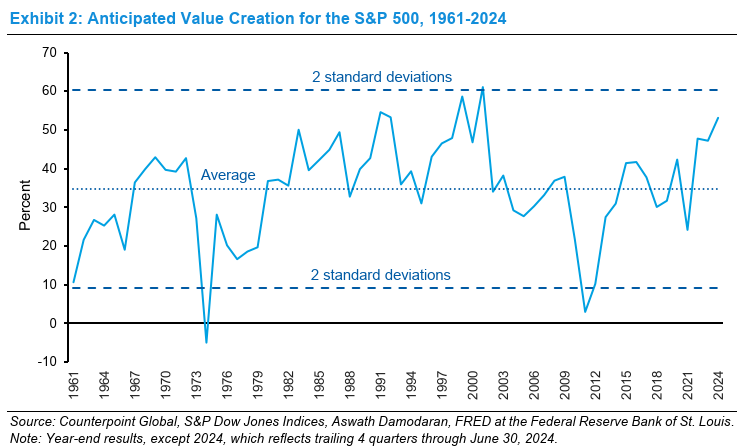
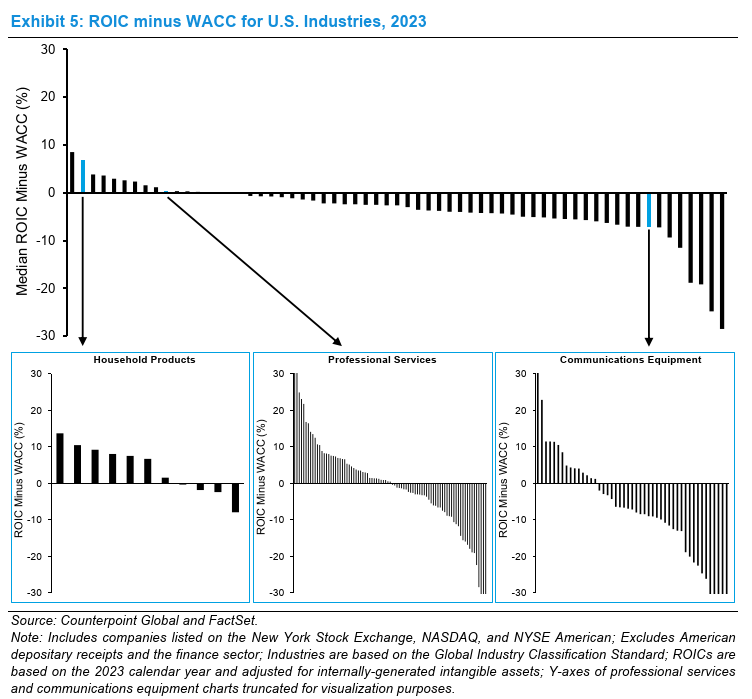
Michael Mauboussin and Dan Callahan have published previous versions of “Measuring the Moat,” the first of which appeared in 2002.  The latest edition (subtitled “Assessing the Magnitude and Sustainability of Value Creation”) offers a broad perspective on the topic, including company life cycles; “the microeconomics of value creation;” industry structure and analysis; firm analysis; and much more.  It is a crash course in equity analysis, complete with 47 exhibits.  (See, for example, one that illustrates how ROIC minus WACC differs dramatically across industries and within industries too.)

Since “the price of a company’s stock almost always anticipates future value creation”:

You can think of a stock price as having one part that reflects the value of the company operating at a steady state of profit and the other part that captures the value the company is expected to create or destroy with its future investments.

The exhibit above shows that the average anticipated value creation is about one-third of the price, but that it varies considerably over time.

Gender and analyst reports

A fascinating paper, “Gender and Analyst Reports,” by Bill Francis, et al., finds that:

Female analysts issue more readable reports and improve report readability over time relative to their male counterparts.  However, female analyst reports are shorter, consistent with a “quality over quantity” approach.  The textual sentiment of female analyst reports is also less optimistic, suggesting that they are more resistant to conflicts of interest than their male counterparts.  In addition, we find that female analyst reports contain more nonfinancial content and are more long-term oriented.

While “men and women, as well as boys and girls, are more alike than they are different,” there are differences, and most every study regarding gender shows that women bring positive character traits into the male-dominated investment industry.

Fiduciary duty?

The chief executive of Focus Financial Partners offered a provocative point of view at an industry conference (as reported by Andrew Foerch for Citywire RIA):

If you’re not willing to take private equity or another form of capital, are you comfortable that you can fulfill your fiduciary obligations to your clients without it?  These days, I think you have to ask yourself that question honestly and ask, you know, how?

Do you agree or disagree?

Other reads

“Rewiring The Financing Machine,” Larissa de Lima, et al., Oliver Wyman.

These changes must be considered holistically as they share a common underlying exposure — corporate credit.  Different products vary in their liquidity and risk profiles, but innovation and competition are blurring the lines between products, complicating risk assessments and comparisons.  Banks and various types of nonbanks are ever more interdependent, while nonbanks are becoming increasingly concentrated and diversified.

“A Private Equity Liquidity Squeeze By Any Other Name,” Michael Markov, CAIA Association.  What if “the worst ever environment for liquidity” doesn’t improve soon?

“Jamie Dimon Is Right. Forget the ‘Damn Number’,” Jonathan Levin,  Bloomberg.

As a general rule, many stock watchers spend too much time estimating earnings to the decimal point and too little digging into the ways that their thesis may be wrong.

“Fund Family Digest: US in 2024,” Bridget Hughes, Morningstar.  Only ten of the largest 150 mutual fund firms receive the highest “parent” ratings (“how well an asset manager stewards capital in the best interests of its investors”) from Morningstar.  An overview of key indicators is provided for each fund firm.

“Tech boom forces US funds to dump shares to avoid breach of tax rules,” Nicholas Megaw and Will Schmitt, Financial Times.

The need to reshuffle holdings could drag on fund performance and trigger capital gains taxes.

“A complicated way to do something very simple,” Joachim Klement, Klement on Investing.

But if volatility targeting funds in the equity space is simply a complex way to exploit trend following, why bother with the higher fees charged by these products?

“Timeless principles of board dynamics,” Bob Rosone and Maureen Bujno, Harvard Law School Forum on Corporate Governance.  A set of basics for governing bodies, including investment committees.

“Watch Out: Wall Street Is Finding New Ways to Slice and Dice Loans,” Matt Wirz, Wall Street Journal.

Wall Street is cranking up its complex bond machine again.

Always

“The wave of the future is coming and there is no fighting it.” — Anne Morrow Lindbergh.

Flashback:  The machine

In 1984, Barton Biggs wrote a strategy piece for Morgan Stanley, “The Giant Present Value Machine Downtown.”  He quoted Jim Harpel, who had “an honorary PhD in net worth enhancement from the financial markets, the premier graduate school in the world,” as referring to the stock market as “nothing but a giant present value machine.”

Biggs stated his objections to the thought that there’s a simple function that connects the stock market to the bond market, questioning assumptions about the equity risk premium and noting that the present value machine “can’t factor in qualitative factors and secular change.”

While the topic is relevant today, the specific references are a bit quaint.  Biggs debated whether the “justifiable price/earnings ratio” should be ten or thirteen (!), and it’s worth noting that the machine is no longer thought of as being downtown.

He concluded by writing of the great John Templeton that he “is unmoved by valuation and so am I.”  Forty years on, one wonders what the two would think of today’s environment.

Postings

Past editions of the Fortnightly can be found in the archives, as can all of the original essays on a variety of topics.  For example, “Questions about the Dominance of Indexed Strategies,” which explores a number of dimensions about the changes in market structure and behavior from indexation (of broad-based passive exposures, as well as other strategies):

Taken as a group, indexed strategies are definitely popular — hugely popular.  If the “price pressure hypothesis” is valid at all, the size of the asset pool and the enormity of the ongoing flows pose important questions for participants in all corners of the ecosystem.

It was published in 2022.  The series of questions posed in the piece are even more relevant today.

Thank you for reading.  Many happy total returns.

Published: October 28, 2024

Subscribe

To comment, please send an email to editor@investmentecosystem.com. Comments are for the editor and are not viewable by readers.

Does it Matter (How the Money is Made)?

Asset owners face dilemmas about whether the investment function ought to be an island unto itself, only concerned about the optimal risk/return profile for the portfolio, or whether other considerations ought to be factored into decision making.

Business models

An expansive look at that topic would need to cover a lot of ground.  Instead, let’s focus on a question that gets much less attention:  Are there business models in which you won’t invest?

As an example, consider the plight of newspapers.  Thirty years ago, their business models seemed unassailable.  Then the advent of the internet led to a decimation of the classified ad business (principally at the hands of Craigslist), a much more difficult display ad environment, and a drop in subscribers because of the availability of online news.  It became a downward spiral that led to the severe contraction of many previously powerful franchises and the demise of some.

But this posting isn’t about the plight of those newspapers.  They are introduced in order to look at the business models of some investment firms that identified a profit opportunity in the midst of the industry’s challenges.  With the assets available at cheap prices, those investors purchased newspaper companies, offering hope to the communities that the operations would survive.

But, over time, the real strategy revealed itself.  There was never any intention to create going concerns out of the struggling businesses.  In short order, employees were cut to the point of irrelevancy, local news was replaced by filler sourced elsewhere, and it became only a question of when the inevitable closure would occur.  Buying at a bargain price, dramatically lowering costs, and milking the business for short-term return rather than trying to sustain it were part of the plan all along.  Vulture capitalism, plain and simple.

When shutting the papers down, the investment firms invariably say that they couldn’t be run profitably, but that is preordained by the strategy employed.  Other kinds of buyers, managing for the long-term health of the business — and being responsive to the needs of the community — could have made it work.  But that was never the goal of the acquirers.

And so, the thematic question of the day:  As an asset owner, does it matter to you how the money is made, or just that the money is made?

Health care

Similar questions are increasingly being asked about investments in health care.  See, for example, a three-part series in the Wall Street Journal:

“You Can Thank Private Equity for That Enormous Doctor’s Bill: Private-equity investors have poured billions into healthcare but often game the system, hurting both doctors and patients” (link).

“As Hospitals Grow, So Does Your Bill: Consolidation across the hospital industry has contributed to the higher cost of healthcare” (link).

“What Happens When Your Insurer Is Also Your Doctor and Your Pharmacist: Health insurers like UnitedHealth Group are seeking to control many parts of our healthcare system, creating potential conflicts of interest” (link).

Or an article from Harvard Medical School that summarizes a study published in the Journal of the American Medical Association about “What Happens When Private Equity Takes Over a Hospital.”  The subtitle offers the conclusion:  “New analysis shows alarming increase in patient complications.”

There are many other examples that could be shared.  Repeating:  as an asset owner, does it matter to you how the money is made?

Private equity

Not all of the “additive for the investor, destructive for others” examples are related to private equity funds, but many of them are.  Despite the protestations of advocates, the standard PE fund structure does not incent behaviors meant to build a business for the long term.  The goal is to generate attractive returns and sell the company to someone else after a few years.

Often, a key part of generating those returns are leveraged payouts, including dividend recapitalizations and/or the sale and leaseback of company real estate.  Those moves can increase returns if the economic environment stays favorable, but they also increase the risk of subpar performance and even failure.  Over the last couple of decades, the economic and interest rate outlook have been supportive; a tougher environment for a prolonged period will likely result in more bankruptcies of companies that could have survived with a different ownership model.

But it’s not that a private equity investment is necessarily problematic.  Perpetual or multi-decade structures can provide better incentives than typical funds; investments marked by operating improvements rather than financial engineering live up to the promise of the form; KKR’s shared ownership initiative represents a change that could to lead to better employee relationships and stronger firms; and “private equity impact funds” can generate positive outcomes where others are trying to maximize profit with destructive business models.

As an example of the last point, there are some specialty private equity health care firms which have shown improvements in patient outcomes, bucking the general results seen elsewhere.  But their returns are lower.  Let’s say they are able to produce a low- to mid-teens rate of return, while other firms not focused on making a positive impact tell you that they expect to earn more than twenty percent.  In which one are you likely to invest?

Answering the question

Private equity investment in health care is increasingly a hot topic.  State and federal governments are talking about restricting or preventing PE investment for some kinds of companies, but the issue goes beyond that industry to the prevalence of destructive business models employed in service of delivering attractive returns to asset owners.  And therefore, asset owners are the ones who have to decide:

Does it matter how the money is made?

The blunt nature of that question might seem to indicate that there is an easy answer.  There is not, unless nothing matters under any circumstance.

Outside of that, where should the lines be drawn as to what kinds of business models are acceptable and which are not?  That’s a thorny issue smack dab in the middle of the intersection of investment, organizational, and mission/purpose beliefs.  Every organization needs to wrestle with competing ideas and interests to determine its stance.

Upon being named an Honorary Fellow of the Chartered Institute for Securities & Investment, John Kay offered some remarks about “the role of the professional.”  Toward the end, he quoted Émile Durkheim:

It is not possible for social function to exist without moral discipline.  Otherwise nothing remains but individual appetites.  And since they are by nature boundless and insatiable, if there is nothing to control them, they will not be able to control themselves.

Asset owners are in the unique position of deciding how capital gets allocated — to which strategies, organizations, and business models — in the process addressing foundational dilemmas like whether it matters how the money is made.

Published: October 23, 2024

Subscribe

To comment, please send an email to editor@investmentecosystem.com. Comments are for the editor and are not viewable by readers.

Hedge Funds, Private Credit, and Being Long-Term

The next essay to be published will be “Does it Matter (How the Money is Made)?”  It will delve into questions about whether and how asset owners should consider the business models and practices behind the returns that they receive — or just focus on maximizing those returns.

Until then, here’s a fresh crop of interesting reads.

Hedge funds

Multi-manager, multi-strategy hedge funds — commonly known as pod shops — have been all the rage.  A report from Acadian poses a question:  “The Systematic Multi-Strategy Hedge Fund: A Better Alternative?”

The report lays out the advantages of pod shops, including avoiding the hassles of selecting, sizing, and evaluating a roster of hedge funds on your own; better capital and operating efficiencies; fee netting; improved diversification; and advantages in risk management.  The big negatives are the difficulty of getting access; “opacity and information asymmetry;” and cost pressures as the talent war continues to escalate.  (Pass-through fees “have become the norm,” often leading to the bulk of returns flowing not to the asset owner but to the manager of the hedge fund and those expensive pods).

Not surprisingly, since it is a systematic asset manager, Acadian goes on to stress the benefits of a multi-strategy approach offered in a systematic fashion.  The firm argues that such a strategy leads to reduced cost pressures; a better alignment between the manager and investors; increased transparency; and improved risk management and liquidity.

Elsewhere:

In a new posting, Rupak Ghose draws an analogy to an earlier time:

The implosion of Man Group is ancient history now but there are timeless lessons.  Highly leveraged funds.  Investors looking for uncorrelated returns.  Products that are dependent on the low correlation between the components.  The continuous search for new capacity.

Francois Lhabitant released a paper, “Ten Common Mistakes Investors Make When Allocating to Hedge Funds (or how to make sure your hedge fund portfolio will disappoint).”  Among those mistakes:

~ Using hedge fund indices to guide strategic decisions.

~ Choosing high Sharpe ratio funds and expecting a high Sharpe ratio combination.

~ Overdiversifying.

~ Applying pie-chart thinking to complex allocation problems.

Private credit

Barely on the radar of most investors a decade ago, private credit has become a juggernaut.  Some readings:

~ “The next era of private credit.”  McKinsey outlines how this still-young area is evolving across a range of different strategies and partnerships.

~ “Private Credit’s Shifting Identity.”  Steven Kelly’s Without Warning cautions, “It has slowly begun undermining most of its original value propositions.”

~ “The Rise of PIK: A Double-Edged Sword for Private Credit.”  On the CAIA blog, Vincent Weber comments on “the increasing use of Payment-in-Kind (PIK) financing” in private credit.

~ “Private debt misconceptions.”  Stepstone defends the asset class against five misconceptions about it.

Being long-term

FCLTGlobal released lists of questions about what it means to be “long-term.”  These “gold standards” touch on governance, incentives, engagement and dialogue, and metrics, with separate questions for asset owners, asset managers, and companies.  While the lists are shorter than you might expect, the questions in each can serve as a good starting point for discussions about what it means to be truly long-term and whether actions match up with intent in that regard.

Skill and returns

The last edition of the Fortnightly featured a paper about excess return profiles of active equity managers that used monthly data across a broad spectrum of managers.  It echoed work done by Essentia Analytics, which is hired by asset managers to analyze portfolio decision making using real-time data.  (An accumulation of Essentia white papers on portfolio manager decision patterns can be found here.)

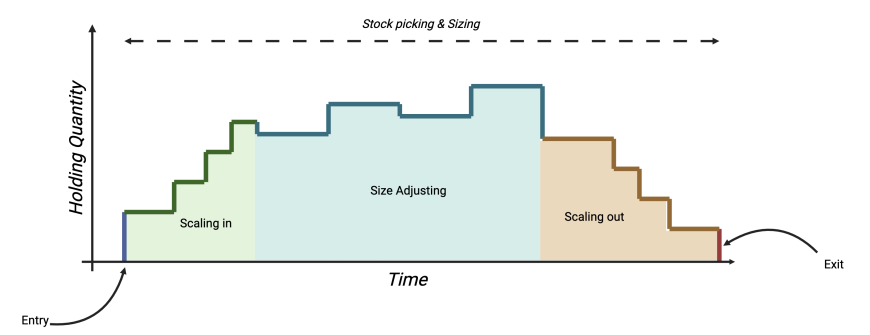
Three members of the Essentia team just released a new study, “Actions Speak Louder Than (Past) Performance: The Relationship Between Professional Investors’ Decision-Making Skill and Portfolio Returns.”  According to it, professional investors face a “combination of a complex ecosystem, limited cognitive resources, and time constraints,” causing them to lose advantages that they have over others and “often displaying the same overconfidence and errors as non-experts.”  The authors introduce a measure they call the Behavioral Alpha Score, which they link to subsequent portfolio performance.

The image above was chosen from the paper because it clearly shows specific decisions to add, subtract, or hold shares of a position over time.  This often gets lost in evaluations based upon the weight of a security within a portfolio, which is affected by other factors in addition to those specific decisions.  Incorporating a graph like this with one depicting the portfolio weight paints a much clearer picture of decision making.

Making a pitch

When you want to get your ideas across, what’s the best way to do it?  Where would you want to be on a spectrum from “like everyone else” to “totally unique”?  Most investment communication can be found in a “like everyone else” pile.

The bottom line of some research regarding pitches to angel investors is that they work best when “the narrative is familiar but not too familiar.”  So a good formula might be stated as “familiarity plus differentiation” — following convention to a certain point in order to orient the audience but moving them beyond that in order to show them that you are not just like everyone else.

(FYI, the Investment Ecosystem provides evaluation and training for organizations and professionals in regards to effective communication — among coworkers and to clients and prospects.)

Other reads

“The Operator’s Dictionary,” Permanent Equity.  A wonderful “guide to terms, ideas, and phrases — annotated with notes, nuance, and nit-picking,” for operating businesses and organizations of all kinds.

“Prisoner’s Dilemma and Private Equity Pacing,” Christopher Schelling, LinkedIn.

Collectively, the individually rational response to committing greater and greater amounts of capital may have resulted in the industry as a whole becoming substantially overcapitalized.

“Todd Combs Retrospective?” Old Rope.  With ongoing interest in what a post-Buffett Berkshire will look like, this piece considers one of the key players, including “questionable decisions” by him at GEICO, as well as other potential issues.

“The Noise Factory,” Joe Wiggins, Behavioural Investment.

For any issue or event, we should ask two questions:  Does it matter?  Is it knowable?

“Just do it! Brand Name Lessons from Nike’s Troubles!” Aswath Damodaran, Musings on Markets.  On valuing brands, using Nike as an example, where the “new CEO has his work cut out for him!”

“Factor Premiums: An Eternal Feature of Financial Markets,” Guido Baltussen and Bart van Vliet, Enterprising Investor.

Factor premiums are an eternal feature in financial markets.  They are not artifacts of researchers’ efforts or specific economic conditions but have existed since the inception of financial markets, persisting for more than 150 years.

“Culture Club: CalPERS puts people first in talent reboot under new CIO,” Sarah Rundell, Top1000Funds.  Early changes by new CIO Stephen Gilmore.

“Broad Strategic Allocation,” AQR.

In our experience, the most insightful SAA analyses are those with thoughtfully constructed constraints or anchors that define a reasonable territory within which the investor is able to address their specific portfolio problem.

“Are Institutional Investors Meeting Their Goals? Spotlight on Earnings Objectives,” Richard Ennis, Enterprising Investor.  A look at how asset owners have done relative to their stated goals since the financial crisis.

“GP Fundraising Trends in 2024 — Does Performance Attract Capital?” David Dawkins, Preqin.

Consistent performance, rather than eye-catching outperformance, has been the foundation of fundraising success for a number of the biggest and most notable funds.

“Visual Matters: Visual Deception in Financial Markets,” Jiali Gao, SSRN.  Does the auto-scaling of charts on investment terminals mislead investors “in interpreting trading information and assessing risks”?

Achievement reveals

“Some people grow and some people swell.” — John Weinberg, senior partner at Goldman Sachs from 1976 to 1990, quoted in Robert Rubin’s bookThe Yellow Pad.

Flashback: Adam Smith, behavioral economist

“Adam Smith, Behavioral Economist” was published in the Journal of Economic Perspectives in 2005.  A question mark was added to the end of that title for a short Harvard Business School interview with Nava Ashraf, one of the authors.  Of Smith’s The Theory of Moral Sentiments, she said that:

The field of behavioral economics, which economists usually think of as a “new” field, was in fact rigorously studying the very factors that Smith, arguably the “father” of modern-day economics, had always thought were critical in human behavior and interaction.

The struggle between “passions” and “the impartial spectator” that Smith referenced is ongoing — and now much discussed, albeit using different words — centuries after Smith wrote about it.

Postings

Check out the categories of postings in the archives that are of particular interest to you.

A very early piece, “Mass Customization and Tactical Asset Allocation,” reviews a paper about “the dance between theory and practice, as well as the push and pull in the industry between customization and industrialization.”  Among the observations about the paper:

Another point of interest comes from a sentence which was quoted earlier:  “Creating a viable industrial TAA process is thus part of the asset manager’s fiduciary duty towards all its clients.”  In a business of scale, the need for “industrial” activities is very real, but there are trade-offs.  Some might argue that industrialization is largely for the benefit of providers rather than clients (resulting in improved margins and allowing for even more scale).

And, while firms need to do what they say they do — and to act in their clients’ best interests — having an “industrial TAA process” is not a necessary element of fiduciary duty.

Thanks for reading.  Many happy total returns.

Published: October 14, 2024

Subscribe

To comment, please send an email to editor@investmentecosystem.com. Comments are for the editor and are not viewable by readers.

Founder Mode, the Damodaran Bot, and “Not-So-Smart Money”

The most recent essay published on the site was “Finding the Right Speed,” which dealt with a problem that doesn’t get much attention.  At what pace should an investment decision get made?  The answer could vary from nanoseconds to years depending on the type of decision; the key is to design an approach that fits best with the circumstances, but it is easy to be pushed into being too fast or too slow.

Speaking of decisions, taking the time to include The Investment Ecosystem in your content diet is much appreciated.

Founders and managers

Paul Graham triggered a lot of online activity with his essay on “Founder Mode.”  He wrote that “there are two different ways to run a company:  founder mode and manager mode.”  As most startup companies scale, they shift from founder to manager mode:

The way managers are taught to run companies seems to be like modular design in the sense that you treat subtrees of the org chart as black boxes.  You tell your direct reports what to do, and it’s up to them to figure out how.  But you don’t get involved in the details of what they do.  That would be micromanaging them, which is bad.

To hear Brian Chesky (the CEO of Airbnb, whose talk spawned Graham’s posting), Graham, and many other commentators tell it, the shift to manager mode is normally the start of a decline of a company.  But that assumes that the founder is motivated more by the continuing process of creation than the money that is flowing their way — and can effectively adapt their process and style to meet the challenges of a larger firm.  Not every founder can do so; it sounds like staying in founder mode must be the very best thing, but in some cases not making the switch can be as dangerous as making it.

The same considerations apply to investment organizations.  Often the founder(s) stick to what got them there — leading to stagnant organizations, declining performance, and irrelevance.

The Damodaran Bot

Aswath Damodaran, the prolific professor of finance and valuation expert, wrote about “the Damodaran Bot”:

This is an AI creation, which had read everything that I had ever written, watched every webcast that I had ever posted and reviewed every valuation that I had made public.

For him, waiting to see the output from the bot and have it compared to his own work and that of others:

I am not sure what results I would like to see.  If AI values companies as well, or better, than I do, that is a strong signal that I am facing obsolescence.  If it does so badly, that would be a reflection that I have failed as a teacher.

Increasingly, we will be asking questions about our own performance — and our worth in a new world.  Damodaran includes some thoughts about the kind of jobs that may be outsourced to machines.

Harvard

Bloomberg story by Janet Lorin is titled “Harvard’s Not-So-Smart Money: Two Decades of Poor Returns and Rich Pay,” and carries a subtitle that says “Its money managers underperformed after changing personnel and strategies at the worst times.”  That pretty much sums up the last couple of decades of the largest endowment fund; the details are here.

Excess return profiles

This graphic appears in a paper from Jo Drienko, et al., “Excess Return Profiles for Stocks Purchased by Active Equity Managers.”  It shows the average magnitude and time horizon of excess returns for new positions taken by equity mutual fund managers.  Upper left is the profile for all funds and to its right is a breakdown between large, mid, and small stocks.  In the lower row are the profiles in each of the nine categories of the Morningstar style box and growth, blend, and value funds.

There are similar graphs based upon quintiles of fund turnover, expense ratio, tracking error, fund size, and other measures.  Plus an exhibit that shows the overall performance of funds rather than just that of the individual new holdings.

The profiles provide insight into the differences in how excess returns rise and fall across different kinds of funds.  In the abstract, the authors summarize their main findings:

Purchases by small-cap funds and value funds deliver outperformance relative to style indices that accrue over long horizons, while purchases by growth funds and high turnover funds outperform over short horizons.

This type of analysis should be a part of how asset managers identify patterns in the performance of their stock picks.  Some have in-house evaluations of the type and others use outside services that specialize in those calculations, but many don’t track them at all.  (Those who allocate assets to asset managers should be asking about whether they can see the results.)  This paper provides some overall tendencies to consider when doing due diligence and constructing portfolios.

OCIO pushback

Institutional Investor published an opinion piece from Dennis Simmons of the Committee on Investment of Employee Benefit Assets that includes the text of its report, “Challenging the OCIO Hype: Debunking the Myths.”  The piece says that promised OCIO benefits “rarely materialize,” and emphasizes that despite hiring an OCIO to shoulder the load, “employers are always ultimately responsible for the prudent management and administration of their benefit plans.”  Simmons also references expected cost reductions not being realized and potential conflicts of interest.

In a piece on the CAIA Association’s site, Brian Schroeder brings up the issue of OCIO search (and review) consultants being too tight with OCIO providers:  “The horse trading potential is limitless.”

The initial wave of OCIO placements has now matured to the point where clients are seeing some of the pitfalls of the structure, while others are very much stuck in performance-shopping mode, just as they were when they hired asset managers directly.

Other reads

“Private Equity Calls in Experts to Fix Firms They Can’t Sell,” Marion Halftermeyer and Layan Odeh, Bloomberg.  The old PE playbook gets a rework.

“Thinning the Herd: ~50% of Unicorns Should No Longer Be Unicorns,” Justine Huang & Wiley Miller, Industry Ventures.

All of the methods we have used to determine Unicorn value have converged at a similar answer, which is that about half of the Unicorn population could be dehorned.

“Who Needs Academic Finance Literature?” William Bernstein, Advisor Perspectives.  Bernstein cites some seminal works of the last fifty years (which came after the initial rush of academic finance frameworks).

“The barbell tolls for fixed income investing,” Huw Van Steenis, Financial Times.

The “barbell effect” long associated with equity investing is now playing out in the bond markets in earnest.  This shift underscores just how much the market structure of finance is changing.

“A Mixed Review for Institutional Private Debt Performance,” Stephen Nesbitt, Cliffwater.  Why have institutional strategies apparently underperformed “SEC-registered private debt vehicles focused on the fast-growing wealth and retail channels”?

“Facing Up to the Growth Curse,” Yves Doz and Keeley Wilson, INSEAD.

Over time, CEOs and senior executives may buckle under investors’ demands for predictable quarterly growth — as these demands become increasingly difficult to meet as a business matures — and be tempted to resort to short-term expedient measures that maintain the appearance of success and growth but prove very detrimental to the longer-term health of their company.

“Living in a Material World: The Surprisingly Gripping Tale of Six Natural Resources,” Laurence Siegel, AJO Vista.  A glowing review of Edmund Conway’s book about the materials that power our world.

“Look for Boring First,” Byrne Hobart, The Diff.

The curse of base rates is partly a blessing:  the historical record has plenty of evidence of bad predictions, and it’s good to keep that in mind when hearing them or making them.

“Tom Brady on the Art of Leading Teammates, Tom Brady and Nitin Nohria, Harvard Business Review.  The soon-to-be Hall of Famer offers some lessons that apply to investment organizations too.

“Wannabe Goldman interns should be hitting the beach,” Robert Morier, Financial Times.  A reminder that jobs far afield from the standard industry path can provide underappreciated development opportunities.

Fear less

“Nothing in life is to be feared, it is only to be understood.  Now is the time to understand more, so that we may fear less.” — Marie Curie.

Flashback: The Power Broker

It has been fifty years since the publication of The Power Broker, Robert Caro’s masterful biography of Robert Moses, which became an unlikely bestseller that is still popular today.

The anniversary has spawned an exhibit at the New York Historical Society, as well as many articles, podcasts, etc.  Among them are a profile in New York and a long series of podcasts from 99% Invisible.

An interview with Caro on the New York Times Book Review podcast is a good introduction.  It offers perspective on power (it always reveals the person who holds it) and how power relationships shift over time.  He also discusses his investigative methods, which are explored in depth in his book Working.

Caro takes years to do his research, so it might seem that his experience offers little applicability for investment professionals, but his tactics and his dogged pursuit of the truth offer inspiration for those charged with uncovering the story behind the narrative.

Postings

Past postings can be found in the archives.

Among them is one on “Communicating in the Virtual World,” part of a series on Talent, a book by Tyler Cowen and Daniel Gross.  A snippet:

In-person meetings often involve a power dynamic; where the most important person sits (and how others array themselves in response) forms a stage — and frames a performance of sorts — that isn’t there online.  Dress, physical presence, and “witty repartee” all diminish in importance.

Thank you for reading.  Many happy total returns.

Published: September 30, 2024

Subscribe

To comment, please send an email to editor@investmentecosystem.com. Comments are for the editor and are not viewable by readers.

Finding the Right Speed

Across the investment ecosystem, the pace at which decisions are made and implemented varies widely.  That raises the question of what the optimal speed should be for any particular investment activity.

Which decisions ought to happen quickly and which ones should be allowed to — or required to — play out over longer periods of time?

The human element

One factor to consider:  By nature, people operate at different speeds.  Some are quick in their responses to developments, at the ready with ideas on how to proceed and prepared to pounce into action.  Others take time to process.

For example, Jim Simons stressed that when people are interviewed for jobs, “there’s too much emphasis on a person’s being able to answer questions quickly.”  He relayed a story of overruling others at his firm who didn’t want to hire someone who “gave slow answers.”  (When hired, that person turned out to be “very good indeed.”)  Then Simons — who was an expert mathematician and one of the greatest investors of all time — said, “I would never have done well at a math competition.  I’m not an extremely fast thinker myself; I just work hard.”  Imagine not tapping into his expertise because you’re in a rush.

Knowing the processing speeds of those involved can help you think about the best time frame for a particular kind of decision.

Organizational impediments

Going too fast can be an issue, but so can going too slow.  Especially in bigger organizations the wheels of decision making can get bogged down.

To avoid that, The Friction Project, a book by Robert Sutton and Huggy Rao emphasizes making “the right things easier and the wrong things harder.”  That means first determining what those right and wrong things are before applying the kinds of tactical recommendations the authors suggest on how to add or reduce friction where needed.

While investment organizations are thought to be less bureaucratic than other kinds of organizations (which is not necessarily the case), one particular area of attention should be the layers of oversight that exist.  A decision that requires a series of approvals is slower — and not necessarily better.

Slowing down time

The environment for investment decision making is problematic, in that the constant hum of the markets and the seeming need to be at the ready with hot takes on the events of the day can distract individuals and organizations from their ultimate mission.

A 2021 paper from NZS Capital, “Slowing Down Time in Organizations,” considered that problem by way of an evaluation of networks, culture, and organizational structure.  Some excerpts from it:

How is it that organizations spend so much time on mission, vision, and culture, yet most employees experience chaos in the day-to-day environment?

At NZS, we’re somewhat obsessed by the idea of time dilation.  More specifically, how can we slow down time compared to everyone else running around as if their hair is on fire?

Through understanding the key network governors – nodes, style bias, and connections – companies can architect structures that provide time for creativity, innovation, and thoughtful decision making.

One size does not fit all, however.  The paper includes sections on different kinds of organizations.

The goal should be to have the right balance of decision quality and decision speed, and that varies by investment philosophy and mandate.  In general, if you’re always deferring decisions in want of more information, opportunity will pass you by, while being too quick on the draw can lead to different kinds of errors.  While not specific to investments, a posting from Trigger Strategy (“How much research is just enough research?  How much is too much?”) outlines and illustrates the point.

Examples

Some situations from across the landscape of the markets where these ideas come into play:

~ Most research on public equities shows that being early on a stock is better, since alpha decays over time (except perhaps for those luminous compounders that seem to go on and on).  On the contrary, analysts covering stocks often ease into ideas, raising recommendations over time as they get increasingly comfortable — just as many portfolio managers will initiate a starter position before becoming more aggressive.  (Even more contrary, there are some firms who say that a required part of their process is studying a prospective holding for a given length of time — even more than a year — before buying.)

~ One aspect of the Dimensional Fund Advisors investment approach is to avoid the trap of using a pre-defined trading game plan that has you transacting at times when everyone else does.  For example, a recent paper from the firm shows the benefits of “avoiding the costs of demanding immediacy” when trading in response to index reconstitutions.

~ Three decades ago, when processing capabilities weren’t what they are today, most quantitative managers traded on a monthly basis.  Some still do.  The general principle involves comparing the quality and frequency of the decision signals to the cost of transacting.  (A footnote in a recent Cliff Asness paper said that “the move from minutes-old information to nanosecond-old information in the last 30 years is the height of irrelevancy for low-turnover strategies.”)

~ A key reason for the current popularity of the OCIO model with asset owners is that the traditional approach of using a consultant for manager selection could lead to six or nine months (or even more) elapsing from the initial discussions of a change in strategy to its implementation.  In most cases, OCIOs have the discretion to make manager changes within the current asset allocation structure, virtually eliminating that delay.

~ Speaking of manager selection, allocators of all types tend to look at three-to-five year windows of past performance for public strategies, both when initially selecting a manager and when deciding whether to retain it.  Unfortunately, most studies show that time frame is a poor decision window.  (A similar issue plays out in a different way in private markets.)

~ In the most recent upcycle in venture capital, some investors changed the game by aggressively investing in new deals with little or no due diligence, no requirements for a board seat, etc.  The increased cadence allowed money to be put to work quickly and early success led to others copying that approach (and arguably intensifying the blowoff top).  Given the disappointing results in venture since then, that speedy strategy doesn’t look as wise as it once did.

In every situation, searching for the right speed is important, as is considering when things ought to be sped up or slowed down from normal — or if they should be varied at all.  Schematics of investment process rarely show how quickly things are supposed to happen.  An internal exercise to describe what normal looks like — and what kind of variability is to be expected (and under what conditions) — can unveil differences of opinion that lead to a more clear examination of beliefs and operating procedures.

Faster and faster

With each passing decade, the computer age has changed the availability of information and the nature of investment practice.  We need to pause and think about the effects of that “sheer speed-up” — a term which Marshall McLuhan used in 1964! — and assess its implications, just as he tried to do back then.

A 2013 posting in the original Research Puzzle blog said:

It might seem that speed is always of the essence, even though in today’s world you’re not likely to add much value through speed.  You are propelled along at the pace of the business, whether that results in good decisions or not.

For the leaders of investment organizations, those realities raise a question:  Does your strategy really require you to play the game as everyone else does, to run at the same speed at which the market runs?  The chances are parts of your process are vestiges of a time gone by.  Rethinking them could be liberating and fruitful.

The need for such rethinking has intensified since then.  Taking a broader perspective, a recent essay by Rory Sutherland (derived from a Nudgestock presentation) asks the question, “Are We Too Impatient to Be Intelligent?”

The general assumption driven by these optimization models is always that faster is better.  I think there are things we need to deliberately and consciously slow down for our own sanity and for our own productivity.  If we don’t ask that question about what those things are, I think we’ll get things terribly, terribly wrong.

Given the advent of artificial intelligence applications, we not only need to ask which tasks are best done by machines and which ones are best done by humans, we must also judge how fast we should try to make decisions using that combination.

Published: September 24, 2024

Subscribe

To comment, please send an email to editor@investmentecosystem.com. Comments are for the editor and are not viewable by readers.

Methods on Autopilot and Battle Lines Hardening

If you find these Fortnightly linkfests of value, please subscribe and encourage your coworkers and friends to do so too.  Word of mouth is the most powerful marketing tool for the writing and services of The Investment Ecosystem.

Upcoming postings include one about the game of speed in the investment world (as well as within organizations) — and another on some difficult choices for asset owners.

On autopilot

“Target” is a loaded word.  In most cases, it’s used in a promotional way, with the intent to anchor expectations.  And it often works.  See, for example, how the target IRR advertised by a general partner makes its way into an asset owner’s investment memo — or how a target volatility can narrow expectations in ways that fit with the current market regime but minimize the broader possibilities of other days.

And then there are target prices issued by equity analysts, often a vehicle for hype.  Those targets are the subject of a paper by Itzhak Ben-David and Alex Chinco.  They contrast the academic expectation — that analysts would apply present-value logic to the calculation of a target price — with the fact that analysts instead overwhelmingly use the simple formula of the title, “Expected EPS × Trailing P/E.”

Analysts are required to show within their research reports how they came up with their target prices.  In studying a collection of reports, the authors find that multiples rule the day, dominating the use of discounted cash flow methods to determine target prices.  And:

When analysts do use a discount model, they often implement it in a way that is inconsistent with present-value reasoning.

There is a notable divide between theory and practice:

Financial economists think about the discount rate embedded in this pricing rule as the most important part of the problem.  By contrast, the analysts in our sample focus all their attention on predicting a company’s earnings.  They pick a recent P/E almost as an afterthought.

The authors acknowledge that “every profession does some things on autopilot.”  That’s why examining embedded assumptions and existing practices should be a regular routine.  Why are things as they are and do opportunities exist if you look at them differently?

Battle lines

The promoters of private equity and its doubters are like the two ends of the political spectrum, each hardening their positions, even as the environment for the strategies has changed measurably over the last few years.

On the “pro” side, Ted Seides wrote a posting in which he quoted David Swensen as saying that private equity is “a superior form of capitalism,” and offered a section that is a “rebuttal to common critiques of private equity.”  As is common, Seides references the “long-term capital” that private equity managers have to put to work, while later writing that “the average holding period is three to five years.”  That disconnect contributes to the abuses and failings of the model, something perpetual or multi-decade fund structures attempt to address.

Among those taking the other side is Jared Dillon, who penned a paper called “The Next Big Short: Hidden Risks Behind Private Equity’s $8 Trillion Market”:

If you are going to a restaurant, a car wash, or a dentist’s office, there is a good chance that it is owned by private equity.

And you have probably noticed that service has deteriorated, and prices have increased.

The reason is that there is a mismatch in priorities between the founder of a business and the private equity owner of a business.  The founder of a business thinks long-term:  How do I please customers and keep them coming back?  A private equity owner only thinks about short-term profitability:  How do I extract the most value out of each customer and transaction?

As the title indicates, Dillon tries to draw parallels between the rapid growth in private equity (and private credit too) and that of the mortgage market before the financial crisis — noting some cracks that have appeared and giving a warning:  “If things really start to break, it could trigger a cascade of effects across the financial system.”

(In the category of historical evidence — which may or may not be worth relying on given the considerable changes in the competitive and economic environments — in July, Dimensional Fund Advisors released a paper, “Understanding Private Fund Performance,” as well as a shorter summary of the findings.)

Investing considerations

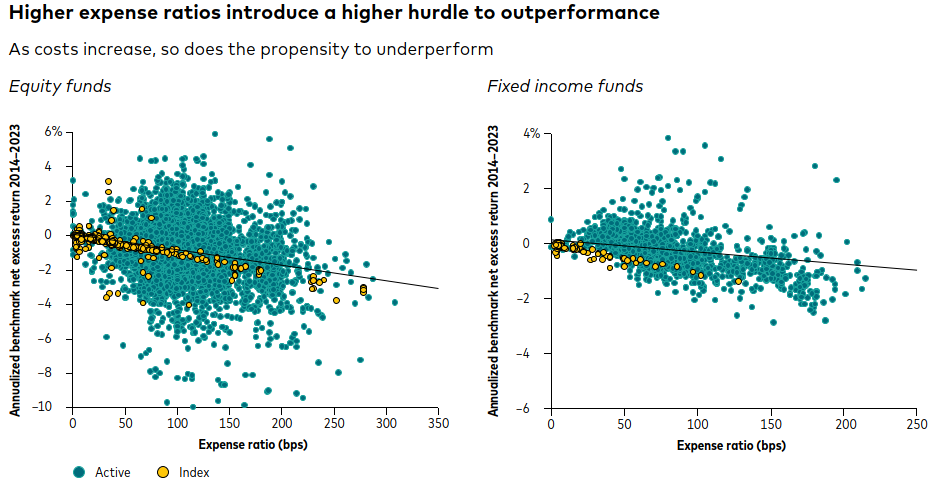
Vanguard issued a pair of basic guides for clients:  “Considerations for index fund investing” and “Considerations for active fund investing.”  Links to them and other related materials (including a piece on combining active managers in a portfolio) may be found here, where the simple frameworks for index and active investing are compared.

The above illustration comes from the active report.  The simple visual gets at an essential element of active investing — that there is an expectation of outperformance that makes the chore harder.  (Our due diligence course stresses the importance of identifying the outperformance goal and an assessment of the probability of reaching it over an extended period of time — in advance of making a commitment.)

Of course, paying higher fees makes it harder to achieve benchmark returns, to say nothing of benchmark-plus ones.  To wit:

In general, the higher the fees the less likely mutual fund investors will outperform.

Other reads

“Private Credit’s Next Act, Huw van Steenis, et al., OliverWyman.

The need to secure access to these new asset classes is prompting private credit players to change tack, looking to partner up with banks rather than be their adversaries.

“The Power of Expectations: Nvidia’s Earnings and the Market Reaction!” Aswath Damodaran, Musings on Markets.  The “dance between companies and investors, playing out in expected and actual earnings.”

“Distress Investing: Crime Scene Investigation,” Sebastien Canderle, Enterprising Investor.

The widespread overcapitalization of start-ups and quasi-universal overleveraging of buyouts have led to a deep-seated zombification of private markets.

“It’s time to end creditor-on-creditor violence in sovereign restructurings,” Jay Newman, et al., Financial Times.

Why have some of the world’s most sophisticated institutions and investment firms allowed themselves to be co-opted and drawn into a process that relegates them to supplicancy?

“In Praise of High-Volatility Alternatives,” Cliff Asness, AQR.  Are compound returns overrated at the line-item level?

“What we see when we look at price charts,” Joachim Klement, Klement on Investing.

It turns out that people who focus more on the most recent data points tend to make more trend-following, momentum-driven forecasts, while people who take in the whole price history tend to be more contrarian in their forecasts.

“Bonds Behaving Badly,” Kathryn Kaminski and Jiashu Sun, AlphaSimplex.  One section is titled, “Inflation Changes How Asset Classes Behave,” which includes a conditional distribution of bond returns and volatility across different inflation regimes.

“Steer clear of the accountability sink,” Simon Evan-Cook, Citywire Selector.

The industry is now riddled with accountability sinks:  combinations of rules, committees, decision-making structures and procedures that mean no individual is responsible when the machine does something stupid.

“The Risk and Reward of Investing,” Ronald Doeswijk and Laurens Swinkels, SSRN.  A new look at the results of the “global market portfolio” (which excludes “emotional assets” and private vehicles for which market prices are not available).

“Beware of Sharpe Objects,” Tommi Johnsen and Preston McSwain, Fiduciary Wealth Partners.

Even though it is common to see investment advisers compare the Sharpe Ratios of investment funds inside a portfolio to one another, it was not intended to be used this way.

“Watching the Watchdogs: Tracking SEC Inquiries using Geolocation Data,” William Gerken, et al., SSRN.  An eye-opening example of how data is stitched together these days.  What else like this is out there?

Wasted time

“The man who views the world at 50 the same as he did at 20 has wasted 30 years of his life.” — Muhammad Ali.

Flashback: Hedge fund time capsule

In late 1996, Ted Caldwell of Lookout Mountain Hedge Fund Review offered a “Time Capsule Opinion.”  The issue asked (and answered) the question, “If you were to lock up your money in one hedge fund for the next ten years, which one would it be?”  Caldwell wrote of the difficulty of the task, admitting:

Luck has historically dwarfed brilliance in the early selection of the phenomenal money managers.

He added:

The science of investing ponders the past, while the art of investing focuses on the future.

The piece contrasts a conservative Jones model fund from an aggressive one — and notes that many successful funds started as the former (and “gained most of their performance” from it, even if that foundation “has been concealed for some time under layers of more sensational strategies”).  Of course, today’s hedge fund environment is much changed, with a multiplicity of strategies and business models.

Caldwell’s lockup pick in 1996 was Lee Ainslie’s Maverick Capital.  According to a 2007 article from Institutional Investor, Maverick indeed had good returns in the first part of the ensuing decade before struggling in the last few years of it.  (The article referred to Ainslie as the “Comeback Kid” based on a strong 2007, which was helped in part by shorting some subprime mortgage lenders in advance of the financial crisis.)

Postings

As seen in the flashback sections of each Fortnightly, around here we like to look back for lessons from both well-known and obscure events of the past.  One example is a posting published in 2021, “Enron: Bad Bets and Surprising Outcomes.”  It ends:

Narratives can overpower analysis (and ethics).  “Vigilance and skepticism” can be viewed as hindrances to the game as it is played, instead of being recognized as essential qualities for good work.

All of the previous postings can be found in the archives.

Thank you for reading.  Many happy total returns.

Published: September 16, 2024

Subscribe

To comment, please send an email to editor@investmentecosystem.com. Comments are for the editor and are not viewable by readers.

Market Efficiency, AI Analysts, Human Analysts, and Wham!

If you were away from work at times in the last few weeks, you may have missed these essays:

“The Active Management Reinvention Project”:  It is time to quit defending active management as it is and to start imagining what it should be.

“A View from the Inside”:  Narratives about the culture of an organization can mask the reality of it.  Often unauthorized accounts are closer to the truth than authorized ones.

Subscribe now to receive future postings.

Market efficiency

In “The Less-Efficient Market Hypothesis,” Cliff Asness argues that “over the past 30+ years markets have become less informationally efficient in the relative pricing of common stocks.”  The paper, which Asness says is “as much an op-ed as it is quantitative research,” is full of ideas worth contemplating.  (For the full effect, don’t skip the extensive footnotes.)

Asness discusses three hypotheses as to why markets are becoming less efficient:  increased indexing, very low interest rates for an extended period, and (the one he favors) a crowd that isn’t wise:

But what if the crowd isn’t independent, but acts in unison?  Well, this has the potential not just to destroy the magical crowd wisdom but to turn it into a negative.

So, has there ever been a better vehicle for turning a wise, independent crowd into a coordinated clueless even dangerous mob than social media?

Social media algorithms “famously push people to further and further extremes,” and Asness sees it in investing as in other things.  But it’s not just “retail” going astray — institutional asset owners also travel in packs, most notably these days in private assets, so it’s good to remember that “no asset class or strategy is immune from the consequences of its own popularity.”  Plus, allocators and overseers get too hung up on line items and use evaluation windows that are wrongheaded.  Those tendencies are fertilized by providers:

The investing world is incredibly adept at explaining to you why whatever has been happening for a while is now going to happen forever.

Ultimately, a less efficient market “should be more lucrative for those who can stick with it over the long-term, but also harder to stick with.”

Asness has foresworn “pure EMH worship,” and in a good interview with the Financial Times, his former teacher Eugene Fama admitted that his efficient market hypothesis has “to be wrong to some extent.”  But how it is wrong and whether you can take advantage of that fact are important questions.

When asked about Asness’ belief that markets have gotten less efficient, Fama replies, “He’s selling products, right?”  But Fama sits on the Dimensional Fund Advisors board, and they sell products too.

AI analysts

Here are two exhibits (smooshed together into one) from a new piece from Sparkline Capital, “AI Financial Analysts.”  As examples, the report describes the use of AI in evaluating executive departures and cybersecurity patents, as well as preparing research reports.  The section on reports points out the difference in using AI for quantitative investing, where “numerical inputs are especially useful,” versus discretionary investing, where:

The text responses may themselves be the desired output.  Rather than have the AI “compress” the supplied information all the way down to a single number, we can have it stop at this intermediate step.  These text responses can then serve as fodder for further analysis by human investors.

In “reimagining the investment firm,” the report lists 29 analyst and portfolio manager functions — and judges which ones “can be completed more efficiently by a [large language model].”  The bottom line:

In our opinion, understanding clearly the complementary strengths of AI and human talent will be crucial for successfully navigating the age of AI.

(See also Seth Godin’s short posting about “Redefining a profession,” in which he asks, “In your work, are you fighting the change or leading it?  It’s hard to see us going back.”)

Human analysts

Sell-side analysts are among the most-studied investment actors, since academics go where they can find data, and recommendations, target prices, long-term growth rates, and earnings estimates offer the kind of time-stamped details that aren’t available for most other decision makers.  As natural language processing and other capabilities have become available, more papers have incorporated qualitative considerations as well.

For example, “Analysts’ use of qualitative forward-looking earnings information,” by Karthik Balakrishnan, et al., compares the risk factors disclosed in IPO prospectuses with subsequent errors in analyst earnings estimates, finding that “the magnitudes of these errors vary with proxies for analyst forecasting ability (experience), analyst reputation (All-Star), and attention (portfolio complexity), but not with analyst affiliation.”  Would an AI analyst pay more attention to those stated risks (and would a portfolio manager make different IPO allocation decisions as a result)?

Speaking of those “All-Star” analysts, why are they influential?  That’s the subject of a paper by Gil Aharoni, et al.  The authors study whether “their status itself generates influence [or] that their quality is superior, consequently yielding them more influence.”  Their work supports the quality hypothesis and finds that there are in effect two cohorts of analysts:  “Never Stars must demonstrate competence, while Current Stars must demonstrate boldness.”

Wham!co

Western Asset Management, commonly known as Wamco, has been rocked by the disclosure that Co-CIO Ken Leech received a Wells Notice from the SEC related to “past trade allocations involving Treasury derivatives.”

Wamco managed $380 billion in bonds, 65% of which was in institutional accounts according to a Pensions & Investments article, “Abrupt departure of Ken Leech raises due diligence bar for Western Asset Management clients.”  The article calls Leech the “institutional face” of the firm, with “significant influence on investments throughout the organization.”  In addition, he was listed as a manager on 25 mutual funds.

Bloomberg reported on the unusual governance arrangement between Wamco and its owner, Franklin Resources (whose stock is down more than ten percent since the news broke), which gave Wamco autonomy not accorded to other Franklin affiliates.

Institutional investors have already started bailing (some of which had the firm on watch lists due to previous personnel departures) and Morningstar has suspended its ratings on all of the mutual funds, so outflows could be substantial.  As these things go, trade allocations will now get a lot more attention during due diligence reviews (and SEC examinations) of multi-product managers, but given the wide array of affiliate relationships in the industry, more attention should also be paid to governance arrangements and expectations.

Influences

Looking back on nearly four decades in the business, Liz Ann Sonders wrote “Songs of Experience: Reminiscences of a Strategist.”  The posting summarizes the people and books that have influenced her the most — and the lessons she took from them.

Other reads

“The Corporate Life Cycle: Managing, Valuation and Investing Implications!” Aswath Damodaran, Musings on Markets.  An overview of the author’s new book.

“Mr. Market Miscalculates,” Howard Marks, Oaktree.

In other words, it’s the primary job of the investor to take note when prices stray from intrinsic value and figure out how to act in response.  Emotion?  No.  Analysis?  Yes.

“The Quant Renaissance: How Alternative Approaches Are Driving the Rebirth of Systematic Investing,” Nina Gnedin and Ori Ben-Akiva, Man Group.  An argument that the “Quant Winter” has passed, because of a normalization of Fed policy plus a proliferation of idiosyncratic approaches driven by alternative data and machine learning.

“A Growing Conflict in Wall St. Buyouts,” Andrew Ross Sorkin, New York Times.

Over the last several years, a new, insidious relationship has quietly developed between the nation’s largest private equity firms, the banks that lend them billions to fund their buyouts and the law firms that advise on these deals.

“Being right versus making money,” James Gruber, Firstlinks.  Five types of investors — rabbits, assassins, hunters, raiders, and connoisseurs — and their winning and losing habits.

“Whatever happened to the wisdom of the bond market?” Katie Martin, Financial Times.

Signal-sniffing algorithms and the greater role of speculative funds are a recipe for jerky market conditions.  A weaker post-2008 ability among banks to absorb shocks does not help.

“A Number From Today and A Story About Tomorrow,” Morgan Housel, Collaborative Fund.

The most persuasive stories are what you want to believe are true or are an extension of what you’ve experienced firsthand, which is what makes forecasting so hard.

“Insider Trading by Other Means,” Sureyya Burcu Avci, SSRN.  Do some “insiders conceal their suspicious trades by publicly reporting them (as they are required to do) in ways that confuse or discourage investigators?”

“Have the insatiable private markets eaten the small cap effect?” Christopher Schelling, LinkedIn.

The effort to find reasonably priced, rapidly growing businesses with durable revenue streams at the lower end of the private equity capitalization range is not like finding a needle in a haystack, but selecting from a stack of needles.

Look away

“The asset management industry compels us to engage with all of these distractions, when the route to better decision making is finding ways to avoid them.” — Joe Wiggins.

Flashback: Up the Organization

Robert Townsend published Up the Organization in 1970.  In one sense, it’s a period piece, especially in regard to organizational roles.  If it’s a position that matters, a “man” is right for the job, while you can count on a “girl” to be there to support him.  The commemorative edition, which came out in 2007, leaves the text as it was originally, while including footnotes from the editor commenting on such outdated language — and helping the reader with some of the contemporary references that have gone stale.

Most of the book is as fresh today as it was then.  Organized as short alphabetical chapters on a broad range of topics, Townsend delivers on the subtitle, “How to Stop the Corporation from Stifling People and Strangling Profits.”  The references to pink message slips for calls to be returned and salary levels may be dated, but the principles aren’t.  The organizational challenges Townsend addressed live on.

Famed editor Robert Gottlieb worked on the original book and in this edition said of Townsend:

He was a secular prophet — somebody who fervently preached exactly as he practiced.  There was no room for hypocrisy in his writing or his life.  Business fads may come and go, but there will always be a need for such pure voices in the wilderness.

Postings

The archives can be sorted by category if you want to narrow down the back catalog.  Here’s an example of a posting picked at random, “Models, Morals, and Management in a Trading Room,” featuring a look at Daniel Beunza’s book Taking the Floor, which has a variety of lessons that extend well beyond trading rooms:

The “performativity” of models in the financial world make them different than models in the realm of the hard sciences.  Two examples, the portfolio work of Harry Markowitz and the Black-Scholes option pricing formula, were descriptive at first and then something more than that, as their adoption shaped how market participants (and markets) behaved.  The theories behind the models became self-fulfilling.

Thank you for reading.  Many happy total returns.

Published: September 2, 2024

Subscribe

To comment, please send an email to editor@investmentecosystem.com. Comments are for the editor and are not viewable by readers.

A View from the Inside

It is a bit surprising that a book titled Private Equity is not much about private equity.  The memoir by Carrie Sun is centered on her time as an assistant for “Boone,” the leader of the investment firm “Carbon.”

Published reports indicate that her boss was actually Chase Coleman of Tiger Global; knowledgeable observers might have guessed that from the descriptions of the firm that Sun provides.  In turn, that makes “Martin” of “Argon” — Boone’s mentor — Julian Robertson, the legendary founder of Tiger Management.  (Despite those revelations, the pseudonyms used in the book are employed in this posting as well.)

Background

In contrast to what you might imagine as the background of an assistant, Sun had worked in investment roles at Fidelity for over four years before she left with conflicted feelings about the investment industry, “hoping to do a pivot.”

It seemed as if there was no real path of advancement for female analysts at Fidelity “except to marry a male PM.”  But the money!  Sun’s compensation rocketed with “very little effort on my part — and this felt cosmically wrong,”  Not everyone was bothered by that; a coworker told her, “I basically sit on my ass and do nothing and make millions.  What could be better than that?”

People said she had missed “the good old days,” which included activities such as “a $160,000 bachelor party, thrown by a few brokers for a star Fidelity trader, aboard a yacht with female escorts, ecstasy pills, and a dwarf-tossing competition.”  (A settlement with the SEC followed.)

When she was interviewing at Carbon, Boone asked her what she did at Fidelity:

“Basically an in-house version of Barra,” I said.  What’s Barra? he asked.  It was then I realized how wide the knowledge gap was between fundamentally and quantitatively driven finance:  here was an investor whom many had called a phenom, who did not know one of the industry-leading providers of optimizers and risk models.

She would soon be immersed in a much different world than the one she had known before.

Responsibilities

A member of the investor relations team told Sun during one of her interviews before being hired that “the goalposts move every day.”  Her first day of work happened to be a Family Day event for the firm, and Boone emailed her a photo of his kids at the party later that evening.

As predicted, “The goalposts moved the next day.”

She hadn’t replied to the email when she first saw it.  Boone told her that she needed to do so upon receiving one:  “I want to know that you read everything I send.”

She had been warned by someone else in advance that “Boone cares about every detail of everything, from periods and commas in investor letters to perfect alignment of text on PowerPoints.”

And, while Sun has been described in press accounts as an assistant (and is slotted that way within the firm), the job covered a large swath of responsibilities, including some investment work and supporting another member of the team in addition to Boone.  A functional list of duties, according to Sun, would be “executive assistant, personal assistant, research assistant, project manager, communications consultant.”

In sum:  On call and expected to perform a wide variety of duties at a very high level.

Carbon

Unlike some other funds, Carbon didn’t limit its reach.  While widely categorized as a hedge fund, it invested in venture capital and private equity as well as public securities across the capitalization spectrum.

“We’re not a hedge fund.”  [Boone] paused to make sure I knew he was not kidding.  “We are an investment firm.”

There was a very fast cadence, an “obsession with time,” to “speak faster, do faster, decide faster.”  In all things:

What else can we do or decide on today?  The rhythm of work was a constant drive to shorten the distance to decision.  If you can decide on something now, do it.  Don’t wait.

Carbon’s broad coverage of different kinds of equity investments, its extensive network, and its reputation gave it access to people, ideas, and data.  To Sun, “Carbon felt like an international newsroom stationed inside a think tank.”

I began viewing Carbon as a decision factory, the main input of which was information — specifically, objective, and not subjective.  Boone did not care about hunches, gut feelings, or intuition; he concentrated explicitly on fact-based decision-making.  Your output was as good as your input, which was why Carbon paid an army of people to amass information, and why it focused on getting on the inside, on gaining access to data of all types.

Carbon also received the best corporate access, those private meetings between investors and companies. . . .  Here was a feedback loop:  higher quantity and quality of information allowed Carbon to make better, quicker decisions, which allowed it to generate greater, quicker profits, enabling it to spend more and more on information.  Asymmetric knowledge is asymmetric power.  Carbon wanted to know everything about you while you knew nothing about them.

At one point, Boone told Sun that an assistant who was leaving the firm “said she appreciated how she had a front-row seat to some of the coolest things happening in the world.”  Pretty heady stuff.

The culture

As is the case at many investment organizations, there was a cultural divide at the firm.  When Boone decided to have a meeting to reinforce “Carbon’s culture, values, and long-term direction,” he wanted “everyone” in attendance — “and by everyone Boone meant the investment staff.”

And that staff was predictably like that described in a previous posting, “The Homophily of Hedge Fund Culture”:

Literally meaning “love of sameness,” homophily can be more thoroughly defined as “the tendency to form strong social connections with people who share one’s defining characteristics, [such] as age, gender, ethnicity, socioeconomic status, personal beliefs, etc.”

Those supporting the investment team were seemingly a world apart from it, and relatively small in number.  As such, they were surrounded by the trappings of wealth and status but not really a part of it.

For one thing, Boone was “incapable of throwing a party not to Vogue standards.”  No expense was spared for firm events or meetings or anything else.  Everything was fancy, even the food that routinely got tossed in the trash, uneaten.  And so were the substantial gifts that Boone gave to Sun.

Boone summarized his philosophy regarding the support staff and their requests for some additional positions to relieve their workloads:

People always think the grass is greener somewhere else.  They leave, they find out:  it’s never greener.  This is how most funds are.  This is what it takes to survive.  If they don’t like it, then they can leave.  We know our pay is among the highest on the Street.  People are paid well; some are even overpaid.  Money is the only reason anyone is here anyway.

It all fit with what Boone told Sun one time, “Carrie, remember, money can solve nearly everything.”  That was the organizational ethos at Carbon.

Pressure points

Even firms like Carbon and people like Boone faced times of stress when things weren’t going its way.  Sun:

I was reminded that stocks are a projection of the most human aspects of us:  irrational exuberance, unexplained depression, inexplicable need to achieve external validation of intrinsic value and worth.  You can diversify away many kinds of risk — country, currency, industry, asset class, and factors like company size and value — but you can’t diversify away the risk of being human.  And being human means that market conditions can and will affect you more than you know.

At one point, she commented on the market reaction to an earnings report by a Carbon-owned company, concluding:

A company can beat expectation and set all-time records and still be depressed.

Two pages later, in response to another earnings announcement for a portfolio holding:

A company can grow, but if it’s not in the precise directions and magnitudes other expect from it, then it can — and often does — take a beating.

If you replace “company” with “person” in those two excerpts, you can get a sense of what was starting to bug Sun.  She could no longer juggle all of the balls to Boone’s expectations; she felt bedeviled by interruptions and her own mistakes — and exhausted from trying.  “All I wanted was help with the work,” but Boone rebuffed her requests.

At one point, she created a “Self-Evaluation for Carrie Sun,” but it carried a subheading:  “(Do Not Submit).”   It was just for her, even though:

I remember staring at the document and dreaming of the freedom to share my truth.

Other things were weighing on her too:

I accepted his unreasonable requests as reasonable ones.

I had plunged headfirst into helping the rich.

I used to think that Boone was driven by a love of the game, whatever the game was, and that making money was a side effect.  No.  There was only money.  Everything else was a side effect.

The book

Each reader will have their own interpretation of the book; it is a Rorschach test of sorts.  Some reviewers see Sun’s tale as mere whining, while others think it paints an important picture of investment industry culture.

The book is a memoir, so it’s not solely a telling of Carbon and Boone, but of Sun’s thoughts and personal life, including a problematic relationship with her parents — and with her boyfriend, whose own family was worth hundreds of millions of dollars.

Michael Lewis has said he thought Liar’s Poker would be the end of something instead of the beginning of something.  Many readers weren’t turned off by his depictions of life on the desk at Salomon Brothers, as he expected; they were inspired to grab for the brass ring themselves.  The world Lewis painted did not fade away in subsequent years — it was supercharged.

One could imagine similar responses to this book.  Aspiring Masters of the Universe wanting to be Boone — and assistants being willing to deal with the hassles in exchange for the money and the gifts and the “front-row seat to some of the coolest things happening in the world.”  (And who wouldn’t want to be interviewed by the creators of Billions, as Sun was, with Boone’s knowledge, when they were thinking about adding a “right-hand-man-or-woman-type character” for the next season of the show?)

But, look closely at Private Equity‘s cover illustration.  It’s an image, taken from behind, of an assistant on the phone.  The lower part of the picture of her has the unmistakable parallel cuts of a shredder.

In part, Sun dedicated the book to “all those who have the courage to quit.”

Due diligence considerations

Investors are presented with carefully crafted representations of asset management firms.  The challenge is to find out what is real and what is not.

Books like this (and others that have been reviewed here, including a notable one about Bridgewater; see the posting) give a glimpse of the messy reality of day-to-day existence in those firms.  Not that everything should be accepted as factual or accurate, but often unauthorized accounts are closer to the truth than authorized ones.

Those doing due diligence need to be able to crack the narrative and see what’s really there.  It is very hard to do, but reading books like this helps to consider the range of possible dynamics at play to include in the mosaic of research.

There are always little things that surprise you, threads worth pulling on.  For example, the use of AOL instant messages at Carbon:

I thought about how hard it was even for Carbon — a nimble and fast-moving crossover fund betting billions on technologies that were transforming the way people talked and shopped and worked and played — to change something as simple as its own system of communication.  In AIM, at Carbon, I saw a pattern hidden in plain sight:  A small decision weighed down by repetition becomes a massive habit.  It becomes inertia.

And, at every firm, there are individuals going through personal struggles, who are conflicted about the business at hand, and perhaps feeling shredded themselves:

Working in an industry that trafficked in conviction, wherein ambivalence was costly and seen as a weakness — an invitation for others to take control and dominate, an effect that’s especially pronounced for women — made me feel like a fraud.  Everywhere I went, decisiveness was valorized.  Doubling down.  Seeking closure.  Being sure, settled, concluded.  I sold a lot of conviction and to my surprise was not terrible at it — which made me feel like a liar.

While you can say that Sun was an outlier, an outsider, an assistant, her thoughts in that regard also plague investment professionals at times.

Realizing things like that is why you should read books like this.


The due diligence courses and other resources provided by The Investment Ecosystem help research analysts and capital allocators improve their analysis of the qualitative aspects of investment firms.

Published: August 29, 2024

Subscribe

To comment, please send an email to editor@investmentecosystem.com. Comments are for the editor and are not viewable by readers.

Sorting Out Active and Passive (and Lots of Other Things)

One specialty of The Investment Ecosystem is due diligence and manager selection.  A short PDF provides a summary of some resources we offer if that’s an area of interest for you.

Active and passive (whatever they are)

CFA Institute Research Foundation released a monograph, “Beyond Active and Passive Investing: The Customization of Finance,” by Marc Reinganum and Kenneth Blay.  It covers the beginnings of passive investment theory and the rise of indexation for benchmarking and, ultimately, investment.  Charts and tables illustrate the trend in indexation around the world; they show that index domination at this point is mostly a one category — U.S. Large-Cap Blend — phenomenon.

In the last section, the authors look to the future and see asset managers needing to shift their emphasis:

Looking forward, asset management will continue to evolve from offering portfolio products to offering portfolio services that develop low-cost, highly customized portfolios . . . what we refer to as hyper-managed solutions.

The report relies on Morningstar data, opting to use that firm’s classification scheme for active versus indexed funds in its analysis, largely skipping over the “What is a passive fund?” question that is posed at one point.

Thankfully, that is addressed more meaningfully in another new CFA Institute publication, “Smart Beta, Direct Indexing, and Index-Based Investment Strategies: A Framework,” by Jordan Doyle and Genevieve Hayman.  They argue:

Inconsistent terminology with respect to index-based products has contributed to the ambiguities surrounding their classification as active or passive investments, making it harder for investors to evaluate funds and compare products.

A conceptual framework is offered that includes four levels of indexed products, from “pure index” — those closest to the original idea of “passive” because they are weighted by capitalization, although they may be deficient in other respects — to those “indexed” products that are very much actively managed.

Among other things, the report recommends “a comprehensive regulatory framework for benchmark indexes where one does not already exist” and requirements for the managers of indexed products to provide more information “regarding indexing methodologies, including security selection and screening procedures, weighting, rebalancing strategies, and conflicts of interest.”

(A 2022 posting from The Investment Ecosystem said “we need some new terminology” to deal with the confusing descriptions in use by different parties in the investment markets.)

The market kerfuffle

The events of early August prompted banner headlines online and in print, “fear” readings off the chart, and a slew of commentary from asset managers and consultants, including from those who otherwise don’t offer much in the way of “thought leadership.”

Since these Fortnightly postings only come out every two weeks and many investments have snapped back, a large number of items that were slated to be included in this edition have found their way to the cutting room floor.  In the inimitable words of Emily Litella (Google her, kids), “Never mind.”

However, here are two things that will come in handy in the future.  First, from Matt Levine, a general description of market spasms:

Market crashes usually have the same mechanism.  People like a thing, so they buy it, so it goes up.  More people like it, so they buy more of it, so it goes up more.  It goes up steadily enough that people think “ehh I should borrow some money to buy even more of this thing,” so they do.  Eventually a lot of very leveraged investors own a lot of the thing.  Then something goes wrong with the thing, its price goes down, the leveraged investors get margin calls, and they have to sell the thing to pay back their loans.  Their losses are big enough that they have to sell other things, things that were fine, to pay back their loans on the thing that went wrong.  The big leveraged investors who owned a lot of the thing that went wrong also all own the same other things, also with leverage, so there is a generalized crash in the prices of the things that big leveraged investors own.

And, a diagram of investor reactions in response to changes in the price of an investment.

Safety in numbers

Charles Skorina offered a posting called “Why take a chance?”  To wit:

In theory, pensions, endowments, foundations, and the like seek active managers to obtain above-market returns.  In practice, that doesn’t seem to be how it works.

A former large endowment CIO mentioned recently that his team would scour the globe for unique opportunities, but the first thing his trustees would ask when told of any rare find was “what other endowments have invested in this?”

Those tendencies are evident in hiring too.  Who is willing to take a chance like Yale did forty years ago?

Let’s be honest.  If the David Swensen of 1985 applied for a CIO position at Yale today, he would not survive the first round of interviews — a young untested Wall Street banker, working on something called interest rate swaps?  No way.

A changed landscape

This image is from “Common Venture Capital Investors,” a paper by Jillian Grennan and Michelle Lowry.  The image shows the difference between the typical venture capital funding rounds of yore versus now.  Starting from the bottom, the blue boxes show how there used to be just a few rounds before an IPO.  The green boxes illustrate the proliferation of additional investors and financings these days, which result in a much different cap table and a much longer wait for a public offering.

The paper looks at the changing dynamics in the venture capital industry, including increased common ownership, i.e., the investment by a VC firm in multiple startups that “operate in the same industry or product markets.”  New investors, larger VC firms, more corporate VC investments, and law changes in some states have all contributed to an altered landscape for investors and startup firms.

The way of the world

For Joe Wiggins, the roller coaster of interest in ESG products is symptomatic of what happens with big ideas in investing.  His recent posting boils it down into three evergreen factors:

Past performance dominates investor behaviour.

Substantial inflows erode future returns.

Asset managers will sell things that benefit them and sell them aggressively.

Evergreen PE fees

Phil Huber of Cliffwater wrote a summary of the fees on tender offer funds and interval funds.  The average levels of fee components are shown here; each is defined in the report and a table provides the minimum and maximum values in each category.  There are significant differences from one fund to another in the composition and amount of fees.

This is a relatively new but fast-growing area.  The oldest of the funds has only been around for fifteen years and the average age is five.

Other reads

“Which One Is It? Equity Issuance and Retirement,” Michael Mauboussin and Dan Callahan, Morgan Stanley Investment Management.

Few investors explicitly consider the wealth transfers that a company can cause when it issues or retires stock that is mispriced.

“The Analyst’s Code,” Drew Dickson, Albert Bridge Capital.  A look back at something Dickson wrote at the dawn of his career, a quarter century ago; “There is no holy grail of investing.”

“Late cycle financial innovation: Are private credit funds the new MBS CDOs?” Synthetic Assets.

Are the LPs being set up to be the bagholders in a private equity downcycle?

“If I go, you should too,” Roland Meerdter, LinkedIn.  Thoughts about the related but divergent interests of institutional asset owners and asset manager salespeople — and whether the departure of the latter might provide a signal.

“The Three Types of Backtests,” Jacques Joubert, et al., SSRN.

It is evident that while backtesting is an invaluable tool, it must be utilised with care and not as the primary driver of research but rather to validate a semi-final and well-formed investment strategy.

“Texas Teachers’ growing pressure on hedge fund fees is working,” Sarah Rundell, Top1000funds.  On the asset owner’s initiatives for a 1-or-30 fee structure and a cash hurdle for incentive fees.  Why are many “others that are similarly inclined rooting [Texas Teachers] on anonymously”?

“The ETF industry’s shark-jumping moment,” Robin Wigglesworth, Financial Times.

Leveraged single-name ETFs incinerate investor money, make markets more volatile and are solely created to generate fees for the sponsor.

“The Impact of Misleading Corporate Communication on Stock Performance,” Lewei He, et al., SSRN.  There has been an increase in misleading communication from companies; this evaluates the patterns of performance for greenwashing incidents (as well as “governance washing” and “social washing” ones too).

“The Private Funds Rule Is Dead. Now, Stakeholders Must Pick Up Where Regulators Left Off.” Thomas Deinet, Institutional Investor.

Regulators also often ignore potential tools that can create better outcomes for investors and their beneficiaries, including principles-based standards.

Being open to the new

“Living in discovery is at all times preferable to living through assumptions.” — Rick Rubin.

Flashback: Lessons from the Valley

Two people with an impact on the development of Silicon Valley passed away recently.  Their stories provide lessons regarding the importance of communication.

Sandy Robertson founded Robertson Stephens, one of the “Four Horsemen” of investment banks that underwrote so many of the technology companies to come public in the last two decades of the 1900s.  His obituary in the Financial Times details his career and includes a quote from Larry Sonsini, “Sandy never raised his voice, never needed to pound the table and never oversold.”  A good reminder that quiet persuasion is usually more powerful than bluster.

The New York Times marked the passing of Susan Wojcicki, “who helped turn Google from a start-up in her garage into an internet juggernaut.”  It included this:

Hunter Walk, a former product manager at Google who worked closely with Ms. Wojcicki, said he admired her ability to be a “translator” in navigating the many “islands, personalities and different incentives” at Google as it ballooned from a small start-up to a sprawling corporation.

“You had to convince her first, but if she believed in you and your idea, she could help translate it for Larry and Sergey,” Mr. Walk said in an email.  “That was the most powerful advocacy a product leader could have on their side.”

That sort of translating is an underappreciated skill.  Translators bridge the gaps between specialists and across teams and divisions of organizations, helping ideas and information flow.  They also can do so with clients and prospects.

Postings

The archives include all of the previous editions of the Fortnightly, as well as original essays on important ideas from around the investment ecosystem.  For example, a 2022 piece, “Looking in the Rearview Mirror,” looks at the “forced selling, margin calls, fears of insolvency, and (eventually) government intervention” related to the LDI crisis that fall.  It concluded:

The leaders of organizations need to ensure that risk management gets taken to a new level, by communicating the need for change and building a culture that identifies and prepares for emerging risks before there is panic on the dance floor.

Thank you for reading.  Many happy total returns.

Published: August 19, 2024

Subscribe

To comment, please send an email to editor@investmentecosystem.com. Comments are for the editor and are not viewable by readers.

An AI Roundup, Eating the Bond Market, and a Demographic Question

The most recent posting on the Investment Ecosystem, “The Active Management Reinvention Project,” addresses the lack of differentiation across much of the active management universe.  It’s worth your time and attention.  (If you have feedback on the piece, please send it along.)

On to the readings.

AI roundup

It seems as if there are new AI applications coming out every day, and there are a significant number of websites dedicated to keeping track of all of it.  For example, the Wolfram LLM Benchmarking Project ranks the performance of more than sixty large language models.

Investment organizations are experimenting with new applications, such as the “research analyst chatbot” at J.P. Morgan.  A U.S. Senate report on “AI in the Real World” is based on “information from six hedge funds, each with different structures and who utilize AI in different ways.”  It touches on issues of importance to individual organizations, as well as potential systemic risks.  Among the concerns:

If an investment advisor utilizes AI to inform or make trading decisions, it could amplify the traditional risk of conflicts of interest.  AI systems may make decisions that benefit the advisor but are hidden within the AI systems such that investment advisors are not able to identify and thereby disclose them to clients.

Angelo Calvello provides advice to capital allocators on dealing with “AI washing.”  (For one thing, don’t rely on regulators to do your job for you; move up the learning curve and do your own work.)  Stepstone Group has issued a report, “Do no harm: how GPs and LPs can use Responsible AI to build trust,” which includes sections on the key risks involved and the global regulatory frameworks that are emerging.

NAV loans

The last Fortnightly featured an image of the various ways that leverage is introduced into a private equity investment program.  A new “visual story” from the Financial Times (sorry, a public sharing link is not available) covers much of the same ground in an expanded fashion.

Among those leverage options are NAV loans.  The Institutional Limited Partners Association (ILPA) released new guidance for dealing with those loans.  It provides an overview of the ways the borrowings can result in “perverse incentives” and a “misalignment of interests” when used by general partners for early distributions or portfolio support.  The report includes recommendations for improved transparency and engagement, as well as suggested legal documentation.

Which way from here?

The old saying is that “demography is destiny.”  A defining feature of the United States economy has been the movement of people and businesses to the South.  In a recent report that looks at the implications for several industries, Lawrence Hamtil and Douglas Ott call that movement “a strong trend that shows no sign of slowing down.”  And the title of a Business Insider article claims that “the future of the US economy is in the South.”

In a paper from the Federal Reserve Bank of San Francisco, Sylvain Leduc and Daniel Wilson take the other side of the argument, seeing changing dynamics, probably because of rising temperatures:

The weakening Snow Belt to Sun Belt migration pattern is broad and holds across counties, commuting zones, and states, as well as for both rural and urban areas.  In some cases, the direction of migration has even reversed.

Whether this trend continues or turns around will have significant economic repercussions.

Eating the bond market

The Financial Times published an article by Robin Wigglesworth and Will Schmitt that declared that “ETFs are eating the bond market.”  It quotes a “bond ETF specialist” as saying, “The evolution of fixed income ETFs and electronic trading in bonds are inextricably linked and have been for over a decade.”  The article includes the image above, which shows where different markets are in the migration from voice to electronic trading.   (It comes from a Flow Traders report that can be found here.)

The theme of the article is that “fixed income ETFs — now a $2tn asset class — are shaking up the old order in a shadowy but important pillar of finance that has long been ruled by big banks and investment groups.”

Equity options strategies

Fidelity published “Liquid alternatives: The power of equity options-based strategies.”  It focuses on the “key benefits that equity options may uniquely provide to investors,” arguing for a strategic allocation (while not really addressing the disadvantages or possible risks):

We believe that strategies prioritizing diversification, discipline, and active management, while also ensuring a consistent investor experience, are essential in helping investors achieve their desired investment outcomes.

The chart above shows the explosive growth in S&P 500 put options volume over the last few years, which is representative of the escalation seen in other kinds of options strategies over that time.  There are signs that market behavior has changed as a result of the increased use of options — will the performance of these strategies do so too?

Responsible investing

A trio of papers on SSRN have the word “responsible” in their titles.  “ESG” is referenced in them, but perhaps “responsible” is gaining favor as a headline description as a part of the ESG backlash.  Here they are:

“Styles of Responsible Investing” (Stuart Jarvis) examines “the extent to which [the various types of funds] involve differentiated portfolio construction” and whether those distinctions have driven performance.

“Window Dressing Among Responsible Investment Funds” (Huiqiong Tang, et al.) finds that “window dressing” by funds isn’t limited to past winners — in some cases funds shift their investments toward their “ethical index just before reporting their holdings.”

“Responsible Asset Managers” (Ke Shen, et al.) investigates whether the asset management firms that manage ESG portfolios score well on ESG criteria themselves.

Other reads

“A Private Equity Liquidity Squeeze By Any Other Name,” Markov Processes.

How the anemic deal climate, record low distributions and massive unfunded capital commitments are pushing endowments further into illiquid private equity & venture capital, increasing risk & leverage in portfolios (and markets broadly).

“Voting machines vs. weighing machines,” Joachim Klement, Klement on Investng.  On the best time horizons for market-based and accounting-based decision making.

“PMs need to be more Bueller, less Rooney,” Simon Evan-Cook, Citywire.

There are two types of competitive people.  One type is competitive in a way that enables long-term success; the other type, in contrast, is childish, destructive and usually fails.

“Investment Manager Selection Is Hotting Up. Are You Ready for the Tough Questions?” Clare Flynn Levy, Enterprising Investor.  Some questions to ask managers, from Evan Frazier and Joe Wiggins.

“The Multi-Family Office of Tomorrow — Simplifying Complexity for Families of Significant Wealth,” Charles Schwab.  The characteristics, services offered, and opportunities for four different types of MFOs.

“The Negative Impact of Crowding on Active Fund Performance,” Larry Swedroe, Alpha Architect.

Relative to traded index funds, funds in the top decile of crowding underperform passive benchmark funds by a statistically significant (t-stat= -4.5) and economically significant 1.4% per annum.

“The Fees on These Funds Will Leave You High and Dry,” Jason Zweig, Wall Street Journal.  Some interval funds are “designed to harvest fees that mutual funds and exchange-traded funds don’t have the chutzpah to charge.”

“RADTEC: A Framework for Managing Downside Risk,” Campbell Harvey, et al., Research Affiliates.

The widespread adoption of tracking error as a measure of risk is one of the most significant errors in the practice of finance.

“How to Design a Secondaries Portfolio,” Preqin.  This primer covers the basics, including that “transparency is a key challenge” and “LPs have to adjust performance metrics.”

“More on pass the parcel deal making,” Chris Addy, LinkedIn.

There are so many conflicts in intra fund transfers — it seems inevitable that at least some deals across PE/venture land will turn south and end up in regulatory fines, lawsuits and a decade to clean up the mess.

It’s hard to see the big picture

“It is easier for a man to be loyal to his club than to his planet; the bylaws are shorter, and he is personally acquainted with the other members.” — E.B. White.

Flashback: Selling by not selling

In 2009, Brookvine (since acquired by Associate Global Partners) published a piece by Jack Gray, “Selling by not Selling.”  It opens:

Successful selling to the institutional investment market requires almost Tao-like contradictory characteristics of patience and impatience, empathy and persistence, integrity and commerciality, discipline and opportunism.  Their confluence describes the complex art of selling by not (explicitly) selling.

Among the challenges (especially when dealing with public entities):

Managers are selling an uncertain, intangible service in a compliance-driven, public environment through layers of agents, where each italicised word is a cause of friction and delay.  Uncertainty exposes buyers to the risk of underperformance.  Intangibility of investment strategies means they can’t be touched or tested unlike concrete products.  Layers mean many eyes (CIO and staff, CEO, Board, Investment Committee, Consultants, . . .) must see if not approve transactions.  A compliance-driven culture causes delays on non-investment issues.  A public environment entails added aversion to headline risk.  Agents create misalignments and an emphasis on the shorter-term.

Postings

Explore the archives to find ideas for continuous improvement no matter what kind of organization you inhabit.  For instance, see a posting on due diligence, “The Dawning Era of Qualitative Analysis”:

Allocators are sitting on a gold mine of information that can be analyzed.  Materials sent by managers across the years can be studied in ways that they couldn’t be before — and the same can be done with investment memos about those managers.  What would such an analysis reveal about the process of selection by allocators and the attributes of manager success?

Thanks for reading.  Many happy total returns.

Published: August 5, 2024

Subscribe

To comment, please send an email to editor@investmentecosystem.com. Comments are for the editor and are not viewable by readers.