The Active Management Reinvention Project

“Active management” is a big tent that includes a broad range of strategies and organizations.

For the most part, stories about active management being under pressure concern traditional vehicles like mutual funds and long-only separate accounts.  Underperformance versus benchmarks, the relentless shift of assets from active strategies to passive ones, and the increased adoption of alternatives have all eroded traditional active management franchises.

This year, the hundredth anniversary of the first United States mutual fund spawned articles (such as this one from the Financial Times) that were more focused on the passing of an era than a celebration of success.  And Morningstar — founded and still best known as a rater of mutual funds — published a piece entitled “The Diminishing Role of Active Mutual Funds,” with a dour subheading:  “Active offerings are in a downward spiral of underperformance and outflows.”

Large firms are pivoting into alternatives, firing staff (rarely investment professionals though), and seeking greater scale through mergers, which never seem to work.  Smaller asset managers are even more at risk, but they have fewer options available to them (although their size does give them greater maneuverability — if they are willing to adjust what they do).

The problem

The active management business has been so good for so long that there is a strong bias to follow the same path as before.  Although change is inherent in a complex adaptive system, other than an increased use of technology, active management looks much like it did a quarter century ago.

Active managers haven’t felt the need to innovate; given the profitability of the endeavor, there wasn’t any great advantage in bucking convention.  Consequently, a remarkable sameness came to pervade the craft, with little differentiation from firm to firm and across time.  That can be seen by looking at the marketing collateral across managers.  It is mostly interchangeable in form, and the stories on offer often seem indistinguishable from one another.

Each manager promises a consistent, repeatable process, selling stasis instead of continuous improvement, as if the job involved pounding out widgets instead of making investment decisions.  (That’s a bit unfair to widget-pounders, since the best of them are always figuring out ways to do it better.)

For their part, rather than seeking differentiation and ongoing evolution from their managers, asset owners mostly play the performance game, moving on from a manager who disappoints to another that appears (based upon the current numbers) to have cracked the code, fishing from the same pond in the same way as they have before.

Asset managers are faced with a problem.  In the words of Abraham Maslow:

One can choose to go back toward safety or forward toward growth.  Growth must be chosen again and again; fear must be overcome again and again.

He was referring to individuals, but the same goes for organizations.  Active management, at least in its traditional form, is stuck in a rut, a victim of its own past success.  We’ve seen this story before; firms and industries get caught up in their current vested interests and fail to innovate.

(A useful analogy comes from Ted Gioia’s description of the rise and fall of television and movie westerns.  His synopsis of the genre’s transition from the dominant entertainment category to that which became old and stale should resonate with investment people.)

Hope springs eternal

“Is this the year for active management?”  That is an evergreen question in articles, blog posts, and consultant reports — accompanied by analyses of the conditions that generally make for better or worse short-term active management results.

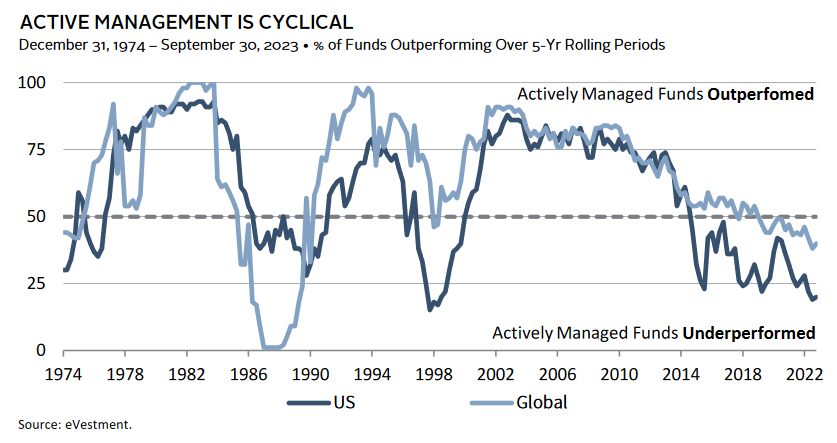
For example, this image is from Cambridge Associates’ 2024 outlook piece, which said, “We believe the landscape is ripe for active managers to reassert themselves in 2024”:

As the title of the chart declares, active management is cyclical.  But, as widely practiced, the periods of outperformance are hard to predict, the base rate of success is low, and the results over the last couple of decades look more directional than cyclical.  (The down-and-to-the-right slope of the lines over the last two decades is reflective of the compression chart used in our due diligence course.  That image presents a stylized view of the wearing away of outperformance over time.)

Fee alpha

In considering how to improve the results of active management, the easiest lever is the hardest one to pull.

Some refer to the improved performance that can be delivered to investors by lowering fees as “fee alpha.”  It is more a release of alpha that would otherwise be retained by an asset manager, since (on average, in most categories) managers outperform gross of fees but not net of them.

Comparisons of low-fee to high-fee managers (again, on average) show better results are produced by those with lower fees.  (One illustration of that comes from an exhibit in a Morningstar article.)  Despite that relationship, there are plenty of investors who believe that “you get what you pay for.”  Intent on chasing down the very best managers, they tend to be trigger-happy, having high expectations and a low tolerance for the normal variability of relative performance.

The ability to lower fees depends on the type of ownership of an asset management firm.  Those that are public companies, divisions of public companies, or owned by private equity find it extremely hard to voluntarily reduce fees, while a firm owned by its founder and/or employees has greater flexibility to reposition the firm’s fee structure should they decide to make an active decision that, all things being equal, will improve performance.

Reinvention

The title of this piece is “The Active Management Reinvention Project,” but one size does not fit all, so it really should be “Your Active Management Reinvention Project.”

(“You” and “your” in this are for the readers who are active managers, but the concepts apply more broadly to other entities in the investment ecosystem — and they should be top of mind for those who allocate capital to managers.)

Such a project involves examining and potentially redesigning the interlaced models that define your organization — the investment, operating, client service, and business models which are comfortable and familiar, but which may be out of date and ill-suited to today’s environment, to say nothing of the ones to come.

The goal should not be to create a new state in one fell swoop, but rather to establish an evolutionary plan.  Reinvention must be a continual process, not a discreet one.  Some changes can happen quickly, but others will (and should) take considerable time.  Of critical importance is the establishment of a culture and mode of operation in which innovation is viewed as an essential ingredient for active management success.

Elements

A holistic design needs to consider the full range of important elements, even if some of them are altered only in small ways or not at all.  Among the key considerations:

Differentiation and edge.  Any review must start with an honest assessment of the current situation, including the interrelated concepts of differentiation and edge.

What do you do that is different than what others do?  Where and how do you add value for your clients?

Unfortunately, many managers claim to have an edge but can’t point to any specific differences in their approach that might lead to it.  Nor can they persuasively posit why an apparent edge should persist in response to the changing circumstances of the future.

Flipping the previous questions:  What do you do that is the same as what others do?  Where and how do you fail to add value (or even subtract it)?

Looking forward, what do you think is possible for your organization in terms of differentiation and edge?  There are initial limitations imposed by current resources, norms, narratives, and capacity for change, but each of those can be transformed over time.  Aspirational goals require patience and persistence.

Dilemmas.  Any change process must deal with the dilemmas that, unresolved, can impede excellence over time.  Among them, how the goals of asset gathering and effective asset management will be balanced; the desired mix of consistency and change in regards to organizational risk taking; and how the dilutive effects of new product offerings on the resources devoted to existing clients are squared with the benefits of those introductions for the firm.

Culture.  An agenda oriented toward change requires a culture that supports it, but many active managers are conditioned to resist bold moves on the organizational front even if that kind of risk taking is embraced within portfolios.  There can often be a cultural divide between investment professionals and the rest of the firm — and an inherent tension between the autonomy prized by individuals and the teamwork it takes for substantive change.  The pace and nature of developmental change depend on your (real, not advertised) starting-point culture and the gap between it and the desired state at any point in time.

Structure and process.  These two need to fit together — and the process must drive the structure, not the other way around.  That calls for more flexible and modular ways of structuring an organization so that it can change readily over time, allowing investment process to evolve as needed.

“Process” cannot be thought of as immutable — or marketed in that way.  Continuous improvement is the gold standard when it comes to process; if you can’t point to specific ways in which your process has changed for the better over the last few years, it is deteriorating without you realizing it.

Technology.  Rapid advances in technology capabilities have changed the possibilities when it comes to structure and process, most notably because of the noisy emergence of AI onto the scene.  It would be a mistake to assume that AI will change everything — or that it won’t change anything.  Each firm has to decide how to use the new tools, knowing that implementing them in ways that lead to investment or operational mistakes could damage your business.

At a minimum, there needs to be a recognition that the potential for a fundamental change in methods is greater than it has been in decades and — as with any vector of improvement — such potential shouldn’t be ignored, but rather investigated with a willingness to embrace beneficial alterations.

Human capital.  Hand in hand with those new technological possibilities comes a requirement to rethink the makeup of roles within organizations and the types of skill sets that are needed.  Training and retraining, areas of weakness at most investment firms, need to be invigorated, moving them from inconsistent osmosis-based approaches to ones that are more intentional and appropriate for future needs.

Incentives.  Do the incentives in place reward the creation of long-term value for clients and the ongoing improvement of the organization’s capabilities?  Or do they incent behaviors that are at odds with those goals?

Investor relations.  Your communication efforts need to be reinvented too.  You need to be able to break the mold of existing investor relations practice and be thoughtful about the ways in which you can communicate — to help you truly stand out from others and to reinforce the unique aspects of what you do.

There will be pushback by some clients and prospects who think that everyone ought to go through the same drill in the same way.  If you can explain why you have chosen to break from convention — and how that relates to your organizational philosophy — you will a) be more memorable than others, b) stand out as a differentiated choice, and c) indicate the kind of independent thought that aids in the building of a long-term relationship that can better weather relative performance cycles.

As with truly active investing, truly active communication pays off.  Every aspect of what you do should be reconsidered; differentiation yields dividends.

The power of transparency and authenticity should not be underestimated.  Sharing the uncertainties and challenges of the active management endeavor indicates thoughtfulness and honesty, laying the groundwork for trust.  Conversely, typical we’ve-got-this-figured-out messages might inspire temporary confidence, but they present an unrealistic picture and ring hollow over time.  Every organization has things it needs to do to get better; if you can’t or won’t share what they are with clients and prospects, you aren’t helping them understand who you are as fully as they should.

Of utmost importance is the qualifying of potential clients by giving them a clear picture of what to expect, especially regarding the variability of future performance and the orientation to improvement that will lead to noticeable changes in process and organizational attributes over time.  Don’t let the goal of winning the business today get in the way of building a mutually beneficial partnership.  That aspect of the typical active management model leads to fragility, not strength.

Advocacy

Asset managers and their advocacy organizations have been stuck defending active management as it is (and has been), not as it could be.  For example, although the Active Managers Council of  the Investment Adviser Association doesn’t seem to be particularly active itself, it does at times respond to articles that question the worth of active management.  But those efforts are sparse and, more importantly, ineffective.  (As of this writing, the group’s 2020-2021 communications plan is available online; a permanent link is here.)

A more helpful approach would be to highlight the many ways in which (some) active managers are innovating and how investors can identify them amidst the mass of sameness and mediocrity.  Advocacy for active management as we have come to know it is a losing cause, since it doesn’t discriminate between those who are diligently trying to improve and those who are content with the status quo, in which active management is something other than what it ought to be.

Reinvention

Starting with a blank slate is a laudable goal, but you must begin where you are (thus the comments above about current assessments of differentiation and edge).  However, having a blank-slate mindset is critical, in that everything should be on the table for reconsideration.

The process will necessarily vary from firm to firm, since there is no single answer to be had.  You can’t just grab an apparent success story and try to replicate it.  To reiterate:  Your goal is to establish a new way of being that is ever-changing and ever-improving, in order to thrive in the ever-evolving marketplace of ideas and investments.  That’s what the next era of active management is going to be about.

In every organization there are people who are eager for change and who can see the small things that might make a difference (and the big things too).  A (sincere) process of reinvention that is responsive to bottom-up ideas — instead of relying on top-down edicts — rejuvenates an organization and unleashes its latent capabilities.

To be sure, there is risk in change, but there is plenty of risk in not changing, especially when the old model is worn out.  It is time to get started on your reinvention project.


If you want to go beyond this high-level summary of the need for change to some practical steps, please get in touch.

Published: July 30, 2024

Subscribe

To comment, please send an email to editor@investmentecosystem.com. Comments are for the editor and are not viewable by readers.

An Energy Transition Debate, a Business of Uncertainty, and Leverage in the Chain

A previous edition mentioned an upcoming posting about “the active management reinvention project.”  It’s still coming!  (Reinvention takes time.)

Subscribe to get that posting (and others to come) in your inbox.

The energy transition

Larry Siegel wrote a piece, “A Realist Assesses the Energy Transition,” for Advisor Perspectives.  In it, he summarizes the work of Mark Mills, “a physicist, venture capitalist, and energy and technology expert,” and concludes:

If Mills is correct, then preparing to adapt to climate change, rather than trying to prevent it, becomes the most important priority.

Siegel argues for a go-slow approach to energy transition, thinking that it is preferable to actions that limit economic growth too much (and he cites a quote attributed to Tyler Cowen:  “We’re going to see how hot it gets”).

That sparked a response from Sloane Ortel of Ethical Capital, “A Subtle Rebuttal to an Energy ‘Realist’.”  She writes that “the dichotomy between sustainability and prosperity that [Siegel] presents is false.  And his logic is not just flawed, but also seductive and therefore dangerous.”

While Siegel had acknowledged that the continued increase in temperatures presents risks, he felt the trade-offs were worth it because greater prosperity would help to lift the poorest around the world out of poverty.  But Ortel pushes back on that, in that the effects of climate change on the largest equatorial cities will be profound, and therefore not the net-positive that Siegel thinks it will be for the masses.  In any case:

For as long as the world remains imperfect, it’s incumbent upon analysts like me and Larry to embrace the reality that many things can be true at once.  There is no “magic bullet” solution waiting in the wings to relieve our planet’s many stresses, nor a simple tradeoff between economic growth and sustainability.

We are, Ortel says, in “the messy gray area where progress actually happens,” but where we are also at risk from “the malignant overconfidence with which us finance types can sometimes trod through thorny ethical terrain.”  (Which happens to lead nicely into the next topic.)

A business of uncertainty

In his latest memo, Howard Marks writes:

Investors and others who are subject to the vagaries of the macro-future should avoid using terms such as “will,” “won’t,” “has to,” “can’t,” “always,” and “never.”

Yet the investment business is fueled by confidence and bold predictions rather than intellectual humility and probabilistic thinking.  It’s what those who are selling their services do — and what clients have been conditioned to expect.

Marks cites two observations from John Kenneth Galbraith about perennial weaknesses that pervade the investment endeavor — “the extreme brevity of the financial memory” and “the specious association of money and intelligence.”  The bottom line for Marks:

Making predictions is largely a loser’s game.

Model validation

CFA Institute Research Foundation released a monographInvestment Model Validation: A Guide for Practitioners, authored by Joseph Simonian.  The need and the problem are summarized early on:

To ensure that asset owners have access to investment products that possess the requisite level of robustness, investment firms must have in place a comprehensive model validation process.  However, as critical as model validation is for the reliability and effectiveness of investment strategies, it is remarkable how decidedly unscientific investment strategy development and model validation often are.

The report covers a wide range of issues and practices.  It would be even better if it was separated into two sections for the different audiences it tries to address.  There is much here for non-professional investors such as asset owner trustees, including important caveats and precautions that ought to accompany presentations of strategies by asset managers.  But the text frequently veers into formulae that are only of interest to specialists, so it’s unlikely that trustees (and many investment professionals who aren’t specialists) will wade through it to get to the essential points.

Private equity leverage

Steven Starr of Seward & Kissel posted this chart and comments about it on LinkedIn.  Each of the blue boxes represents a lending arrangement that could add leverage to a private equity investment:

In this hypothetical, there is leverage up and down the structure, but no single lender has the full picture of the multiple levels of leverage.  And while this may be an extreme example, this is not science fiction.

Starr explains some situations that he has observed, and has good suggestions for lenders and allocators alike.

Two related items from the Financial Times:

~ Blackstone “has become one of the biggest buyers of a type of bank loan that has become a lifeline for the private-equity industry,” including those on its own buyout funds.

~ In a rare instance of investors apparently influencing PE fund behavior, the volume of NAV loans has dropped precipitously after pushback from them.

In and out of favor

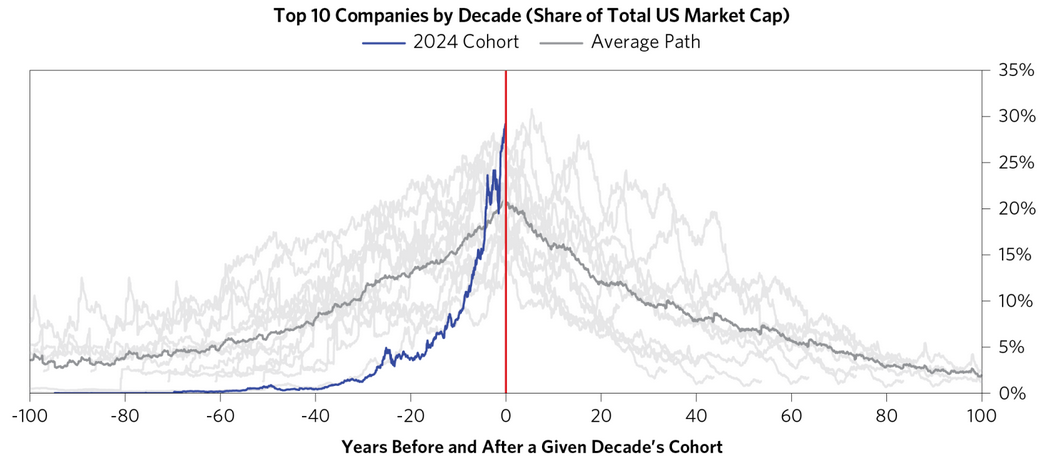
This comes from Bridgewater’s piece on “The Life Cycle of Market Champions.”  It shows how the dominant companies from each of the last twelve decades have fared over time — a good visual of how the market favorites come and go in dramatic fashion.  The report also includes charts of individual industries that illustrate some notable cycles.

Other reads

“The Right Kind of Stubborn,” Paul Graham.

The reason the persistent and the obstinate seem similar is that they’re both hard to stop. But they’re hard to stop in different senses.  The persistent are like boats whose engines can’t be throttled back.  The obstinate are like boats whose rudders can’t be turned.

“How GIC’s Cautious Experimentation Is Paying Off,” Alicia McElhaney, Institutional Investor.  The large asset owner tries to take a “rifle-shot, cannonball approach” to new organizational and investing initiatives.

“The Venturification of Research & The Resulting Prisoner’s Dilemma,” Michael Dempsey.  Changed dynamics along the spectrum from pure research to startups.

“Can Equal Weight Solve Our Concentration Crisis? Not So Fast…” Ryan Giannotto, Enterprising Investor.

Specifically, equal weight suffers from significant operational costs, underperformance, questionable assumptions, and skewed risk bets.

“Finding Ideas Before Others,” Ian Cassel, MicroCapClub.  How you find ideas — and how ideas find you.

“Old School FX Traders Are Being Replaced by Algos With Names Like Viper,” William Shaw and Alice Atkins, Bloomberg.

As they try to keep up, there’s been a sea change in the type of talent that banks rely on to staff their trading desks.

“All or Nothing — The Importance of Data in Secondaries,” Clipway.  An analysis “underscores the importance of thoroughly examining an entire portfolio during due diligence, especially in the LP-led secondary market, to understand the risk and return profile of the bottom 30% of NAV.”

“Should Canada Require Its Pension Funds to Invest More Domestically?” Keith Ambachtsheer, et al., SSRN.  The Canadian fund business model “has performed remarkably well to date,” but faces outside pressure due to the reduced exposure to Canadian equities over time.

“Have value investors been hindered by this quirk of accounting?” Joseph Taylor, Firstlinks.

Maybe this quirk of accounting goes some way to explaining why systematic low P/E, low price to book strategies haven’t worked as well as they did in the past.  A whole swathe of companies may have been excluded for being too expensive when they weren’t.  A lot of companies only look cheap in hindsight and never at the time.

“Quantifying Sequence-of-Returns Risk for Institutional Investors,” Kevin Machiz, Callan.  Sections include specific looks at the risks for Taft-Hartley plans, public DBs, corporate DBs, nonprofits, and target-date funds.

“Real-Estate Meltdown Strains Even the Safest Office Bonds,” Matt Wirz, Wall Street Journal.  CMBS is the acronym that first comes to mind regarding real estate worries.  Make room for SASB.

“Does ‘Skin in the Game’ Really Matter?” Joe Wiggins, Behavioural Investment.

Skin in the game is an important idea but also one we can get wrong by misjudging where it exists, what it is telling us and when it might be a problem.

The dilemma

“You have two options.  You can stay the same and protect the formula that gave you your initial success.  They’re going to crucify you for staying the same.  If you change, they’re going to crucify you for changing.” — Joni Mitchell.

Flashback: Copying your neighbor

The abstract from a 2003 paper, “Thy Neighbor’s Portfolio: Word-of-Mouth Effects in the Holdings and Trades of Money Managers,” by Jeffrey Kubik, et al.:

A mutual-fund manager is more likely to hold (or buy, or sell) a particular stock in any quarter if other managers in the same city are holding (or buying, or selling) that same stock.  This pattern shows up even when controlling for the distance between the fund manager and the stock in question, so it is distinct from a local-preference effect.  It is also robust to a variety of controls for investment styles.  These results can be interpreted in terms of an epidemic model in which investors spread information about stocks to one another by word of mouth.

Anecdotal evidence (and common sense) indicate that this effect didn’t disappear upon publication of the study.  Decisions by asset managers (and asset owners, advisors, etc.) are influenced by those in their network, especially those with whom they have in-person contact.

Postings

Explore the archives to see the back catalog of evergreen essays, including “When Analysts Throw in the Towel”:

Analysts are expected to be industry experts, but some aspects of the job are performative in nature:  hold recommendations that are implicitly something else; reiterations done for promotional purposes only; earnings estimates that have over time become more and more “adjusted” in order to support a position; and target prices with varying time horizons and no clear delineation of embedded market expectations or stock-specific risk adjustments.

Thanks for reading.  Many happy total returns.
Published: July 22, 2024

Subscribe

To comment, please send an email to editor@investmentecosystem.com. Comments are for the editor and are not viewable by readers.

Two Kinds of Social Investing (and a Host of Other Great Reads)

Jason Zweig’s book, The Devil’s Financial Dictionary, is the subject of the latest Investment Ecosystem posting.  (Subscribe here to see all of the content as it is released.)  It is an unusual and fun look at the lexicon of the investment business:

Zweig provides a mix of history, etymology, and satire that takes the book well beyond the typical dictionary.  Skepticism about the language and practices of the investment world is essential for lay investors and professionals alike — and the recurring abuses and calamities of the investment industry come in for deserved cynicism.

On to the readings.

Social investing (A)

In a recent paper, J. Anthony Cookson, et al. provide a review of research into the interplay of social media and investing, “distinguishing between research using social media as a lens to shed light on more general financial behavior and research exploring the effects of social media on financial markets.”  The quantity of papers cited is impressive, showing that the topics have received a lot of academic attention, and a number of important areas of study are covered.

To pick one, how does the “abundant but noisy” content that flows from “non-experts” affect the network structure of information and the behavior of investors (and investments)?

Rather than traditional media editors determining which stories are featured, thus receiving the most attention, social media attention is driven by popularity, often mediated via algorithms.  In turn, this enhances the scope for information cascades and for coordinated sentiment to influence markets.

Social media amplifies human predispositions while introducing new effects:

Is investors’ propensity to place themselves into a financial echo chamber a natural tendency that would exist to the same extent irrespective of social media interactions, or do features of these platforms exacerbate echo chamber behaviors?  In reality, social media both shapes us and reflects fundamental aspects of ourselves.

Social investing (B)

Another kind of social investing is the subject of research by Hoa Briscoe-Tran. et al.  They examine the “S” in ESG, challenging “the common ESG investing approach of amalgamating factors without considering their distinct, potentially contradictory, risk and return implications.”

The study focuses on the MSCI ESG ratings, in which the social category has “two primary components: the human capital score and the product safety score.”  However:

The expected impact of a firm’s social ratings on its future stock returns varies depending on whether the ratings pertain to human capital or product safety.

The two scores have opposite effects:

This divergence questions the practice of combining varied ESG factors into a single score, which can mask the distinct risk and return implications of each component.  Our findings underscore the complexity and diversity within ESG factors, particularly the social dimension, advising investors and practitioners to consider ESG criteria’s individual aspects in investment decisions.

Active, passive, and magnificent

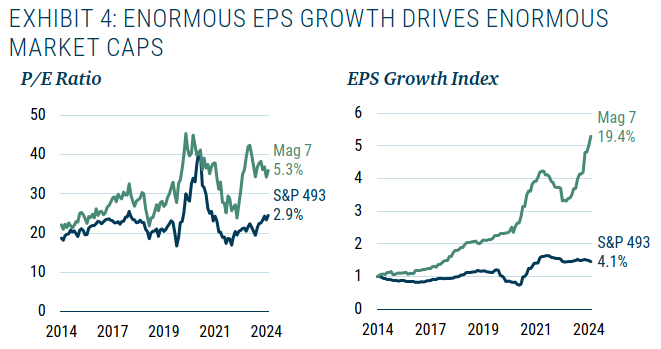
The latest quarterly letter from Ben Inker and John Pease of GMO includes the above exhibit, showing on the left that the annual growth of the multiple on the Magnificent Seven has outpaced the rest of the market, but that the real story is on the right:

The primary driver of the enormous market caps of the Magnificent Seven (Spectacular Six? Fabulous Five?) is — drum roll — the enormity of their EPS growth.

But those stalwarts aren’t the main course in the piece, which is titled “FAQ: Passive Investing.”  Regarding the headline topic, the authors summarized the difficulty of divining the impact of the increase in passive investing:

The problem has instead come from the dilemma of wanting to say fairly definitive things about the impact of passive investing on the stock market when it is exceedingly difficult to make conclusive statements about the effect of a single market change in an environment in which many other things have also changed over the same basic time scale.

Among the topics discussed are the differences in scale economics for active and passive funds; how the effects from the growth in passive depend on which investors are making the switch to it; and the different incentives for plan sponsors managing defined contribution plans versus defined benefit ones.  Of note, although markets have changed a lot in the last few years, most multi-asset portfolios look a lot like they did before:

This suggests that the elasticity (read: price sensitivity) of multi-asset investors isn’t particularly high.  Some of this is due to tight benchmark constraints, some of it is just inertia.

The bottom line:

The reality, then, is not so much that the rise of passive investing ruins markets, but only that it changes them.  It changes how much short-term investors should care about flows.  It potentially changes how much long-term investors should bank on mean reversion.  It changes how all investors should think about correlations, seeing as both passive flows and passive allocations might mechanically introduce (or reinforce) sources of asset co-movement.

Morningstar conference

A pair of columns in the latest Mutual Fund Observer include perspectives on the Morningstar Investment Conference.  The first item in David Snowball’s ten takeaways notes that “it’s not a conference for investors anymore”:

It might simply be a healthy evolution that financial planners are spending less time on things that are hard and iffy (selecting up-and-coming managers) and more time learning about “winning the next generation of high-net-worth investors.”

He also mentioned that Morningstar waived the admission fee for advisors who would attend three sponsored sessions — and gave a description of the exhibitor hall that made it sound moribund.  (Many conference organizers are wondering how to reinvigorate their previous models in a post-pandemic world.)

Charles Boccadoro provided an in-depth review, including lists of hot and not-so-hot topics.  Among other things, he said a panel “expressed an almost nostalgic desire for more in-depth articles with less click-bait titles, but also the recognition that this desire is at odds with today’s media business model.”  That is telling, since many of Morningstar’s own web offerings are fronted with click-bait titles in a way that they didn’t used to be.

Commercial real estate

Since 2005, Tadas Viskanta has been the go-to source for the daily curation of investment reads.  One recent set of links included three articles on commercial real estate that provided a good summary of the state of the market and the actions of the big investors most exposed to it:

“Fearing Losses, Banks Are Quietly Dumping Real Estate Loans” (New York Times).

“Real Estate Bets Gone Wrong Roil $1.24 Trillion Canadian Funds” (Bloomberg).

“Property group boss likens UK office values to ‘melting ice cubes’ ” (Financial Times).

Generating commentary

Perhaps the only thing worse than having to read portfolio attribution summaries period after period is having to write them.  Don’t fret, a machine will take care of it for you.  For example, clicking “generate commentary” in this FactSet application will spit out the copy.  But is it as good at painting things in a favorable light?

Other reads

“The Last 72 Hours of Archegos,” Ava Benny-Morrison and Sridhar Natarajan, Bloomberg.

Weeks of testimony have exposed cringeworthy misjudgments and costly blunders in various camps throughout the crisis — hardly Wall Street’s preferred image of calculated risk-taking.  Bankers, for example, painfully acknowledged how they relied on sometimes-vague or evasive trust-me’s from Archegos while doling out billions in firepower for Hwang’s bets.  That confidence melted into confusion . . .

“Hedge Funds: A Poor Choice for Most Long-Term Investors?” Richard Ennis, Enterprising Investor.  On balance, they are “alpha-negative and beta-light” and investors mute the performance of the best ones by over-diversifying.

“Optimization and Evolutionary Dead Ends,” Christopher Schelling, LinkedIn.

An optimization is quite literally best fit to one environment — that’s what it means.  But when environmental conditions are not as expected, optimization is what creates fragility.

“Balancing Innovation & Control,” Capco.  An accumulation of articles regarding governance issues, primarily in the areas of technology and sustainability.

“Elephants in the Investment Committee Boardroom,” True North Institute.  Among ten top-of-mind issues for asset owners:

1) The long-term prospects for private equity

2) Artificial Intelligence: investment opportunities and the impact on our investment process

3) Illiquidity management: managing PE capital call cash requirements as distributions dry up

4) Alpha from public equities: active vs passive debate

5) Rethink our ESG Policy (making it more practical)

“Broyhill Book Club 2024,” Broyhill Asset Management.  This year’s compilation, with links to previous editions.

“BlackRock throws support behind effort to move pensions beyond ESG,” Lee Harris and Brooke Masters, Financial Times.  Regarding the Alliance for Prosperity and a Secure Retirement; Tim Hill, a retired Phoenix firefighter who is president of the alliance is quoted as saying:

We are not pro-ESG.  We are not anti-ESG.  What we are is ‘pro’ letting investment professionals, who have a fiduciary duty to their beneficiaries, do the work that they’re supposed to do.  We are ‘anti’ politicians, from either the right or left, interfering with that fiduciary duty so they can carry out a political, social agenda.

What room are you in?

“If you’re the smartest person in the room, then you’re in the wrong room.” — Richard Feynman.  

Flashback: Ray DeVoe

In the days when research reports were found on paper rather than pixels, you could walk into a portfolio manager’s or analyst’s office and see whose work was getting their attention (although most noticeable were the large stacks of unread research piled around).

You might very well see “The DeVoe Report” from the firm of Legg Mason Wood Walker.  Ray DeVoe was an old-school analyst who was unafraid to point out the follies of the business.  His 2014 Bloomberg obituary cited two phrases for which he became famous (each of which is referenced in Zweig’s The Devil’s Financial Dictionary).  He originated the term “dead cat bounce,” and Warren Buffett among countless others has quoted his maxim, “More money has been lost reaching for yield than at the point of a gun.”

Postings

Check out the archives to find earlier editions of the Fortnightly and original essays that target the important problems faced by investment organizations and professionals.

For example, in 2023, proposed rules for investment advisors from the SEC prompted a posting, “The Outsourcing Debate: Principles and Rules”:

While the proposed SEC rule is getting the attention, the general questions behind it are what’s most important.  How good are advisory firms at assessing the trade-offs — for their clients, not themselves — of the range of outsourced services that they are employing?  How well can they judge the quality of those providers?  Does their own circle of competence qualify them to evaluate that of others?

Organizations should want to get better at all of this, whether the rule forces them to do so or not.

Thank you for reading.  Many happy total returns.

Published: July 8, 2024

Subscribe

To comment, please send an email to editor@investmentecosystem.com. Comments are for the editor and are not viewable by readers.

A Devilish Lexicon of Investment Discourse

The back cover of Jason Zweig’s 2015 book summarizes it in this way:

The Devil’s Financial Dictionary skewers the plutocrats and bureaucrats who gave us exploding mortgages, freakish risks, and banks too big to fail.  And it distills the complexities, absurdities, and pomposities of Wall Street into plain truths and aphorisms anyone can understand.

Book blurbs are famously promotional (like investment pitches), but the work lives up to its billing.  Zweig provides a mix of history, etymology, and satire that takes the book well beyond the typical dictionary.  Skepticism about the language and practices of the investment world is essential for lay investors and professionals alike — and the recurring abuses and calamities of the investment industry come in for deserved cynicism.

Zweig is the perfect guide to the lexicon of “Wall Street,” a term used to indicate “the financial industry, wherever it is situated.”  In his work as a columnist for the Wall Street Journal, he demystifies and debunks the fads of the day.

In 2003, Zweig provided commentary for a revised edition of Ben Graham’s The Intelligent Investor, using examples and ideas from subsequent decades to illuminate the precepts outlined in that seminal work.  A new, updated edition is now available for pre-order; it “offers readers an even clearer understanding of Graham’s wisdom and how it should be applied by investors today.”

The dictionary

Entries in the dictionary cover a range of topics, from A:

AAA, adj.  Traditionally pronounced “triple-A” — but, more recently, “AAAAAAAAAAAAAAAAAAAAGH!”

To Z:

ZOMBIE FUND, n.  A portfolio, typically a HEDGE FUND or PRIVATE-EQUITY FUND, that functions like the living dead.

Each of those entries goes on to provide more context and each is still timely today, given that AAA tranches of commercial mortgage-backed securities are now showing losses in value (something that is never supposed to happen) and there is increasing concern among asset owners about zombie funds, which linger beyond their expected or productive lives but provide managers with additional fees.

The excerpts show the general form of the definitions; the capitalized items within them cross-reference to other terms in the book.  In addition, fanciful (imagined) situations accompany some of the entries, complete with clever names for the individuals and firms cited.  To wit:

“We’re advising investors to overweight financial stocks,” said Shirley Hugh-Geste, chief market strategist for Kahn, Mann, Crooke & Banditto, the Wall Street investment bank.  “We think 2008 will be a record year for earnings in the financial sector as the housing sector regains its momentum.”

A few more examples (some of them are just the first parts of longer entries):

AXE, n.  The Wall Street analyst whose opinions hold the greatest sway over the price of a stock — until his or her hot streak runs out, at which point a new “axe” takes a whack at it.  This bizarre cycle continues for decades without most investors ever noticing that the blade is never swung by the same person for long enough to be meaningful.

BULL MARKET, n.  A period of rising prices that leads many investors to believe that their IQ has risen at least as much as the market value of their portfolios.  After the inevitable fall in prices, they will learn that both increases were temporary.

CAREER RISK, n.  The risk that, by thinking independently, a money manager might lose clients, endanger a big salary, and harm his or her own career; for money managers, the only risk that matters.

DISCLOSURE, n.  A statement that, by law, absolves a company of all responsibility — including any responsibility to present the statement in language that isn’t so stupefyingly obscure that nobody can understand it.  Intended to protect investors, disclosure instead protects the firms that issue it.

IPO, abbr. n.  “Initial public offering,” or the first sale of a company’s stock by private owners who know everything about it to public buyers who know nothing about it.

NEW ERA, n.  A period of collective investing insanity during which, according to its proponents, stocks should be valued by new rules — such as “this company is growing so fast that its value is infinite.”

NON-TRADED REIT, n.  A real-estate security that promises high income for the investor but usually delivers it only for the financial advisor.

OVERSIGHT, n.  A word with two opposite meanings:  “supervision,” as by a regulator or risk manager, and “omission or negligence.”  The directly contradictory meanings should serve as a warning to investors:  oversight can result in either outcome.

REGULATOR, n.  A bureaucrat who attempts to stop rampaging elephants by brandishing feather dusters at them.

STOCK-PICKER’S MARKET, n.  An imaginary set of circumstances in which shrewd and skillful investors stop competing against each other and are able to trade exclusively with an unlimited supply of morons.

UNCERTAINTY, n.  The most fundamental fact about human life and economic activity.  In the real world, uncertainty is ubiquitous; on Wall Street, it is nonexistent.

Zweig is excellent at connecting the current meanings of terms to their historical roots.  For example, “broker” is derived from the phrase of six centuries ago meaning “to tap a barrel of wine or ale,” allowing for an analogy to a person today “who taps — and potentially drains — a source of liquid wealth.”  And who would have guessed that a bond “indenture” would connect to “dentures” because of the toothed pattern by which the document for a deal was split (so that the parties could match up the pieces to confirm authenticity in the case of a dispute or expiration)?

“Panic” — both a noun and a verb — comes from the god Pan, “a grinning but ugly man with the horns, ears, and hairy legs of a goat . . . the god of herds and flocks, serenading them with his pipes”:

To the Greeks, a sudden fright was called panikos, “of Pan.”  Today’s herd of panicking investors, scattering in a selling frenzy set off by the unexpected, would be all too familiar to the ancient god.

The book highlights a number of absurdities that common discourse takes for granted:

~ The market is said to “act” this way or that, and many other verbs are applied to it in ways that are appealing to humans but not revealing, part of the storytelling that is built into the business.

~ “One company could spend twice as much on its borrowings as another and still report the same EBITDA,” which Charlie Munger referred to as “earnings before including the decisive adjustments.”

~ “The next _________” is catnip, be it regarding a person, a stock, or whatever.  Peter Lynch said that “the next of something almost never is — on Broadway, the best-seller list, the National Basketball Association, or Wall Street.”  As Zweig notes, “the next Peter Lynch” was applied to many asset managers who turned out not to be.

~ “The investors who obsess the most over beating the market are the most likely to get beaten by it.”  An important point that is little discussed.

~ Wall Street forecasts, “almost never have probabilities attached,” unlike weather forecasts or sports odds.  (An aspect of the seer-sucker theory:  “For every seer there is a sucker.”)

~ “Pareidolia” is the “human tendency to see meaningful patterns or trends in random events or images.”  Investors often engage in the equivalent of seeing “the Virgin Mary on a grilled-cheese sandwich.”

~ “Touch” is that certain something that (currently-winning) professional investors have.  “When that streak ends, people will say that the manager has lost his or her ‘touch’ — although none of them would have been able to say what exactly that was while the manager was hot.”

The book reinforces the view that despite all the new products and ideas being spewed forth year after year, the underlying forces that drive investor behavior are remarkably similar across the generations.  Which is not to say that there is a constancy of perspectives, beliefs, or actions.  Interpretations change with the market winds.  Three examples:

~ One tendency of investment providers is to let self-serving bias affect their descriptions of recent performance:

When a portfolio earns high returns, its manager will ascribe that outperformance to his or her rational, skillful selection of superior investments.  The behavior of other investors, the overall environment, and luck itself have nothing to do with it.

When a portfolio performs poorly, however, the manager will attribute that to bad luck, “unprecedented events,” a “difficult environment,” or the bizarre behavior of all those other investors who are too irrational to appreciate the fine investments he or she has selected for you.

~  The “halo effect” is powerful:

In early 2000 . . . with Cisco Systems’ stock up more than 100,000 percent over the previous decade, Fortune magazine called its chief executive, John Chambers, “the world’s greatest CEO.”  A year later, with the stock down almost 80 percent, Fortune described Chambers as having been dangerously blind to signs of the coming collapse.

~ In a 2002 speech, Alan Greenspan extolled the benefits of securitization in dispersing risk throughout the system.  Eight years later, he said that securitization “was the immediate trigger of the current crisis.”

Using the dictionary

Unlike most dictionaries, this one can be read from cover to cover in a relatively short period of time.  Or you can pick it up to digest a few entries now and then.  One great way to use the book is by looking up common terms as you read them in a portfolio manager update or an analyst research report.  Doing so will help you to think more carefully about what you are being told — and to be cautious about using the lingo you throw around yourself.

From Zweig’s introduction:

Luck, uncertainty, and surprise are the most fundamental physical forces in the world of investing.  Wall Street’s communications with the rest of the world are often designed specifically to deny the power of these forces.

The denser the jargon, and the more polysyllabic the terminology, the more likely someone is hiding something from you.

The Devil’s Financial Dictionary explores the language of investment practice, providing a helpful perspective for investors — and raising a caution flag for professionals and organizations who think that business as usual is the way things ought to be.


A footnote for rare book collectors and seekers of value:  The initial press run for the dictionary erroneously left out the last few chapters.  At the time that error occurred, Zweig called it his own Inverted Jenny, in reference to a famous stamp that has an unintended upside-down image of an airplane.  It is highly prized by philatelists.

Published: July 1, 2024

Subscribe

To comment, please send an email to editor@investmentecosystem.com. Comments are for the editor and are not viewable by readers.

Selection Algos, Better Deals, and a Shared Interest

The next essay on the Investment Ecosystem is tentatively titled “The Active Management Reinvention Project.”  (Sign up to receive all postings via email as they are published.)

On to the latest crop of readings.

Selection algos

A pair of briefs from Addepar written by Dane Rook and Dan Golosovker address the manager selection process.  The first, “What’s Your Algo for Manager Selection . . . and How Good Is It?” says:

An investor’s processes for manager selection can materially impact their portfolio-level returns.  However, many investors struggle to think analytically about their selection processes and do not know objectively how good those processes are or how to improve them.

The briefs specifically address the evaluation of managers in private markets, but the ideas apply equally to public mandates.  The “false temptation of past performance” is the big problem; the authors instead want to identify the “deeper drivers of performance that can function as high-confidence signals of future results.”  But most selection processes fail the tests of a good algorithm; furthermore:

Many investors’ selection algos aren’t codified anywhere, which not only limits their consistency, accuracy and efficiency, but also reduces their amenability to “debugging.”

In practice, investors have “an unfortunate satisficing tendency”:

They often focus their deep diligence on what information is offered to them by prospective managers, rather than demanding the information that matters most.

The theoretical characteristics and steps to be taken are fleshed out — and augmented by the second brief, “The ‘Algorithmic’ Mindset for Selecting Best-Fit Manager in Private Markets.”  A footnote speaks to the title:

We emphasize “best-fit” managers, because the managers that deliver the best returns might not be the managers who are the most appropriate [for the] investor:  there is also a need to factor in alignment, contribution to portfolio-level diversification and risk management, and various other relevant properties.

(The critical “deep diligence” phase referenced by the authors is at the heart of the Advanced Due Diligence and Manager Selection course.  Also of note:  Many of the shortcomings mentioned in terms of the imprecision of selection algorithms also apply to the investment processes of fundamentally-driven asset managers.)

Better deals

Emily Holdman of Permanent Equity, a firm that manages multi-decade private equity funds, wrote a report called “Better Deals.”  In a series of short and interesting chapters, it examines the dynamics of negotiation and the behavioral tendencies that come into play — and serves as a cultural yardstick for a broader range of investment management deal making.

The final section is “Ask All the Questions: Overcommunicate and Don’t Assume Anything.”  It includes:

People sometimes limit their inquiries to avoid appearing ignorant or difficult.  This is exactly the kind of self-sabotage that leads to poor outcomes.

Questions are a cornerstone of real relationships (along with listening).  Interest in the other party is healthy, not intrusive.  Dialogue develops mutual understanding.  Which can lead to trust.  Which, ultimately, results in better deals.

In parts of the ecosystem without a multi-decade time horizon, the pace is more frenetic and (it seems) the actions more cutthroat, but the advice still applies.

A shared interest

In “A Shared Interest: Do Bonds Strengthen Equity Monitoring?” Todd Gormley and Manish Jha investigate how corporate bond holdings at asset managers affect their monitoring and voting of their equity positions.  From the paper:

Investors influence governance through a combination of voice (managerial engagement and voting) and exit (selling one’s position).  Lacking the ability to participate in shareholder votes, bond investors are typically not thought to play an important governance role, and commonly used measures of institutional investors’ incentive to be engaged stewards focus solely on their equity positions.  However, bond investors have many reasons to be concerned about firms’ governance structures, which can influence bond values (via increased firm value), credit ratings, and the likelihood of repayment.

The authors “find evidence that institutions’ bond holdings predict their stewardship activities,” highlighting “how the determinants of institutional investor attention are more complicated than typically assumed.”

(Because firms differ structurally and culturally, the amount of information sharing across asset classes varies quite a bit from manager to manager.  It would be fascinating to see how those firm-specific factors are reflected in their unique voting patterns.)

Private markets

This image comes from “Crossing the Threshold: Mapping a Journey Towards Alternative Investments in Wealth Management,” a report from CAIA Association.  The stylized view could be improved with the addition of key categories of public assets, especially since the report says that one way to change perceptions about private market vehicles “is to position private markets exposure alongside public markets exposures”:

By removing the imaginary line between private and public markets, investors begin to conceptualize their allocation to “alternatives” instead as exposures that are an important part of the overall [portfolio] construction.

The challenge for an association of analysts whose credential has “alternative” in its name is to avoid the excesses of the “alts for the masses” push of product providers and to faithfully execute the fiduciary responsibilities that are the foundation of wealth management — at a time when the opportunity set is different than the one that created the historical record.  It’s a tough balance between the two forces, as is evident in the text.

Another credentialing body, CFA Institute, has published “Private Markets: Governance Issues Rise to the Fore.”  The report includes information from a survey of CFA Institute members, recommendations for investors and policymakers, and a section on “the end of the era of cheap money” and its implications for governance.  Of particular interest is the sixth chapter, a primer on governance issues in private markets which serves as a good introduction for investment advisors and asset owners alike.

With an asterisk

There have been several articles of late about private equity managers buying positions on the secondary market (at a discount) and immediately marking them up to their last official valuation.  For one, an Institutional Investor piece by Michelle Celarier examined this “sleight of hand,” legal as it is.

As mentioned there, secondaries have been a hot spot in a sluggish private equity landscape, with those markups aiding performance.  Buying such exposures on the cheap can be a value-adding strategy, but the instant gains may mislead investors, who are prone to imagining repeatability and chasing returns.  The numbers should be thought to come with an asterisk until those revaluations are sized and gauged as to the likelihood that they will last.

Other reads

“Six Words for a Capital Raise: ‘Slow is Smooth. Smooth is Fast.’ ” John-Austin Saviano, High Country Advisors.

Whatever the reason, an overeagerness to tell your story risks it being told badly, wasting priceless introductions, and the process becoming an awful slog.  Create a generic deck, run unstructured meetings, and give meandering answers and you’ll find yourself pushing on a string.

“Market efficiency and value added by listed and unlisted U.S. institutional investor real estate portfolios,” Alexander Beath and Maaike van Bragt, CEM Benchmarking.  A 24-year study, including the “proportions of investors outperforming by year and the implied probability that investors have skill in alpha generation.”

“How Do Public Pension Plan Returns Compare to Simple Index Investing?” Center for Retirement Research.

Over the full period [2000-2023], plan returns are virtually identical to the simple index strategy, but plans have done much worse since the Global Financial Crisis.

“A tl;dr for annual reports: same is good, change is bad,” Bryce Elder, Financial Times.  Two studies of the language of corporate filings.

“Betting with a Weak Hand,” Joe Wiggins, Behavioural Investment.  On poker and investing:

We are not sure what a strong hand is.

We will misjudge when we have a strong hand.

We will play too many hands.

“Janus Henderson’s Ali Dibadj: ‘You’ve just got to roll with the punches’,” Brooke Masters, Financial Times.  The challenges of managing a large asset manager that resulted from the merger of disparate firms.

“Seven Questions About Proxy Advisors,” David Larcker and Brian Tayan, Stanford Business.

The proxy advisory industry is marked by considerable controversy regarding its purpose, influence, value, and objectivity.

“Nvidia to get 20% weighting and billions in investor demand, while Apple demoted in major tech fund,” Jesse Pound, CNBC.  The unexpected effects of an “index” rule.

“Dilemma on Wall Street: Short-Term Gain or Climate Benefit?” Lydia DePillis, New York Times.  (Note:  This topic will be the subject of an upcoming Investment Ecosystem essay.)

Portfolio managers have conflicting incentives as the economic and financial risks from climate change become more apparent but remain imprecise.

“The Cultures that Actually Win,” Gapingvoid.  Charlie Munger and Amish barn raising; “trust is everything.”

The key question

“Why are we doing it this way?” — William Donaldson, a founder of DLJ; his NYT obituary said he thought it was “a question that can be asked about everything.”

Flashback: The Five Percent Club

A 2023 article in the StarTribune answered the headline question:  “Minnesota was once a leader in corporate philanthropy. Is that still true?”  The backstory:

Nearly five decades ago, the Five Percent Club put the state on the map nationally as a leader in philanthropy.  Target and 22 other Minnesota companies vowed to give away 5% of their pre-tax earnings to charity — the first group of its kind in the nation.

Actually, it wasn’t called Target at the time; the discounter was part of Dayton Hudson then, and the pledge was at the parent level.  The Club got its name because the firms “gave 5% of their earnings before taxes back to the community.”  Today, the members of the broader Keystone Program give at least 2%, with half reaching the 5% level.

The “shareholder value” movement kicked in around the time of the formation of the Five Percent Club — and the debate between the two ways of thinking continues today.

Postings

The archives include all of the previous editions of the Fortnightly.  For example, “Becoming a Learning Organization” taps observations from the CIA (like the one below) and applies them to investment organizations:

Institutional learning from those directly involved in events can provide context for situations of the future.  As time passes, people move on, memories fade, and important lessons are lost — or misremembered.  After-action reports of significant events can illuminate investment dilemmas of the future and, perhaps more importantly — if objectivity versus blame drives the culture and interviews are conducted with that intent — the social and psychological factors that affected those involved.

Thank you for reading.  Many happy total returns.
Published: June 24, 2024

Subscribe

To comment, please send an email to editor@investmentecosystem.com. Comments are for the editor and are not viewable by readers.

The Investment Manager Playbook, the Baylor Way, and Much (Much) More

Welcome to another edition of the Fortnightly, your source for interesting stories and ideas from around the investment ecosystem,  (Subscribe here to receive each new Fortnightly and original essays via email.)

The most recent posting on the site, “Recognizing the Risk of Flow-Driven Performance,” looks at a new paper that analyzes the impact of inflows (and outflows) on performance for liquid strategies.  That effect trips up allocators in subtle and not so subtle ways.  The paper uses “bubble ETFs” to show what happens when funds have ownership stakes that are large in comparison to the daily volume of their holdings.

The investment manager playbook

A previous edition of the Fortnightly covered “The Investment Office Playbook — What Managers Don’t See,” by Ted Seides.  Now he has shifted to the other side of the table, with a posting on “The Investment Manager Playbook: What Allocators Don’t See.”  It is an answer to these eternal questions:

Don’t managers know size is the enemy of performance?  Why are all these managers so greedy?

Which boils down to:

The investment manager’s playbook hinges on its decision to stay the same or grow.  That choice carries implications for the team, investment opportunities, and risks the manager will encounter to maximize its probability of long-term outperformance.

In almost any rational assessment, the playbook favors growth.  Expanding organizations can attract and retain talent and capital, which creates durability.  Staying the same may benefit from focus, but it carries significant business risk.

Seides walks through two choices over time — growth or “stay the same” — to illustrate why managers choose to get bigger despite the risks to the performance of its initial strategy.  The backdrop for all of it is the instability of the existing asset base because of investors who are quick to fire in response to the variability of performance (that comes with the territory of active management, although expectations in that regard are often out of whack).

While the write-up faithfully presents the mindset of managers in making the choice to expand, a couple of points of pushback:

~ The dilution of performance that (normally) accompanies larger asset sizes and the dilution of skill that (normally) results from expanding into new strategies may be acceptable trade-offs for an asset manager in order to build a more stable business, but asset owners still should be wary of those moves.

~ “Growth” need not involve just scale and complexity.  Too many firms “stay the same” by not focusing on continuous improvement of their existing strategy and their communications about it.

The Baylor way

There are few asset owners who actively use social media to promote their thinking about the what, how, and why of their approach.  Dave Morehead of Baylor University is one of the exceptions.  His feeds on LinkedIn and “Twitter” offer ongoing perspectives on investment and organizational issues of interest to both fellow asset owners and other industry participants.

A March article by Alicia McElhaney for Institutional Investor focused on how Morehead builds his team, given that attracting talent to Waco, Texas can be a challenge.  The first of three recent With Intelligence updates by Marc Hogan addresses Baylor’s manager selection process.  In it Morehead describes what he says to its managers when they are hired:

In general, we are going to be taking money from you when everyone else is giving you money, and everybody hates it when you redeem.  On the flip side, when they’re all redeeming from you and I’m tripling my allocation to you, you should really like that.

Years ago, Charley Ellis described the philosophy of the best institutional allocator he had seen.  It was the same one as Morehead outlined.  Another focus in the With Intelligence piece was Baylor’s willingness to ask more personal questions of managers than others doing due diligence.  (That’s one topic in this course from the Investment Ecosystem Academy.)

Social media presence and press coverage can cut both ways, but Morehead has made a name for his school in the investment world by offering greater transparency than others.  Will more take the same path?

AI corner

For most people, the age of AI started eighteen months ago with the public introduction of ChatGPT.  This chart provides a bit more perspective on developments in the field.

It comes from Citi’s report, “What Machines Can’t Master: Human Skills to Thrive in the Age of AI.”   It includes sections on competitive advantage (computers versus humans), the most valuable human skills according to a variety of experts, and the training and development of those skills.

Two other things you might not have seen.  An intriguing paper by Mohammad Atari, et al., “Which Humans,” considers the implications of the narrow base for many large language models:

This systematic skew of LLMs may have far-reaching societal consequences and risks as they become more tightly integrated with our social systems, institutions, and decision-making processes over time.

And, in a posting on Marginal Revolution, Alex Tabarrok writes that “a spot-market for hiring AIs is developing.”  Expertise in understanding the strengths and weaknesses of various AI capabilities will be essential (especially in the investment world).

Banks

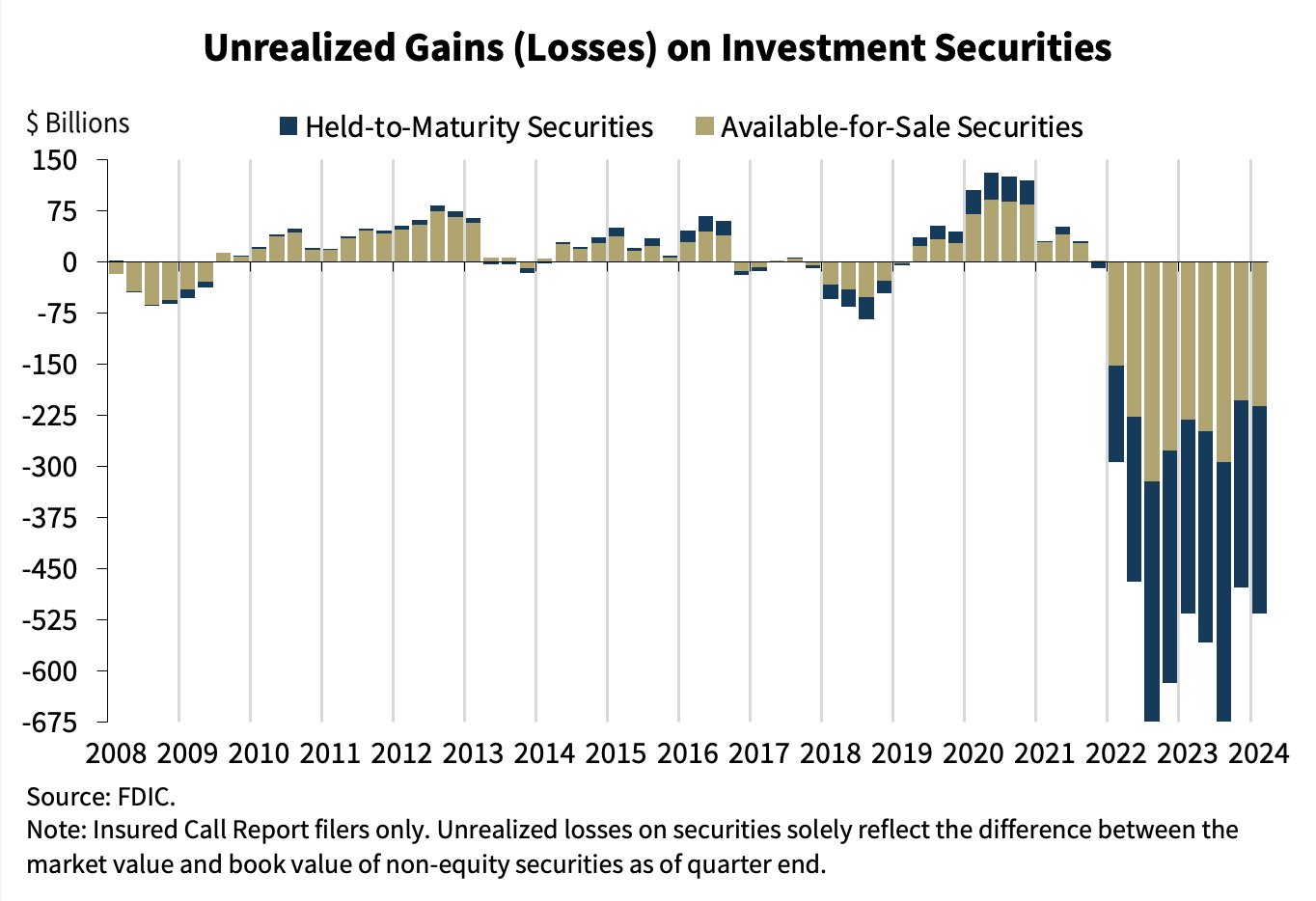
Tabarrok also posted this stunning chart of unrealized losses at U.S. banks.  Ominously, that note is titled “Bailouts Forever.”

Mood

Since Ark Invest lost its mojo (by chance, its decline started within days of this early Investment Ecosystem piece), Cathie Wood has become known for her regular predictions about stocks, markets, and the economy that seem well beyond the realm of possibility.  On May 23, she wrote, “In our view, the search for cash and safety in the equity markets today is as intense as that during the Great Depression in the early 1930s.”

Granted, sentiment is not always easy to divine, but since she posted that view, Nvidia is up another 25% and its CEO has gained celebrity status, including being asked to sign a woman’s chest.  (After asking, “Is that a good idea?” he did it anyway.)  A whiff of lower interest rates last week goosed a bunch of speculative plays.  And Roaring Kitty has reanimated the meme-stock crowd.

“Is that a good idea?” would seem to be the question of the day.

Zen-like

A way to think about due diligence.

Other reads

“Stock Market Concentration,” Michael Mauboussin and Dan Callahan, Morgan Stanley.

What feels disconcerting to many investors is that the rate of increase in concentration in the last decade is the most rapid since 1950.

“Rating on a Behavioral Curve,” Utpal Bhattacharya, et al., SSRN.  Analysts rate the firms that they cover relative to each other.  What are the implications of that (and the opportunities presented by it) when looking across the full range of analysts?

“The Long-Run Performance of Public Pension Funds in the US,” Richard Ennis, SSRN.

We identify two distinct eras of public fund performance, separated by the Global Financial Crisis of 2008 (GFC).

“Does diversity add value to asset management?” Tommi Johnsen, Alpha Architect.  A review of an academic article on diversity and hedge fund performance.

“Is ESG a Luxury Good?” David Larcker, et al., Stanford Business.

If demand for ESG follows the economic pattern of a luxury good rather than a basic necessity, boards will want to rethink how they plan, prioritize, and invest in ESG.  They can expect demand for ESG will not be static but reflect whether the economic cycle is favorable or unfavorable.

“It Is (Still) Time for LP’s To Be Accountable . . .,” AIM13.  “A compendium of things to look for in private equity LPAs.”

“Direct Lending Unlikely To Deliver Promised Returns,” Joseph Bohrer, LinkedIn.

Direct lending funds, desperate to invest all the money they raised, are taking more credit risk, accepting worse terms, at lower yields.

“Continuation Funds: What You Need To Know,” Greg Norman et al., Harvard Law School Forum on Corporate Governance; and “The Growing Popularity of Continuation Funds,” Hayley McCollum, Marquette Associates.  Basic information about these increasingly important vehicles.

“Regarding the Usage of Cash Hurdles in Incentive Fee Arrangement,” an “open letter” from a group of large asset owners and consultants.

The long-term health of the industry is dependent on a healthy alignment of interests between GPs and LPs, and we believe incentive payments on true value-add fixes a misalignment that has been present in fee structures throughout the maturation of the hedge fund industry.

“The Investing Boom That’s Squeezing Some People Dry,” Jason Zweig, Wall Street Journal.  Implications for individuals and their advisors when products that are easy to get into are hard to get out of.

Talk is cheap

“A principle is not a principle until it costs you money.” — Bill Bernbach.

Flashback: An intern at Enron

It’s intern season, which makes it a good time to read Giuseppe Paleologo’s “Memories of an Enron Summer.”  The short piece recounts his time as an intern at the firm the year before it blew up.

The author captures the cultural environment there and the belief that animated Enron’s feverish rise and even more dramatic fall, but he “couldn’t understand how Enron made money.”  He spreads the blame for the company’s failure more broadly than some accounts.  Everyone wanted in on the game:

It was self-organizing bad behavior.  What was the mechanism, though?  My explanation is that Enron became very successful at something (gas trading) and as an organization it extrapolated that success could be achieved in anything it set its mind to.  This enabled two classes of behaviors, each feeding on the other.  First, an entrepreneurial hypertrophy, and associated excess risk taking:  every new idea should be pursued, because it was new.  Second, controls and processes were seen as obstacles.

Most interns are trying too hard to please those in charge to notice the incongruities around them.  But, as we say around here, “all organizations are messy,” although not normally to the degree of Enron.

Postings

The archives include all of the previous editions of the Fortnightly.  Among the postings are several series, including one on Bill Gross and Pimco.

Thank you for reading.  Many happy total returns.
Published: June 10, 2024

Subscribe

To comment, please send an email to editor@investmentecosystem.com. Comments are for the editor and are not viewable by readers.

Recognizing the Risk of Flow-Driven Performance

In the “assets” module of the Advanced Due Diligence and Manager Selection course, there is a section on the relationship between performance and flows.  As discussed there, it is widely accepted that flows are responsive to performance.

Good performance leads to inflows and bad performance leads to outflows.  It makes sense given human nature — and study after study has shown it to be true across asset classes, public and private.

A simple visual accompanies the narration:

After some notable examples of that principle, the arrow on the slide starts to rotate, resulting in this:

The effect of flows on performance isn’t talked about much at all, even though the impact can be dramatic in certain situations.  There is little research on the topic; one good example was published in the Financial Analysts Journal in 2014, “Flows, Price Pressure, and Hedge Fund Returns.”  The authors, Katja Ahoniemi and Petri Jylhä, concluded that “one-third of estimated hedge fund alphas are due to flows.”

A new paper

Enter “Ponzi Funds,” a paper from Philippe van der Beck, Jean-Philippe Bouchaud, and Dario Villamaina.  As for the use of the word “Ponzi”:

We emphasize that the title of this paper does not suggest that concentrated investment funds are literal Ponzi schemes as defined by the SEC. . . . Instead, the term ‘Ponzi funds’ merely conveys the notion of self-inflated returns.

It is difficult to estimate the degree of performance that stems from price pressure related to flows, especially for open-ended mutual funds, hedge funds, and separate accounts, each of which presents data challenges.  In contrast:

ETFs are ideally suited because their portfolio holdings and flows are observable at a daily frequency, and because the vast majority of ETFs perfectly reinvest flows in their existing positions on the same day.

Funds (of any kind) that on average have ownership stakes that are large in comparison to the daily volume of their holdings are the most likely to have returns that are affected by flows:

When concentrated funds become large, their fund illiquidity spikes giving rise to self-inflated returns.

The importance of self-inflated returns in explaining funds’ overall returns increases monotonically in both the size and the concentration of their portfolios.

In regards to one anonymized thematic ETF, when it “received a 1% inflow on a certain day and proportionally rescaled its positions, it bought 20% of the daily volume in the underlying stocks.”  That being the case, it is not hard to imagine flows driving performance.  (Of course, the process works in reverse when there are outflows.)

From their research, the authors conclude that “investors are unable to differentiate between self-inflated returns (price impact) and fundamental returns (stock-picking skill).”  And there is a compounding effect:

Because investors place a higher weight on the most recent return, even short-lived price pressure can have an impact on the distribution of fund flows.  This can cause an endogenous feedback loop:  Flows cause a price impact, which is a realized return that causes further inflows and amplifies the initial price impact.

The paper includes charts that show a significant difference in return patterns between “run-up ETFs” — ones that have had substantial outperformance — from “bubble ETFs,” those which have had cumulative Ponzi flows at the upper end of all of the run-up funds.

For run-up funds, “excessive outperformance is on average not followed by a subsequent crash,” with cumulative returns reverting to market returns.  But the bubble-ETFs crumble well below those levels.

Examples and strategies

The first sentence of the paper provides an egregious example from outside the world of ETFs:

The collapse of Archegos Capital Management prominently showed that when investment funds trade concentrated positions, portfolio returns can be driven by the funds’ own price impact.

A more typical recent example is ARK, which very much fits the pattern of Janus in the the dot-com era:  performance begat flows which begat performance as the cash was plowed into a limited number of relatively illiquid stocks — until the music stopped and the machine reversed.

The ebb and flow of performance comes with the territory, but capital allocators often overlook the flow effects buried in the performance record and select a fund at the worst possible time.

While it is impractical to calculate the “Ponzi flow” before choosing a manager, it is easy enough to have that be a factor that must be addressed before making a commitment.  Estimating the general risk is possible even if the specifics are lacking.

As the authors note, “timing the crash is difficult.”  Strong moves in relative outperformance can last a while, and some investors are willing to chase a bubble while it is still inflating, although that can be a dicey strategy if the vehicle used is not easy to exit quickly.

Everyone wants to be in on the virtuous part of the cycle, but not its evil twin.  Managers adept at self-inflating returns tend to be particularly alluring just before the gears shift.


In addition to the course mentioned, The Investment Ecosystem offers training and facilitation for organizations regarding due diligence, innovation, and communication.  

Published: May 29, 2024

Subscribe

To comment, please send an email to editor@investmentecosystem.com. Comments are for the editor and are not viewable by readers.

Humans versus Machines, Real Estate Questions, and Faltering Factors

No matter your particular taste in music, you are likely to have an interest in the most recent posting on the site, “The Music of Investment Genres and Processes.”  The analogies offered will help you think about industry practices (and communicate with others about them).

If you find these Fortnightly editions and the other essays helpful, please recommend The Investment Ecosystem to your co-workers and friends.  If you’re new and want to subscribe (for free!), you may do so here.

The robots are coming here

Nathan Dong begins his paper, “Can AI Replace Stock Analysts? Evidence from Deep Learning Financial Statements,” with a screenshot of a headline from the New York Times Magazine, “The Robots are Coming for Wall Street.”  (That article was published more than eight years ago.)

Using deep-learning techniques (and an inexpensive setup), Dong’s approach “outperforms human analysts in 12-month-ahead target price forecasts by a large margin.”  The abstract concludes:

Overall, the results of this research support the notion that AI has the potential to replace human analysts in certain aspects of predicting financial performance.

Figuring out what the machines can do better than the humans is a point of focus these days.  Target prices are low-hanging fruit.  Dong suggests that the lagging forecasting performance of analysts “reflects the degree of optimism bias or the need to curry favor with companies’ management.”  Another potential factor is unveiled via the research methodology:  adding interest rate information was helpful in improving the performance of the AI model, but most sell-side analysts don’t pay much attention to it.  Plus, target prices are promotional devices for selling ideas — and analysts can sometimes get into leapfrogging games to have their targets stand out from others.  Using information available to all, the machine outperforms by removing longstanding behavioral distortions that are an accepted part of assigning target prices.

Another paper, “Financial Statement Analysis with Large Language Models,” by Alex Kim, et al., includes this conclusion:

Even without any narrative or industry-specific information, the LLM outperforms financial analysts in its ability to predict earnings changes.  The LLM exhibits a relative advantage over human analysts in situations when the analysts tend to struggle.

Much more to come.

Embrace the mania?

A report by Que Nguyen of Research Affiliates counsels readers to “Learn from Last Tech Bubble to Embrace GenAI Mania.”  It provides some history of the dot-com period, performance comparisons of a few notable companies of that era, and favorable words for the economic progress that comes from manias “despite the misallocation of much capital.”  As far as investing lessons:

Those who invested in profitable, well-capitalized tech companies in 1996 fared well over the long term.   Those who piled into speculative companies at the height of the mania while eschewing “old economy” stocks often experienced significant losses.

For the current case:

If investors believe that GenAI will be as impactful as the internet, they will need to participate by getting invested, and the best approach will be to stay diversified and be prepared to hold through ups and downs.

John Rekenthaler of Morningstar also compared today’s environment with the dot-com era, coming to a different conclusion, that “with internet stocks, most of the industry’s future leaders arrived not with the first wave of technology, but the second.”

In “The Alpha Cycle,” Joe Wiggins opens with a cautious reminder:

Industries in which capital has become abundant and optimism unbridled often end up disappointing investors.

And, in the process, the “intoxicating mix of unusually strong performance and seemingly irrefutable narratives draws increasingly large flows” to the asset managers who most embrace the mania, setting up a classic error in manager selection:

Selecting active fund managers who have enjoyed prodigious tailwinds comes with twin challenges.  First, we are likely to grossly overstate the presence of skill (we cannot help but conflate performance with skill).  Second, even if they do possess an edge, it is unlikely to matter because the odds of investing successfully in an area that already has stretched valuations and delivered exceptional performance are poor.

Real estate questions

Two property funds — Blackstone Real Estate Income Trust (BREIT) and Starwood Real Estate Investment Trust (SREIT) — continue to raise eyebrows among market watchers, while their sponsors try to convince investors that the bottom is nigh.  Cash flows fell below dividends in 2023 and each fund has had redemption requests exceed stated caps at times.  The monthly limit for withdrawals for SREIT was just slashed, with this explanation:

[As] a fiduciary to our stockholders, we cannot recommend being an aggressive seller of real estate assets today given what we believe to be a near-bottom market with limited transaction volumes, and our belief that the real estate markets will improve.

Two articles focus on the uncertainties around BREIT, which is significantly larger than SREIT.  The New York Times gives a short synopsis of the issues, while a subheading on a much longer piece from Business Insider wonders whether BREIT is a house of cards.

The essential question is shrouded in fog, since no one knows what the properties in the portfolios are worth.  That means that there are potential issues regarding the fairness of prices for incoming and outgoing investors (and for the fees based on net asset value).  With the increased popularity of semi-liquid alternative investments, these concerns are bound to be an area of attention for quite some time.

Endowment performance

True North Institute published the first report in a promised “performance ranking series,” this one focused on large U.S. university endowments.  The four conclusions:

Outperformance or alpha is becoming more difficult to generate for even the most capable of institutional investors.

Total portfolio absolute returns are primarily driven by the overall risk budget of the portfolio including large allocations to illiquid asset classes — primarily comprising private equity.

It is not clear that the large endowments are outperforming the average private equity and venture capital investor.  High allocations to private equity do not necessarily translate into high overall portfolio alpha.

We do not assume that private equity and venture capital will deliver the same level or consistency of returns in the future.  Endowments with more diversified sources of illiquidity premium may outperform in the future.

Faltering factors  This image is from “A Guide to Factor Investing,” by Alex Goroshko of NEPC.  It aptly demonstrates the quandary of the day:  The two factors, size and value, that were thought to be the most reliable (and which became the backbone of many investment strategies) peaked in performance around the time when factor investing dramatically increased in popularity.

Other reads

“Banks in Disguise,” Marc Rubinstein, Net Interest.

Unzip companies across a range of industries . . . and you will find financial companies lurking inside.

“Portfolio Construction & the Lower Middle Market,” Tim Hanson, Permanent Equity.  How to think about building a portfolio of private companies for multi-decade performance.

“Behind the J-Curve,” Juliet Clemens, PitchBook.

In due time we shall see whether recent vintages can make remarkable recoveries to get ahead of the curve rather than remaining behind it.

“In the Thick of It: How Performance Teams Are Driving Value Across the Organization,” FactSet.  There have been significant changes in this area over the last few years, including much more remote/hybrid work, expanded responsibilities, greater integration with other teams, and an increased need for new skills.

“Multi-strategy hedge fund primer: deep dive into diversification,” Aurum.

Multi-strategy hedge funds are not a homogeneous group and they can vary enormously; adopting different business models, areas of focus, risk parameters, levels of concentration, liquidity requirements and fees.

“The Economics of Private Equity,” Alexander Ljungqvist, CFA Institute Research Foundation.  This literature review summarizes major research findings regarding private equity and includes a helpful bibliography that includes conclusions from a wide variety of analyses.

“An Open Letter to Vanguard CEO, Salim Ramji,” Dave Nadig, Echo Beach.

Vanguard is entirely opaque.  Your ads all promise me that there’s value in being an owner.  So show me!

“Hedge funds hit by lack of private equity exits,” Harriet Agnew, Financial Times.  The denominator effect and assets tied up in PE affect the allocation to other strategies in the “alternatives” category.

“For the Analyst: Peer Benchmarking Methods to Improve Earnings Forecasts,” Ahmet Kurt, et al., Enterprising Investor.

Finding suitable peers for financial analysis is a vexing task that requires careful consideration of firms’ underlying economics, accounting choices, and financial statement presentation.  But without comparable financial statement information, peer benchmarking may yield less meaningful and even misleading insights that negatively impact earnings forecasts.

“Initial Observations Regarding Advisers Act Marketing Rule Compliance,” SEC.  Early indications of shortcomings in implementation of the new rule, including, “Advertisements stating that the advisers were ‘free of all conflicts,’ when actual conflicts existed.”

Find a partner

“Nothing clears up a case so much as stating it to another person.” — Sherlock Holmes (from Silver Blaze by Arthur Conan Doyle).

Flashback: Early warning

A year and a few days before 9/11, Inferential Focus sent its clients a briefing, “Bombs and Networks: New Terrorist Organizational Tools and Western Intelligence.”  It warned of an increased level of terrorist activity and the development of new organizational structures made possible by improved networking capabilities.

While citing other groups, the focus was on the Arab Afghans, led by Osama bin Laden, which we would soon enough learn to call Al-Qaeda.  The briefing ended:

Thus, the issue becomes:  Who is evolving faster — networked terrorist organizations and their communications systems or Western intelligence services?  Bombs and networks are forcing bigger and faster changes in intelligence realities.

The references to Hamas in the piece are a reminder that nearly a quarter century later intelligence services have trouble understanding the potential threats emanating from those networks.

Investment risk management — which doesn’t involve matters of life and death — likewise often suffers from a lack of attention to changes in the established order of things.

Postings

The archives are full of essays that might interest you.  For example, here’s a bit of “The Red, Amber, and Green of Performance Tests, a posting from 2022:

Explicit and implicit performance rules are often applied without consideration as to whether they add value or not — since they just seem right — even though they are often counterproductive.  Therefore, it makes sense to identify and assess them, and to design organizations to minimize the bad decisions that can result.  This is especially difficult given the chains of agents that reinforce the tendencies.

For example, an institutional asset owner may have to deal with layers of tests applied by consultants, in-house due diligence analysts, the CIO, and the investment committee.  Someone at an advisory firm may use an outside research firm for ideas, need to hew to the buy list of a centralized due diligence function, make a presentation to their investment committee — and then have to sell the idea to clients.  At each stage, performance exerts a gravitational pull on those involved.

Thank you for reading.  Many happy total returns.
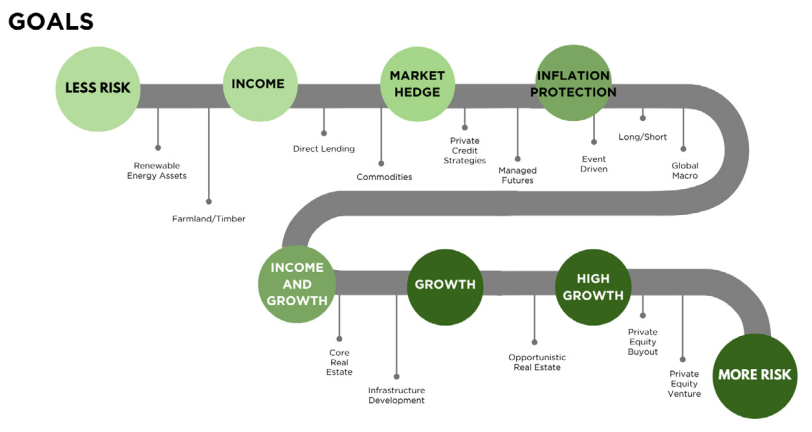
 

Today is the sixteenth anniversary of the debut of “the research puzzle” blog, which laid the foundation for this site.  A special thanks to those who have been reading across the years.

Published: May 27, 2024

Subscribe

To comment, please send an email to editor@investmentecosystem.com. Comments are for the editor and are not viewable by readers.

The Music of Investment Genres and Processes

Is your investment process jazz or classical?

There are other possibilities, of course, but let’s stick with those.  At a basic level, jazz is improvisational.  The “chart” is just a melody and some chord changes (and maybe lyrics).  In contrast, classical music comes with a “score” where almost everything is laid out and strict adherence to it is the goal.

In some cases, there is a blending of the two styles, when a jazzy sound is coupled with a defined arrangement (at times including some improvised solos).  Much big band music falls into that category.  And works by George Gershwin, Duke Ellington, Stan Kenton, and Gunther Schuller, among others, were fully orchestrated but clearly had their roots in jazz.

Investment process

Let’s go back to the notion that the two approaches are mutually exclusive — one rule-based and the other working off of a general framework that is elastic in its implementation.

Which is closest to your investment process?

Or, if you are responsible for allocating assets to investment managers, which category does each of the managers you choose go into?  Are they playing jazz or classical?

Most descriptions of process sound like classical music.  For example, asset managers often brag that what they do is consistent and repeatable — and that phrase is often echoed in response by allocators when they are asked to evaluate those managers.  Similarly, advisory firms want to make things sound structured and logical.  The message:  “We can play this music over and over, and make it pleasing for you every time.”

In classical music, with everything apparently laid out in the score, there are still matters of interpretation, so one rendition of a famous work can sound different than another, resulting in collectors sometimes owning several recorded versions — and having an opinion about which is best.  Tempo is one of the biggest differentiators among the variations.  (To wit, Leonard Bernstein’s famous comments about Glenn Gould’s highly unusual take on a Brahms concerto.)

In the same way, even a process that is promoted as fixed has degrees of variability involved, sometimes inconsequential in the scheme of things but often more significant than advertised.  Finding and sizing that variability is an important task for those doing due diligence.

Just as improvisation in music is risky business — whether you are playing on your own or trying to react to the surprises that your bandmates introduce into the mix — improvisation in investment is too.  That’s why stories of consistency resonate with allocators.

Change

Speaking of risky business, the investment markets are interlocking complex adaptive systems, so change comes with the territory, making a classical mindset less tenable over the long term than it appears.  A brief clip from an appearance by Brad Jacobs on Shane Parrish’s Knowledge Project podcast describes the problem.  (The whole interview is here.)

Yet change is hard.  Long-time fans can get frustrated if they go to a concert and large parts of it consist of new material or deep cuts instead of the golden oldies.  Billy Joel hasn’t had that problem, since he only recently released his first new song in a couple of decades.  Not to worry, the crowds still show up to see him.

The familiar is comfortable.  When a 69-year-old is playing air guitar in an arena, he wants his idol to do the solo just like he did on the album a half-century before.

It’s like that with investing too; we are suspicious of change in a process, even though changes in process are necessary to stay in contact with the environment over time.

Flat-out improvisation is frowned upon by most, unless such eclecticism has resulted in admirable returns.  (In that case, investors often see performance, infer process, and go along for the ride.)  But a run of ill-advised flyers that crash and burn sours investors on extemporaneous forays.

People

While it’s generally best to have a mix of different kinds of people involved in an investment process (to provide balance and avoid the trap of a uniform perspective), mixing those who have a jazz mindset with others who have a classical one can be a challenge.

Feeling the environment and adjusting quickly to surprises is not at all like executing according to a well-defined plan, so problems develop when there’s a lack of clarity in approach.  There are natural frictions of that type that are to be expected, but sometimes a fault line develops from them that causes more serious issues.  (A benefit of ethnographic due diligence is the opportunity to ask insightful questions that surface those kinds of disconnects.)  There will always be relative strengths and weaknesses — and differences of opinion — among an investment team.  The question is whether they can still come together as an ensemble in satisfying ways.

Genres

A common theme between music and investment is an obsession with genres.  There is an inherent need to draw lines between categories — and to decide who is best in each.

This year, 94 Grammys were awarded in eleven genres, several of which have multiple categories.  But those groupings have changed considerably over time, as a historical list of current and former categories demonstrates.

And then there is the question of what kind of music belongs in any genre.  Is it really country if it doesn’t have a twang in it?  If so, much of the popular country music of the last few decades would have a hard time qualifying.  And that particular question has been out there for longer than that, as Matt Zeigler recounted in a posting about “The Greatest Award Ever Lit On Fire On Live TV” (lit by Charlie Rich, after John Denver won the Country Music Award for entertainer of the year).  Just this year, Beyoncé’s new album topped the Billboard country chart, following forays by other unlikely crossovers since Ray Charles recorded Modern Sounds in Country and Western Music in 1962.  Cross-fertilization abounds in the music ecosystem, often in unexpected ways.

There is a constant evolution in categories, as musical worlds collide and create new planets and stars.  The most interesting developments often happen at the edges of a genre, where influences from other realms are tapped and combined to create something fresh.  Sometimes those developments amount to new wrinkles; at other times they prompt emergent categories that radically change the music scene.  (There’s often a geographical center for new beginnings; consider Detroit, Seattle, and the Bronx as a few of the many examples.)

Ditto on the investment front.  Categories proliferate, divide, morph, and go from obscure to common (or vice versa).

No one would have won Best General Partner, Secondaries a few years ago.  It wasn’t a thing.  Private credit was only elevated to asset class status by most within the last decade.  Litigation finance?  Pod shops?  Crypto?

And a lot of the old categories that are still around would be greeted by yawns at an investment award show.  Growth at a reasonable price got its own acronym back in the day but it doesn’t seem like anyone talks about it any more.  The traditional categories have gotten boring and aren’t a focus of attention.  Even the active-versus-passive debate has worn thin — the SPIVA numbers barely change no matter what part of the cycle we’re in and passive continues to gain share in liquid strategies.   (Speaking of category malleability, the word “passive” has gotten mushy with indexes that aren’t really passive in the classic sense often being lumped in with ones that are.)

Reinvention

Music and investing are social phenomena, and mimetic desire is a strong force.  As new sounds gain popularity, there is a rush to imitate, just as there is when new investment strategies show good performance and begin to attract assets in size.

The urge to copy is strongest at those times of success, but there is another kind of copying that comes later, after the burst of popularity has faded.  In music, cover songs and tribute albums can unlock new appreciation and meaning.  Musicians across genres have mined the so-called Great American Songbook of the last century to good effect, and there have been jarring and revelatory redoes like Johnny Cash covering “Hurt” by Trent Reznor of Nine Inch Nails.

The reprise of an investment strategy usually lacks the specific attribution that is available in music if a copyrighted work is remade — although some try to claim a tie to Buffett or other gurus for marketing oomph — but such reinventions can put a productive spin on an old notion.  For one thing, they can incorporate adaptations that the originators of the strategies have failed to seize.

Coda

The topic of changing genres brings us back to the subject of changes in investment process.  Because allocators carve up the strategies of the day and judge managers within them, they are concerned with style drift that would take a manager away from the location in the current map of possibilities where they had stationed it.

But the map is always changing and style drift should be expected and, depending on the circumstances, encouraged.  Is the drift merely reflecting transitory changes (movement toward what’s becoming more popular or away from what’s becoming unpopular, only to see it revert), or something that represents a fundamental, sustainable evolution that should be embraced.  It isn’t easy to tell, but style drift shouldn’t automatically be rejected — or embraced.

Process drift, on the other hand, should be expected as a result of continuous improvement efforts.  A consistent and repeatable process is nothing to brag about.  One that gets better year by year ought to be the goal.

When asked about genres, musicians often reply with the saying that “there’s only good music and bad music,” that arbitrary boundaries can get in the way of judging quality.  That’s true in the investment world as well.

Standards and practices and dividing lines don’t stand still.  Appreciating what they are today — and understanding their power as social norms — is essential.  But so is remembering that they aren’t eternal.


Issues of categorization and investment process are covered in depth in the Advanced Due Diligence and Manager Selection course.  The process module is also available on a standalone basis in the short course, Analyzing Investment Process.

Published: May 23, 2024

Subscribe

To comment, please send an email to editor@investmentecosystem.com. Comments are for the editor and are not viewable by readers.

A Blank Slate, Changing Circumstances, and Deepfakes

In addition to content, The Investment Ecosystem offers consulting, training, coaching, and facilitation for investment organizations and professionals.  For more information, see our website to schedule a virtual meeting.

The most recent posting on the site, “The Advisory Dilemma: Personalized or Systematic?” deals with the important decisions that advisory firms must make in terms of the nature of their services.

A blank slate

Here’s your assignment:  Manage a pool of $47 billion, starting from scratch.

That’s the job that John Barker, chief investment officer of the Mastercard Foundation, has, as outlined in an article from Institutional Investor.  Not only constructing the portfolio but building the organization.

What would you do if you were in his shoes?  How much would your solutions to this unique opportunity mimic what everyone else is doing?

Changing circumstancesWe all know that markets are continually evolving, even though we sometimes act as if we can lock down an approach that will work for all time.  The above image came from Bloomberg.  It shows the dramatic change versus four years ago in terms of the effect of increases in Treasury yields on the prospect for positive (nominal) returns.

Other reminders of fundamental changes come from Morningstar’s “Diversification Landscape 2024” report.  Here’s its sixty-year look at the correlation between Treasuries and large stocks:

And one since 2002 that shows how significantly two equity sectors have varied in correlation to the market (and that technology has not):

For a longer view, Bryan Taylor went back to 1251(!) to divide the past into five financial eras and twenty historical periods.  (Paper here.)

Each period is separated by geopolitical events, such as the end or beginning of a war (1815, 1914, 1945), a stock market bubble (1720, 1929, 2000), a secular low or high in interest rates (1896, 1981, 2020) or similar events.  These events signal a change in the zeitgeist of the period and consequently a change in the returns to stocks, bonds, bills and the equity risk premium.

We have found that high returns in one period are followed by low returns in the next period and vice versa.

Taylor places us in the era of globalization, which he has beginning in 1982.  However, he breaks that era into three periods, the latest starting in 2020, the title of which heralds a potential shift to a completely different era:  de-globalization.

Deepfakes

Angelo Calvello wrote an opinion piece for Pensions & Investments, “Deepfakes — the next threat for investors.”  A video example created for demonstration is included, plus some plausible scenarios in which a deepfake could be used to fool investors.  Particularly troubling:

Deepfakes are created by using deep learning technologies (hence the “deep” in “deepfake”), often generative adversarial networks (or GANs).  Yet, despite the complexity of the underlying technologies, almost anyone can manipulate videos, audio and images to create deepfakes without the need for extensive programming skills.

The emerging risks point out the need for good operational due diligence:

Because allocators and managers depend on third parties (custodians, fund administrators, brokers, etc.) to provide critical services, their due diligence process should include a rigorous assessment of the vendors’ digital security policy and procedures.

Legends

Jim Simons, the iconoclastic founder of the mysterious and wildly-successful Renaissance Technologies, passed away at 86.  Gregory Zuckerman, who authored the book The Man Who Solved the Market about Simons, wrote a remembrance for the Wall Street Journal.  Ted Merz summarized Simons’ five very short guiding principles.  (In 2017, the New Yorker published a very good article on the research center Simons created after leaving the active management of Renaissance.)

“Woodstock for capitalists” — the Berkshire Hathaway annual meeting — was held on May 4.  The absence of Charlie Munger (who, according to Warren Buffett, was peaking when he died at “the age of 99.9”) and Buffett’s own advanced age gave the meeting a different feel than in years past.  In a poignant moment, a boy asked the question, “I’m wondering if you had more day with Charlie, what would you do with him?”  Here’s the video.

Debt

Morgan Housel wrote a posting about debt and the volatility of life (“Not just market volatility, but life world and life volatility:  recessions, wars, divorces, illness, moves, floods, changes of heart, etc.), using a series of simple images, including this one:

The black lines stay the same, but one image has very wide red bands (representing how low levels of debt mean that the effects of the volatility are largely a non-issue) and one very narrow ones, which present a different state entirely.

Seeing the posting prompted Howard Marks to write a short essay on “The Impact of Debt.”  The use of leverage is a factor in the management of companies and of portfolios, and attitudes about it vary significantly over time in response to changes in the environment.

Other reads

“The Curious Case of Catalysts,” Joe Wiggins, Behavioural Investment.

There are problems in each of these components — we are poor at making predictions about future events, we aren’t great at forecasting the reaction of other investors, and things are never constant.  Other than that, we are all set.

“Big Tech Capex and Earnings Quality,” John Huber, Base Hit Investing.  How will the huge increases in capital expenditures by the big tech companies affect their returns (and investor perceptions of them)?

“The OCIO Mirage & Investment Office Costs,” Charles Skorina.

If the goal is to deliver superior performance, service, and solutions and be there for multiple generations and perpetual institutions, who is most likely to endure and deliver?

“Looking for the exit: Oregon battles overweight allocations to illiquids,” Sarah Rundell, Top1000funds.  One example of how a fund adjusts its portfolio construction in response to the denominator effect (private market assets at the Oregon Public Employees Retirement Fund are now 55% versus the target of 40%).

“Don’t tell me how I am doing,” Joachim Klement, Klement on Investing.

Your performance tends to improve if you stop comparing it to other investors or some arbitrary benchmark.  If you focus only on your investment process and what you can control, you are less stressed about your investments and give them more time to create long-term performance.  You are less likely to sell assets that may go through a temporary drawdown, and you feel less pressure to just invests in what has worked most recently.

“These 4 pillars are the ‘SOUL’ of organic growth,” Joe Duran, Citywire RIA.  A simple framework for the next generation of advisory firm leaders.

“Carried Interest: Assessing Current and New Methodologies on Valuation,” Johnson Associates.

By understanding the current value of carry awards, firms will be able to more accurately determine all-in economics across traditional compensation and carried interest.

“Can Machines Time Markets?” AQR.  Thoughts on whether “small, simple models — not complex machine learning models — are best suited for market timing applications,” or whether “astronomical parameterization” offers new possibilities.

“Common Investor Relations Representation,” David Volant, SSRN.

I find common IR representation increases common institutional investor ownership, overlap in sell-side analyst coverage, and similarities in guidance practices across clients — even among economically dissimilar firms that operate in different industries.

“IFRS Accounting Standard Will Support Better Investment Decisions,” Nick Anderson, Enterprising Investor.  Companies subject to IFRS will be rolling out changes to their financial statements over the next three years.

Success

“If your work is unfulfilling, the money will be too.” — Jerry Seinfeld, via Ben Carlson.

Flashback: A tsunami of change

The brokerage industry underwent a time of significant change in the late 1990s.  Once upon a time there were mid-sized firms who were very influential with asset managers and instrumental in bringing firms public.  Most of the notable ones were gobbled up by banking firms in a relatively short period, including these which agreed to be acquired in 1997 alone:  Alex. Brown (by Bankers Trust); Robertson Stephens (BankAmerica); Montgomery Securities (NationsBank); Wheat First (First Union); and Piper Jaffray (U.S. Bancorp).

Within a couple of years, the dot-com boom had turned into a bust and the banks were cutting back on those research operations (and in some cases being bought themselves).

In 1999, Goldman Sachs said goodbye to 130 years as a partnership and became a public company.  An article by Joshua Franklin details some of the twists and turns in its quarter century, including the switch from a brokerage firm to a bank holding company during the financial crisis.

Postings

The archives include all of the previous editions of the Fortnightly, as well as essays on important ideas from different pockets of the investment ecosystem.  Here’s an example of an posting from December, “Identifying Unrealistic Expectations in Manager Selection.”

Thank you for reading.  Many happy total returns.
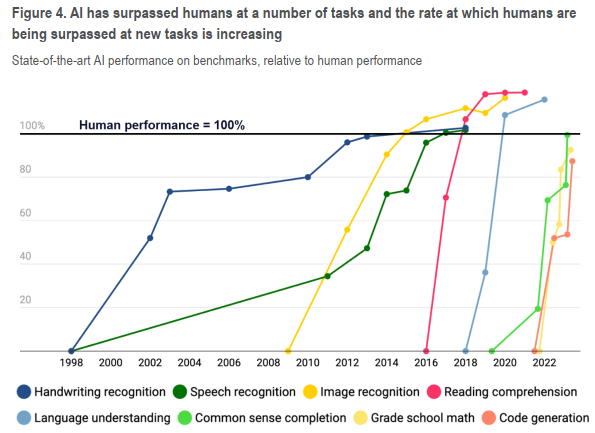
Published: May 13, 2024

Subscribe

To comment, please send an email to editor@investmentecosystem.com. Comments are for the editor and are not viewable by readers.