Analyzing the Due Diligence Process to Produce Better Outcomes

Despite its importance throughout the investment ecosystem, due diligence receives relatively little attention and study compared to other core functions.

There isn’t much industry-produced research about the “how” of due diligence.  One of the goals of our Advanced Due Diligence and Manager Selection course is to provide a collection of sources on such topics.  (The main goal is advancing the state of the art in the qualitative analysis of investment organizations.)

There is also a paucity of academic research on the subject.  In the first line of their paper, “Due Diligence and the Allocation of Venture Capital,” Jack Xiaoyong Fu and Lucian Taylor write, “Due diligence is widespread in practice but largely absent from academic research.”

The paper includes a number of interesting conclusions which we’ll cover before considering broader issues regarding due diligence.

A novel approach

In the abstract, Fu and Taylor summarize their methodology:  “Using cell phone signal data, we measure the duration of pre-investment meetings between venture capitalists (VCs) and startup employees.”

What that means in practice:

To construct our proxy for the amount of due diligence on a VC deal, we analyze cell phone signals near VC and startup offices.  This fully anonymous dataset includes cell phone location information with timestamps, recorded whenever an app is active or running in the background.  While this technology fully complies with legal standards and contains no individually identifiable information, it still allows us to measure potential meetings between VCs and startup employees.

Note the word potential.  The authors thoroughly cover problems with the data.  Most importantly, the analysis only covers in-person meetings at VC or startup offices, leaving out phone calls, virtual meetings, and meetings at other locations.  A variety of database and technology issues mean that the dataset is not as complete and accurate as would be preferred.  Also, in-person meetings were disrupted by the pandemic, so trends in visits were altered during that time.

The phone information was matched to PitchBook data on 22,000 deals, enabling the series of analyses about the frequency and length of in-person meetings (and their relationship to investment outcomes) that are covered in the paper.

Conclusions in the paper

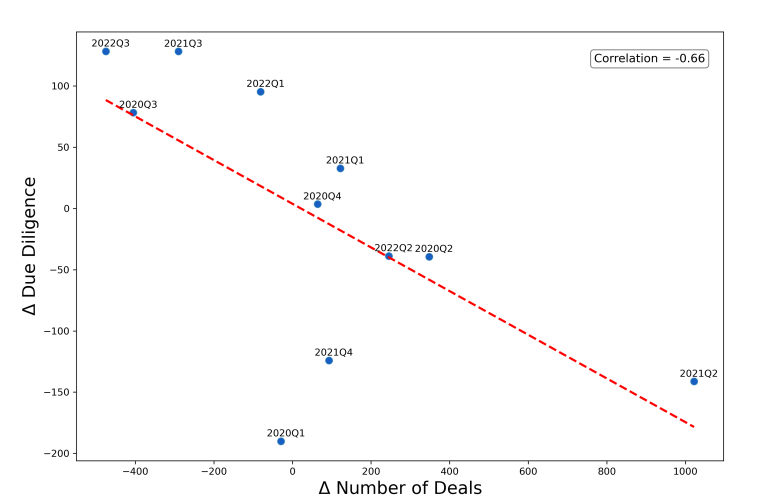
The authors had hypothesized that there would be less due diligence done during “hot” periods in the markets for deals.  The figure below shows the relationship between quarterly changes in deal volume (shifted one quarter forward) and the median due diligence minutes over the same two quarters; the results match the hypothesis:  “In short, busier investors perform less due diligence.”

In one sense that seems obvious, since with a static staff there is less time for each deal when there are more deals to be researched.  But that simple calculation raises a question about whether due diligence standards should change when the demand for venture capital does.

Other findings (with “VCs” referring to the broad range of investors in venture capital, not just VC funds):

~ There is “a strong negative relation between diligence levels and the number of investments the VC makes within 18 months of the focal deal.”

~ “Some VCs ‘spray and pray,’ making many investments with little due diligence.  Other VCs follow a more selective strategy, making fewer investments but performing more diligence.”

~ The authors looked at different kinds of investors, concluding that “diligence levels are lower for ‘nontraditionals’ such as [corporate venture capital buyers], growth/expansion investors, hedge funds, and other asset managers.”  Despite their higher level of assets under management, asset managers generally do less due diligence.  (As covered in an issue of the Fortnightly, Morningstar concluded that “mutual fund managers do not appear to be skilled private-company stock-pickers.”)

~ Geography plays into the choice as to whether to do in-person due diligence.  When the VC and the startup are further away from each other it happens less frequently.  One theme of the paper is that due diligence is costly.  The time and expense of travel is one of the more obvious costs.

~ “On average, diligence levels are higher for investors who manage fewer assets and make fewer other deals in the surrounding months.”

~ And, regarding the bottom line, “less due diligence is associated with more dispersed investment outcomes” and “an investor’s full-sample exit rate — a proxy for investment success — has a strong, positive correlation with its due diligence intensity.”

The bigger picture (part one)

Some investment practitioners are quick to dismiss conclusions coming out of academic research in their area of expertise — after all, they live in the real world, not in an ivory tower.  (That certainly isn’t the case with quantitative investors, who may argue about the methods employed in an analysis but are always thirsting for new ideas to incorporate into their strategies.)  A good rule for all is to consider the quality of the work and then match the evidence presented versus their experience and prior beliefs.  Sometimes a paper provides a piece to the ongoing puzzle of market behavior and opportunity.  Avoiding academic research by inclination prevents capitalizing on that possibility.

In this case, Fu and Taylor have been clear that their approach only addresses one aspect of due diligence — in-person meetings — and for a variety of reasons is an incomplete assessment of what they are trying to judge.  (“Our measure captures only a portion of VC due diligence, and the proxy we use is noisy.”)

So, how should we think about their conclusions?

~ Their methods echo those of practitioners these days, who use alternative datasets as inputs in investment decision making.  Similar concerns regarding collection practices, data shortcomings, and analytical assumptions can exist in those applications.  Nonetheless, there still can be value in incorporating the data into a strategy.  The same principle can be applied here.

~ Since the conclusions fit with other indications of capital allocation practices, they serve as a reminder that such examinations can prompt important discussions about the value of due diligence and how it is conducted.

The bigger picture (part two)

From the paper:

We model due diligence as producing a signal about the quality of the startup-VC match.  The investor chooses how precise of a signal to obtain, analogous to how much due diligence to perform.  This choice involves a tradeoff:  learning is costly but allows a more profitable investment choice.

How do organizations go about choosing “how precise a signal to obtain” and “how much due diligence to perform”?  The reasons behind those important decisions are often murky, with workloads and budgets seeming to determine strategy and tactics.  Instead there should be clearly-defined arguments for dealing with the trade-offs involved to optimize the quality of due diligence.  (Doing that usually results in deeper work on fewer opportunities.)

An obvious place to start is by considering the value of in-person meetings versus virtual ones.  (A previous posting dealt with the topic of onsite visits.)  Fu and Taylor made a choice to have “meetings lasting longer than five hours flagged as false positives since they likely indicate other activities.”  That filter could be questioned, since those doing exhaustive due diligence are likely to exceed that limit.

(Granted, since startups are usually small and less complex than developed organizations, the filter probably makes more sense in this case than it would if the study concerned the due diligence of other kinds of firms.)

Whether to do in-person meetings, where they should be held, how to conduct them, how long they should be, etc. constitute just one category of decision choices among many that come into play in the due diligence process.  Each of them deserves to be thoughtfully examined when setting standards and preferences — and should be revisited with some regularity.  New areas of research and special situations can often lead to needed reassessments of existing practices.

Some kind of tracking of methods is helpful in thinking about the impact of the choices.  Just as the authors of the paper tried to compare the “intensity” of the due diligence effort (in one respect) to outcomes, connecting the successes and failures of investments to the types of due diligence employed might reveal areas for improvement.  Usually the assessment of an investment is all about the strategy and entity involved; it should also include a review of the methods of diligence and selection employed.

One important step to take in that direction is elevating discussions about those methods throughout the decision making process.  Including sections in an investment memo about the “how” of the due diligence — and having it be an always-reviewed part of oversight by supervisors and governing bodies before approving an investment — results in an ongoing dialogue that actively considers allocation decisions in light of the quality of the investigatory effort behind them.

That increased focus on the nature of the process naturally leads to an ongoing effort to improve due diligence methods and better decision making overall.

Published: January 19, 2025

Subscribe

To comment, please send an email to editor@investmentecosystem.com. Comments are for the editor and are not viewable by readers.

Investing Around the Clock? With Formulas? With Multiagent Systems?

Happy New Year.

A few things you may have missed during the holiday quiet period:

The last Fortnightly featured some of the most popular postings from 2024.

Our most recent essay referenced some examples of academic research and posed questions for practitioners.

A LinkedIn article discussed using “a show of hands” in presentations and meetings to gauge audience beliefs — and gave some examples of simple yet powerful questions.  (Quick, are interest rates high or low?)

The Investment Ecosystem is now on Bluesky, posting interesting links and visuals.

On to the readings.

Around the clock

In his newsletter False Positive, Miles Kellerman explains how “measurements of time are essential to today’s capital markets,” and that “now markets are experiencing another change to their space-time continuum: the advent of 24/7 trading.”  And “24/7 trading changes everything.”

Not only will there be regulatory issues, Kellerman writes, but political ones.  Imagine how the financial crisis (or other market spasms) would have played out if there hadn’t been the natural breaks offered by closing the markets for most of each day — and all weekend.

There are also technical concerns about how clearing and settlements processes might be affected under a different set of rules.  And, critically, disrupting the existing system could have unpredictable implications for the behavior of different kinds of investors and for the evolution of the investment ecosystem.

Kellerman’s conclusion:

For hundreds of years, we’ve decided those hours should be strictly limited.  And now those limitations are being withdrawn.  The implications, both for our markets and our politics, will be seismic.  Because the best strategy for a game is very different when it has no end.

AI and investment decision making

Angelo Calvello wrote an opinion piece for Institutional Investor called “Investment Management in a Box.”  In it he states, “Today it’s possible to use artificial intelligence to create the full range of mission-critical organizational functions necessary to run an asset allocator, asset manager, or investment consultant.”

The idea goes beyond using a single large language model to creating a multiagent system (MAS) that replicates the capabilities necessary to operate an investment function.  For those contemplating how organizations will be designed in the future (a central concern here at the Investment Ecosystem), the ideas are worth examining in depth.

To take advantage of the opportunities presented, Calvello sees the need to overcome our “algorithm aversion”:

The primary obstacle to adopting MAS and advanced AI is not technical or operational but rather the behavioral bias that says investing is inherently a human activity.

It would seem that trust in AI-dependent systems will come in fits and starts (with any significant failures or enforcement actions having the potential to disrupt adoption trends).  Recent research from Francesco Stradi and Gertjan Verdickt shows that “although investors update their return beliefs in response to [forecasts], they are less responsive when an analyst incorporates AI.”  Danielle Labotka of Morningstar cites other evidence about the “disclosure effect” that causes a lowering of trust, but she recommends that investment advisors be transparent with their clients about the use of — and the benefits from the use of — AI.

Alts for the masses

The headline for a recent Jason Zweig column in the Wall Street Journal:  “You’re Invited to Wall Street’s Private Party. Say You’re Busy.”  It begins:

Hold on to your wallet.  Wall Street is gearing up for a sales push that could enrich the middlemen and impoverish you.

Zweig argues that when it comes to alternative investments, the “potential virtues come at the cost of higher fees, greater risk, more conflicts of interest and less disclosure.”  And illiquidity.  But circumstances have made the retail market particularly attractive now for the purveyors of such products:

As the managers of alternative funds have struggled to resell a glut of overpriced assets, they’ve also been stymied trying to convince big clients to add more money.

No wonder there’s an intensifying push to strip away the traditional protections for smaller investors.

While Zweig urges individuals to proceed with caution when considering private investments, in a presentation to “an SEC advisory committee on the mainstreaming of private assets for retail investors,” Phil Bak champions more radical improvements to the existing system.  He thinks that regulations need to change — and technology and transparency need to improve — so that private assets can “benefit from the same opportunity for price discovery and liquidity” as is available in the public markets.

The industry battle to get private investments to individuals is being waged on two fronts:  advisory firms and defined contribution plans.  Regarding those plans, the Defined Contribution Alternatives Association released a paper, “Modernizing Retirement Savings.”  As could be expected from an advocacy organization, it reports that “it is widely agreed that the inclusion of alts in DC retirement savings plans can strengthen the retirement outcomes of participants.”  A more balanced view comes from Aaron Filbeck, writing in the Investments & Wealth Monitor about “The Complex Case of Integrating Private Markets in Retirement Plans.”

Formula investing

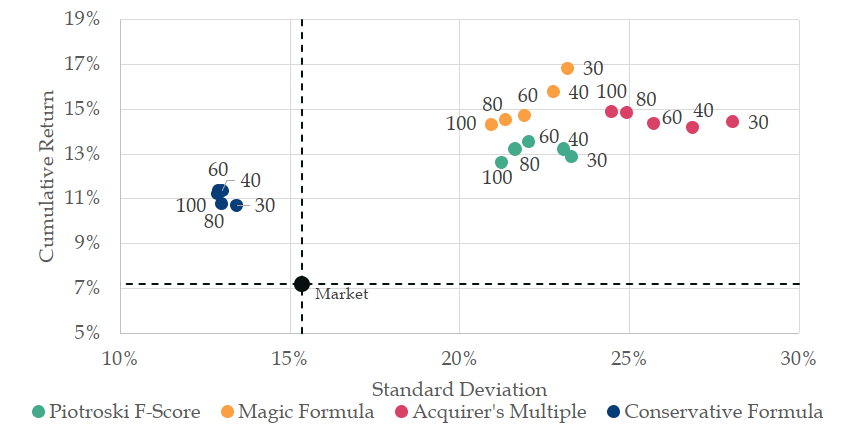
In “Formula Investing,” Marcel Schwartz and Matthias Hanauer evaluate four popular investing approaches.  The results for the period 1963 to 2022 are shown above (the multiple dots indicate the different number of stocks included in the long-only portfolios that were created).

While “all formulas exhibit predictive power . . . no single formula consistently dominates across performance metrics.”  And there are periods when all of them trail the market.  Plus, the results have not been as strong this century as they were before:

While all formulas remain successful for concentrated long-only portfolios in the post-2000 period, we observe some performance decay relative to earlier periods, underscoring the need for continuous innovation in investing strategies.

Revaluation alpha

Rob Arnott of Research Affiliates writes that while we are told that past performance is not predictive, “we are relentlessly tempted to believe otherwise.”  The critical question is:

What aspects of past returns are (at least modestly) predictive of future returns, what aspects are perverse predictors, and what aspects are pure noise?

Arnott distinguishes between structural alpha, revaluation alpha, and noise, asserting that revaluation alpha (which he terms “pernicious”) causes investors to misjudge probable future outcomes.  Unfortunately, there are incentives for academics and investment organizations to promote their good results without noting the potential reversals in valuation ahead.

Skin in the game

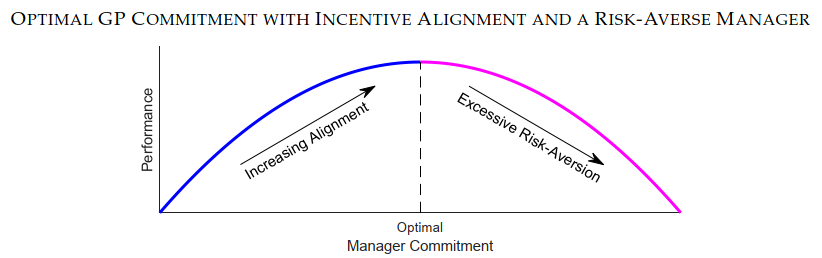
This stylized image comes from “Do GP Commitments Matter?” a paper by Gregory Brown and William Volckmann for the Institute for Private Capital.  It seeks to “fill the gap in research” regarding the size of commitments and fund performance:

Despite the ubiquity of the practice, and the belief that it aligns GP-LP incentives, there is almost no large-sample empirical analysis of GP commitments.

The study pegs the optimal commitment in the 10-13% range, “which is substantially higher than the average commitment rate of 3.5%.”

Other reads

“Optimus Prime Brokerage,” Daniel Davies, Financial Times.

If this consultation exercise ends up with a requirement for big funds to show their cards to their prime brokerages, then that will not only make a big prime brokerage operation an incredible competitive advantage, it will also hugely tilt the playing field in the favour of the sellside versus the buyside.

“2035: An Allocator Looks Back Over the Last 10 Years,” Cliff Asness, AQR.  A clever look at expected returns for the next decade (and how existing norms may be brought into question).

“FY24: Princeton & Yale Returns Dragged by VC & Lack of Stock Exposure, Harvard boosted by Tech & Hedge Funds,” Markov Processes.

By our count, it was the first time that the average school (and the simple 70/30) has beat the Ivies two years running since fiscal 2003 — when our records for all Ivies begin.

“The CEO Scorecard: How Directors Select a CEO When They Have Real Skin in the Game,” A.J. Galainena, et al., Stanford Business.  The ways in which ValueAct tries to improve succession processes so that they don’t “devolve into a series of subjective arguments.”

“What LPs Really Like About Their Favorite GPs,” Anthony Hagan, Freedomization.

An allocator is usually only ready to be overly bold about a manager after enduring (from other GPs) a lot of hurt, a lot of betrayed trust, a lot of soul searching, and has spent many years painfully shedding the scales of naivete.

“Doing deals or constructing portfolios,” Christopher Schelling, LinkedIn.

Planning doesn’t always seem as sexy as doing deals, but boring is what works.

“What company’s past reveals the future of OpenAI?” Walt Hickey, Sherwood.  Investors like to look for analogues — here are thirteen ideas of company stories that OpenAI’s could end up resembling, from Adobe and Visa to Taco Bell and Lehman Brothers.

“Persistent Alpha: Lessons from the Pod Shops,” Daniel Rasmussen, et al., Verdad.

We think it’s possible that the pod shops are succeeding not just because they have access to exceptional talent but because of their disciplined execution.  It’s possible that their edge lies in dynamic capital allocation to short-term alpha generators, rigorous risk management using advanced risk models, and the strategic use of leverage to amplify returns.  If those are indeed the core building blocks in the model, there’s no reason it couldn’t be reengineered using the thousands of public managers plying their trade in liquid funds.

“Our 2024 Hedge Fund Analyst Christmas List,” Edwin Dorsey, The Bear Cave.  An annual list of resources for analysts (of all stripes).

Look for the little things

“It’s worth remembering that it is often the small steps, not the giant leaps, that bring about the most lasting change.” — Queen Elizabeth II.

Flashback: Rivers of money

In 2010, Venkatesh Rao wrote a piece, “Ancient Rivers of Money,” on his blog, Ribbonfarm.  His river metaphor provides a good visual representation of the changing nature of cash flows in the economy (and the behavior of organizations that rely on them for life):

Some rivers of money are very old and very stable.  You can at most fight to displace others from prime positions along the banks.  Others are new and unstable and may change course frequently, creating and destroying fortunes through their vagaries.

(A hat tip to Taylor Pearson’s link to Rao’s posting in The Interesting Times and his extension of the ideas.)

While Rao does not reference the investment industry per se, his concept is a useful one in studying it.  What rivers are drying up?  Where are new brooks being formed that will be mighty some day?

Postings

All of the postings are available in the archives.  While they are sorted into categories, most have broad application in the industry and are evergreen.

For example, take a 2021 posting, “Resisting the Force Field of Observed Performance,” which deals with a powerful force in decision making — as long as performance pleases, qualms are ignored:

The reluctance to act while the numbers look good is reinforced by others, including investment committees, advisors, clients, and other interested parties. No one wants to step away from a winner over “concerns.”

Thank you for reading.  Many happy total returns.
Published: January 6, 2025

Subscribe

To comment, please send an email to editor@investmentecosystem.com. Comments are for the editor and are not viewable by readers.

Sipping From the River of Academic Research

There is a constant flow — you could even call it a torrent — of academic research about the investment world.  Most of it is quantitative in nature, describing conditions of the past in the hopes of finding a key to unlock the future.

For investors employing systematic strategies, such studies offer ideas that could be incorporated into their models.  They also can be of value to others, providing questions to consider about investment process, decision making, organizational design, and the functioning of markets.  This posting references a few recent papers in that light and includes some of those questions (in italics).

As you might expect and as the selection below illustrates, the percentage of studies that involve artificial intelligence in some way has expanded significantly of late.  (An asterisk next to the link indicates that AI was used in the analysis.)

Analysts and analysis

“Large Language Models as Financial Analysts,” Miquel Noguer i Alonso and Hanane Dupouy (link*).

If, when answering “extrapolation questions that are the core of valuation and stock picking, the level of analysis provided by these LLMs is similar to that of skilled humans,” how should investment processes be structured?  Should we be hiring prompt engineers rather than experienced analysts?

“Re(Visiting) Large Language Models in Finance,” Eghbal Rahimikia and Felix Drinkall (link*).

Are you using general purpose LLMs or (much smaller) domain-specific ones?  How do you mitigate the look-ahead bias that results from LLMs being trained over multiple time periods?

“Can news predict firm bankruptcy?” Siyu Bie, et al. (link*).

Since the evidence shows that “ChatGPT-generated news-based variables significantly improve bankruptcy prediction,” how should that change equity and bond analysis?

“(Deep) Learning Analyst Memory,” Laurenz De Rosa (link*).

How are analyst beliefs about future earnings formed?  Does recalling salient events and periods from the past make analyst forecasts better or worse?

“Learning to Be Overprecise,” Christoph Merkle and Philipp Schreiber (link).

Why do the confidence intervals of forecasters remain unrealistic in the face of evidence that they are too narrow?  Why do they “adjust their beliefs too little, which results in a persistence of overprecision”?

Financial reporting

“The Impact of Tone and Readability on Understanding Earnings Releases,” Yoshitaka Hirose and Takeaki Ito (link).

Can investors be misled about a company’s prospects by the readability and tone of its earnings announcements?

“Generative AI in Financial Reporting,” Elizabeth Blankespoor, et al. (link*).

Do you care if company financial reports are being written to some degree by generative AI systems?  If so, are you using tools to detect such usage? 

Gender

“Gender Differences in Sell-Side Analysts’ Corporate Site Visits,” Guangyu Li, et al. (link).

Why do female analysts visit companies less frequently and have higher levels of relational visits (those accompanied by buy-side investors) rather than analyst-only ones?

“Beyond the Ticker: Female Brands and Fund Manager Investment Decisions,” Emanuele Bajo, et al. (link*).

Since brands often develop distinct gender identities, are the stocks of companies evaluated and used differently by male and female portfolio managers?

Big questions

“Measuring Multi-Period Returns,” Raman Kumar, et al. (link).

Is “Cash-Flow Weighted Return” a better way “to measure average multi-period returns for investments with intermediate cash flows and varying periodic returns”?  Could it displace the deeply-entrenched IRR as a metric?

“Limits to Diversification: Passive Investing and Market Risk,” Lily Fang, et al. (link).

Do the benefits of diversification diminish as more and more investors invest in index-based portfolios?


What interesting research have you read lately?  Please send it along.

Published: January 4, 2025

Subscribe

To comment, please send an email to editor@investmentecosystem.com. Comments are for the editor and are not viewable by readers.

A Potpourri of Popular Postings

It’s the holiday season, when things both speed up (with family commitments, travel, etc.) and slow down (business activity).  To celebrate, here is something completely different from the normal Fortnightly.  (We’ll be back to regular programming in January.  In the meantime, check out our new Bluesky account for interesting things to read.)

Below are links to and excerpts from some of this year’s most popular Investment Ecosystem postings — one from each of the categories in the archives.

“The Active Management Reinvention Project,” Asset Manager, July 30.

Active managers haven’t felt the need to innovate; given the profitability of the endeavor, there wasn’t any great advantage in bucking convention.  Consequently, a remarkable sameness came to pervade the craft, with little differentiation from firm to firm and across time.

“Does it Matter (How the Money is Made)?” Asset Owner, October 23.

Asset owners face dilemmas about whether the investment function ought to be an island unto itself, only concerned about the optimal risk/return profile for the portfolio, or whether other considerations ought to be factored into decision making.

“Thoughts about Asset Manager Pedigree,” Due Diligence, February 8.

For allocators who must seek the approval of others to get their ideas used, pedigree is an easy sell.  Whether the process involves convincing a chief investment officer or an investment committee that a recommendation should be given the green light and/or marketing a pick to institutions or individuals for their portfolios, playing the pedigree card can be very effective — but far too simplistic.

“Humans, AI, and Organizational Upheaval,” The Research Puzzle, November 4.

While the natural (and necessary) inclination will be to build AI expertise in your organization, laying the groundwork for a new cultural and collaborative framework will be just as important.

“The Advisory Dilemma: Personalized or Systematic?” Investment Advisor, May 9.

Decisions about customized versus personalized services alter the role of the individual investment advisor, who is the critical link between a client and the firm.  Is an advisor expected to implement advice created by others or to be involved in creating the advice? Is it an investment role or a relationship role?  What are the advisor’s obligations to the client in terms of assuring that the firm’s recommendations are in fact appropriate?

“A Devilish Lexicon of Investment Discourse,” Learning Curve, July 1.

The Devil’s Financial Dictionary explores the language of investment practice, providing a helpful perspective for investors — and raising a caution flag for professionals and organizations who think that business as usual is the way things ought to be.

“Emerging Managers, a Simple Process Framework, and Measuring the Moat,” Fortnightly, October 28.  As with all of the (normal) Fortnightly postings, this one included a wide variety of reads.  In addition to the title topics, there are items on gender differences in analyst reports, a bold take on fiduciary duty for investment advisory firms, a changed corporate credit landscape, private equity liquidity, an old Barton Biggs strategy piece, and much more.

Biggs stated his objections to the thought that there’s a simple function that connects the stock market to the bond market, questioning assumptions about the equity risk premium and noting that the present value machine “can’t factor in qualitative factors and secular change.”

Thank you for reading.  Many happy total returns.
Published: December 23, 2024

Subscribe

To comment, please send an email to editor@investmentecosystem.com. Comments are for the editor and are not viewable by readers.

Institutional Imperatives, Family Offices, and Securities Lending

The most recent posting on the site deals with a common question these days:  whether to have a meeting virtually or in person.  The question applies across investment roles, although in this case it addresses the due diligence of asset managers.  Regarding onsite visits:

There is a big difference between conducting a visit to confirm what you already believe and being open to new evidence and possibilities.  The design of a visit should maximize discovery and push on the boundaries of transparency — not follow a standard playbook.

Where can’t you go?  Who can’t you see?  What won’t they talk about?  Why?

On to the readings.

Institutional imperative (public equity)

A December 6 Wall Street Journal article by James Mackintosh began in this way:

Here are two particularly scary forecasts for investors:  Goldman Sachs thinks the S&P 500 will make just 3% a year over the next 10 years, as Big Tech dominance eventually falters.  Bank of America expects 0%-1% a year for a decade, a catastrophic investment prospect.

Their conclusion:  Buy stocks anyway, because the next year looks great.

Elsewhere, BlackRock’s 2025 outlook opens with an observation:  “Historical trends are being permanently broken in real time as mega forces, like the rise of artificial intelligence (AI), transform economies.”  It then says that “2024 has reinforced our view that we are not in a business cycle.”  (The quotes are from the online version; the PDF is slightly different.)  The bottom line:  overweight U.S. equities.

On the flip side of the bullishness, the list of classic warning signals (in addition to BlackRock’s revocation of the business cycle) includes a variety of valuation levels approaching or exceeding previous peaks; bearish analysts throwing in the towel; the demand for leveraged exposure to large cap stocks rocketing higher; speculative plays thriving; and the U.S. market “sucking money out of the others.”

For professional investors measured against benchmarks (most all of them), this presents a dilemma.  You don’t want to be too late, but you can’t afford to be too early.  The institutional imperative plays on.

Institutional imperative (private equity)

You might think that the sloppy times in private equity recently would lead to some increased caution on the part of investors, but a variety of surveys of large asset owners show that more of them are planning to increase their exposure than decrease it.

A recent report from bfinance shows the satisfaction rating regarding private equity falling from 94% in 2022 to 69%, almost identical to the 68% that expect to increase or maintain their exposure to the strategy in the next 18 months.  That’s versus 8% that want to reduce it (the remaining quarter of those surveyed don’t invest in private equity).

Financial Times article cites a survey of public and sovereign wealth funds that showed a slightly higher level of asset owners planning to reduce private equity, but still a very small percentage.  Why?

“Public funds are going to continue in aggregate to allocate more to private markets until something bad happens,” said Paul O’Brien, a trustee of the $11.2bn Wyoming Retirement System.  “Nothing bad has happened yet.”

As popular strategies do, the “endowment model” has spread far and wide from its roots.  Never one to pull his punches, Richard Ennis sees the ongoing love affair with private markets at those pioneering institutions as symptomatic of an Endowment Syndrome, marked by “(1) denial of competitive conditions, (2) willful blindness to cost, and (3) vanity.”

What are the chances that endowments will reverse course and that others will follow once again?

Family offices

Sharon Schneider of Integrated Capital Strategies created a LinkedIn post in which she wrote, “There’s really no such thing as a three-generation Single Family Office.”  She outlines the strains that develop because “the structures, legal entities, trustees, advisors and norms of the family office established by their grandparents” don’t fit with the disparate interests of the “cousins” (“they contain multitudes”).

As if in response, Morgan Stanley published a report, “The Future-Ready Family Office.”  It provides the firm’s prescription for the sustainability of a family office, with recommendations in four key areas:  governance, staffing (including what to outsource and what to keep in house), investing, and education.  Regarding Schneider’s concerns:

Often, the purpose of a family office is dictated by the first generation’s or founder’s goals and preferences.  But, as the family grows and evolves in subsequent generations, its needs and priorities may change.  Unless the family office pivots accordingly, it may become set in its ways, leading to missed opportunities, instability or fracturing among the family — ultimately creating risk for the family office and family.

Also on the family office front (and also on LinkedIn), Craig Dandurand of the Tuckwell Family Office shares a presentation summarizing the differences he found moving from an institutional asset owner to a family office.

Securities lending

Most of the time, securities lending is thought of as a way to add a little extra return on top of a portfolio.  State Street, one of the big players in that business, would like you to look at it more broadly.  Thus, its report, “The ‘Sharpe’ Point of Securities Lending,” offers information on the returns, standard deviation, skewness, Sharpe ratio, and Sortino ratio of the strategy — in the hopes that you’ll be enticed by the “efficiency frontier expansion” on offer.

(The data used start in 2008.  That’s an interesting time to pick, especially since some exhibits begin with January of that year and some with October — and the MSCI ACWI sample, used for comparison, starts in March 2009.)

The value of information

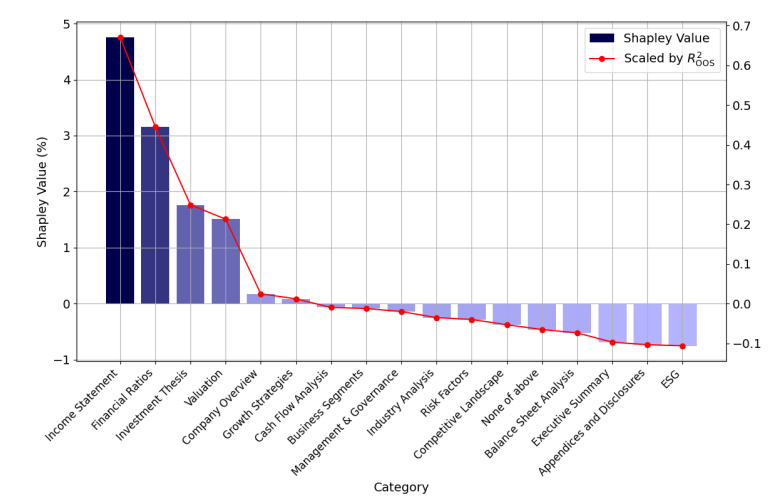
In the study “The Value of Information from Sell-side Analysts,” Linying Lv tries to answer the question, “Do analysts generate value for their clients, or are they merely peddling expensive noise?”

Academics are increasingly using large language models to evaluate written investment reports, which “investors consistently rank . . . as more valuable than earnings forecasts and stock recommendations.”  Those latter indicators have anchored the previous assessments of the contributions of analysts.

Using more than a hundred thousand analyst reports, the author tapped the large language model to address a variety of questions, including assessing “how much each topic within the reports contributes to explaining stock returns.”  That ranking is pictured in the chart above.

Other reads

“Democratizing Risk,” Roland Meerdter, LinkedIn.

True democratization requires more than access alone; it demands a system that supports stability alongside participation.  Fund managers need to carefully balance liquidity with stability through prudent redemption policies, resilient structures, and investor education on the risks of private markets.

“TSMC: Totally Stupid Market Chaos,” Owen Lamont, Acadian.  Why is the stock violating the Law of One Price (in a significant way)?  What does that say about the market environment?

“Time-varying asset allocation,” Todd Schlanger, et al., Vanguard.

These potential value-added returns are made possible by the fact that returns for stocks, bonds, and their sub-asset classes deviate materially from their long-term averages over the medium term, defined here as the next decade; and that there is a directional relationship between the “fair value” of these asset classes at a given point in time and their future realized returns.

“The Whiz Kid Who Made Billions for Yale Is Rethinking His China Strategy,” Rebecca Feng and Juliet Chun, Wall Street Journal.  From the wisdom of saying “I don’t know” to “the gamble that made a career” to changing strategy in response to investors’ concerns about overexposure to China amid political risks.

“The secretive world of McKinsey’s $48 billion hedge fund,” Laith Al-Khalaf, Sunday Times.

McKinsey Investment Office (MIO Partners) started out as a pension plan for the firm’s partners, but has morphed over the decades into an investment juggernaut.

“Mutual Funds & Unicorns,” Jack Shannon, Morningstar.  In a piece subtitled “A fruitless marriage,” the firm concludes that “mutual fund managers do not appear to be skilled private-company stock-pickers.”

“The Worst Time To Conduct Due Diligence,” Anthony Hagan, Freedomization.

There is something inherently unnatural about the ready-set-go fundraising protocol most of us have been subliminally trained to accept and follow.

“Market Concentration: How Big a Worry?” Goldman Sachs.  Four interviews from different perspectives (and a number of exhibits) regarding one of the hottest market topics.

“AQR’s Cliff Asness Says AI Has Now Taken Over Parts of His Job,” Justina Lee, Bloomberg.

“AI’s coming for me now,” he said.  “It turns out it’s annoyingly better than me.”

Know when to hold ’em

“Blessed is the man who, having nothing to say, abstains from giving us wordy evidence of the fact.” — George Eliot.

Flashback: Hedge fund evolution

In 2018, David Finstad wrote a piece for Institutional Investor, “Have Institutional Investors Spoiled the Hedge Fund Party?”  It is a good summary of the evolution of the “industry” to that point, as performance “declined precipitously” from its heyday and assets under management “exploded.”

Among the changes Finstad identified:

The makeup of hedge fund investors shifted from return-seeking high-net-worth individuals and family offices to large institutions that had more modest return expectations and were more focused on risk management and diversification benefits.

For investors, the biggest benefit has been a reduction in funds that have blown up or been involved in fraudulent activity.  The biggest negative has been degradation in alpha received from their hedge fund investments.

He felt that “institutional investors [were] incentivized to keep their jobs rather than serve their funds’ best long-term interests.”  Six years on, not much has changed.  The pod shops have come to dominate the landscape; their pass-through expenses from an unbridled “war for talent” mean that “the value proposition of hedge funds is questionable today,” just as it was in Finstad’s telling.

Postings

All of the previous postings can be found in the archives.

One example, “Identifying the Complexity Risks in an Organization,” ends this way:

Under any circumstances, market stress can amplify organizational stress and business model stress. Increased complexity of whatever sort means that periods of pressure can be more unpredictable than they otherwise would be.  In all respects it pays to gauge the payoff for complexity and the potential downsides involved, so a multidimensional analysis of it should be part of your strategic planning process.

Thank you for reading.  Many happy total returns.
Published: December 9, 2024

Subscribe

To comment, please send an email to editor@investmentecosystem.com. Comments are for the editor and are not viewable by readers.

Judging Whether to do an Onsite Meeting or a Virtual One

It used to be that having a meeting meant deciding where (their place, your place, or some other location), when, and why.  If the parties were in the same geographic area, it was mostly a question of whether the time spent was commensurate with the assumed value for each of them.

The calculus was different when there were greater distances involved, including more time spent (usually much more) and significant travel expenses.  Would a phone call or series of them suffice?  Often not — there was too much on the line.

And so patterns of interaction developed, with some modest changes over time as electronic communications improved, but most important activities occurred in person.  With the advent of videoconferencing, things changed further, but overall use was relatively modest.  Then came the forced experiment of the pandemic.

Now investment organizations have extensive experience with video tools and are making choices about what kinds of interactions should occur virtually and which should be in person.  In this posting we’ll consider some of the factors involved with those choices as they relate to the due diligence of asset managers.  Similar assessments could be (and should be) performed for other functions across the investment ecosystem, including your own.

Meetings

To assess an asset management organization, there is extensive material available to asset owners, advisory firms, consultants, etc.  Websites, fact sheets, due diligence questionnaires, database submissions, presentations, performance analyses, and required regulatory reports, as well as third-party evaluations.  The depth and breadth of that information varies based upon the kind of manager under review, but there is always much to parse.

To go beyond that, those conducting due diligence usually engage directly with the asset manager.  The quality of those interactions determines whether there is any value added over and above the information (and quantitative analysis of it) available to all.

Intermediaries who make recommendations about managers often highlight the access they have to them and report the frequency of meetings with managers.  If asked, they may offer further detail.  For example, here is a (pre-pandemic) breakdown from one institutional consulting firm:

Onsite meeting at manager’s office (12%)

Video call with manager (1%)

Phone call with manager (58%)

Meeting with manager at consultant’s office (26%)

Interaction at conference or manager event (3%)

Upon seeing this, your first instinct might be to consider whether the aggregate count of “meetings” provided by the consultant is more a tally of “touches,” but that points out the key issue:  It’s impossible to tell the worth of the interaction from the categories that are given.  A phone call could yield an important discovery or it could just be a dry recitation of what did well and what did poorly over the last quarter, a nothingburger in the scheme of things.

Also, it matters who is involved.  If every call is with the portfolio manager, it might seem as if that’s as good as it gets, but that flow of information is one-dimensional and therefore likely to be of much lower quality than if a broader perspective is available.  (And that certainly applies if almost all of the information comes from an investor relations person.)  Narrow exposure to an organization limits the understanding of it.

Going on site

Edgar Schein’s classic bookOrganizational Culture and Leadership, offers this simple list of instructions for someone trying to understand an organization:

1. Visit and observe.

2. Identify artifacts and processes that puzzle you.

3. Ask insiders why are things done that way.

4. Identify espoused values that appeal to you and ask how they are implemented.

5. Look for inconsistencies and ask about them.

6. Figure out from the above the deeper assumptions that determine the observed behavior.

You can argue that the list is more appropriate for an organizational consultant who has time and access than a due diligence analyst, but that points out a key gap in much due diligence practice.  Instead of discovering culture, process, and other attributes of an organization on their own, analysts lean on the narratives of managers, often accepting them as is or modestly poking around the edges of them.

As Gillian Tett wrote in her book (reviewed here), “We are creatures of our environment in a social, mental, and physical sense, and these aspects intensify one another.”  The promise of an onsite visit is to get a sense of that environment — in the hope that Schein’s “visit and observe” leads to some deeper insights than those otherwise on offer.

Yet most visits aren’t structured to encourage that.  Very often, the meetings occur in a conference room, with a standard set of interviewees (portfolio manager, analysts, marketing people) in attendance, hewing to a meeting format determined by them (usually some sort of presentation, followed by Q&A).

In contrast, a visit designed for discovery would follow an agenda set by the due diligence analyst, interviewing people (of varied functions and levels) one-on-one where they work, and focused on learning new things for the mosaic of understanding that is needed.

“Analyst capture” is possible in either case, but more likely in the first one.  Group meetings tend to be performative rather than realistic, with everyone playing their part.  Individual interviews offer more information, not because people betray trade secrets but because they naturally describe how things work.  And getting out into the organization opens up new avenues of inquiry and observation, including how the office is structured (the kinds of work spaces and who sits where) and the nature of the activity within it, all good indicators of culture.  Plus, the artifacts in an office or cubicle provide clues about the people within them and about the organization.  Most importantly, being where the work gets done gives you the ability to ask “show me” questions that inform your understanding of the elements of investment process.

There is a big difference between conducting a visit to confirm what you already believe and being open to new evidence and possibilities.  The design of a visit should maximize discovery and push on the boundaries of transparency — not follow a standard playbook.

Where can’t you go?  Who can’t you see?  What won’t they talk about?  Why?

Going virtual

The pre-pandemic breakdown of consultant visits listed above showed that only 1% of its contacts involved video calls with managers.  No doubt it is much higher than that now and may even constitute a majority of interactions.

While a virtual meeting doesn’t offer the advantages that really getting immersed into an organization does, it can be a workable substitute for the standard conference room meeting.  It is preferable to have the parties appear in separate video feeds, since it can be hard to see the reactions of people arrayed around a table (one of the few advantages of being in a group meeting).  While analyzing facial expressions and body language is always hit and miss, given the extent of our use of video tools over the last five years, we can probably come close to judging people’s reactions as well as we could in person.

To improve the discovery process when doing due diligence from a distance, it helps to copy those aspects of the recommendations for onsite meetings given above if they are feasible.  You still should try to interview individuals from different roles and parts of the organization; sometimes it is even easier to do so virtually than during an onsite meeting, since people may work at a variety of locations.  Other basic tenets can be mimicked:  Your agenda, no presentations, one-on-one meetings.  The key missing pieces in a virtual setting are those observations and inferences that can only come when you are on location.

Making choices

Given that the constrictions related to the pandemic are now behind us, those doing due diligence have been making choices about whether to continue with their previous practices regarding onsite visits or to replace some of those meetings with virtual ones.  (That is in addition to the increased use of virtual meetings to replace many of the interactions handled by phone before.)

There are obvious time and cost advantages to cutting out travel and going virtual, so organizations doing due diligence need to weigh those advantages against the possible repercussions of not “kicking the tires” in the old-fashioned way.

The crux of the matter is what you feel you get out of in-person meetings and how to value those hard-to-value benefits versus the costs, which can be easily calculated.  What are you looking for?  And what is the best way to get what you are after?  Being specific about your goals at various stages in the process and across time can provide general rules (and exceptions) to guide you.

That applies to both initial due diligence and ongoing, “maintenance” research.  Regarding the latter, perfunctory quarterly updates are usually lost opportunities.  Instead of talking to the same person about the same short list of topics, the time should be spent on expanding your knowledge base about the firm into new topics through new contacts.

Many involved in due diligence have already lowered the frequency of onsite visits, deciding that virtual interactions sufficiently meet their needs.  It will be interesting to see where the new normal is — whether the trend will continue in that direction or whether there will be a reversal.

Parting thoughts

If you have read the Investment Ecosystem for very long — or certainly if you have attended a workshop or taken an online course* — you know that the qualitative analysis is at the core of what we do, and that onsite due diligence is strongly preferred, but only when it can be performed in ways that allow for substantive discovery.  Otherwise, it is not worth the incremental time and resources.

Virtual tools can be extremely helpful in some situations.  They also allow for experimentation in practices — and for backing away from onsite visits when the payoff isn’t clear but the costs are.  But the shortcomings can’t be minimized.

On the other hand, those who can leverage access to go deeper into organizations — to not just see what they are today but to make good assessments of what they are likely to become — may find that onsite visits are even more valuable now than they were before, especially relative to what their competitors are doing.


*There is much more on these topics in the Meetings and Interviewing modules of the Advanced Due Diligence and Manager Selection course (or as part of the course-plus-coaching option).

Published: December 4, 2024

Subscribe

To comment, please send an email to editor@investmentecosystem.com. Comments are for the editor and are not viewable by readers.

Private Fund Structures, Mutual Funds in the Crosshairs, and Capital Market Assumptions

Thursday is Thanksgiving Day in the United States, making it a perfect time to thank you for reading and for passing along our material to others.  We truly appreciate it.

If you missed it, the latest posting was about “Communicating Across Time.”  We all have our tried and true ways of communicating, but they can become out of date, so we “need to consider whether our messages are heard, whether they resonate, and, yes, whether they blend with the zeitgeist.”

On to the readings.

Private fund structures

A posting from Goldman Sachs, “Choose Your Vehicle: A Closer Look at Private Market Fund Structures,” begins:

We do not believe there is a universal best choice between private market fund structures.  The decision involves a set of trade-offs along four key dimensions.  We believe the assessment should reflect the outcomes of an investment program, rather than a single fund.

The four dimensions are liquidity, complexity, product availability and access, and performance.  Goldman considers evergreen funds to have the advantage in the first two categories and drawdown funds to come out on top for the last two.  (Regarding performance, a Neuberger Berman piece comes to the opposite conclusion.)

There has been an increased interest in evergreen funds of late, because of the shortcomings in drawdown funds that Goldman identifies; the desire on the part of some investors to have vehicles that are allowed to hold companies for longer periods when warranted; and the need for private equity managers to have products designed to tap the private wealth market.

For an example of how one firm is marketing its capabilities and experience, see a PDF from Partners Group, “Five lessons from 20+ years in evergreens.”  Among the ideas it promotes are that an evergreen structure can allow for better adjustments to market environments (the differences in the type of investments it has made across time are striking); built-in vintage diversification (although the graphic in that section shows that there appears to be no holdings longer than that of a typical PE fund); and “more frequent and precise valuation assessments.”

Mutual funds in the crosshairs

It’s that time of the year, when mutual funds pay out capital gains distributions that cause taxable investors to pay up on gains realized by the funds they hold.  Morningstar calculated preliminary estimates of those gains and published lists of the top fifty anticipated distributions in percentage terms (six are above 45% of net asset value) and by leading fund firms.  There can be a variety of reasons for gains to occur beyond the normal decisions of portfolio managers, but one reason sticks out:

The common theme among most of these top 50 funds is outflows.

Whether triggered by a portfolio manager leaving or performance troubles, sizable outflows lead to bottom-line consequences for taxable investors (in addition to downward price pressure on any illiquid holdings during the fire sale).

Morningstar also adjusted the methodology of its “medalist” rating system.  As explained by Jeffrey Ptak (who had authored a note with additional information presaging the move), 12% of its 26,000 ratings were lowered as a result, versus only 3% that were raised.  Equity funds took the brunt of it, with around 18% of them being knocked down at least a notch.  Here are the distributions of ratings, before and after the change:

But that’s not the end of it.  The medalist ratings are assigned in one of two ways, by analyst or by algorithm.  Almost all of the initial moves were regarding algorithmic ratings; changes in analyst ratings will roll in during the coming months.  The initial expectation is that a quarter of them will be altered — and that virtually all of those will be downgrades.

However, analyses of fund flows show that it’s not the medalist ratings from Morningstar that drive flows — it’s the famous star ratings that affect investor behavior.  In that light, a recent research paper from Lauren Cohen, et al. (“Box Jumping: Portfolio Recompositions to Achieve Higher Morningstar Ratings”) is particularly interesting.

An important appeal of Morningstar’s [star] ratings is that they reflect the outcome of a standardized and transparent evaluation process largely based on pre-specified formulas.  These features appeal to investors because the star ratings facilitate meaningful comparisons across several funds and avoid concerns over an ad hoc evaluation process.  However, these same features of standardization and transparency make the rating system susceptible to strategic behavior and manipulation by funds, especially given the importance of higher ratings for fund managers in garnering fund flows and the corresponding revenues.

The authors show that purposely drifting into a nearby style box that has had lower returns can lead to increased flows because of the easier relative comparisons there, even though “funds appear to sacrifice [absolute] return performance when box jumping.”

Finally, a Financial Advisor IQ article points to a JPMorgan settlement that highlights the risks to a brokerage or RIA firm that puts its clients in mutual funds when (as is increasingly the case) a clone ETF is available.

Capital market assumptions

John Authers writes, “This is the season when investment houses publish their forecasts for the coming year, and I excoriate them as a waste of time.”  But his target in the column that follows is that other annual ritual, the creation of long-term capital market assumptions:

In theory, very long-term projections should be driven more than anything else by the starting point.  When stocks look historically expensive, expect the subsequent decade to be worse than the average, and vice versa.  There are also sharply different ways to approach asset allocation, so you would expect a variation in approach.  Instead, what emerges is: 1) remarkable stability in projections over time; 2) a tendency to herd around a few round numbers; and 3) an odd belief that some asset classes can do well regardless of circumstances — particularly private equity.

Authers offers a variety of supporting charts and concludes that “it’s disconcerting to see that even the institutions that really must plan a long way into the future are still so perfunctory in their long-term thinking.”

An ecosystem echo

Byrne Hobart’s article in The Diff, “The Modern Private Equity Business was Invented in Beverly Hills in the 70s,” has moved behind a paywall, but here are a couple of sections comparing today’s PE ecosystem with the one Michael Milken built at Drexel:

Put all of this together, and you have a suspiciously familiar financial ecosystem:  there’s a central node that 1) has a good fundamental understanding of the businesses it’s involved in, 2) has essentially unlimited creativity for crafting new financial solutions if the old ones don’t work out, and 3) has enough of its own capital to own the highest-upside piece of every deal and enough captive outside capital to place all the paper that gets sold.

It’s also a model with natural conflicts.  You have one party who’s well-informed, and who exercises more discretion than everyone else:  clients do the best trades they can, but the very best ones are trades they won’t even see.  Negotiating complex deals as both a principal and agent can leave plenty of profit for all sides when bid/ask spreads are wide, but the more asymmetric the information is, the longer those valuation gaps take to close.  It’s a fantastically profitable approach, but it requires inputs:  not just capital and talent, but an accumulated stock of either trust or owed favors that can be tapped at will.  Counterparties know that they’re dealing with someone well-informed who aims to make a good profit from the transaction, and they’re willing to do this if they trust their counterparty to make the right moves.  But this kind of leverage is hard to measure, and like other varieties it cuts both ways.

Other reads

“The king is dead, long live the king!” Rupak Ghose, Rupak’s Substack.  It has gotten harder to be an active long-only bond manager.

“The art of being a lucky investor,” Simon Edelsten, Financial Times.

Do not target higher returns than markets seem likely to deliver — you will end up taking on too much risk to achieve them and only enhancing your likelihood of spectacular failure.

“What the future holds for quant investing: Ten hypotheses,” Mike Chen, Robeco.  Including “faster model evolution and faster alpha decay.”

“How Asset Owners Are Redefining the Total Portfolio Approach,” Henry Fernandez, et al., MSCI.

Whatever approach a chief investment officer takes, fostering collaboration is job number one.

“Which Asset has the Best Bubble Potential?” Joe Wiggins, Behavioural Investment.  The attributes that lead to a bubble, the classes of investors involved, and the distinction between fundamental assets and belief assets.

“Buybacks Gone Wrong: A Case for More Disciplined Capital Allocation in Corporate Finance,” Deiya Pernas, SSRN.

The root of this issue lies in the fact that most management teams lack a rigorous methodology for evaluating the intrinsic value of their company’s stock.

“Backdoor Private Credit Funds Are Luring Billions From Insurers,” Scott Carpenter, Bloomberg.  “Rated feeders” allow insurers to cut their capital costs through “the alchemy of turning stakes in private debt funds into top-rated bonds.”

“When IR Met AI: How the Technology Is Shaping Earnings-Day Prep,” Mark Mauer, et al., Wall Street Journal.

Public companies frequently mention generative AI on earnings calls, citing its positive effect on the bottom line or promising results in tests.  But there’s one application they leave unspoken: the technology’s role in those very calls.

“Green Bonds: New Label, Same Projects,” Pauline Lam and Jeffrey Wurgler, SSRN.  The bonds “are usually not funding projects with green aspects that are particularly novel for the issuer.”

Turbulence

“A time of turbulence is a dangerous time, but its greatest danger is a temptation to deny reality.” — Peter Drucker.

Flashback: The subprime meltdown

We usually feature links from the past in this section, but this time we connect to a new story about the seminal financial crisis of this century.  Doug Lucas runs the excellent Stories.Finance site, and this time the story is his own.

Lucas was a collateralized debt obligation (CDO) analyst for UBS at a time when those CDOs were stuffed with subprime mortgages.  In the bloodbath to come, average write-downs were 55% for senior AAA-rated CDO tranches and 80% for junior AAA ones (with a median write-down of 100%!).

The tale is an amped-up version of the scrum that occurs whenever an investment idea with size and leverage and derivative vehicles gets taken too far.  Those questioning the status quo are called names and accused of mounting a bear raid by those with a lot at stake; the experts (in this case the credit ratings agencies) make a stand by publicly defending their calls; and, on the other side, those who see calamity coming accuse the bearish of not being bearish enough.  (Here, John Paulson was the accuser.)

In August 2007, before it all came tumbling down, Lucas was quoted as calling the subprime mess “The greatest ratings and credit risk-management failure ever.”  Looking back now, of the lies involved in the mortgage originations “and the liars downstream” in the investment industry, he summarizes it all in this way:  “One of the worse things humans have ever done to one another without using weapons of war.”

Postings

Almost two hundred postings are available in the archives, so try out some names and phrases in the search box and see what you can find.  One example, “The Double-Edged Sword of Manager Selection,” includes this:

The expectation is that manager selection will take advantage of two edges, that of the manager and that of the selector.  But, like the blades of a sword, each of those edges gets dull and chipped.  They need to be honed to keep them sharp — although over time they can get so thin that they become ineffective.  The sword as museum piece rather than as an advantage in battle.

Thank you for reading.  Many happy total returns.
Published: November 25, 2024

Subscribe

To comment, please send an email to editor@investmentecosystem.com. Comments are for the editor and are not viewable by readers.

Communicating Across Time

Investment professionals expect to be judged on the basis of their analytical capabilities, but skill at communicating their ideas clearly is often the deciding factor in terms of how successful they can be.

Of course, that generalization needs to be tempered by the clarification that the balance between analysis and communication varies widely by investment role — and the frequency and type of interactions with others depends on the structure of an organization and its culture (as well as the need to engage with external parties).

Common issues

Two basic problems come up over and over.

The first is a lack of editing, of telling more than should be told under the circumstances.  Whether in a report or a meeting or a presentation, excess detail — relating everything you know (or at least it seems that way to the intended audience) — is the most common trap.  Given the analytical effort it took to form your opinion and the desire to show a command of the material, it’s natural to want to paint an elaborate picture.

Along with that, the casual use of terminology and acronyms with those for whom that lingo is not typical inhibits understanding.  That should be obvious and easily avoidable in a situation where a deep specialist is speaking with someone outside of the investment world, but it happens surprisingly often even in that case.  The same principle applies with sophisticated clients and coworkers too, where the differences in knowledge aren’t as vast but are very real and often not appreciated.*

The passage of time

Just as markets evolve, the tapestry of information from which we draw does too.  Not very many people in the business today can say that they attended one of the annual gatherings known as the Predators’ Ball, although a larger subset lived through the era which it defined, and a greater number still would have read the Connie Bruck book that carried the same name and captured the age.  Using “the Predators’ Ball” without clarification in a presentation today would draw blank looks from most and perhaps a knowing glance here and there.

Language morphs over time too.  What did the people at those Predators’ Balls call the bonds that were fueling their activity?  Junk?  Low grade?  High yield?  All three terms were used widely then; the more respectable-sounding “high yield” has won out over time.  Similarly, “leveraged buyout” is most often now just “buyout,” in part because not all buyouts are leveraged, but mostly because it’s been nice to get that pesky word “leverage” out of the way.

Generational change

There also are broader cultural forces that are changing communication protocols in ways large and small.

To wit, Tim Hanson of Permanent Equity wrote a posting about communicating with someone using a “universally positive and reassuring gesture.”  Or so he thought.

It was the classic thumbs-up symbol.  In fact, he subsequently “learned that Gen Z views the thumbs up as ‘actively hostile’ and an unsettling ‘passive aggressive dig’ and that it’s rude to respond with one,” causing his message to be lost in translation.

To compound the confusion, he found that his lack of an exclamation point in a reply meant it was taken in a different way than he had intended.

Those seem like small things, but Hanson draws a larger conclusion:

Generational differences are real and if not explored in good faith together can be impediments to the growth and development of an organization.

Communication starts with awareness.

New rules

Ted Gioia, an astute observer of cultural developments, published a piece last week on “The 6 New Rules of Communicating,” which was subtitled “The era of teleprompters and talking points has come to an end.”

He wrote:

Western culture was built on one-way communication.  Leaders and experts speak — and the rest of us listen.

But Gioia sees a major shift, with hierarchies “toppling” and “even reversing.”  Consequently:

Here are the six new rules of engagement — for politicians, broadcasters, and all aspiring experts, decision-makers, and leaders.

1. You gain more trust when seated, not standing.

2. Don’t speak at people — speak with them.

3. An informal tone is more persuasive now.  Even leaders must adjust to this.

4. Conversations have more influence than speeches.

5. Spontaneous communications delivered from a personal standpoint are considered more “real” than a script created by a team or speechwriter.

6. Soundbites and talking points are less impactful than storytelling, humor, and off-the-cuff comments.

By and large, investment communication tends to be formulaic and risk averse.  Just look at quarterly updates, fact sheets, stock recommendations, and the like.  Or sit through a slate of meetings with asset managers.  Same old, same old.  Predictable, scripted, and boring.

Will the trends that Gioia foresees spread even into such a hidebound realm?  We’ll see.  Who wants to go first, at the risk of appearing to be “a dinosaur pretending that it’s a ballerina”?

Communicating across time presents real challenges, especially for those who have been around for a while and who are invested in the stories, idioms, usage patterns, and personal styles that have served them well.  But all of us need to consider whether our messages are heard, whether they resonate, and, yes, whether they blend with the zeitgeist.


*The Investment Ecosystem offers communication training for investment professionals (individuals and teams, onsite or virtually).  One effective exercise involves trying to explain a concept or a recommendation in different ways across a range of parties with varied levels of knowledge, interest, and authority.

Published: November 20, 2024

Subscribe

To comment, please send an email to editor@investmentecosystem.com. Comments are for the editor and are not viewable by readers.

IRRational Comparisons, Impact Venture Capital, and Practice Versus Premise

AI this, AI that.  You can’t get away from it.

And it is featured in the most recent essay on the site (“Humans, AI, and Organizational Upheaval”), which deals with a critical topic that is conspicuously absent from almost all discussions about the investment applications of AI:

While the natural (and necessary) inclination will be to build AI expertise in your organization, laying the groundwork for a new cultural and collaborative framework will be just as important.

More broadly, machines are affecting the nature of organizational learning; insights from a recent book about those dynamics are included in the posting.  Needles to say, important stuff.

IRRational comparisons

A recent paper by Simon Hayley and Onur Sefiloglu, “Bias in IRRs,” examines problems with the internal rate of return measure:

We identify two separate biases, resulting from variation in the periods over which assets are held, and their covariance with the returns achieved.  These biases raise IRRs compared to the returns on other asset classes.

The use of IRRs makes a “Quit-Whilst-Ahead” option available to private equity managers, since exiting strong early investments can lock in high IRRs.  That further obscures the already difficult evaluation of whether a manager is lucky or skillful — and it allows the manager to more easily market its next fund.  A robust IRR is marketing gold.

The biases lead to attractive comparisons for PE returns versus the annualized rates of return on other kinds of funds:

The notably higher average IRRs generated by PE funds (13.2% per annum compared to a total return on the S&P500 of around 10%) can largely be accounted for by bias, and hence would be entirely consistent with there being no outperformance by the PE sector.

But rather than recognizing the biases and being skeptical of advertised numbers, professional investors overwhelmingly take IRRs at face value.  “Surveys clearly show that investors continue to rely on IRRs,” something which is evident to anyone who has been in investment committee meetings.  Such reliance “is likely to lead to misinformed asset allocation decisions,” although that never seems to be discussed by those involved.

Early in the paper, the authors write, “The IRR is known to be a problematic measure.”  Perhaps that ought to be stamped in a large, bold, red font on investment memos, although dependence on IRRs is so embedded in practice that such warnings might be ignored.

An Enterprising Investor posting by Ludovic Phalippou, “The Tyranny of IRR: A Reality Check on Private Market Returns,” takes up a similar theme.  The first of three promised articles, it focuses on “the source of the belief,” using news items and practitioner publications to show why “most investors believe that private capital funds are such clear outperformers.”

The use of since-inception internal rate of return (IRR) as the industry’s preferred performance metric and the media’s coverage of the sector’s performance are to blame.

The myth of the Yale model — a belief of superior returns stemming from a heavy allocation to private equity funds — is based solely on a since-inception IRR.

Whether these ideas ring true to you or not, they are of utmost importance to institutional asset owners, who have established ways of analyzing private asset returns, and for advisory firms that expect to ramp up the exposure to such funds for their clients.  The topic ought to be at the top of investment committee agendas.

Impact venture capital (and the big picture)

An article by Alan Gutterman, “Impact Investment Funds,” offers a good framework for investments “made with the intention to generate positive, measurable social and environmental impact alongside a financial return.”

But the piece comes across differently today than it did just a week ago.  The political winds have changed (at least in the United States), prompting a “Now what?” question.

Prohibitions against non-financial considerations by governmental pension plans (even when those “non-financial” considerations are directly related to long-term risks and returns) seem sure to spread.  And litigation will likely be more prevalent against asset managers, owners, and intermediaries that use ESG/sustainability/impact criteria in their selection processes.  Debates within organizations will intensify.

It was easier to hold beliefs about impact investments with the wind at your back; with a fresh wind in your face, it is a whole different story.

Bloomberg piece by Frances Schwartzkopff covers a recommendation that “all ESG fund managers . . . have a lawyer on the team, or on speed-dial.”  Over the last two decades, ESG has become integrated into the investment system, and now there is likely to be a backlash quite beyond the one seen in the years leading up to the election.

Consider a couple of publications from CFA Institute released in the last two months:  How to Build a Better ESG Fund Classification System and Net Zero in the Balance.  Again, “Now what?”  How will the political environment change the path of investment practice?

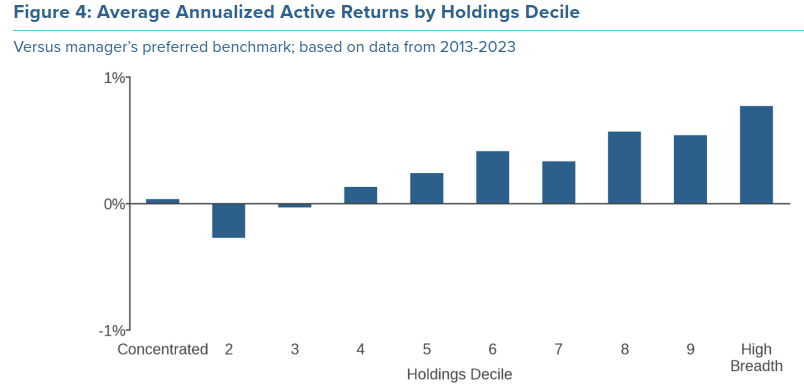
Practice versus premiseAcadian Asset Management is a systematic manager which invests in very diversified portfolios.  Therefore, the conclusions of its report “Concentrated Equity: Practice Versus Premise” might be expected.  As for the premise referenced in the title:

For asset owners under pressure to meet high absolute returns targets and frustrated with active fees charged for closet indexing, the premise of investing with stock pickers who focus on a limited set of “high conviction” holdings has intuitive appeal as well as support from academic literature on the performance of mutual fund managers’ largest active positions.  But does the approach work in practice?

The chart above shows the results of the Acadian study.  The first decile (encompassing the most concentrated funds) shows a slight outperformance, although that was driven by good results “only in the late teens and through mid-2021.”

And, while “investors scanning track records for exceptional performance are inordinately likely to find it produced by concentrated managers,” the same can be said for those trying to identify laggards.  Higher active risk means a higher dispersion of returns — and “the noisiness of concentrated strategies’ returns raises the stakes in distinguishing skill from luck, since it increases the likelihood of exceptional performance that results from chance.”

Thematic funds

Morningstar has issued its “Navigating the Global Thematic Fund Landscape.” The survey includes an informative look back at the history of thematic funds (starting in 1948!), an in-depth classification system, and analyses of asset levels and results for the funds in major markets around the world.  The charts tell the story:  Most thematic funds don’t survive for fifteen years and only a sliver of the original cohort actually outperform.

A crack in the model?

The widely-admired “Canadian model” includes both investment and organizational attributes.  Regarding the latter category, one of the tenets is the lack of political interference.  That makes a recent action by the province of Alberta a surprise:  It removed the board, the CEO, and three other executives of the Alberta Investment Management Corporation (AIMCo).  Details in a CBC story.

Other reads

“Misaligned Incentives, Jamin Ball, Clouded Judgement.

I’m not meaning to imply big funds = bad.  But there is a culture and mindset that starts to creep in the larger and larger funds get, and it’s up to founders to determine which investor falls into which bucket.

“Forget Hedge Fund Strategy Labels – Here Are Three Groups that Matter,” Toby Goodworth, bfinance.  Grouping the many hedge fund types into convex/divergent, market independent, and directional strategy buckets.

“Past, Present, and Future of Modern Finance,” Rob Arnott, Research Affiliates.

[Historically]  Innovative concepts are challenged, then accepted as fact, eventually becoming received wisdom, even dogma.

[Now]  Both the academic and practitioner communities in our industry are perhaps too complacent, and too invested in maintaining the current equilibrium or paradigm.

“AI: Your New Investment Guru or Overzealous Intern?” Ken Akoundi and Kartik Uchil, Institutional Investor.  On the possibilities for an investment office when artificial general intelligence is available — including the importance of “a ‘human-in-the-loop’ system.”

“Debunking a View on Performance of Long-Short Equity Managers,” Brendan James, et al., Evanston Capital.

Active managers on average tend to de-risk during a drawdown which can lead to names with heavier active manager ownership falling more than the market and names with heavier-than-average short interest rising more than the market.

“The Case for the Seventh P: Progression in Nonprofit Investment Stewardship,” Allison Kaspriske, Commonfund.  Given that the Investment Ecosystem is itself an advocate for continuous improvement strategies, we are in favor of getting organizations “to look beyond the present moment and ensure they are prepared to meet future challenges head-on.”

“Wall Street frenzy creates $11bn debt market for AI groups buying Nvidia chips,” Tabby Kinder, Financial Times.

Its rapid growth has raised concerns about the potential for more risky lending, circular financing and Nvidia’s chokehold on the AI market.

“Meeting the challenge of the new regime in endowment portfolios,” Edward Ng, et al., BlackRock.  A new interest rate environment, growth uncertainty, and increased volatility mean that asset owners should adjust their previous approach.

“The #1 Use Case for AI,” Tim Hanson, Permanent Equity.  Using a machine to do what people should be doing in the first place.

Past and future

“No amount of sophistication is going to allay the fact that all your knowledge is about the past and all your decisions are about the future.” — Ian Wilson.

Flashback: Go figure

In the October 8, 2007 issue of Barron’s, Alan Abelson’s column carried the title “Go Figure.”  It referenced the “explosive stock market rally” the previous week, which was prompted by announcements from Citi and UBS that they would take multibillion write-downs related to subprime mortgages, leading investors to believe that such admissions meant that the banks “were confident that the worst of the subprime fiasco and the credit crunch were over, the formidable pile of leveraged-buyout loans gone sour was no big deal, and, from here on, it was all blue skies.”

Regarding such a belief as “essentially bonkers,” Abelson wrote:

The worst isn’t over; on the contrary we haven’t truly begun to feel the full effects of the demise of subprime mortgages, the damage visited on the global credit markets and the unchecked disaster that is housing.

The market peaked the next day before heading into the depths of what has come to be called the Global Financial Crisis.  Without government intervention, the list of casualties among leading financial institutions would have been very long indeed.

Postings

All of the postings (close to two hundred now) are available in the archives.  As one example, check out “Challenges and Quandaries in Manager Research,” part of a series of postings about The Bond King by Mary Childs, concerning Bill Gross and Pimco.  It is anchored by a number of questions for those doing manager research, and also includes this reminder:

Many doing due diligence are too cautious with managers, and not just the famous ones.  They are concerned about future access, so they don’t want to ruffle feathers.  It’s not that you want to go in with both guns blazing, but you need to go where others haven’t gone.

Thank you for reading.  Many happy total returns.
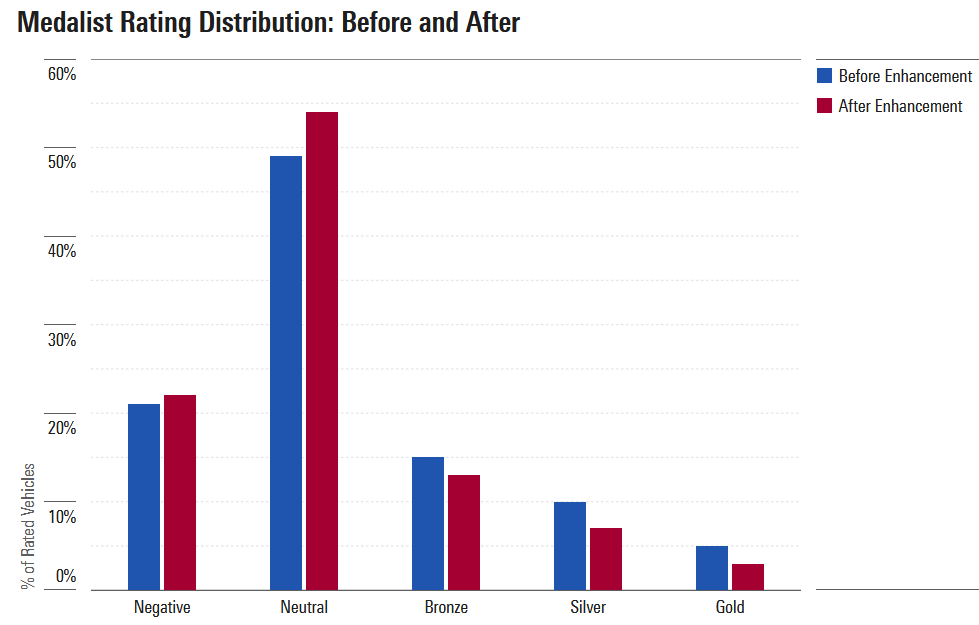
Published: November 11, 2024

Subscribe

To comment, please send an email to editor@investmentecosystem.com. Comments are for the editor and are not viewable by readers.

Humans, AI, and Organizational Upheaval

The general thought expressed in earlier postings here is that incorporating artificial intelligence into investment processes means figuring out what machines do best and what humans do best and structuring accordingly.

A book by Matt Beane, The Skill Code: How to Save Human Ability in an Age of Intelligent Machines, adds an important layer of consideration to that notion.

The transfer of skills

Beane’s ideas are focused on the relationships between experts and novices — and the risks to organizations when traditional modes of interaction are disrupted as artificial intelligence and other computing capabilities are substituted into processes.

His examples come from a variety of fields, including investments.  For example, if you have become a financial planner, you likely started with some basic training, much of which was book learning.  Then, “you got involved in practicing financial planners’ work, helping them in limited ways in the beginning, more complicated ways as you went on, and ultimately helped to mentor newbies as you were about to complete your training.”  That cycle of development, the passing of knowledge from those with expertise to those without it, is at the heart of much organizational learning.

The transfer mechanism is imperfect, of course.  The “experts” may not have the expertise that is assumed or are poor at (or uninterested in) conveying it to others.  Or they may feel like they don’t have the time, given the demands of their roles.  Instead of an apprenticeship of sorts, in some cases the relationships can amount to no more than the passing on of some heuristics and war stories, rather than a mechanism to propagate valuable knowledge across time.

Beane sees the bond between experts and novices as foundational for success, raising a concern:

In millions of workplaces, we’re blocking the ability to master new skills because we are separating junior workers from senior workers, novices from experts, by inserting technology between them.  In a grail-like quest to optimize productivity, we are disrupting the components of the skill code, taking for granted the necessary bundling of challenge, complexity, and connection that could help us build the skill we need to work with intelligent machines.

Reinvention

With the increasing availability of AI applications, leaders are faced with significant questions about whether and how to remake their organizations to take advantage of the possibilities.  Among the issues:

~ Some kinds of organizations, including most asset managers, have heavily promoted the consistency of their process.  That narrative will have to be restructured to talk about change.  That’s a good thing overall, but it will be tricky for many.

~ Errors related to AI applications that reveal a lack of understanding of their workings can result in regulatory scrutiny, recriminations from clients and stakeholders, and career risk.

~ Greenwashing has made those doing due diligence more sensitive to claims about ESG capabilities and processes.  In a similar way, “AI-washing” will be a top-of-list concern for anyone vetting an organization.

~ Many large organizations have been aggressive in adding AI staff, making it hard for others to hire the expertise needed to implement an appropriate strategy.

Those concerns will be in the forefront, but Beane’s book is a reminder that culture, social fabric, and organizational learning will be disrupted as AI capabilities are introduced.  Leaders must think holistically about the implications of those moves for the future of the organization.

The dynamics of learning

Beane covers a number of important concepts regarding learning in organizations:

Experiential learning.  While a base level of training is required, “experiencing the complexity of a situation is often better for skill development than significant explicit instruction.”  Providing detailed procedures to follow might seem to be the best way to convey how to do something, but it actually inhibits learning.  At each stage of development:

The skill code thrives in “goldilocks” territory;  not too much complexity, not too little.  Not too little direction or information, not too much.

Expertise can sometimes inhibit learning.

[There] is the blindness that comes with the “seen one, seen ’em all” phenomenon:  after a while, if you’ve got solid skill, it’s all too easy to fit your mental models onto most any complexity to predict what’s coming.

Talent capture.  Sometimes, “domain expertise is hoarded, and silos of skill are protected,” leading to unfulfilled employees and a lethargic organization.

Shadow learners move things forward.  By observing how things are working and seeing what could be made better, “shadow learners” come up with new ways of improving existing processes.  That requires a willingness to see past the existing norms and rules to make good things happen.  Most people are reluctant to push against established ways, especially in cultures that discourage such input from underlings.  But some people can’t help themselves — and they are the ones that drive progress.  (There are always latent ideas of worth in an organization and people who have an eye for improving things but may struggle to be heard.  Great leaders find ways to unlock those hidden assets.)

Inverting the learning.  In some situations, someone towards the top of a hierarchy needs to learn from those further down the ladder, in what is called an “inverted apprenticeship.”  Since it’s odd — with the senior person being the one “messing up, asking silly questions, struggling on task” — there are some risks involved if that person is worried about losing face in the eyes of others because of a lack of knowledge.  A common example is when there are technology capabilities that could be helpful for a senior person to master but junior employees are the ones who have the necessary knowledge.  In those cases, the roles are reversed.  (Beane uses an example from investment banking to illustrate that general principle.)

A new party at the table

Consider the possible scenarios over time for the integration of AI into an organization’s processes.  You have the potential down the road for “humans teaching an AI to teach humans to teach an AI to . . .”

It is the organizations that are already primed for learning that will have the best chance of success in that confusing new environment, but even they will face challenges as the shift to new processes occurs.

While the natural (and necessary) inclination will be to build AI expertise in your organization, laying the groundwork for a new cultural and collaborative framework will be just as important.

All of the learning dynamics cited above will come into play; existing team members will have to adjust to meaningful changes in methodology and communication; new roles will be created; and new skill sets will be required.  In short, an upheaval.

Are you ready?


To delve more deeply into impending issues of organizational change, please reach out.

Published: November 4, 2024

Subscribe

To comment, please send an email to editor@investmentecosystem.com. Comments are for the editor and are not viewable by readers.