Spray and Pray, an Equilibrium of Disequilibrium, and Two Sides of Capitalism

As we approach the start of a new year, thank you for your support of these writings and your thoughtful comments.

If you missed it, the first edition of the new “clippings” offshoot of the Investment Ecosystem came out last week.  Each posting will feature images and snippets of text, all of which you can view in less than a minute; links are included if you want to get more detail.

It can be found on the Substack platform; you can subscribe here to receive each posting by email.

Spray and pray

Two decades after its founding, Tiger Global became known for its unusual approach to venture capital investing:

The New York-based hedge fund and venture firm had earned a global reputation for its fast-paced, “spray-and-pray” style of investing, writing giant checks far and wide in hopes that a small number of them would yield outstanding returns.  Tiger rarely took board seats, assumed a hands-off approach to oversight, and while it invested in companies at all stages of their life cycle, it became known for driving up company valuations in late-stage deals.

That quote comes from “Big bets and broken unicorns: Tiger Global’s rise and reckoning,” an article by Issie Lapowsky for Rest of World,  which tracks the firm’s impact on companies in India that hoped for and angled for the easy money and then got it.  (Things didn’t work out as planned.)

It’s an interesting story about how waves of capital can distort things.  In the aftermath:

The founders of these now-infamous companies have rightly borne the brunt of scrutiny for the scandals and failures that followed. Yet questions remain:  How much of the blame should lie with Tiger and other hyperaggressive investors for fueling the global unicorn bubble, and the slaughter that followed?

And, as another bubble swells in the artificial intelligence era, has anyone learned their lesson?

An equilibrium of disequilibrium

A captivating posting by The Terminalist tackles the history of information markets.  An important starting point:

There must always be enough information asymmetry — enough gap between what prices reveal and what informed traders know — to compensate those traders for their costly research.  Markets . . . exist in a perpetual state of almost-efficient, never quite arriving.

An equilibrium of disequilibrium.

The author walks through six key changes in information markets (starting in 1531!), with the pattern repeating over and over:

Chaos to order.  Disorder to structure.  Fragmentation to unification.  Each channelled new technology to reduce information entropy.  The playbook never changed.

Which brings us to the present day.  Who will create the “high-quality evaluation infrastructure” to corral large language models and other capabilities in a way that becomes the new standard?  The bottom line is a lucrative bottom line:

Financial markets have a perpetual need to reduce information asymmetry.  And those that build the infrastructure to minimise it across market participants capture enduring value.

Two sides of capitalism

Appearing within a couple of days of each other:

“Why Sears’s Last Great Hope Was a Promise That Never Materialized,” Lauren Coleman-Lochner, New York Times.  The story of Sears, Kmart, and Seritage Growth Properties, featuring two decades of conflicts of interest and extraction capitalism.

“The Boss Who Gave His Employees a $240 Million Gift,” Gregory Zuckerman, Wall Street Journal.  “When Graham Walker sold his family’s Louisiana company, he made sure his 540 employees got a cut.”

Insurance assets

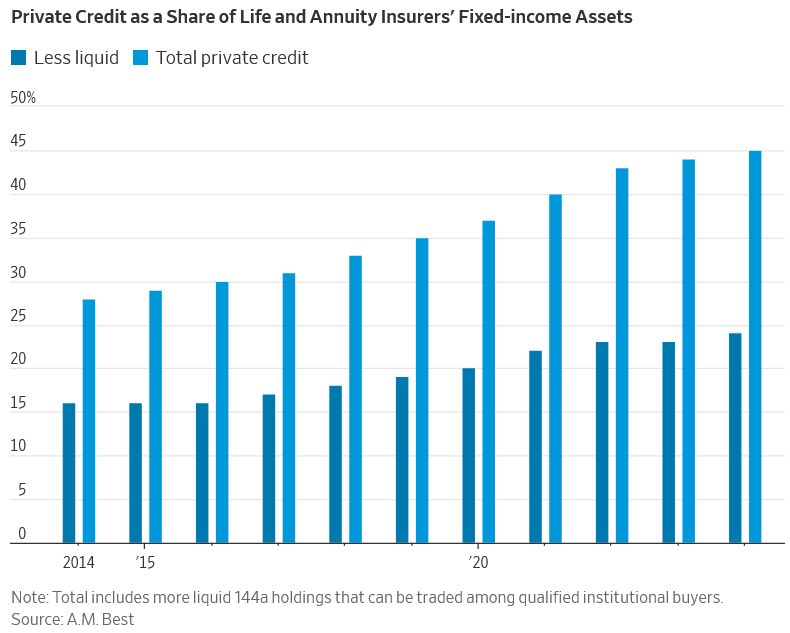
This chart is from a Wall Street Journal article by Heather Gillers, “Warren Buffett and Private Equity Both Love Insurance. The Similarities End There.”  It shows the increased use of private credit in insurance portfolios.

While private-asset managers appear to be using insurance companies to follow “in Buffett’s footsteps,” the author lays out “the radically different philosophies of a 95-year-old legend and the new crop of float-hungry investor-insurers.”

Ajit Jain, the head of Berkshire Hathaway’s insurance operations, was quoted as saying that a more difficult economic environment may expose the riskiness of the life insurance portfolios that are in vogue right now, the adoption of which “could end in tears.”

Alternative asset managers

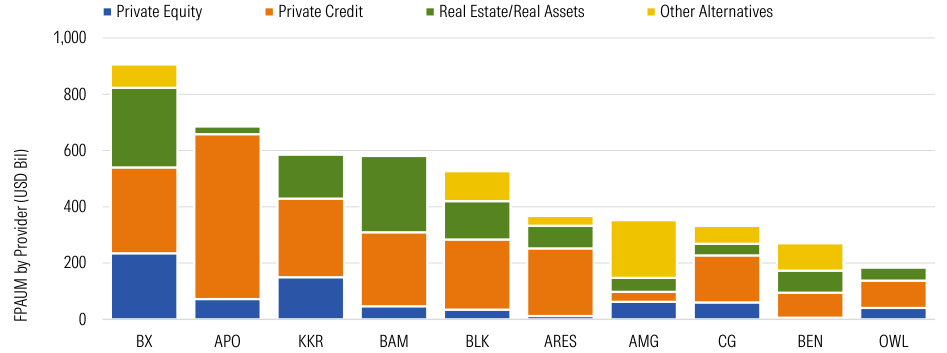
Also regarding alternative asset managers, a Morningstar report by Greggory Warren provides a trove of exhibits about the publicly traded firms that he follows.  For example, the image above shows the assets under management in the main alt categories for those firms.

As one subheading states, “Alternative Managers Operate in a Completely Different Ecosystem than Traditional Managers,” something reflected in the detailed moat ratings that are provided.

Mission investing

Meketa provided a short summary of its Mission-Driven Investing Day Roundtable, which featured representatives of two leading asset owners:

The roundtable highlighted two different but deeply complementary paths for aligning capital with climate resilience, community strength, and long-term value creation. CalSTRS advances mission through a fiduciary lens by embedding sustainability across a global portfolio.  MacArthur does so by deploying catalytic, risk-tolerant capital where it is most needed.  Both models expand what is possible when mission becomes a strategic driver of investment decisions.

While the discourse about climate change and other issues seems to have gone underground, “Clients, beneficiaries, and communities increasingly expect capital to do more than deliver risk-adjusted returns.”

Book club

This time of year brings forth all kinds of “best of” lists, including those about books of the year.  The author of the Substack newsletter Mr Market Miscalculates took an uncommon approach to reading in 2025:

I dedicated the entire year to “old, undiscovered gems”:  the oldest was published in 1972 while the most recent is from 2017 but still covers the events of the October 1987 crash.

The document linked here is more than a list of books — it’s a wonderful set of short descriptions of notable events, ideas, and strategies that have shaped the investment world.

Other reads

“The Broken Yardstick: Why Your ‘Historic’ P/E Chart is Lying to You,” Fundamentally Sound.

Comparing the S&P500 PE ratio of today to that of the past is apples-to-oranges comparison.  This common comparison assumes that the “E” (Earnings) in the 1990s and early 2000s measures the same thing as the “E” in 2025. It doesn’t.

“Marc Rubinstein on the Hidden Fault Lines in Modern Finance,” Michelle Celarier, Institutional Investor.  Shadow banking, insurance portfolios, multimanager hedge funds, and similarities in today’s environment to the conditions that preceded the Panic of 1907.

“Mistrust and/or Distrust Between LPs and GPs,” Anthony Hagan, Freedomization.

A plethora of LPs, during initial GP engagement, define their method of due diligence as organic and people-centric, with a high emphasis on the motivations, integrity, and pragmatism of team members, but then launch into a very mechanical and mundane process of demanding large batches of ordinary information and asking pre-scripted, prosaic questions.

“2025 Buy-Side Quant Job Advice,” Giuseppe Paleologo, At night we walk in circles and are consumed by fire.  An excellent overview, also of general interest to job seekers in other areas.

“Value Creation and Firm Life Cycle,” Tatjana Puhan. et al., SSRN.

Taken together, our results suggest a simple, implementable principle for long term public investors:  tilt equity portfolios toward financially unconstrained mid-life firms and manage risk at the life cycle tails.

“How CalPERS aims to add 50-60 bps using TPA,” Amanda White, top1000funds.  A look at the internal expectations for what will surely be one of the most scrutinized applications of the total portfolio approach.

“The Impact of U.S. Stock Buybacks: Theory vs Practice,” Victor Haghani and James White, Elm Wealth.

In sum, buybacks are not a neutral corporate finance choice but a force shaping market dynamics, investor welfare, and fiscal policy.  Their rise since the 1990s may be one of the most under-appreciated drivers of U.S. equity market performance and warrants greater attention from academics, investors, and policymakers.

“Between Headlines and Numbers: Tracking What We Can’t Yet See in AI Buildouts,” Olga Usvyatsky, Deep Quarry.  Digging into the accounting disclosures surrounding AI financing, equipment, and data centers.

“Peer Momentum,” Lionel Smoler-Schatz, Verdad.

Within biotech, we find that peer momentum adds predictive power beyond stock-level momentum, strengthening forecasts and improving signal robustness in a domain where traditional financial metrics are often uninformative.

Prescient

“The new writing will be about technology, the global economy, the electronic ebb and flow of wealth.” — Jay McInerney in Bright Lights, Big City (1984).

Flashback: Philip Fisher

In 1987, Forbes published two pieces about the investor Philip Fisher, a short appreciation from Warren Buffett followed by an interview with Fisher.

The interview delves into Fisher’s approach:  a small number of stocks, many of which were held for a considerable length of time.  He said, “I hate the buzzword ‘technology’,” but liked companies that “can expand their markets by taking advantage of the discoveries of natural science.”  The general formula for his winners:

They are all low-cost producers; they are all either world leaders in their fields or can fully measure up to another of my yardsticks, the Japanese competition.  They all now have promising new products, and they all have managements of above-average capabilities by a wide margin.

Also, he preferred it if clients argued against a new idea — if they were enthusiastic, “that’s usually a warning sign that it’s too late to buy.”

The interview begins with Fisher’s concern about the “huge overextension of credit in all directions.”  The interviewer asked, “When will the crash come?”  Fisher:

I haven’t the faintest idea whether we are in 1927 or 1929.  Some awfully bright, able, sound people were scared as hell in 1927.  But the thing rolled on for two more years, and that may happen here.  I don’t know.

The date the issue was published?  October 19.  (Which happened to be the largest one-day market drop in history, by a sizable margin.)

The music of investment

A 2024 posting beings with a simple question, “Is your investment process jazz or classical?”  It also deals with changes in process, the people involved, and investment categories:

Standards and practices and dividing lines don’t stand still.  Appreciating what they are today — and understanding their power as social norms — is essential.  But so is remembering that they aren’t eternal.

(All of the previous postings are available in the archives.)

Thanks for reading.  Many happy total returns.
Published: December 29, 2025

Subscribe

To comment, please send an email to editor@investmentecosystem.com. Comments are for the editor and are not viewable by readers.

Fairy Tales and Marvels in the Ecosystem

Welcome to another edition of the Fortnightly.  If you subscribe you’ll get these compilations in your inbox every two weeks, providing you with links to interesting investment readings, along with a little commentary.

You will also see original work, the most recent piece being a posting about the “professional strangers” of due diligence.

In a few days, the first installment of Investment Ecosystem Clippings will be issued on Substack.  You can sign up for it now.

The theme of this edition comes from the first section and applies broadly throughout.

Fairy tales and marvels

In his latest posting, Aswath Damodaran explores the logic of trillion dollar market capitalizations.  Regarding our fascination with certain levels:

From a rational perspective, you could argue that these thresholds (billion, half a billion, trillion, etc.) are arbitrary and that there is nothing gained by focusing on them.  [In a previous post] I argued that crossing these arbitrary thresholds can draw attention to the numbers, with the effects cutting both ways, drawing in investors who regret missing out on the rising market cap in the periods before (a positive) and causing existing investors to take a closer look at what they are getting in return (perhaps a negative).

Rather than giving answers, Damodaran offers the concept of “breakeven revenue” as one way to think about the reasonableness of a current valuation.  In turn, that leads to the 3Ps he uses to consider likelihood — is it possible, plausible, or probable? — a construct that can guide all sorts of investment discussions about fairy tales and marvels and all those routine ideas in between.

He closes with some general conclusions, including that a highly priced stock does not necessarily equal an overpriced stock.  And that “investors at many tech companies, including most on the large cap list, have given up their corporate governance rights, often voluntarily (through the acceptance of shares with different voting rights), to founders and top management in these companies” — a couple of whom are cited as “more emperors than CEOs.”

Risk management

The Thinking Ahead Institute issued a report called “Fresh snow | risk management for investment systems.”  The thesis is that traditional risk management — what the report calls risk 1.0, which started seven decades ago with Harry Markowitz — is no longer fit for purpose:

The main difference between risk 1.0 and risk 2.0 is the underlying model of reality.  Newtonian physics for 1.0, and complexity science for 2.0.

While it is almost never highlighted by strategists, chief investment officers, and product providers, the quantitative work that underlies typical risk management is merely “simplifying a small subset of reality,” which is unlikely to be repeated.

That point is brought home by short summaries of five market spasms — exactly the kind that are used in risk management exercises for “what would happen if” examples.  But they hadn’t happened before they did real damage and the next big surprise will be a brand-new one too.

Each of the five past events includes a summary of the risk 1.0 assumption that was violated, the results that were unexplained by it, the model blindness involved, the inadequacy of VaR to manage it, and neglect of the systemic risk that resulted from it.

For working within a complex adaptive system, the risk management tools that are deemed to be state of the art aren’t good enough.

More bubble talk

The last edition of the Fortnightly had a section on bubbles.  Not to overdo it so soon, but Howard Marks issued a new memo on the topic shortly thereafter.  He did his normal good job of thinking about the possibilities, including by asking an important question:  “Who can identify the boundary of rationality?”  (Speaking of fairy tales.)

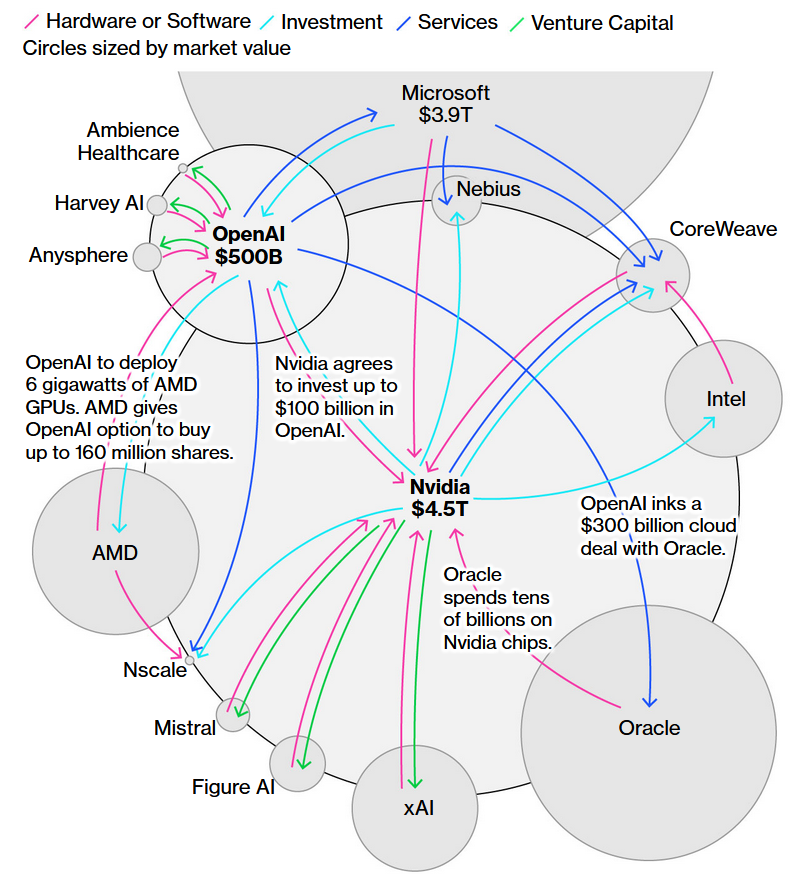
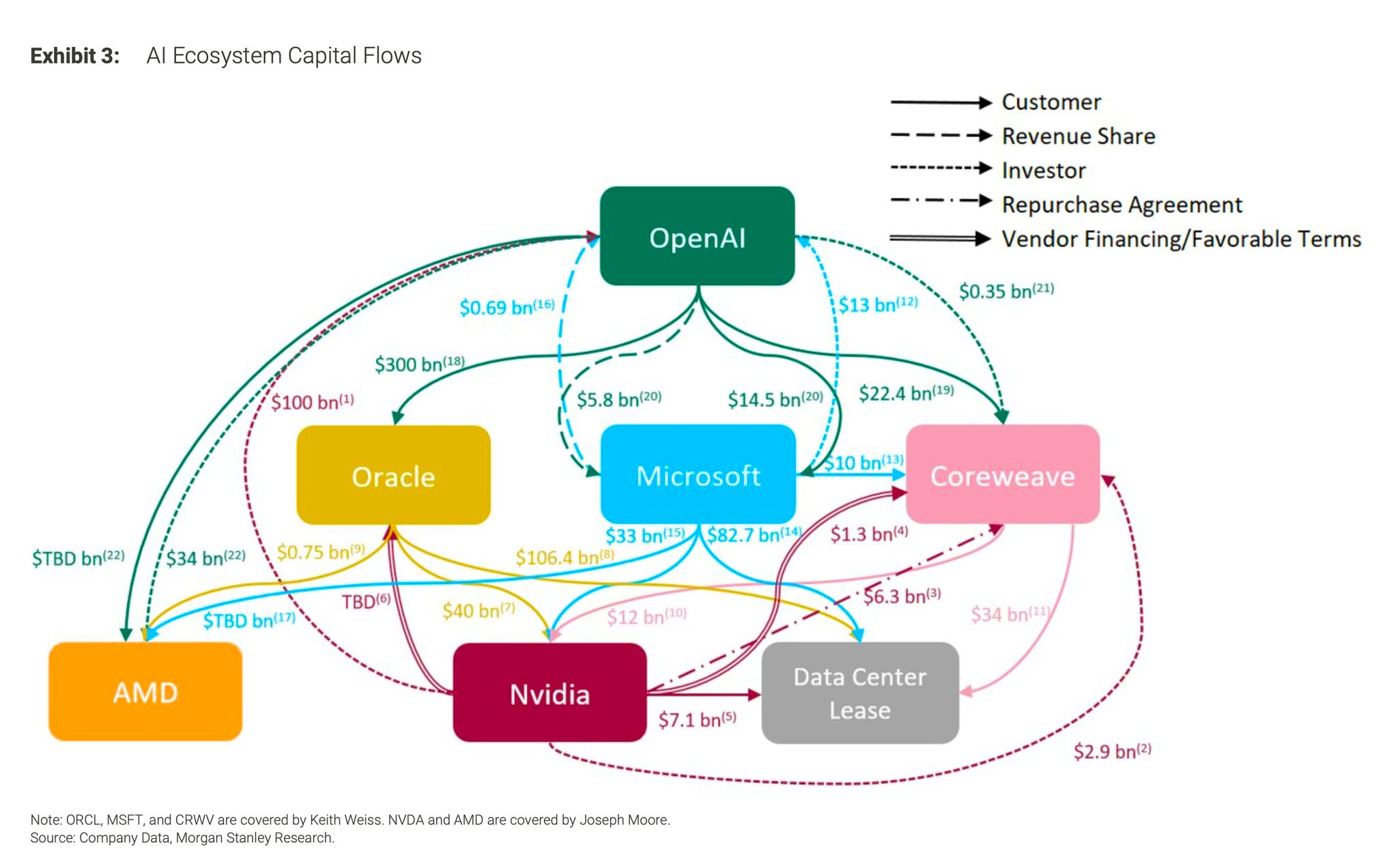
Among the important ideas discussed are the differences between “mean-reverting bubbles” and “inflection bubbles;” the specific areas under bubble watch today; the “circular deals” that are becoming increasingly prevalent; and the recent surge in debt financing — and special purpose vehicles — for data centers:

Is it prudent to accept 30 years of technological uncertainty to make a fixed-income investment that yields little more than riskless debt?

The tone of the postscript to the memo is notably different than found in other investment writings — and it has received a lot of attention as a result.  Marks called the outlook for employment as a result of AI “terrifying.”  And:

Finally, I’m concerned that a small number of highly educated multi-billionaires will be viewed as having created technology that puts millions out of work.  This promises even more social and political division than we have now, making the world rip for populist demagoguery.

Active mutual funds

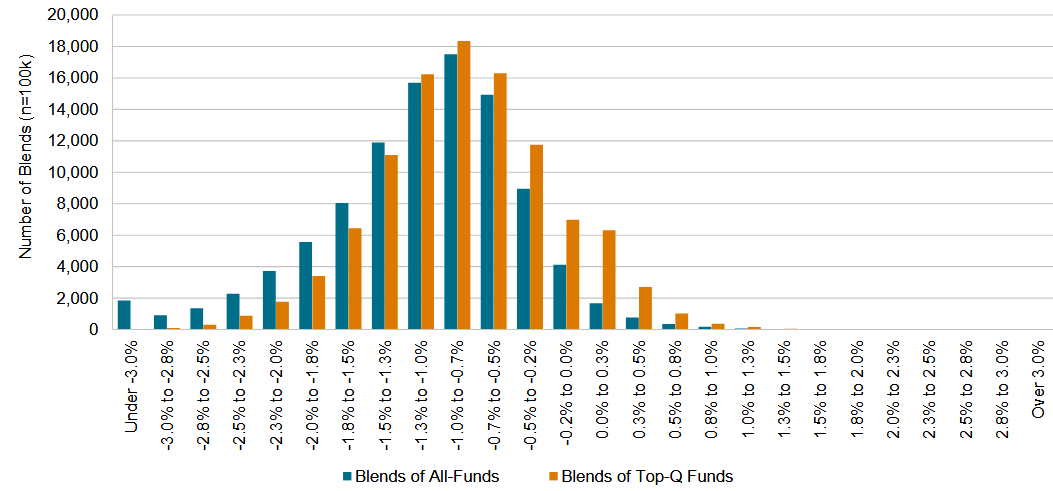
A new report from S&P Dow Jones Indices addresses the question “How do portfolios of active funds compare to similarly weighted blends of indices?”

The report offers a number of different ways of looking at the possibilities.  The chart above shows the relative returns for random mixes of funds versus an indexed portfolio (using the same category allocations between the two to keep them comparable) for the decade ending in 2024.

As would be expected based on the underperformance of individual funds versus their categories, the histogram is heavily skewed to the left of zero, indicating that the active fund portfolios lag the indexed ones a high percentage of the time.

The blue bars show the results when drawing from all available funds.  The orange ones illustrate blends that only choose top-quartile funds for the five years ending before the measurement period started (mimicking the approach of many allocators of capital).

The latter strategy is better than drawing from the whole universe, but the results are still overwhelmingly subpar.  As has been shown in other studies, that improved outcome “had more to do with screening out the worst performers than it did with more frequently choosing alpha-producers.”

Also, if you’re wondering where due diligence might pay off, “the identification of outperformers among International Funds offered the highest positive impact at the portfolio level.”

Independent asset managers

Dave Finstad wrote an article about the due diligence of asset managers and the challenge of identifying those that will be good partners:

One thing that I can say that did help explain future performance was employee ownership.  In my experience, I found that employee-owned firms had a stronger culture and were able to attract and retain superior investment professionals compared to those firms with little to no employee ownership.

They also tend to be more focused on generating performance than on gathering assets.

His views are backed up by empirical studies.  In addition, surveys (including ones at Investment Ecosystem presentations, workshops, and via the online course) have shown that employee-owned firms are favored overwhelmingly by due diligence analysts.  But they have a hard time building out portfolios dominated by those kinds of organizations because they are becoming scarce, which makes Finstad “a little sad.”

Mystery versus mastery

Earnest Sweat of Groundwork published a posting called “The Jason Kapono Problem.”  In it, he used the basketball player in the title to illustrate a problem that he sees in venture capital.  Namely, that investors often prize mystery over mastery, lottery tickets over deals with real results and better odds of success.  The latter “often get scrutinized more heavily than the buzzy phenoms”:

We are in a moment where the hottest AI companies look like high school phenoms.  They show up to demo day with vibes, velocity and a spreadsheet full of inbound from hyperscalers.  The market squints and sees a projected future All-Star.  Maybe Hall of Famer.

The unknown becomes the valuation.

Timing is everything

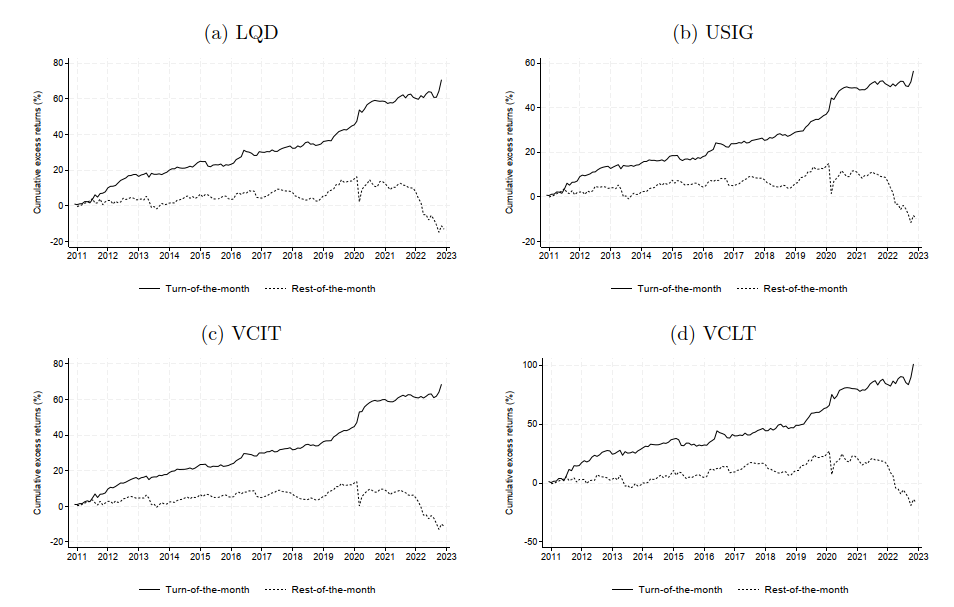
A paper by Clemens Sialm, et al., “Recurring Demand for Corporate Bonds,” states that “nearly all of the credit premium of investment-grade corporate bonds is earned during a narrow window around the turn of the month.”  Why?

This pattern can be explained by the monthly bond mutual fund reinvestment cycle, which is driven by the rebalancing methodology of the main bond index benchmarks.

Shown above are the returns for four investment grade bond ETFs.  The solid line in each graph shows the return from investing during that window.

Given the propensity of market participants to close windows of opportunity once they have been broadcast, it will be intriguing to find out what happens to this anomaly in the years to come.

Other reads

“The rise of proprietary capital,” Rupak Ghose, Rupak’s Substack.

If internal capital grows to be a majority of AUM, is it still worth running external money?  How do you balance returns and the increased focus on Sharpe ratios benchmarked against the pod shops?

“Venture’s Media 2.0 Moment,” Rohit Yadav, All Things VC.  Branding has become a big thing, since “the story is the strategy.”

“Everyone’s at the Party — Fortunately and Unfortunately,” Georgina Tzanetos, CAIA Association.

In short, the music is still going, but success in 2026 and beyond will hinge on discipline, transparency, and knowing when to step back from the noise.  Dystopian author Kurt Vonnegut once said, “Dance first, think later,” but in private markets, that mindset has run its course.

“Investors Must Scrutinize ‘Performance Detractors’ in Semi-liquid Private Markets,” Henry Cotton and Bradley Budd, bfinance.  Dividing potential detractors into “performance drags” and “performance risks.”

“How liquidity killed diversification,” Phil Bak, BakStack.

Only one trade remains, and all of your fancy models and static correlation matrix data can be tossed in the trash.  One trade remains, and it’s the only one you need to focus on.  Risk-on, or risk-off.  That’s it.  That’s all that matters.  And that’s all that remains of Modern Portfolio Theory.

“The Psychological Burden of Concentration,” Adam Wilk, MicroCapClub.  With a concentrated portfolio, can you “sit with discomfort long enough to let real compounding work”?

“Canada Pension Giant Balks at Paying Fees to Co-Invest With Private Equity,” Swetha Gopinath, Bloomberg.

Large pensions and sophisticated investors like CPPIB have for decades jointly invested with buyout firms in marquee transactions on a no-fee, no-carry basis.  An influx of capital from wealth channels now threatens to change that dynamic.

“How Banks Exploit Your Psychology,” Larry Swedroe, Larry’s Substack.  The “anatomy of financial exploitation” in yield enhancement products.

“A Century of Cycles: Five Lessons from Jim Grant,” Excess Returns.

“Do not stand in line to make an investment.”

In market tragedies too

“What destroys the characters of tragedy is their refusal to let it be, their stubborn insistence on their own ideas, their own wills.”  — Alexander Leggatt.

Flashback: ESG forecasts

In November 2021, the Wall Street Journal published “Where Will ESG Investing Be in Five Years?”  The subtitle:

We asked 10 experts to look into their crystal balls and predict the fate of socially responsible investing.  They had some very different views.

Yes they did.  You can see the optimism of the time, as well as the emerging concerns.  What isn’t there?  Forecasts of the political backlash that disrupted the trends that were in place.

Regime change

Early in the history of The Investment Ecosystem there were postings that appeared under the heading “Charts.”  One from April 2022 featured some images related to the apparent end of the “one-way move in bonds for four decades.”  It included looks at the correlation between bank stocks and interest rates, the performance of growth versus value, and this one, showing the trajectory of inflation and interest rates:

We know now that those levels of inflation pulled rates higher.  Despite some contrary indications, it seems like the weight of the evidence is that we have moved to a new market regime after a very long time.

Thanks for reading.  Many happy total returns.
Published: December 15, 2025

Subscribe

To comment, please send an email to editor@investmentecosystem.com. Comments are for the editor and are not viewable by readers.

The “Professional Strangers” of Due Diligence

A previous posting asked the question “How do we know (what we think we know)?”  It probed the issues involved in “mapping the landscape of our understanding,” in part by referencing the legendary fact-checking regimen at the New Yorker.

Learning from others

A New Yorker fact checker might spend a couple of weeks or so investigating and verifying a story, becoming an expert of sorts for a short period of time on a topic they probably knew little about beforehand.  Invariably they talk to people that they don’t know to determine the accuracy of some aspect of the story.

But relying on the statements of others — who have their own agendas and faulty memories — can be dicey, to say the least.  Talking to Strangers, a 2019 book by Malcolm Gladwell, includes a range of real-world examples that illustrate how poorly we judge the behaviors and intentions of people we don’t know — and how easily we can misunderstand, misconstrue, or be led astray.

There are obvious implications for due diligence in that regard, including the need to design an approach to the process that acknowledges the pitfalls inherent in relying on what you are told, as well as the need to modify tactics as warranted, depending on the quality of the interaction as it unfolds.  If an exchange is long on narrative and short on transparency (as many are), that is important in and of itself and the “information” received should be discounted.

While there is no doubt that more investment knowledge and experience are positive attributes for an analyst, they are muted by the ineffective structuring of due diligence encounters and poor interviewing skills.  Because of the leverage those non-investment capabilities can provide, they should be at the core of a due diligence analyst’s development program, but are often not addressed at all.

In his book, Gladwell offers a variety of situations that point out how we can go wrong in our interpretations of others.  One consequential example:

The people who were right about Hitler were those who knew the least about him personally.  The people who were wrong about Hitler were the ones who had talked with him for hours.

While, according to Gladwell, “we believe that the information gathered from a personal interaction is uniquely valuable,” it instead may be uniquely misleading.  The quality of the information conveyed is dependent on the motives of the narrator and the willingness of the listener to accept the story at face value (or actively — and creatively — poke holes in it).

Professional strangers

To step back and think about this a bit more, a visit to your local library might turn up a 1980 book — that probably hasn’t been checked out in years — The Professional Stranger by Michael Agar.  (Or you may find the 1996 second edition; quotes below are from the first.)

It is subtitled “An Informal Introduction to Ethnography.”  The professional strangers in the title are ethnographers, who describe the activities and culture of a group of people through interviews and close observation, in the process creating “a social relationship within which an exchange of information occurs.”

You can see the similarities to the due diligence process.  However, while the goal is the same, the differences are stark.  Ethnographers take months or years to study the composition and dynamics of a group, sometimes embedding within it.  Most people doing due diligence have very little time allocated to onsite visits and meet with a select group of people, interacting with them in a controlled environment.

Those are very different kinds of experiences.

For those doing due diligence, exposure to the precepts of ethnography should lead to a more realistic weighting of the narratives offered by an organization; a reluctance to make bold statements about the organization’s culture to others; and a desire to find ways to bridge the gulf between the thickness of the actual cultural atmosphere and the thin impression of it that results from standard due diligence practice.

Granted, there is much in a book like Agar’s that might not be of interest, including details about the specific groups he analyzed (villages in India and Austria, as well as the lives of drug addicts, both on the streets and in a hospital/prison).  But as with other works on ethnography, there are plenty of insights that come from seeing how a professional stranger goes about deciphering a social milieu.

Consider this quote from the book:

Most groups have official or unofficial stranger-handlers to deal with outsiders.  Such stranger-handlers are natural public relations experts.  They can find out what the outsider is after and quickly improvise some information that satisfies him without representing anything potentially harmful to the group.

The social groups that Agar studied were considerably less formal than a modern investment organization, where there are designated stranger-handlers and many other employees are steeped in the official narrative.  That puts a premium on conducting a due diligence visit in ways that deviate from the standard routine in order to get beyond the narrative and into the realm of discovery.  (That’s a key part of the Advanced Due Diligence and Manager Selection course.)

A few pertinent observations from the book:

~ The goal is to understand the group from the perspective of those involved, but the perspective of an outsider is important too.  However, a rush to judgment based upon your own views can inhibit the ability to see the culture as it really is.

~ Along those lines, “learning the language and learning the culture are far from independent tasks.”  There might not be a language barrier in the classic sense, but every organization has its own internal language that differs from the way it presents itself externally.  Picking up on that is hard but rewarding.

~ There’s a difference between “when a person is willing to give you information and when they are trying to give you something to get rid of you.”  (Or give you something that they want to give you instead of what you want.)

~ Good interviewing skills make all the difference, but there is no formula.  Structured interviews can be good in some situations, but are often too limiting, as opportunities for discovery aren’t capitalized upon because of the need to complete the list.  Conversely, you can realize after the fact that a free-form interview got very far afield and some core questions were left unasked.

~ You want to find out “the way that group members interpret the flow of events in their lives.”  Hearing how they see things as individuals can reveal much about an organization.

~ Even early in the process, at the top of the information funnel, “you are already bouncing between learning and checking what you have learned.”

~ When it comes to research into the group, “no one knows how much is enough.”  And, “If you’re going to learn a complex pattern, you need a lot of time.”

Risks

In 2005, James Montier wrote a seminal report, “Seven Sins of Fund Management.”  While it concerned investors making decisions about companies, his third sin applies equally to any kind of due diligence:

The insistence of spending hours meeting company managements strikes us as bizarre from a psychological standpoint.  We aren’t good at looking for information that will prove us to be wrong.  So most of the time, these meetings are likely to be mutual love ins.  Our ability to spot deception is also very poor, so we won’t even spot who is lying.

That is the biggest risk when doing onsite due diligence.  Just being there may give you a sense, to reference Gladwell’s book again, that you have “uniquely valuable information” when you do not.

That sense can be reinforced by prior exposure from a distance.  Let’s say the person being interviewed is an investor of some renown, whom you have followed for years.  You are at risk of already having a parasocial relationship with them, in which you feel a strong connection and think that you have an understanding of who they are.  That can color everything that happens in an interview and your interpretation of it — and lead to an unwillingness to come to a negative conclusion.

While the theme of this posting revolves around understanding “strangers,” there are also risks that can develop over time.  As trust builds up, due diligence can get less diligent — even downright sloppy — so that detrimental changes are overlooked rather than triggering a reassessment.

Keeping these risks front of mind and frequently discussing them is essential.  Otherwise you are better off not doing onsite due diligence at all.


This thread will continue in the next posting.  Subscribe now to receive it via email.

Published: December 9, 2025

Subscribe

To comment, please send an email to editor@investmentecosystem.com. Comments are for the editor and are not viewable by readers.

Questioning the Convergence, Bubble Watch, and Following the Evidence

Sometime soon, there will be a new Investment Ecosystem outpost on Substack.  But nothing will change in the existing setup.  You will still see the regular IE fare (sets of curated links like this one and essays about the changing investment world) in the same places (online or via email) as you do now.

The Substack will be an add-on offering.  Called Investment Ecosystem Clippings, it will be just that — snippets of text and images found elsewhere that are worth sharing.  Quick to review but likely to get you thinking.

Clippings will be free and if you’re interested, you can sign up now so that you’ll get the first issue when it is published.

Now, on to the readings.

Questioning the convergence

The convergence of public and private investing is a major theme across asset classes.  Institutions are managing portfolios differently and structuring their organizations differently in response to the decreasing separation between the two categories of assets.

The so-called democratization of alternatives is a big factor in the convergence, as the investment industry pushes hard to get private investments into retail channels of distribution, including defined contribution plans.

But that’s where things get messy.

For example, see “Evergreens: The Tree That Never Sheds,” a report from EDHEC by Evan Clark which focuses on the perpetual funds that are attracting assets:

These vehicles promise access, convenience, and periodic liquidity — but closer analysis reveals structural features that pose material risks for investors.

The concerns are summed up in the details behind five bullet points, each of which is addressed with helpful exhibits:

Performance driven by unrealised gains

Fee misalignment

Illusory risk-adjusted performance

Liquidity mismatch

Governance conflicts

A new paper is drawing attention to another potential hurdle for “the convergence,” as indicated by its title, “Private Equity, Public Capital, and Litigation Risk.”  The authors, Ludovic Phalippou and William Magnuson, begin their conclusion in this way:

Private equity has long operated with limited transparency, minimal regulation, and contractual insulation.  That equilibrium is now shifting.

Said another way:

As retail exposure to private equity has grown, the line between stylized financial storytelling and actionable fraud has narrowed.

The customs and legal agreements of the institutional world, shaped in no small part by the desires of limited partners not to get shut out by the most attractive general partners, will come under increased scrutiny:

Practices normalized in institutional settings — misleading performance metrics, manipulable valuations, opaque fees, limited liquidity, and fiduciary duty waivers — become significant litigation risks when ordinary investors enter the picture.

Foremost among the many issues is the fact that “private equity formation documents frequently limit or entirely eliminate the fiduciary duties that managers owe to their investors.”

For one example of the disconnect, the law firm Carlton Fields recently released “Alternative Retirement Plan Investment: The Checklist,” in response to a change in guidance for pension plans from the Department of Labor.  Note the emphasis on fiduciary duties found there.

A posting from Tim McGlinn of TheAltView reveals how BlackRock appears to be dealing with this issue in target date funds that include alternatives — by trying to offload its fiduciary duties to others.  It does not do that in its alternatives-free target date funds.

All of the wondering about whether this convergence will be a good thing is not concentrated on the retail side of the fence.  A commentary by Chris Cumming in the Wall Street Journal (“Private Equity’s Embrace of the Mass Market Alarms Longtime Investors”) starts simply:  “Private equity’s old money is not happy about the new.”

Institutional investors fear getting crowded out of deals, as well as the possibility that the money chasing private equity will erode returns available to them — and say they are willing to alter allocation decisions as a result:

Eighty-three percent of these private-equity heads told ILPA they would be less likely to invest with a manager that took in large amounts of capital from individuals.

Bubble watch

Another popular topic these days:  bubbles.  Here are a number of readings along those lines.

GMO has warned of bubbles off and on for quite some time.  A quarterly letter (“It’s Probably a Bubble, but There is Plenty Else to Invest In”) by Ben Inker offers a “taxonomy of bubbles,” which includes illustrations of the risk-reward trade-offs (as seen by the firm) in four recent bubble environments.  They term them the internet bubble (2000), the “everything” bubble (2007-8), the duration bubble (2021), and the AI bubble (now).  Regarding today’s version:

Plenty of other risk assets are trading at fair or even compelling valuations, and even if today’s financial markets turn out to be rationally priced, there is no long-run expected return give-up for tilting your portfolio away from the AI darlings and into those other assets.

Rajiv Jain of GQG is known for his willingness to go against the crowd at times.  In September, the firm published a posting, “Dotcom on Steroids,” that argued that the technology sector “stands at a significant inflection point,” featuring “the trifecta of rich valuations, increasing macro risk, and — perhaps most importantly — deteriorating company fundamentals.”  Comparisons are made to address what it feels are misperceptions about the quality of today’s tech companies versus the dotcom era.  A second part with the same title was recently released; it focuses on OpenAI and the exuberance for the company that “seems to overlook the fundamental fragility of the current business model.”

On the other side of the argument is Owen Lamont of Acadian.  “Firms are the smart money,” he wrote, observing that we aren’t seeing the stock issuance that marked the dotcom era:

Let’s conclude by considering the claim that the U.S. is currently experiencing an AI bubble similar to the tech-stock bubble.  I’m skeptical, because today I don’t see a lot of equity issuance by AI-related firms.  In contrast, as of 1999, technology firms were issuing equity hand over fist.

Lamont expanded on that argument in a follow-on posting, in which he acknowledged that the situation can change relatively quickly, as it did from March 1999 to March 2000, when issuance increased dramatically over that year.

For research into bubbles, check out the links from The Capital Spectator and the “short field guide to bubbles” from Alpha in Academia.  The latter also includes examples featuring technical analysis, which some think can help in evaluating bubbles.

Following the evidence

In a posting on his blog Behavioural Investment, Joe Wiggins asks an important question:  “How Can Investors ‘Follow the Evidence’?”

“Evidence-based investing” became a popular phrase over the last two decades, making it all sound so easy.  But Wiggins puts the desired goal into proper perspective:

A robust piece of evidence may directly contradict another equally strong argument.  Investment decision making is about understanding what we are trying to achieve, assessing the available evidence and drawing a necessarily uncertain conclusion.

He provides a number of good examples, including that of using a static asset allocation or varying exposures based on valuation.  Good arguments can be made for either; “If we are following the evidence, what should we do?”

Barely bears

It is common in the financial media to call a drop of 20% a “bear market” — a level of precision that doesn’t really tell you much.  But that “unofficial definition” is handy to gauge the length of those drawdowns, like the chart above, which appeared in a Spencer Jakab column in the Wall Street Journal.  (Periods that included a recession — also an imprecise definition — are shown in red.)

The piece was titled “Why We Could Use a Good, Long Bear Market.”  We’ve had two of those this century, neither recently.  Jakab wrote that they can be “both awful and therapeutic”:

Long bear markets accompanied by a recession discredit the last boom’s wildest themes and its cheerleaders.  They also remind us of what capital markets are for:  matching mostly good businesses with patient savers’ nest eggs.

The optimism premium

Are you concerned about lists of equity valuation statistics showing that a great many of them are higher than at other times in modern market history?  Head on over to Hudson Bay Capital for a dose of wishful thinking.

“No, Stocks Aren’t in a Valuation Bubble — Not Even Close,” screams the title of a piece by Jason Cuttler, the firm’s senior markets and derivatives strategist (although the disclaimer says that it “does not necessarily reflect the view of Hudson Bay Capital”).  He sees the fair value for the S&P 500 at $9,000 in an “optimism regime,” writing that “such outcomes are consistent with President Trump’s ‘MAGA’ policy goals,” and that:

Investors who myopically focus instead on the recent history of P/E multiples risk missing out on such generational upside.

Nouriel Roubini of the firm offered an optimistic economic outlook with many of the same themes but in a more muted fashion.  He thinks that “US exceptionalism is intact” and that “deep pessimism about medium term US growth and returns is unwarranted,” although he cites more caveats to the potential growth surge he sees coming.  Chief among them is that “some policy proposals — if fully implemented — would justify a more stagflationary outlook.”  Not to worry, though:

Four guardrails have become increasingly binding against stagflationary policies:  market discipline, Fed independence, strong and market-savvy economic advisors, and a limited Republican majority in Congress.

Judgments about those “guardrails” animate today’s market debate.

(A tip of the hat to Toby Nangle of FT Alphaville, who wrote a longer summary of Cuttler’s piece.)

Junk chart

A Bloomberg article about the strong weekly finish to November included this image, which deserves a place in the junk chart of the year contest.  Adding the returns of five assets together is certainly a novel concept, but a meaningless one.  Hopefully we won’t see it again.

Other reads

“Hedge Funds Call This Psychologist When Their Traders Start Losing,” Gregory Zuckerman, Wall Street Journal.  Dave Popple:

[Top hedge-fund traders] are the rare overlap of leaky attention, which allows them to pick up signals others miss, and strong discipline and willpower.

“Why Smart Investors Choose Not to Play, The Case Against Active Management,” Larry Swedroe, Larry’s Substack.  A case study in institutional advantage leading to unfavorable outcomes — wrapped in an analogy regarding the benefits of carding a par on every golf hole without really trying.

“Ethical firms are more likely to merge,” Joachim Klement, Klement on Investing.

Indeed, there is a kind of self-sorting among firms where some firms disproportionately attract employees with many ethics violations.  Over time, the industry thus splits into companies with high integrity and companies with a lack of integrity.

“How Journalists Are Becoming the New Power Hire in Private Funds,” Jake Conley and Shahrukh Khan, Cash and Carried.  Searching for talent “to extract information that hides behind numbers, or that numbers don’t pick up to begin with.”

“Multistrategy hedge funds are hiring armies of insufferable clones,” pseudonymous author, eFinancialCareers.

Difference was what once made the hedge fund industry great.  Now there’s just an army of clones.

“Blue Owl’s Failed Merger and Cracks in Non-Traded BDCs,” Covenant Lite.  On the firm’s reversal of its plan to merge a public business development company and a private one, and what it means for the sector.

“A Risk Professional’s Guide to Physical Risk Assessments,” GARP Risk Institute (for the Climate Financial Risk Forum).

Physical risk assessments are likely to become an increasing influence on day-to-day risk management, and it’s important for all financial institutions to grow their understanding and insight into how their portfolios are likely to be impacted.

“Behavioral Finance,” Simon Hallett and Tim Kubarych, Harding Loevner.  Short videos about “the common cognitive biases that affect all investors” and how one firm aims to mitigate them.

The illusion of knowledge (including about quotes)

“The greatest obstacle to discovery is not ignorance — it is the illusion of knowledge.” — Daniel Boorstin (although it is most commonly attributed to Stephen Hawking, who may have repeated it later).

Flashback: Motif Investing

Motif was an online brokerage, in operation from 2012 to 2020.  It was chiefly known for the ability to buy “motifs,” thematic baskets of stocks that could be bought or sold via a single trade, as well as other innovations.

But it couldn’t survive against the established players in the industry, especially after the move to low- and then zero-commission trading.  Its intellectual property and technology assets were sold to Schwab after it closed down.

The proliferation of ETFs has meant that there’s usually one that fits the bill for any thematic idea you might have.  If not, improved technology and fractional trading at most brokers means that it’s possible for you to execute on motifs you dream up.

(Studies of thematic fund performance have shown that they rarely outperform standard indexes, since they usually become available after optimism around a theme is already priced in.  And, the funds have a high closure rate, since assets flee after the flame is gone.)

Oddly, the Motif Investing home page still appears as it did five years ago, although none of the links work.

Quality shareholders

The topic of “quality shareholders” was the subject of an early Investment Ecosystem essay.  It featured ideas from Lawrence Cunningham and Philip Ordway, a link to a discussion between them, and a series of questions for those who work at asset management firms.  Those investors face challenges to acting as quality shareholders and, similarly, attracting quality investors themselves.

Thanks for reading.  Many happy total returns.
Published: December 1, 2025

Subscribe

To comment, please send an email to editor@investmentecosystem.com. Comments are for the editor and are not viewable by readers.

A Complex Adaptive System (Everywhere You Look)

The latest Investment Ecosystem posting asked a simple question:  “How Do We Know?”

It delved into “mapping the landscape of our understanding,” an essential aspect of due diligence:

Not nearly enough time is spent detailing what we don’t know.

What we think we know gets most of the attention and drives the narratives that lead to decision making.

The overlooked question is: “How do we know (what we think we know)?”

On to the readings for this issue, starting with an examination of the overall theme.

A complex adaptive system

It should be no surprise that a report titled “Reframing Financial Markets as Complex Systems” would be featured here, since that idea formed the foundation of this site.

The CFA Institute Research & Policy Center issued the report, which was authored by Genevieve Hayman and Raymond Pang.  They argued that traditional financial models don’t adequately account for the way things really work:

Market-level phenomena (e.g., volatility, crashes, contagion, innovation) result from myriad interactions among heterogeneous agents (e.g., investors, firms, governments, regulators), often yielding unexpected (i.e., heavy-tailed) or nonlinear outcomes.

The heterogeneous adaptive agents don’t stand still:

Market participants differ in their goals and strategies, but they are mutually interdependent and adapt to each other’s behavior and environmental conditions.  Investors, fund managers, and regulators react to each other’s activities, often in feedback loops.

Those reactions travel along interconnected networks that have changed dramatically over time.  The complex systems that result “may exhibit resilience (the capacity to absorb shocks and reorganize), but they can also harbor hidden fragility.”

As you read this issue, think about how each of the topics reflects changes in the ecosystem.  Identifying changes and the unappreciated x-order effects of them should be a core part of an investment process.

Cockroaches

Oh, boy.  A month ago Jamie Dimon mentioned the possibility of cockroaches in the credit markets on an earnings call and now that’s all anyone talks about (including us).

Howard Marks used the meme (mixing it with the “canary in the coal mine” idiom) in a memo on the state of credit.  While noting that issues are cropping up, he didn’t think they were systemic but a normal part of the credit cycle:

This isn’t part of the plumbing of the financial system but rather a regularly recurring behavioral phenomenon.  So, it isn’t ‘‘systemic,’’ but it is “systematic.”

He revealed that his firm, Oaktree, had a small position in First Brands (one of the cockroaches), did some research, and “reached the correct conclusion” (although he wasn’t specific about what that meant).  He wrote that during the firm’s long history they’ve “experienced plenty of defaults and even a few frauds,” which he says comes with the territory of “knowingly bearing credit risk for profit.”

Stephen Nesbitt of Cliffwater struck an emphatic chord in a short piece, “No Cockroaches in Private Debt.”  As with Marks and other purveyors of product, he has a vested interest in whether that turns out to be true.  (As you can judge from a posting, “The Interval Fund That Ate the Market,” from Covenant Lite.)

Nesbitt argues that credit problems will show up in the broadly-syndicated loan market, not in private credit.  One reason:  because those loans “are less likely to be private equity sponsored, making their debt more susceptible to weak management and fraud.”

But private debt is by no means immune from those kinds of problems.  The recent case of Renovo Home Partners has drawn a lot of attention, since its (private equity sponsored) debt went from being marked at par to zero on BlackRock’s books when the firm went under.  (Oaktree also owned the debt.)  With more firms owned by private equity showing signs of distress, you can expect there to be other surprises, although maybe the holders will get better about marking them down in a timely fashion.

Concerns are spreading about the quality of ratings in private credit, the degree of concentration of that kind of debt (especially at insurance companies), and even the increased prevalence of private credit in the enormous and speculative AI buildout going on.  Here’s Paul Kedrosky’s take on “The Great Credit Convergence”:

The line between public and private credit is functionally gone: there is a single continuum of liquidity and opacity.

That efficiency hides danger:  spread compression, shared exposures, correlated marks.

Private credit is now infrastructure finance for AI (and defense and energy).

The only real lending difference now:  who sees the marks — and when.

Across the credit spectrum we have seen a loosening of standards and an explosion in new debt structures.  Given the dramatic changes since the financial crisis, it only makes sense to worry about the cockroaches that are showing up now.

If they continue to multiply we’ll know what terminology to use, thanks to Leyla Kunimoto of Accredited Investor Insights:  “A group of cockroaches is called an intrusion.”

ESG, we hardly knew ye

In 2021, we published “The ESG Juggernaut and Points of Pushback,” which began with a sole sentence:  “ESG is dominating the investment business.”

It used a paper titled “Seven Myths of ESG” to frame issues for both proponents and opponents of the many concepts embedded in the acronym to consider, in conclusion asking:

Does your organization have clarity about where it stands on these cornerstone issues?  Do your actions reflect those choices?  Do your clients and/or stakeholders understand your beliefs and why you hold them?

After the ensuing political scrum it’s time to pick up the pieces.  Where to start?

“ESG Ratings Are Trash” (a paper by Brian Bolton) and “A Lawsuit Waiting to Happen” (a report by Bryce Tingle for the Fraser Institute) are focused on ESG ratings as they came to be, a disparate set of underlying ideas that was mashed together into a catch-all category by the workings of the investment industry in a dash for cash.

We are now back to the hard and necessary work of analyzing and identifying specific long-term risks to companies.  Many of the concepts embedded in ESG are essential considerations in determining whether and how value will be created or destroyed.  But they don’t fit together into a nice, neat package for marketing.

Gold

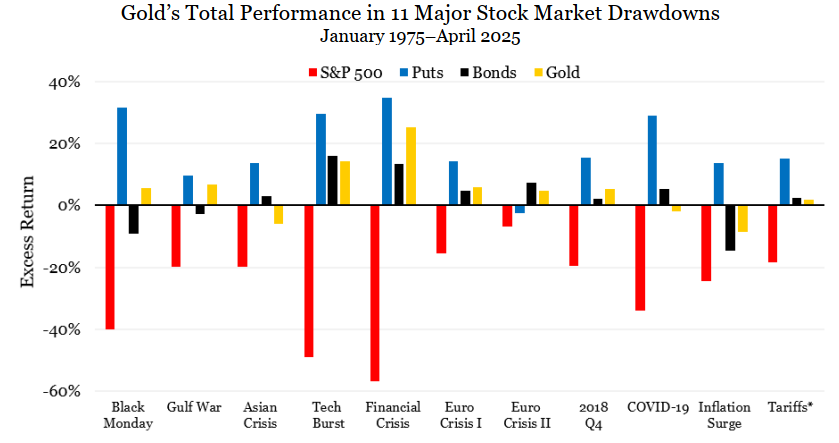
Investor interest and flows follow price, so gold has gotten a lot more attention lately than it usually does.  This chart comes from “Understanding Gold,” a paper from Claude Erb and Campbell Harvey.  They find that “when gold hits all-time highs, the subsequent multi-year returns are low or negative,” but a large number of exhibits paints a nuanced picture of gold, and the authors offer one intriguing possibility:  that Basel III could allow commercial banks to hold gold for regulatory purposes, which would change the dynamics of the metal.

Other evaluations of interest come from D. E. Shaw and Man.

13Fs

Once upon a time 13Fs provided a fairly complete snapshot of what the big money (in equities) was doing, by showing what positions were on the books as of a half-quarter before, with which you could compare to the previous quarter and see what had changed.  A Bloomberg article notes the general problems with that approach (the delay involved and the exposures not captured), but a posting from Inside the Mind of Mojo (“The ABCs of 12D Chess For 13Fs”) digs much deeper into how misleading the data can be:

This is the real anatomy of sophisticated capital deployment by modern hedge funds, and it’s the reason that treating 13F filings like stock-picking scorecards misses the entire game.  These documents are quarterly freeze-frames of multidimensional systems in constant motion — static images of pawns being deployed in a sophisticated game of 12D chess.

Most press reports — and some investment strategies based upon 13F information — assume that the world operates the way it has before.  That’s true in some cases, but not at the margins of alpha discovery, where change occurs.

Lone wolf

Recent issues of the Fortnightly have had sections about sell-side analysts.  Here’s another:

The lone analyst with a sell rating on Fiserv Inc. ahead of the company’s crushing stock selloff says the writing was on the wall for months.

The headline on the Bloomberg story in which that appears referenced the “26-year-old analyst who beat Wall Street.”  Dominic Ball, an analyst at Rothschild & Co Redburn, explained his stance:

There was a big dichotomy between what was happening on the ground, when we speak to merchants and retailers, versus what the investor base thought was happening.

The chart above comes from a Spencer Jakab column in the Wall Street Journal which asks, “Are Stock Analysts Useless?”  His answer is no (but that their recommendations often are).

Factors and causality

A new brief, “Causality and Factor Investing: A Primer,” by Marcos López de Prado and Vincent Zoonekynd was published by the CFA Institute Research Foundation.  Its theme is that the “econometric canon applied in factor investing studies — linear regression, two-pass estimation, p-values, and correlation-based statistics — rarely discusses causality,” leading to “real-world consequences.”

The “factor zoo” has turned into the “factor mirage,” a problem for the creators and consumers of the slew of products created over the last couple of decades.

In addition to a short examination of the thesis (which will be expanded upon by the authors in a coming work), a list of questions is included in the brief that can be used to craft “a due diligence questionnaire, investment memo, or strategy approval process.”

Other reads

“Alpha ex-Ante,” Lewis Enterprises.

The dividing line between debt and equity has melted into a gradient of structured promises.  Credit investors now participate in upside through covenant engineering; equity investors protect their downside through liquidation stacks and preferred waterfalls.

“Somewhere Down There,” Jeffrey Ptak, Basis Pointing.  Opening the nesting dolls of a fund to inspect the structure and fees.

“Winners and Losers in a World Without Quarterly Reporting,” Clare Flynn Levy, Essentia Analytics.

Whether in markets or in individual portfolios, the rhythm of information release shapes how decisions are made, how risk is managed, and how attention is allocated.

“A Company Sold Investors $1 Billion in Art. Did it Paint Too Rosy a Picture?” Zachary Small, New York Times.  How one alternative asset class is being marketed to the masses.

“From Sharpe to Pedersen: Why Active Management Isn’t Zero-Sum After All,” Diego Costa, Enterprising Investor.

There must, therefore, be a middle ground:  a market that is just inefficient enough to reward those who uncover information, but efficient enough to keep profits from lasting too long.

“The Gravity of Habit: How Assumptions Drive the Re-up Cycle,” Anthony Hagan, Freedomization.  Thoughts on the “psychological game of Twister that GPs and LPs play” and how it is changing in a time of “hand-to-hand combat for every available commitment dollar.”

“‘Total Portfolio Approach’ Is Shaking Up How Trillions Get Managed,” Justina Lee and Lu Wang, Bloomberg.

To its proponents, TPA is a better fit than the old static model —  known as Strategic Asset Allocation — for an unpredictable world in which inflation spikes or geopolitical shocks can easily upend market assumptions.

“Why poker is used to train traders,” Kris Abdelmessih, Moontower.  A posting based upon a video by Jerrod Ankenman of Susquehanna.

“The Add-On Illusion: Why Traditional Attribution Analysis Misses the Mark,” George Pushner and P.J. Viscio, Kroll.

Created value attribution is certainly complicated by add-on acquisitions, but a careful and methodical breakdown of the value impacts of each add-on can identify true organic value creation and is a critical component of the measurement of Alpha.

Open doors

“When one door closes, another opens; but we often look so long and so regretfully upon the closed door that we do not see the one which has opened for us.” —  Alexander Graham Bell.

Talent

A 2022 Investment Ecosystem posting used a book by Tyler Cowen and Daniel Gross as a jumping off point for examining issues of talent in investment organizations.  One pitfall is that “you may end up experiencing the ‘winner’s curse’ of finding out you paid too much in your rush to capture that talent”:

That is especially true when notions of intelligence are intertwined with observations of an investment track record (which is an inherently noisy measure of quality).  Intelligence is context dependent and so is performance.  If you hire someone into a new organizational environment, they may struggle to understand how to succeed within it.  Or they may encounter a much different market regime to navigate than they had before and find it difficult to adapt.  Faced with tougher circumstances, their results may suffer, and perceptions of their intelligence may decline along with them.

Thanks for reading.  Many happy total returns.
Published: November 17, 2025

Subscribe

To comment, please send an email to editor@investmentecosystem.com. Comments are for the editor and are not viewable by readers.

How Do We Know?

A few sizable credit losses of late have created headlines and caused ripples of concern, although spreads remain tight and covenants loose, so worries aren’t widespread.  At least not yet.

There has been talk of cockroaches — when will the next unpleasant example show up? — and participants in different parts of the credit markets are claiming that the problems can be found elsewhere, certainly not in their house.

Given the huge increase in assets in fairly new structures and strategies (and the eternal tendency to press bets that are working), it would not be a surprise to see an infestation of problem positions, but we’ll leave the prognostication about the likely outcomes to others.

Our concern relates to the quality of due diligence, not just when trouble reveals itself, but on an ongoing basis.  And to the discipline required to stick to a standard of quality as the norms of market behavior wax and wane.

Fact checking

An entertaining and informative New Yorker article by Zach Helfand, “The History of the New Yorker’s Vaunted Fact-Checking Department” (which appeared in print with the simpler headline “Vaunted”), provides a ready analogy:

It’s difficult to check facts, or to talk about fact checking, without coming off as a know-it-all, a fussbudget, or a snob.  But knowing things is hard.  Checking is a practice.  It’s not omniscience.

So,

How do you confirm a fact?  You ask, over and over, “How do we know?”

There is no formula (and lots of ambiguity):

Sometimes one source is enough.  Sometimes ten aren’t.  Checking is a forced humility.  The longer you check, the more you doubt what you think you know.

Investment organizations generally don’t have a fact-checking ethos or the structure to support one.  Most research is the product of an individual who puts forth an idea for others to act upon and is thereby accountable for it if they do.

As with authors, investment decision makers prize their autonomy and can bristle at the oversight of others, wanting their work to stand on its own as conceived.  Doubts about the process behind an idea can mar the story being told, erode confidence in it, and open up questions about what is known and unknown.

The New Yorker article references the “checker’s paradox”:

The more you know, the more you know that there is more you don’t know.

No one likes to admit that.

Standards

History shows that due diligence practices shift in response to the environment.  A tailwind of easy money begets looser standards until the sloppiness that has crept into the process results in big problems.  Then never-again promises are made, only to be broken during the next cycle.

Actually, including the word “standards” in that description is misleading, since its use should be reserved to indicate absolute expectations and actions, not relative ones.  Standards that slide around aren’t really standards.

In structuring a due diligence process, a certain amount of specification should come into play — we do this, we don’t do that — but overdoing it can lead to a check-the-box notion of completeness, which is not what due diligence should be about.

Instead, it is the quality of the effort that matters.  Does it measure up?  The New Yorker is “vaunted” in regards to its fact checking because of its long-standing obsessiveness about the process and the tales and examples passed from generation to generation that attest to it.

While an assigned fact checker carries the bulk of the load on a story, many others have eyes on the piece, including other fact checkers who may be consulted, the head of the department, authors, editors, and the editor-in-chief.  It is everyone’s business to get things right.  Learning about the “how” of the checking that has been done is to be expected.

Contrast that with recommendations that stem from investment due diligence work.  It is rare to see much if anything in a written recommendation about the diligence process that had been employed — and presentations and committee meetings focus on the conclusions offered before quickly moving to an exchange of opinions between those proposing an idea and those deciding its merits.  The evidence as presented gets the attention, not the methods behind its acquisition.

Ultimately, the recommendations — and the people who make them — are judged on outcome not process.  And, as long as things go well, they are left to their own devices (and compensated for their calls).  It is no wonder standards slide.

Another contrast between the New Yorker milieu and the investment world comes with how outsiders judge the effort.  As the author writes, “People like finding errors in the magazine, probably because the magazine is so smug about its fact checking.”  To that point, in a subsequent issue a letter to the editor pointed out a factual error in the article on fact checking.  There are always readers reviewing the work and nitpicking.

Compare that to the ultimate users of a due diligence recommendation (consultants, asset owners, advisors, whomever), who mostly want to get the bottom line and don’t ask much about methods.  They are primarily interested in performance and predictions, and don’t seem to care how they come about.

Weak links

The investment ecosystem is made up of a vast network of differentiated agents.  For the implementation of any particular investment program there is a chain of those agents that connects the owner of an asset to the organization and individuals that invest it.

They say that a chain is only as strong as its weakest link and yet the quality of the due diligence and analysis in investment chains is usually obscured or unexamined.  It is — unfortunately and dangerously — often assumed to be better than it actually is.

To illustrate the point, just sketch the investment chains for some of the credit losses that are making headlines, note where the diligence failures have occurred, consider the work that could have been done to prevent the calamities, and ask why it didn’t occur.  Then think about how much those chains are reliant on assumptions about due diligence being rigorous rather than checks to find out whether it actually is.

We can’t know everything.  There are boundaries and barriers and, inevitably, gaps of knowledge which even the most diligent of analysts won’t be able to fill.  That doesn’t mean that all is lost; uncertainty comes with the territory.  But judging how to deal with those gaps should involve mapping the landscape of our understanding.

Not nearly enough time is spent detailing what we don’t know.

What we think we know gets most of the attention and drives the narratives that lead to decision making.

The overlooked question is:  “How do we know (what we think we know)?”

Excellence in due diligence comes from living that question day after day.


This theme will continue with the next essay, which will explore the reality that a great deal of what we think we know we have only learned from what other people have told us.  If you’d like to get postings via email as they are published, you may subscribe here.

Published: November 13, 2025

Subscribe

To comment, please send an email to editor@investmentecosystem.com. Comments are for the editor and are not viewable by readers.

Asset Owner Governance, Sell-Side Analysts, and the AI Capex Boom

If you are a new reader of this publication:  The goal of the Fortnightly is to provide a curated set of reads from across the investment world that are moving (or will move) institutional investment activity.  In addition, occasional original essays provide in-depth ideas for the kind of continuous improvement that’s necessary for long-term success.  To receive each posting in your email, subscribe here.

Asset owner governance

Redouane Elkamhi and Jacky Lee published a paper about “The Benchmarking Prisoner’s Dilemma.”  They argue that the common approach of having a board (or investment committee) approve a top-down benchmark for an asset pool and the benchmarks for individual parts of it, results in a “double-agency problem” in which:

The organization settles into a “safe but constrained” equilibrium — careers are protected and optics are preserved, but genuine value creation is limited.

Instead, the authors favor a situation where the responsibility for benchmarking of asset categories is delegated to the CIO and CEO, thinking that it leads to improved total-portfolio efficiency; the decoupling of benchmarks from investment decisions; higher-quality alpha; better talent alignment; more honest reporting; and higher risk-adjusted returns.

While all of that sounds great, it’s not clear that the game theory involved would actually translate in practice.  Especially questionable are the assumptions about the incentives for and behaviors of those involved and the cultural norms embedded in individual organizations and the asset owner community in general.

Howard Marks also addressed asset owner governance in his latest memo, “A Look Under the Hood,” which offers his impressions of a meeting with a state pension fund’s board, senior staff, and investment consultant.  His overview covers a wide range of concerns for asset owner fiduciaries, reflected in the results of a survey of the fund’s decision makers, and gives his opinions on the relevant topics.  The memo could be useful as the basis for a discussion by an investment committee as part of a periodic review of beliefs to identify areas of agreement and contention.

One set of important governance practices involves the reporting of decisions, positions, and results to fiduciaries, beneficiaries, and other stakeholders.  Government pension plans often make much of that information public, while many other asset owners don’t.

lawsuit filed in July by Rich Wiggins against the Iowa Public Employees’ Retirement System (IPERS) has brought some of those issues to the fore.  Tim McGlinn at TheAltView has dug through the IPERS information and published three postings questioning its reporting of 1) investment costs and benchmarking analyses (as prepared by an outsourced provider); 2) benchmarking practices for individual asset classes; and 3) the calculation of (and the striking visual presentation of) tracking error as “risk.”

Regardless of the future path taken by that litigation, asset owners ought to consider their own reporting standards carefully.  There is a long chain of (internal and external) investment agents in the investment world and many opportunities to present information in favorable ways.

Sell-side analysts

Because elements of their work can be tracked, the performance of sell-side equity analysts has been extensively studied over time.  Here are three pieces of research from the last few months that address different angles of interest:

“Empty Vessels Make the Most Noise: Analyst Self-Promotion Behavior and Market Outcomes,” Chun Liu and Shunzhi Pang.  In our age of social promotion, judgments about analysts are shaped by “both standardized professional metrics and carefully constructed personal narratives.”  Career opportunities are shaped in different ways than they used to be.

“Clinging to Beliefs in Financial Markets: Solving the Post-Earnings Announcement Drift Puzzle,” Odhrain McCarthy.  That “drift,” the playing of which is a feature of many investment strategies, “is not an unconditional anomaly but largely a conditional one — it mostly occurs when quarterly earnings contradict the prevailing analyst recommendation.”

“Sell-Side Analysts’ Rating Systems,” Leonardo Madureira, et al.  The ratings systems used by brokerage firms and how they are mapped to consensus ratings featured on data platforms and websites “have implications for the determination of whether analysts tend to herd or be bold and on the reactions of investors to the issuance of stock recommendations.”  A fascinating example of an overlooked set of practices that affects investor behavior and the academic analysis of analyst beliefs.

The AI capex boom

Several previous editions of the Fortnightly have included links to material about what seems like the biggest financial story of the day (but one which really only shot to the top of investors’ minds in the last few months).  Here’s another chapter.

Kai Wu of Sparkline Capital published “Surviving the AI Capex Boom,” a report in which (as is typical of the firm’s output) the topic is examined via a large number of helpful charts and comments.

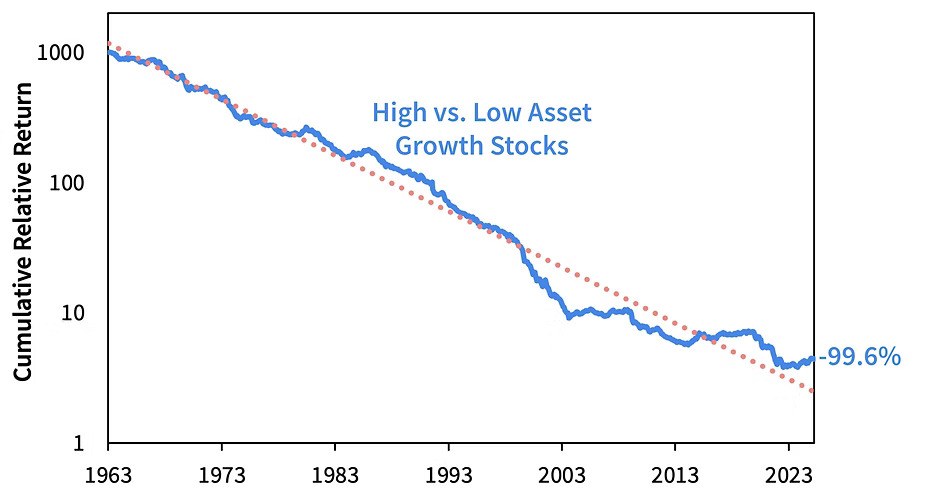
Setting up the main theme in dramatic fashion is the above image, the title of which is “Asset-Heavy Firms Underperform.”  According to the footnote, it shows “the relative return of top vs. bottom quintile stocks based on trailing 1-year capex to revenue.  Equally-weighted and rebalanced monthly.”

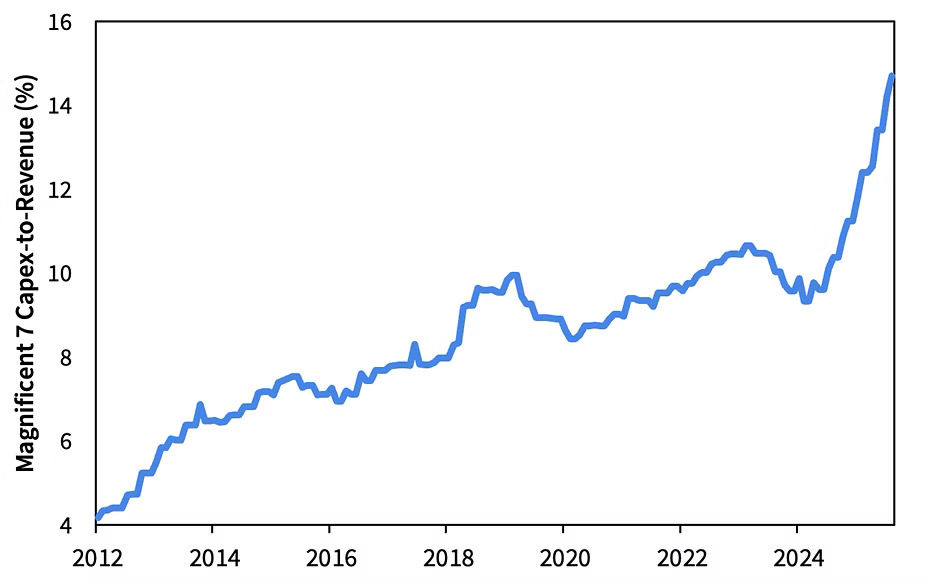
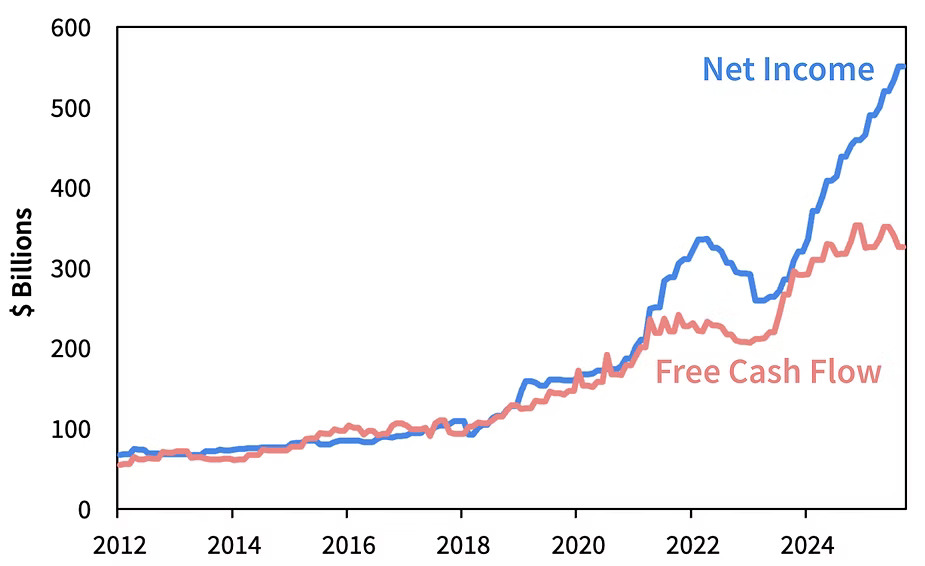
Today’s market leaders are morphing from asset-light plays to capital-intensive ones, with a sudden and significant rise in capital expenditures:

Leading to a divergence in net income and free cash flow:

There is much more covered in the report, including “hidden AI winners,” comparisons to previous hype cycles, the “AI prisoner’s dilemma,” and:

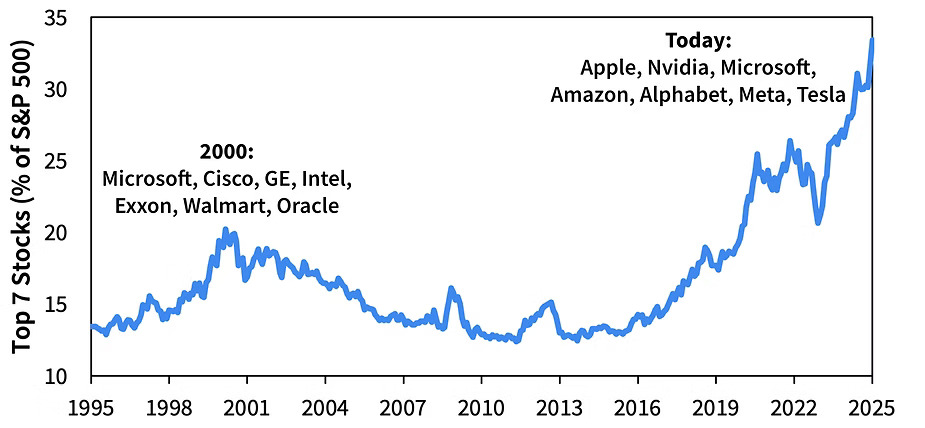
Although the Magnificent 7 still have sterling balance sheets, they are increasingly entangled with less financially-sound firms like OpenAI, CoreWeave, and Oracle.  In addition, with free cash flows dwindling, they are starting to turn to debt financing.

The stakes for the market are high, since it “is increasingly driven by a single theme”:

General partner positioning

Anthony Hagan of Freedomization writes regularly and well about the relationships between general partners and limited partners, mostly from the latter’s point of view.  However, three recent pieces have focused on choices made by GPs regarding how to position themselves in those relationships.

~ Which will it be, putting forth an aura of transparency or mystique?

~ Six topics about which GPs might take advantage of strategic ambiguity.

~ Doing reverse due diligence (to identify LPs you’re better off doing without).

Margin math

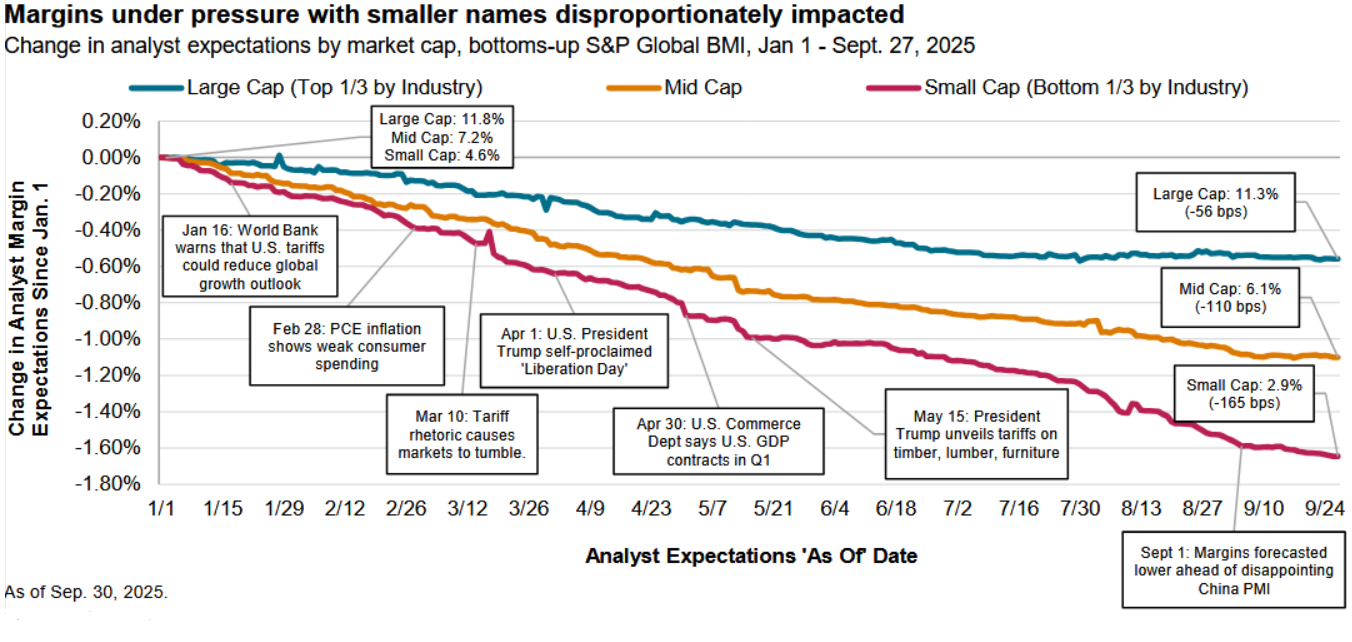
According to an S&P report, the forecasted sales growth for global companies is outpacing that for earnings because of pressure on margins due to “supply chain contagion,” related to increased tariffs and other issues.  As you might expect — and this graphic shows — the effects are more pronounced for smaller companies.

Other reads

“How to Use the Sharpe Ratio,” Marcos Lopez de Prado, et al., SSRN.

The Sharpe ratio remains the most widely used measure of investment efficiency, yet its naive application leads to misleading inference and financial losses.

“What’s up with private credit ratings?” Toby Nangle, Financial Times.  Insurance industry regulations provide a window into credit ratings issued on direct loans, prompting questions.

“The Cockroaches in Private Credit,” Covenant Lite.

BDCs and other private credit lenders exposed to healthcare roll-ups are already feeling the pressure.  While healthcare platforms make up a small share of assets, they make up a disproportionate share of problem loans.

“The Trading Floor – Cathedrals of Capitalism,” Rupak Ghose.  A brief history of and differences among trading floors at different kinds of firms.  (See also a previous Investment Ecosystem posting on the dynamics of an investment bank trading floor.)

“The Challenge of Diversification,” Chris Satterthwaite, Verdad.

Asset class diversification works well in theory, but for the return-maximizing investor the reality has been that benefitting from diversification has not been easy.  The sources of diversifying returns have been too fickle.

“Breathe Through Your Mouth,” Jeffrey Ptak, Basis Pointing.  Estimating the underlying expenses of a popular leveraged ETF.

“The New Face of Private Markets in Your 401(k),” Hilary Wiek, PitchBook.

Income-producing private assets are the best fit for offerings that allow frequent contributions and periodic withdrawals, which may disappoint those expecting this movement to provide access to more high-octane PE or VC.

“Strategy shares will go up if bitcoin goes up and won’t if it doesn’t: Citi,” Bryce Elder, Financial Times.  Parsing a research report on the preeminent bitcoin treasury company.

Cognitive diversity

“Surround yourself with people who are thoughtful in ways you are not, because they see what you can’t.” — Shane Parrish.

Flashback: Venture capital valuations

Released as a working paper in 2017 and subsequently published in the Journal of Financial Economics, “Squaring Venture Capital Valuations with Reality” by Will Gornall and Ilya Strebulaev laid bare a common industry practice that doesn’t stand up to scrutiny.  Namely, using the stated valuation of the most recent round of venture capital as the measure of its real value:

Many finance professionals, both inside and outside of the VC industry, think of the post–money valuation as a fair valuation of the company.  Both mutual funds and VC funds typically mark up the value of their investments to the price of the most recent funding round.

Written during a time when it became popular to name and count “unicorns” — those venture firms having a valuation above a billion dollars — the authors poked holes in the game:

Equating post–money valuation with fair valuation overlooks the option-like nature of convertible preferred shares and overstates the value of common equity, previously issued preferred shares, and the entire company.

Subsequent work by the authors and others have supported the conclusion that the stated value of venture companies is too high; most analyses have put the overvaluation in the neighborhood of fifty percent.  Yet we still see inaccurate values of firms cited in the press and in investment reports — and (most importantly) in the accounts of investors and employees — at levels much higher than they should be.

More on sell-side analysts

A 2023 posting, “Social Forces and Sell-Side Analysts,” was published on this site as a part of an extensive series, “Anthropology and Investment Organizations,” which looked at cultural patterns in different parts of the investment ecosystem.

Social forces play a meaningful part in investment decision making despite protestations to the contrary, and the role of the sell-side analyst is particularly exposed to those pressures:

“Webs of relationships” characterize the environments within which analysts operate, including those with the companies that they analyze, the buy-side investors who tap them for information (and “concierge services”), others in the firms at which they work, and their analyst counterparts at other firms, with whom they compete.

Thanks for reading.  Many happy total returns.

Published: November 3, 2025

Subscribe

To comment, please send an email to editor@investmentecosystem.com. Comments are for the editor and are not viewable by readers.

Continuation Funds, Differentiation, and the Modern Market

It’s an old story.  A hot area of the market starts to show some cracks and a few notable players make the news because of outsized losses in failed investments.

Some hits in the credit markets have generated lots of headlines recently, which makes it a perfect time to ponder the quality of due diligence practices.  That’s the topic of an upcoming essay from The Investment Ecosystem.  To receive it in your inbox, subscribe here.

On to the readings.

Continuation funds

As markets evolve, assessments of a class of investment strategies or structures can change.  For example:

The trajectory of continuation funds is a story of their remarkable turnaround, from a reputation associated with “zombie funds” to a repository of trophy assets.

That’s from a CFA Institute report by Stephen Deane and Ken Robinson on continuation funds, which acquire one or more assets from another fund managed by the same general partner.  “The Rise of Private Equity Continuation Funds,” an excellent law review article by Kobi Kastiel and Yaron Nili, addresses many of the same issues, “exploring the cautionary tale [the funds] present to the conventional deference of law and economic theory to private contracting among sophisticated parties.”  Among those issues:

~ There are all sorts of conflicts of interests.  A general partner is purporting to act as a fiduciary for both sides of a transaction (including for new investors in the continuation fund that weren’t in the legacy fund).  Those investors who move on to the continuation fund and those who cash out have different interests.  Which group comes out ahead in the transaction?

~ Something on the order of ninety percent of investors don’t roll over their stakes.  For many it feels like a forced choice, given the short amount of time to make a decision in most cases, the lack of information made available to them, and the inexperience of investing in individual companies versus hiring managers.

~ Limited partnership agreements “do not protect [limited partners’] interests regarding continuation fund transactions” (Kastiel/Nili) and the members of limited partner advisory committees aren’t responsible for representing the interests of all of the limited partners.

~ Law firms and financial advisors involved have their own interests in helping continuation funds be formed and in maintaining good relationships with general partners.

~ Limited partners are reluctant to litigate regarding questionable general partner tactics because they think it will impede their ability to gain access to other funds in the marketplace.

~ While advocates promote the funds as a “win-win-win” for all involved, in the end it’s the general partner that “almost always wins” (Kastiel/Nili).

These two sources provide a rich assessment of the practical realities and power dynamics in this area that should be of use to asset owners considering their options.

Given the rapid adoption of continuation funds, the historical record on them is sparce.  Two recent papers provide some early evidence as to the composition and performance of them:

“From Exit to Extension: The Rise of Continuation Vehicles in Private Equity,” Leon Luepertz, et al.

“Continuation Funds: Performance and determinants 2018-2023 vintages,” Oliver Gottschalg.

Differentiation

One concept we use in evaluating investment organizations is a simple ledger with “same as” on one side and “different than” on the other.  True differences are relatively rare, be they in investment process, operations, or any other facet of organizational design or activity, since most organizations within a particular realm look alike in big ways and small.

That’s true with portfolio structure too, which makes a new paper from Rocco Ciciretti, et al., “Portfolio Overlap and Mutual Fund Performance,” of particular interest.  The authors “find evidence of a negative relation between portfolio overlap and the fund’s future extra performance where only low-overlap funds, i.e. those that differentiate more their holdings from those of other funds, achieve positive risk-adjusted returns.”

Building those kinds of portfolios is behaviorally difficult, especially during periods of weak relative performance, when pressure from internal and external sources magnifies a portfolio manager’s concerns about career risk.  Building a culture that mitigates those tendencies and encourages differentiation should be a leadership priority.

The modern market

Morningstar released a report, “When Public Meets Private: Rethinking the Modern Market,” in which it highlights the performance of the Morningstar PitchBook US Modern Market 100 Index, which “has outperformed its public market equivalent over all trailing time periods with lower volatility.”

The index is comprised of the ninety largest public companies and the ten largest private firms.  Well, sort of.  Venture-backed private firms; large, successful private companies aren’t spicy enough.

Using Morningstar’s sector classification, the combination yields a technology weighting that is close to fifty percent (about fifteen points higher than the firm’s public index).  The report concludes:

This is only the beginning.  We are committed to developing a next generation of companion indexes designed to equip investors with more accurate tools, deeper insights, and better ways to navigate an evolving market landscape.  Together, these innovations will help move the science — and art — of investing forward, enhancing transparency, access, and opportunity for the entire market ecosystem.

Let’s see:  technology, convergence, and indexing as innovation.  It checks all of today’s boxes.  But in a few years will it still be at the center of trends or the vestige of a particular era?

Seating charts

One of the virtues of onsite due diligence is to see how offices are organized and, if possible, to observe where people sit at meetings.  Cultural dynamics are reflected in how people are arranged, something that Matt Levine has covered well in sections of his columns titled “Everything is seating charts.”

If you think that masters of the universe don’t care about such mundane things, take a look at a recent New York Times article by Ken Belson.  In the print edition, its headline was “Inside the N.F.L.’s Most Powerful Huddle” (the quarterly meetings of the league’s owners).  But the online title better captures the scene:  “Inside the World’s Most Powerful High School Cafeteria.”  To wit:

The seating chart in effect serves as a proxy for their status and their beefs.

Read it and know that such concerns motivate behavior even in organizations that seem above it all.

A complex web

There have been a number of attempts to map the increasingly recursive investments of key companies in AI.  For example, from a Bloomberg story, which called the relationships a “complex web”:

This one comes from Morgan Stanley:

Each published within the last couple of weeks, the images are already out of date, as new announcements seem to come nearly every day.  What’s the endgame?

Other reads

“Investing as Myth-Making,” Alexander Campbell, Campbell Ramble.  Stories are what drive the markets — and a simple structure (compelling narrative, inconvenient reality, genuine complexity, and predictable endgame) is used to summarize a bunch of the popular narratives of the day.

“Exploring Capital Efficiency,”  AQR.

The most diversifying investments are the most likely victims of this “line-item thinking” because their performance tends to stand out in the broader portfolio.

“Unlocking Domestic Investment Opportunities: Aligning Public Goals with Pension Fund Realities,” International Centre for Pension Management.  Regarding “the investable window” — how things need to come together for infrastructure investments to be successful for governments and investors.

“Where Factors Speak Loudest,” Lionel Smoler Schatz, Verdad.

We believe size matters — not as a standalone source of return, but as a modulator of other factors.  In our research, we have found factor premia are strongest in microcaps and fade gradually as market cap increases.  Small size amplifies factors, while large caps dilute them.

“The diversification illusion: how indexing turned the S&P 500 into a single risk bet,” Philip Hackleman and Álvaro Freile, Citywire Americas.  On the effect of indexing “in changing correlations between independent stocks.”

“6 Ways Longevity Is Transforming Investment Careers,” Tiffany Tivasuradej and Sarah Maynard, Enterprising Investor.

The investment industry’s greatest asset has always been its people.  As populations age and careers extend, that asset is changing in ways firms can’t ignore.

“The Mysterious Billionaire Boss at Jane Street Smashing Trading Records,” Sridhar Natarajan, et al., Bloomberg.  A fascinating story of a very un-Wall-Street-type co-founder of the highly successful firm.

“Changing Times,” Charles Skorina.

If most investment managers think alike, what’s to keep AI and algorithms from taking their jobs?

“Alternative Investment Due Diligence For RIAs: A Framework For Compliantly Evaluating Private Funds,” Ben Henry-Moreland, Nerds Eye View.

In short, different investments require different levels of due diligence.  While some are relatively transparent about their structure, risks, and costs, others require a much deeper dive for an advisor to meet the “reasonable basis” standard.

“This is a warning,” David Villalon, LinkedIn.  Copilot in Excel and “the risk of embedding non-deterministic AI into critical business functions.”

Keep them simple

“The simplest questions are the hardest to answer.” — Northrop Frye.

Flashback: Lehman Brothers

It’s only been three months since Lehman appeared in a Fortnightly flashback, that time featuring a 2007 slide deck describing the firm’s internal risk management.

We revisit the topic because Bryce Elder of FT Alphaville dropped a posting that included a trove of links to sell-side reports from around the time that Lehman went bust.  Short summary:  no one had a clue what was happening.  Given that the lessons of the past aren’t always passed on, the reports should serve as a module in investment training programs.

The chart above comes from a Morgan Stanley piece.  Such a “cone of possibilities” that shows the bull, bear, and base cases of an analyst is much preferable to a single target price under normal conditions, but it too fails in an all-bets-are-off situation.  The stock was a zero in less than three months.

A view from the inside

An essay on this site a year ago reviewed Private Equity, a memoir that oddly enough wasn’t about private equity per se, but the the culture inside one of the most highly recognizable investment firms of the day.

At its core, it is about the cultural divide that exists at most firms:

Those supporting the investment team were seemingly a world apart from it, and relatively small in number.  As such, they were surrounded by the trappings of wealth and status but not really a part of it.

Those insiders know things about the organization that even the most astute outside observers and due diligence analysts don’t.  As a result, the book is revealing.

Thanks for reading.  Many happy total returns.
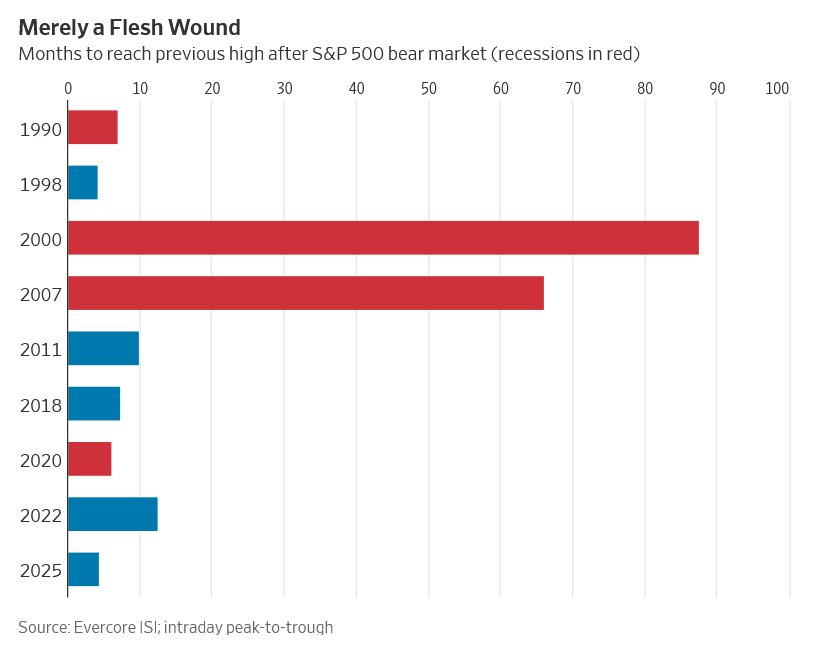
Published: October 20, 2025

Subscribe

To comment, please send an email to editor@investmentecosystem.com. Comments are for the editor and are not viewable by readers.

Humans and Machines, Greatest Hits, and Wounded Lions

Programming note:  The Fortnightly will not be published on October 6, returning two weeks later.

In case you missed it, the most recent Investment Ecosystem essay is “The Tyranny of the Playbook,” which examines “the missing art in the management of investment organizations.”

Humans and machines

Tesla represents one of the oddest market stories of the past several decades.  An amazing success in many respects, it is also known for some shady practices and frequent promotional claims regarding new features that turn out to be vaporware.  And for a very high multiple on its stock.

Those investors who love it really love it, and the same could be said for sell-side analysts.  A Financial Times article by Bryce Elder recounted the breathless and persistent advocacy of Tesla by Adam Jonas and his autos team at Morgan Stanley in 62 reports so far during 2025.  (A total of 32 reports were written about all of the other seventeen stocks that the team covers.)

A sell-side analyst has a hard job.  It’s a challenge to avoid being buffeted by market moves — last week, an analyst upgraded Tesla at $416 after downgrading it at $308 in June — and there are pressures and potential conflicts from all sides (companies, clients, and your firm).  Add to that the risk of falling in love with a stock or a CEO and you have a behavioral minefield.

So when will those rational machines take over?

Two other Financial Times articles address aspects of that question.  Alan Livsey looks at a Bernstein Société Générale test which showed that AI did pretty well with some basic tasks, but:

After this, everything went a bit sour.  Making pretty pictures and assessing the tone of earnings calls only make up a small portion of an analyst’s job.

In a similar vein, Robert Buckland thinks the junior analysts doing those basic tasks are most at risk now, with the people at the top not being disrupted any time soon.  In more than three decades on the sell-side, even as supporting technology advanced, Buckland saw very little change in the structure of how the work was done.  Now it’s coming and organizations (including slow-to-change sell-side ones) will be transformed.

So the questions are how fast and in what ways that will happen.  (Reach out if you want to have a discussion about what it might mean for your organization.)

Greatest hits

Focus Consulting Group marked its 25th anniversary with a compendium of ideas across the years written by its founder Jim Ware.  The firm has produced an impressive pile of books, papers, and videos over that time, all focused on the continuous improvement of investment organizations.  Its work on culture is particularly notable, including examining the various tribes within an organization, the importance of leadership behavior, the pernicious effects of blame, and the damage that can be wrought by a “Red X.”  All (and much more) covered in this summary.

Wounded lions

Bloomberg article by Nishant Kumar carried the title “Hedge Fund Traders on a Bad Streak Are the Hottest Recruits Around.”  You might not believe it, but:

Rather than being damaged goods, veteran portfolio managers making heavy losses are now some of the hottest recruits around.

Fallen stars are being viewed as battle-tested hunters temporarily off their game.  That moment of weakness is when they’re most poachable, driven and available at a discount, people with knowledge of the matter say.  Instead of the slog of recouping a pile of losses at their previous employer, traders can wipe the slate clean and start making money for themselves again.

While the trend is “infuriating some important investors and hedge fund bosses,” a hedge fund recruiter provides the pitch:

Even a wounded lion is still a lion. And the lion isn’t mortally wounded.  He will heal.  And when he’s fully back, that lion is worth a lot more money.

A fascinating read.

Focus versus diversification

There is an ongoing debate about concentration versus diversification in investment portfolios (see recent items from Owen Lamont of Acadian and Brian Chingono of Verdad arguing against concentration).  This image does not address that, but rather the discount given to companies with diversified operations versus focused ones.

The analysis comes from BCG.  It concludes:

On average, companies that streamlined their scope, concentrated capital and talent, and followed through with disciplined transformation outperformed peers in both relative [total shareholder return] and valuation metrics.

As you might suspect, and as is shown in the chart, the attractiveness of focus versus diversification varies in response to the economic environment.  BCG makes a long-term call on what works:

Although diversified models can offer advantages in moments of systemic crisis, the long-term premium increasingly favors focus.  In today’s market, where strategic clarity is scarce and investor scrutiny is high, focus is a path to market outperformance.

Reinventing cap-weighting

Research Affiliates, which is known for its pioneering work on “fundamental indexing,” has introduced another new variety of index, one “designed to fix a costly but little-known ‘bug’ in cap-weighted indexing.”

As with previous RA offerings, the index selects holdings based upon fundamentals but in the new incarnation weights them according to their market values.  The firm says that results in “better macroeconomic representation and better performance,” specifically by avoiding the “performance drag of procyclical rebalancing” of the leading cap-weighted indexes.

Another permutation.  As with all things like this, how well will the forward look match the backward one?

Active ETFs

While the massive size of passive ETFs means that they dominate active ETFs in terms of market value, the number of active ETFs is rising dramatically, as illustrated in the chart.

It comes from Morningstar’s “Guide to Active ETF Due Diligence.”  The report covers strategies that are well-suited to active structures (and those that aren’t); the relationship of ETFs that are linked to or derived from traditional fund structures; the importance of bid-ask spreads to the total cost of ownership; transparent versus non-transparent vehicles; differences in tax efficiency; and more.

Other reads

“Familiar Signal, New Context: The Evolution of Earnings Call Sentiment Analysis from Lexicons to LLMs,” Mengmeng Ao, et al., S&P Global.  On the effects of moving from rules-based natural language processing to LLM-based sentiment models.

“AI Will Not Make You Rich,” Jerry Neumann, Colossus.

There is nothing better than the beginning of a new wave, when the opportunities to envision, invent, and build world-changing companies leads to money, fame, and glory.  But there is nothing more dangerous for investors and entrepreneurs than wishful thinking.

“Wish I Was Making This Up,” Jeffrey Ptak, Basis Pointing.  Talk about a bad combination:  A fund paying out high distributions (including a return of capital) and investors chasing performance results in a bizarre bottom line for them.

“Songs my portfolio manager taught me (part 6),” Dan Davies, Back of Mind.

When this sort of order went round, usually after complaints from the sales desk of not having enough research to sell, everyone did the only thing they could do; they took all the existing crap they had, and lied about their level of conviction.

“Fun with Numbers, feat. The American Investment Council,” Tim McGlinn, TheAltView.  Sloppy (misleading?) advocacy by an industry group made up of major players.

“How do you get management to talk about things they don’t want to talk about?” Ian Cassel, MicroCapClub.

They only invest in businesses where there is enough transparency to allow them to see the business separate from whatever management is telling them.

“Best Practices for ERISA Plan Sponsors and Fiduciaries in a Changing World,” Stephen Rosenberg, Wagner Law Group.  Six recommendations for “A Cheat Sheet for Deciding Whether to Add Private Equity or Other Alternative Investments to Plans.”

“Hedge Funds Have a Reputation for Ruthlessness. Dmitry Balyasny Took a Different Approach.” Michelle Celarier, Institutional Investor.

“Dmitry leads first and foremost through positive reinforcement, which means that the firm’s culture is really characterized by encouragement and support, not fear,” says chief risk officer and partner Alex Lurye.

Cause and effect

“The answers you get depend upon the questions you ask.” — Thomas Kuhn.

Flashback: Showing again

Robert Redford’s death last week brought forth an outpouring of memories of his acting and his work as a director and promoter of independent films.  It also caused fans to watch his movies, including All the President’s Men.

Redford became interested in the story of Watergate well before it garnered much attention — and bought the rights to Woodward and Bernstein’s book even before it came out, then starred in the film version of it.

It is particularly timely to revisit it today.  Then, there were many examples of Nixon administration officials criticizing and pressuring the Washington Post about its reporting, waging a public campaign against it while covering up and lying about the facts of the matter.

Now we are seeing unprecedented attacks on the press by the current administration, including several multibillion-dollar lawsuits by Trump against media companies, direct pressure on firms to axe content/people, regulatory actions being subject to toeing the administration’s line, and threats to suspend broadcast licenses for exercising free speech rights.

More than a half century later, the words of Ben Bradlee at the end of the film are once again relevant:

Nothing’s riding on this except the First Amendment of the Constitution, freedom of the press, and maybe the future of the country.

Process improvement

Among the pieces in the archives is “Creating and Sustaining Process Improvement,” a posting from 2022.  It examines improvement loops and the differing effects of “working harder” and “working smarter.”

Thanks for reading.  Many happy total returns.
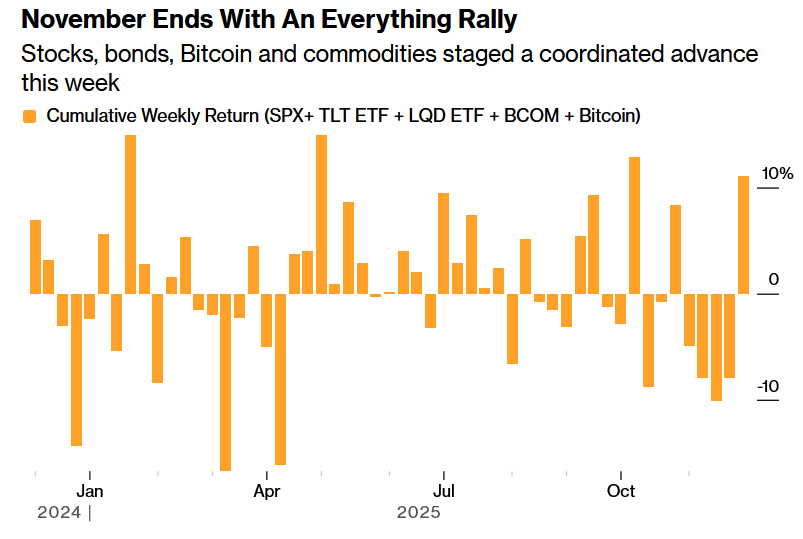
Published: September 22, 2025

Subscribe

To comment, please send an email to editor@investmentecosystem.com. Comments are for the editor and are not viewable by readers.

The Tyranny of the Playbook

Given the vast number of different strategies employed by professional investors, a revelatory question when you meet someone might be, “What game are you playing?”

While that inquiry is phrased in a more casual way than found in most initial encounters, after some give-and-take you’d probably get a good idea of where that person fits in the ecosystem and what type of investment philosophy they employ.

You’d also come away with a sense of the narrative elements that they use to tell others what they do.

This posting is not about those investment games or marketing games, but rather the inclinations of individuals and organizations to accept or challenge the status quo industry practices in their playground of choice.

Playing to win

Phil Bak wrote a piece entitled “Playing to Win.”  The subheading — “You can’t be loved by your industry’s incumbents and be a disruptor at the same time” — tells you where he is on the innovation spectrum, which is borne out by the anecdotes he conveys.  One example:

So I am getting ready for the final big boss level meetings with this company, and I had a choice to make.  Do I tell them what they want to hear, which will lock in the deal, or do I tell them what they need to hear?

Being the idiot that I am, I chose the latter.

A choice he then termed “playing to win.”  In contrast:

There are a lot of people in the finance industry who aren’t playing to win.  They think they are, but the game they are trying to win is one of career ascension.  A game of politics.  A game of love-me.  A game of being nice.

A game of not wanting to upset their competitors, especially not the biggest ones. After all, they might have a job for me one day.

That’s not playing to win.  They aren’t going for the kill.  Good people, nice people, smart people.  Good at what they do.  Professionals.  But the killer instinct?  They don’t have it in them.

That speaks to the career risk that constrains investment professionals and the stasis that plagues the organizations they inhabit.

Which is why it is essential to incorporate new ways of thinking into an industry that despite the dynamism of the markets can be resistant to change.

Doing both things

The always-entertaining Rory Sutherland gave a presentation at Nudgestock 2025 on “Soft Power in a Hard World.”  His thesis was that we get stuck in an either-or mode when we make decisions — including hewing to our native side of the explore-exploit tradeoff.

To Sutherland, it shouldn’t be a tradeoff at all; we ought to always be doing both.  To illustrate his point, he referenced the famous “waggle dance” of bees, which directs the members of the hive to the most attractive sources of nectar and pollen.  It turns out that about twenty percent of the bees aren’t following the dance at all.  (Another example of the Pareto principle.)  Consider this description of the complex system in which bees have evolved over millions of years (a bit longer period of development than the modern investment industry):

If you don’t have the rogue bees, the random bees, the hive gets trapped in a local maximum and starves to death.  It gets overoptimized on the past, because all big data comes from the same place, the past.  The hive will then become preoccupied in harvesting sources of pollen that it knows about and completely underinvest in discovering new fields where flowers may have come into bloom or new opportunities.

To succeed you need to do both short-term things and long-term things.  The mindset is different for each of those pursuits and organizations tend to focus on what can be quantified, playing to that local maximum.  But the real world is one of fat tails and the big wins aren’t found in a spreadsheet or model, certainly not one that projects thin tails:

Most of business is probabilistic.  The most effort in business is devoted to pretending that it isn’t.  It’s the pretense effectively of certainty, the pretense of knowledge.

Sutherland has many other worthy ideas, including observations on the success of long-standing family businesses (and the risks inherent in an obsession with “shareholder value”).  He also quotes Benjamin Braun:  “You have to dare to be different otherwise you do not cut through the noise.”

The tyranny of the playbook

In Bak’s posting, he recounted an opportunity to present to a venture capitalist:

I went through our rationale.  I’m talking about outsourced capital markets services for independent asset managers.  I’m talking about my reverse cap fund and index concentration.  And she was horrified by my presentation.  I shit you not:  horrified.

“Where is the problem slide?  Where is the solution slide?  Where is the TAM?”

And I’m like, you want me to disrupt the entire finance industry but you can’t handle me disrupting the standard pitch deck formula?

Bottom line is, she was playing one game.  A game where a pitch deck is a book report and should be done the correct way.  I was playing a different game.  I was focused on clients and opportunity.  She was playing to check off boxes.

That vignette encapsulates the tyranny of the playbook — the career playbook, the organizational playbook, the industry playbook.

More than anyone, you would expect a venture capitalist to be among the most imaginative listeners around.  But if you’ve seen how formulaic venture pitch books are, you know that the decision makers can be as hidebound as anyone else, thinking that the current playbook captures the way of the world.

Rogue bees

In most investment organizations, there is a severe shortage of rogue bees, of people who aren’t satisfied following the swarm in the direction called for by today’s waggle dance.

To mix metaphors, we need to foster those who don’t stick to the current playbook but think about the kinds of ideas and resources and talent the next game will require — and are willing to push for them.

Seeing the value of those rogue bees has always been a challenge in the investment world, where their contributions can’t be measured in basis points and the changes they propose can’t be backtested to “prove” that they work.

Finding those people and effectively leveraging them is the missing art in the management of investment organizations.


If you found this of interest, check out “The Active Management Reinvention Project,” published in 2024.

Published: September 17, 2025

Subscribe

To comment, please send an email to editor@investmentecosystem.com. Comments are for the editor and are not viewable by readers.