Bitcoin Treasury, the Value of Creativity, and Paying Up for Safety

If you don’t already receive these postings via email, you may sign up here.  (And don’t forget to share with your co-workers and friends.)

On to the readings.

Bitcoin treasury

Michael Saylor of Strategy (née MicroStrategy) is the godfather of the corporate bitcoin treasury movement.  He has bet his company on the digital currency (if “currency” is an appropriate description of bitcoin).

In the Financial Times, Craig Coben writes that, since the premium afforded by investors to Strategy for its bitcoin holdings has been shrinking, “it feels like the magic is fading.”  But other companies are rushing to adopt Strategy’s strategy.

As chronicled in a series of Be Water postings, we’ve seen similar developments before, especially during the 1920s bubble in investment trusts and the crash in their values that followed.  And you can hear an echo of the CDO-squareds of the financial crisis, with a new “Strategy-squared” plan to use a “digital-asset treasury company to invest in other digital-asset treasury companies.”

Proponents are thinking big.  For example, Zac Townsend of Meanwhile, “a BTC-denominated life insurer and asset manager building long-term financial infrastructure,” wrote an opinion piece for Institutional Investor, which began:

The conventional wisdom on Bitcoin treasury companies that make holding BTC their primary business is that they’re just clever public-market arbitrages.  They’re levered bets on digital gold wrapped in corporate paper.  But to believe that take is to miss the forest for the trees.  These firms aren’t short-term trades.  They’re the seed stage of the world’s next generation of endowments.

The institutional world has been inching toward the inclusion of crypto investments in the standard toolkit.  Banks and advisory firms that swore they wouldn’t offer crypto-related products are now doing so.  And investment credentialling organizations have responded too — see one 2023 example, “Valuation of Cryptoassets: A Guide for Investment Professionals,” from CFA Institute.

Every supposed new era in investing promises a bright future of expanded possibilities.  Sometimes it comes true, sometimes not.  Making choices as to what to believe when in the midst of the excitement is the hardest part.

The value of creativity

In “The Value of a Creative Hire in Finance,” Stacy Havener offers a scenario:

Your new creative hire walks into a meeting.  They’re the only one in the room without a CFA designation.  They can’t rattle off the Sharpe ratio from memory.  If you asked them to explain a basis point, they might pause.

At this point, you might say, “Why would you hire someone that unprepared?”  Except they aren’t really unprepared, you just think they are because they don’t know what you know or do what you do.

They bring different skills to the table — ones in short supply at many organizations.  Havener does a good job of describing what it takes to connect with (and stay connected with) prospects and clients in ways that are outside of the typical playbook for many investment professionals.

But the need for creative types is not limited to the marketing function.  Having everyone of one type on an investment team impedes good decision making and results in a lack of continuous improvement in methods.  You won’t end up with needed creativity in the investment process if you don’t have some at-least-marginally-creative people involved.

Chenmark invests in small businesses, but the topic of its most recent weekly piece fits here and is applicable to all of us, no matter where we are in the investment ecosystem.  We all should want to “read the air,” yet the ability to do so is generally undervalued in our industry.

Paying up for safety

Recollections of the late-nineties stock market are usually focused on technology companies, especially the dot-coms which crashed thereafter.  But all manner of stocks reached multiples substantially above their norms, including some “big and safe” ones.  Coca-Cola traded around fifty times earnings before that ratio fell steadily over the ensuing years, finally bottoming in the low teens during the financial crisis.

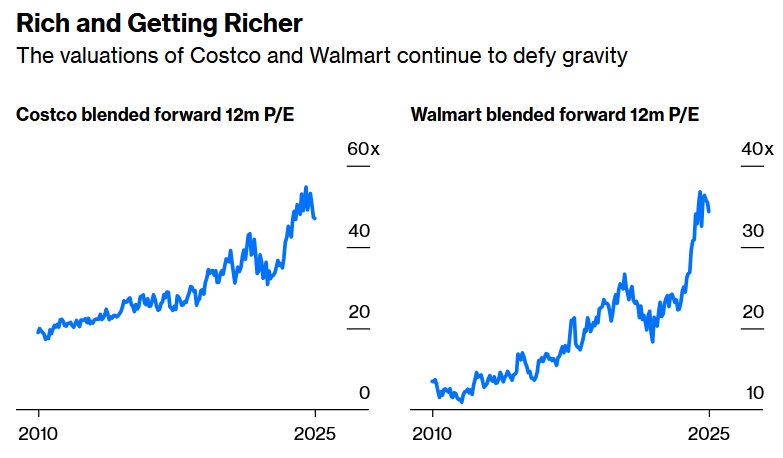
Bloomberg column by Jonathan Levin points out a similar circumstance today:  “Forget Nvidia. Costco and Walmart Look Scarier”:

As the story goes, Costco and Walmart are all-weather stocks.  Their reputation for good value means they profit in good times and snap up market share when the economy goes south.

And, as you can see from the charts (and from history), how those profits are priced by investors can vary significantly over time.  “Reasonable” is a movable standard.

AI pitching and AI washing

Angelo Calvello, a veteran of marketing AI investment capabilities, offers recommendations on “how to pitch an AI strategy.”  His four lessons provide a good framework for investment managers trying to figure out how to position themselves in this new world.  The last of the lessons — “Explainability Is Non-Negotiable” — deals directly with one of the core questions that managers have:

Allocators won’t invest in AI strategies where the model developer is unable to explain the model decisions (despite the irony that human decision-making is equally opaque).

For those on the other side of the table, Joseph Simonian published a report for CFA Institute, “AI Washing: Signs, Symptoms, and Suggested Solutions for Investment Stakeholders.”  He covers the motivations behind AI washing for managers and the dilemmas they face promoting changes in their process related to AI.  The report ends with a list of “the most pertinent questions for asset owners and prospective clients.”

Active and passive

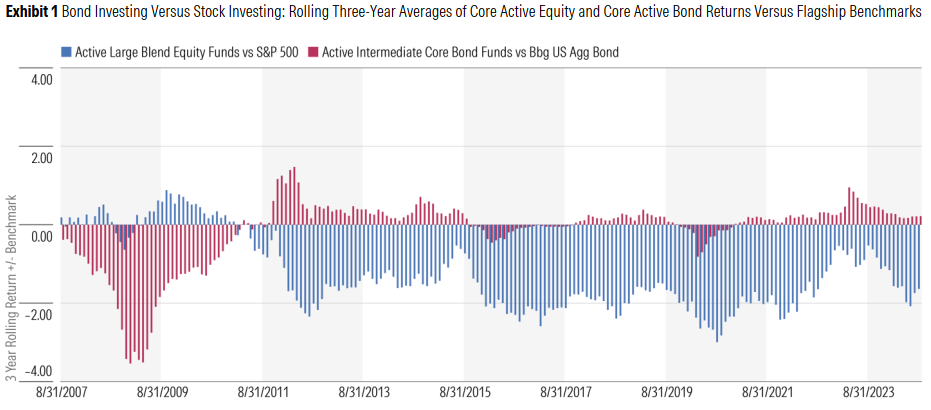
Eric Jacobson of Morningstar wrote a report entitled “The Bond Market as Fertile Ground for Active Management.”  It “argues that the bond market’s structure and complexity create substantial inefficiencies so fundamental and inherent that eliminating them anytime soon would be a mammoth and improbable task.”

This chart, one of many in the report, shows the pervasive underperformance of equity funds over the last fifteen years and the frequent, if modest, outperformance by bond funds.

Elsewhere, writing for the Alpha Architect website, Larry Swedroe examines the “classification paradox” for equity vehicles, which he believes “creates more confusion than clarity”:

Rather than getting caught up in arbitrary active/passive labels, investors should focus on more meaningful distinctions.

Down on the farm

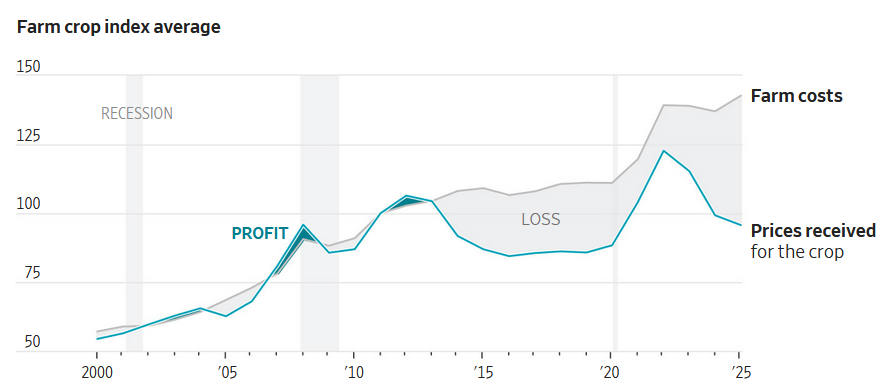
Wall Street Journal article begins:

American farmers are good at producing two crops: corn and soybeans.  Too good, actually.

Advancements in seeds, pesticides, and equipment have led to bumper crops.  Plus, farmers have gone from planting “fencepost to fencepost” in the old days to increasing the acres planted:  fenceposts are rare now (allowing for a bit more land to plant), tiling has drained most of the wet spots, and irrigation is used in dry areas.  Plus, a warming climate has made it possible to plant in northern regions where it wasn’t practical before.

The cost of inputs has increased significantly — and demand and market prices have lagged, resulting in the decade-long loss profile shown in the chart.  Tariffs have made the demand situation even more dicey.

Surprisingly, land prices have increased steadily over the years, although a little softness is starting to show up.  As the article indicates, the Trump administration is considering a bailout for farmers; given the way large producers now dominate the business, that may not provide the help to those who need it the most.

Other reads

“An Old-School Hedge Fund Strategy Reboots Outside Big Pod Shops,” Liza Tetley and Nishant Kumar, Bloomberg.

Making money out of event-driven strategies requires conviction and a lot of patience.  It’s at odds with the rules hard-coded into the DNA of most pod shops that typically set tight loss limits to achieve the steady returns their investors demand.

“Bull Markets,” Ian Cassel, MicroCapClub.  Polar opposite challenges and behaviors in bull and bear markets.

“Private Markets for the People? Or Just More People for Private Markets?” Ludovic Phalippou, SSRN.

Giving individual investors exposure to a high-fee, opaque, conflict-ridden asset class — marketed using gameable metrics and de facto fictional track records — is not governance for the people.  It’s governance at their expense.

“Democratizing Private Markets: Private Equity Performance of Individual Investors,” Cynthia Balloch, et al., SSRN.

We document that individual investors [in private equity] achieve performance comparable to institutional benchmarks and outperform public markets on aggregate.  However, this overall success masks important heterogeneity, with a significant wealth gradient where the most affluent investors substantially outperform the least affluent.

“Spotting Accounting Shenanigans with AI,” Matt Robinson, AI Street.  Can machines do a better job of spotting problems than analysts, who are anchored by management guidance?

”Carpet Guys,” Phil Bak, BakStack.

There is only so much we can learn from our computer desk.  There is only so much we can understand about the world through screens.

Confidence

“Too little confidence, and you’re unable to act; too much confidence, and you’re unable to hear.” — John Maeda (via Jim O’Shaughnessy).

Academic research

Most Fortnightly editions, including this one, reference academic research sources.  A 2022 posting, “How to Use Academic Research,” covers some basics and then provides three examples of papers and questions that could be asked in response to them.  The topics considered are pairs trading, fund size, and selecting managers.

Thanks for reading.  Many happy total returns.

Published: September 8, 2025

Subscribe

To comment, please send an email to editor@investmentecosystem.com. Comments are for the editor and are not viewable by readers.

The Hunt is On, The Drinking Game, and Unexceptionalism

A late August buffet of tasty reads for you before market activity starts to pick up again.

As a reminder, the mission of the Investment Ecosystem is to help investment professionals and organizations working on continuous improvement.  To that end, if you ever want to weigh in on how we are doing — regarding our publications and courses, or Tom Brakke’s presentations and consulting work — you may do so anonymously here.

The hunt is on

In a Bloomberg story, “Private Equity Keeps Inventing New Ways to Give Cash to Investors,” Andrea Auerbach, global head of private investments at Cambridge Associates, was quoted as saying:

All sides of the industry are looking for liquidity in different ways.  The hunt is on.

The dearth of distributions from private vehicles has changed the game.  The illiquidity premium is starting to look like a penalty.

Preqin put summaries of three different vehicles — continuation funds, evergreens, and secondaries — into one short report, “Unlocking Liquidity in Private Markets 2025.”  Each is related to the current theme, although they don’t really fit together — or deal much with the problem except on the margins and over time.

Jason Zweig of the Wall Street Journal aims a laser pointer at the core issue in his column, “The Ivy League Keeps Failing This Basic Investing Test.”  Those endowments pressed the edge of the envelope on private funds and, as happened to them during the financial crisis, outside events unveiled the inherent risk in their strategy.  While not (yet) facing their own threats from the Trump administration, other asset owners who gorged on privates in imitation should see the trade-offs differently now.

To look at liquidity and private equity in a different way, Richard Ennis and Daniel Rasmussen analyzed the “public-market pricing of private equity interests on the London Stock Exchange.”  While the number of vehicles included in the review is admittedly small, collectively they hold over a thousand buyout funds.  The authors conclude that private equity is more volatile, more correlated, and has a much higher beta than public equity — and that discounts to net asset value are below and much more variable than those indicated by reported secondary transactions.

The drinking game

Long-time CNBC correspondent Bob Pisani started a Substack newsletter.  His first dispatch was about dealing with difficult people (he used a different word).  The most recent posting is “Drinking on Wall Street: A Primer.”

Pisani paints the drinking scene in some detail.  What’s most interesting is his place within that culture, how and why he did some of his work over cocktails and what parts of the market story come out in that setting versus others.

Also of interest was his view of “the dirty truth about Wall Street commentary: most of it is crap”:

80% of it was garbage, and I am not exaggerating.  Most analysts and strategists exhibit very little original thinking and are exceptionally poor writers.

Journalists and investors both need to get at the story (and be able to tell it well).  We have much to learn from each other.

Unexceptionalism

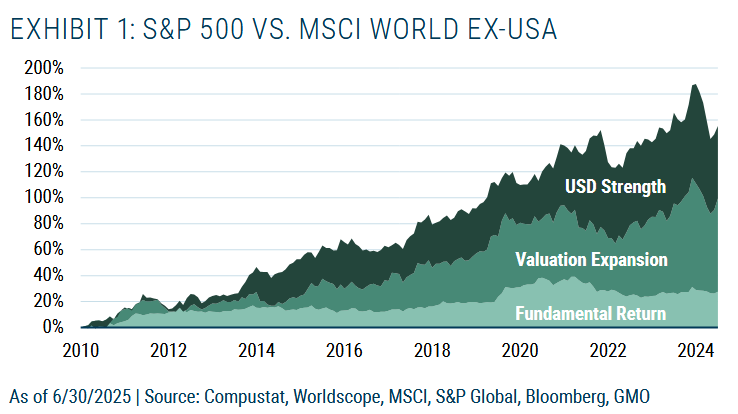
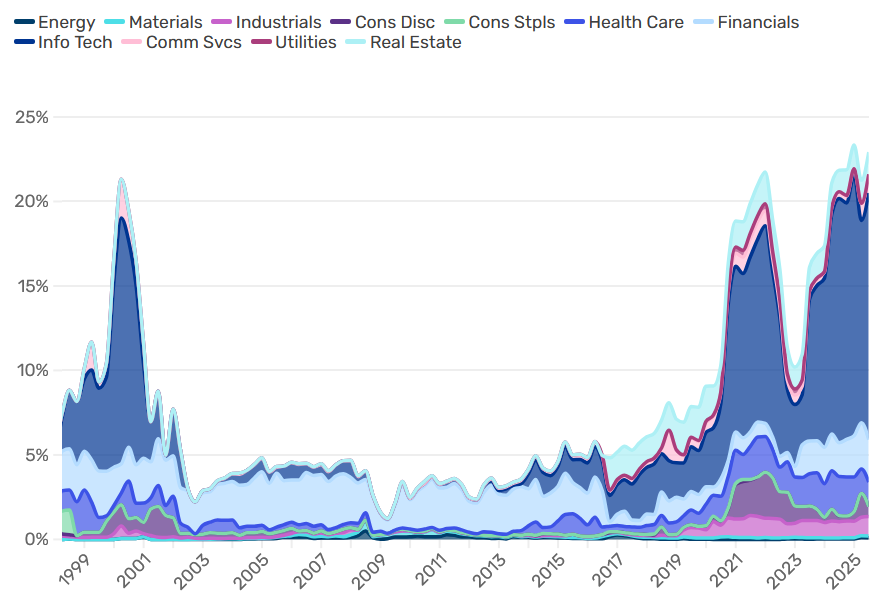
The latest letter from Ben Inker and John Pease of GMO is “American Unexceptionalism,” a play on the pervasive phrase that doesn’t include the “Un-.”  The new description stems from the relatively small portion of differential return of the S&P attributable to fundamentals:

The magnificence of the success of the very largest companies in the U.S. stock market has led to an assumption that U.S. companies on average have done well, when in fact they have not.

The chart is also included as an example of another kind of unexceptionalism:  the use of stacked-area charts when a regular line chart would provide more information.  The same information done in that fashion would allow for accurate and easy observation of the ebb and flow of the three individual parts, something that is not possible when values are stacked together.  (This example is a convenient one, but stacked-area charts are a widespread industry scourge.)

Hedge funds

On the same day last week, Bloomberg published two articles on hedge funds.  One:  “Frustrated Hedge Fund Investors Push Back on Sky-High Fees.”  The other:  “Investors Pile Back Into Hedge Funds With Decade-High Inflows.”

The first article is really about the passthrough fees of multistrategy funds — and a few asset owners balking (or talking about balking) at the high levels of fees that the funds are levying against gross returns.  But the story itself doesn’t really live up to the headline.  There may be an inclination by some to push back on fees, but there’s no real sense that it’s happening much at all.  And, for those firms that have had “unusually high returns,” the asset owners are not as concerned (although in that case they’d sure like to have a cash hurdle in place).

According to the other article, no matter those qualms, “appetite for the largest multistrategy firms . . . has remained consistently high.”  Allocators are pushing hedge funds these days — despite the owner-unfriendly terms that have remained in place for decades — and multistrats, the latest and boldest manifestation of those terms, are the luxury goods that people want to say they own.

Buffer funds

AQR has extended its previous work on buffer funds, with a short summary on its website and an extended article published in the Journal of Portfolio Management.  As before, the verdict is that the popular funds underdeliver on their promised goals.  For starters, those payoff diagrams that are part of the pitch don’t represent reality very well.  In fact,

Buffer funds are less a breakthrough and more a familiar repackaging:  the promise of comfort, cloaked in complexity, at the cost of risk-adjusted returns.

In that they uphold “the broader lineage of structured products,” with the analysis adding to “a growing body of evidence that much of the innovation in this space is superficial, engineered more for sales than for substance.”

Individual investor power

Marc Schmitt sees a pattern in recent years that has “reshaped the trajectory of financial innovation itself.”  A couple of quotes from his paper:

The technology-enabled rise of individual investors has democratized financial markets, challenging the long-standing dominance of Wall Street professionals.

Existing models often assume rational agents operating within information-efficient environments, overlooking the behavioral patterns and technological affordances of the modern individual investors.

There is no doubt that market power has shifted somewhat — just ask those pros who were on the short side of the big meme stocks — but to what degree?

Along similar lines, Byrne Hobart wrote a posting on The Diff about “Corporate Populism,” in which he sees new kinds of corporate activity designed to appeal to retail investors.  Investor relations of a different sort.

Other reads

“The Calculus of Value,” Howard Marks, Oaktree.  A great exposition of price and value, with some comments on the current market state.

“Private Credit Hyperscalers Risk Eroding Investor Returns,” Jeffrey Diehl, et. al, Adams Street.

Rapid asset scaling increases pressure on investment teams to deploy capital, which can compromise underwriting standards and credit selection.  This can lead to sub-par returns, an underappreciated risk for institutional investors, the traditional source of capital for private credit managers.

“Being an angel investor is tougher than it looks,” Craig Coben, Financial Times.  Years of investment experience in one area don’t necessarily prepare you for another.

“It’s So Simple,” Jeffrey Ptak, Basis Pointing.

Talk about a good sort.  It’s an almost perfect stairstep from the cheapest funds to the priciest and it didn’t matter how long the period was.

“Cash Holdings,” Michael Mauboussin and Dan Callahan, Morgan Stanley Investment Management.  How should we think about cash on corporate balance sheets?

“Seemingly Straightforward Positive GP Characteristics That Are Tricky For LPs To Evaluate,” Anthony Hagan, Freedomization.

The tone of a GP’s or placement agent’s fundraising frustration visibly and audibly changes when these individuals believe their product truly embodies or delivers what LPs have historically sought, yet it still fails to gain the expected traction.

“Are Busy Analysts Detrimental? Evidence from Stock Price Crash Risk,” Lucas Schwarz and Flávia Dalmácio, SSRN.  What workload produces the best results?  (A universal and important question; see also this posting.)

“The Spectrum of Infrastructure Assets,” Meketa.  A summation of the range of offerings.

Talking your book

“I have never been more right.” — Neil Woodford, to his fund company board, two months before the fund was suspended due to an illiquidity crisis (source).

Flashback: Leverage

Leverage builds in every cycle before some of it is cleared out (in whatever manner).  You could date our current market cycle to the end of the financial crisis — quite a long time — or the pandemic-induced selloff.  In either case, we’ve seen leverage increase of late in a variety of ways.

That makes it a good time to link to a D. E. Shaw piece from 2010, “Lessons from the Woodshop: Common Sense in Managing and Measuring Leverage.”  The woodshop reference is an analogy to woodworking:

Leverage and power tools share three fundamental properties:  they can be extremely helpful, they can allow for far greater precision, and they can be really dangerous, even in the hands of experts.

The conclusion:

Quantity should not be the sole consideration in evaluating leverage.  Equally important are the quality and riskiness of both the portfolio and the leverage supplied.

Wined and dined

The only posting in a short-lived category on this site, “Lutèce, Antoine’s, Arnaud’s — and Denny’s” recounts being wined and dined by companies and brokers forty years ago.  Some things have changed, but this hasn’t:

Wherever you are in the ecosystem, there are people whose job it is to curry favor with you.

Thanks for reading.  Many happy total returns.

Published: August 25, 2025

Subscribe

To comment, please send an email to editor@investmentecosystem.com. Comments are for the editor and are not viewable by readers.

A Modern Financial Tale, Succession, and That Time of the Year

It has been a year since the publication of the popular posting “The Active Management Reinvention Project.”  What attempts at (real) reinvention have you made or seen made by others?  (Time marches on.)

A modern financial tale

In a new article, The Terminalist examines the “LSEG saga,” wherein the London Stock Exchange Group purchased a collection of financial data assets that had been assembled by Thomson Reuters, including Eikon, its terminal offering.

The conglomeration of assets, put together over the last three decades, “carried extensive technical debt from years of underinvestment, representing a rushed merger of two different product roadmaps, operating architectures, and technology stacks.”

Before LSEG became involved, Blackstone carved out those assets from Thomson Reuters (calling them Refinitiv), using a little equity and a whole heap of debt.  So, despite the firm having “decaying infrastructure while losing market share to better-capitalised rivals,” the cash flow was needed to pay interest, not to invest in the business.

In short order, before the folly of the endeavor was apparent, Blackstone talked LSEG into buying Refinitiv, “tripling the equity value in less than a year, when the core business was still incinerating capital.”  The Terminalist calls it “a staggering wealth transfer from LSEG shareholders” and “a loot like none other.”

There is much more to the story, including LSEG’s liberal use of adjusted measures and EBITDA to make itself look better.  For now:

When boards reward executives for performance that excludes the costs of poor judgment, they don’t just enable bad decisions; they guarantee them.  When private equity extraction mechanisms go unchallenged, public company balance sheets become extraction targets and shareholders unwitting ATMs.  When financial engineering surpasses operational excellence, valuations become inflated by metrics that obscure their true value.

Succession

Permanent Equity rolled out a series of seventeen emails earlier this year, all on the topic of succession, a vast collection of information that is now available in one spot.  Included are the core questions that need to be addressed, useful resources from elsewhere, and a cast of characters to illuminate the ideas, from Augustus Caesar to Willy Wonka, Vito Corleone to Steve Jobs, and Spiro Agnew to Logan Roy.

The firm invests in long-horizon private equity, but the content is more broadly applicable.  There are succession issues in every organization, including all the ones you invest with and your own.

That time of year

As July turns into August, things get quieter at many firms and the markets slow down.  Until something happens.

The August to October period has featured many of the more notable market spasms over the years.  Owen Lamont of Acadian provides historical context for the seasonal patterns that existed when the United States was an agrarian nation.  Now he chalks it up to summer vacations.

Byrne Hobart agrees:  “The mechanism for these summer losses is, at least in part, a matter of tracking down the person who’s in a position to make an authoritative decision.”  That contributes to the “slow-then-fast nature of a summer slump.”

Meanwhile, who is minding the shop at the asset managers you use?  That’s the question asked by Joseph Eden in a Citywire Selector article, “What really happens when fund managers go on holiday?”

Data centers

The last two editions of the Fortnightly have included pieces on data centers from Paul Kedrosky.  His latest, “The Kanye/Data Center Crossover,” deals with the sudden change in interest in the topic.  (The title comes from a comparison of search volumes for data centers and for Ye.  Unfortunately, the posting is behind a paywall.)

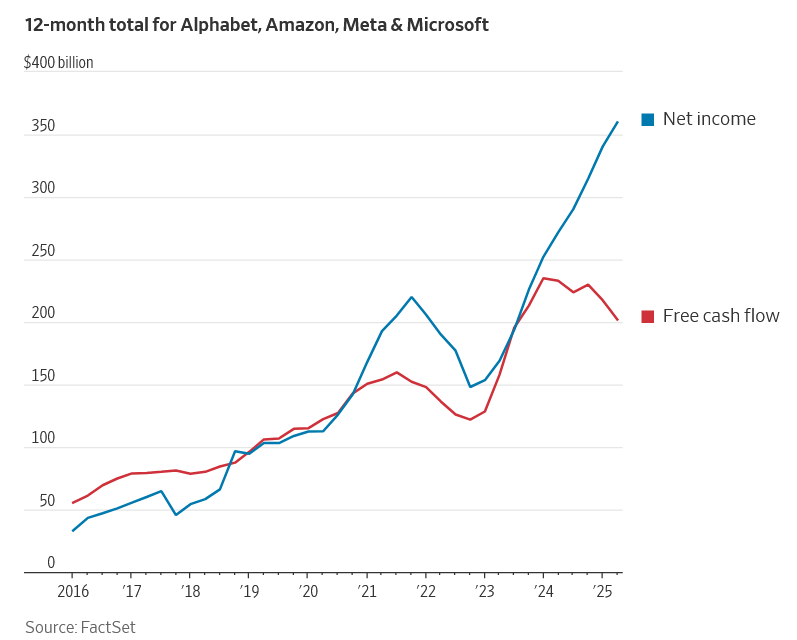
To his point, stories about implications of the massive capital expenditures being funneled into data centers are now proliferating elsewhere.  For example, the illustration above comes from a Greg Ip piece in the Wall Street Journal (“The AI Boom’s Hidden Risk to the Economy”).  See also “Will data centers crash the economy?” by Noah Smith.

Given the potential economic impact (and portfolio impact, due to the number of investment strategies tied to the trend), it ought to be near the top of the research agenda.

Memorable answers

Anthony Hagan of Freedomization shares interesting perspectives week in and week out regarding the relationships between general partners and limited partners.

One example:  “Memorable GP Answers To Common LP Questions.”  Note that all of the situations involve general partners being clear about who they are and what they are trying to do, rather than shading their spiels to try to please.

Housing

Matt Zeigler put together “five cool charts” regarding the housing market for Epsilon Theory, identifying narrative shifts regarding that key part of the economy.  The charts concern where bargaining power is now (it’s turned into a buyer’s market); the effects of climate, tariff, and zoning changes; and how “housing as an investment” has varied in narrative intensity over time.

New heights

This image from the Man Group shows the share of MSCI World stocks trading at more than ten times enterprise value to sales.  Its conclusion:

While AI-driven enthusiasm has pushed valuations to extremes, history tells us that stocks trading at these multiples rarely deliver the returns needed to justify their price tags.  Caution is warranted.  Fundamentals still matter.

What’s yours?

Other reads

“Buffett’s Intangible Moats,” Kai Wu, Sparkline.

Buffettʼs long-term success is largely driven by systematic exposure to two key factors:  Intangible Value and Quality.

“KKR recut terms with big backers to hand rich investors larger share of deals,” Alexandra Heal, Financial Times.  The push to market private assets to individuals — and to put that money to work right away — is leading to changes in terms for institutional asset owners.

“More Meetings Means Less Thinking,” Joe Wiggins, Behavioural Investment.

Even when the process to reach a decision takes time and spans multiple meetings, it doesn’t mean that there has been space for measured thinking.  It is more likely just a chain of meetings where instinctive, system one thinking has been the guiding and dominant influence.

“Four Mantras from the Endowment: A Personal Journey,” Ted Karns, LinkedIn.  Lessons from “debates, cycles, mistakes, crises, recoveries, and conversations around conference tables” at the Princeton endowment.

“How GenAI-Powered Synthetic Data Is Reshaping Investment Workflows,” James Tait, Enterprising Investor.

Investment professionals routinely face limitations:  historical datasets may not capture emerging risks, alternative data is often incomplete or prohibitively expensive, and open-source models and datasets are skewed toward major markets and English-language content.

“Two lesser-known factors behind David Swensen’s success at Yale,” Charley Ellis, Financial Times.  Organizational alpha, internally and in dealings with asset managers.

“Nothing Works All the Time,” Ben Carlson, A Wealth of Common Sense.

Just because something worked in the past doesn’t mean it will work in the future.

“The $2 billion (plus or minus) marketing boost that helped mainstream ETFs,” Pat Allen, Finfluential.  Why you see all of those advertisements for QQQs.

“What A World (A Few Stories),” Morgan Housel, Collaborative Fund.

BlackRock CEO Larry Fink once told a story about having dinner with the manager of one of the world’s largest sovereign wealth funds.

The fund’s objectives, the manager said, were generational.

“So how do you measure performance?” Fink asked.

“Quarterly,” said the manager.

The gap between ideals and reality.

Asymmetry

“Our knowledge can only be finite, while our ignorance must necessarily be infinite.” — Karl Popper.

Flashback: Entrepreneurs

Saras Sarasvathy’s 2001 paper “What makes entrepreneurs entrepreneurial” became widely known because of a copy that included notes attributed to the venture capitalist Vinod Khosla.  Below the title he wrote, “First good paper I’ve seen.”

Sarasvathy contrasted the “effectual reasoning” of entrepreneurs and the “causal rationality” that dominates most business thinking.  While causal rationality “tends to focus on the avoidance of surprises as far as possible”:

Great entrepreneurial firms are products of contingencies.  Their structure, culture, core competence, and endurance are all residuals of particular human beings striving to forge and fulfil particular aspirations through interactions with the space, time, and technologies they live in.

Causal reasoning:  “To the extent that we can predict the future, we can control it.”

Effectual reasoning:  “To the extent that we can control the future, we do not need to predict it.”

Much different mindsets.  And while it is not the point of the paper, the exposition helps to explain why so many established firms have a hard time innovating.

Capital allocation

Three postings from early 2024 reviewed books that dealt with capital allocation problems:  The Climb to Investment Excellence (Ana Marshall), The Rebel Allocator (Jacob Taylor), and The Counting House (Gary Sernovitz).  An index of the series provides short descriptions and links to the postings.

Thanks for reading.  Many happy total returns.

Published: August 11, 2025

Subscribe

To comment, please send an email to editor@investmentecosystem.com. Comments are for the editor and are not viewable by readers.

The Illusion of Readiness, Language Barriers, and Foie Gras

It may be the summer doldrums but this issue of the Fortnightly is overflowing with worthwhile ideas.  Pass it along to others and if you haven’t subscribed you can sign up here.  Always free (and your email won’t be used in any other way).

If you missed it, in a recent posting we mused about those one-pagers so common in the investment universe.

The illusion of readiness

Inside the Mind of Mojo has only been available on Substack for a few weeks and the anonymous “Mojo” has already produced a number of great essays.  The latest one, “The Illusion of Readiness,” is a must read.

At a time when pod shops are viewed as the repository of the best talent, Mojo identifies a problem in the pipeline:

The pod system has created a generation of analysts who mistake opportunity for readiness.  I understand the analysts who prematurely sprint to be in control of their portfolio before they have earned it, but think, even believe, they have earned it.  The whole ecosystem has been designed to reward short-term output, not building intermediate term and long-term foundation.

Instead of learning their craft and expanding their horizons, analysts are running fast down a narrow chute:

It’s because the ecosystem taught them to optimize for attribution, not absorption.  Learning takes a backseat to optics.

Analyst pod theater.  But it’s not entirely the analysts’ fault.  Let’s be real.  The ecosystem encourages all of this.

The piece is the kind of cultural tableau that you rarely find in investment writing, full of insights not only applicable to pod shops but other kinds of organizations too.  For example, this describes a persistent problem in hiring within the industry — that individuals are given undue credit for results that relied upon the efforts of others:

And here’s the dirty secret about that early success:  much of it isn’t even yours.  The TMT analyst walks out with his entire AI playbook, charts and KPIs and the whole domino effect mapped out, none of which he actually developed.

Many employee selection mistakes (and manager selection mistakes) stem from such misattribution.

There’s much more to recommend, including the way in which Mojo uses Kobe Byant’s rules of improvement to contrast with the ethos that the pod shop model perpetuates.

Language barriers

Joe Wiggins highlights an overlooked yet critical fact for investors:

One of the (many) unusual features of the investment world is that it brings people together who are engaged in entirely distinct endeavours and assumes that they are (pretty much) doing the same thing.

He points out that individual investors can be susceptible to every new opinion that comes along because they lack a grounding philosophy.  But language barriers “are also a major issue for investment teams”:

Teams with conflicting incentives and principles are inevitably beset by constant friction, frustration and disharmony.

In short, they aren’t talking the same language.  (That’s why good due diligence work is attuned to the unique language of an organization and that used by different individuals within it.)

Language barriers act as impediments in a number of other ways too.  Firms that manage money across a range of asset categories often fail to take advantage of their breadth of knowledge (which should offer actionable insights) because of the struggle to communicate across categories.  Investment committees made up of disparate specialists often suffer from the same problem — the separate spheres of experience of the members can divide the group rather than unite it in a common purpose.

Foie Gras

With the title of his latest Basis Pointing posting, Jeffrey Ptak paints an indelible image that goes with the famous market adage, “When the ducks are quacking, feed them.”  That saying is all about filling customer demands for a hot product without regard to whether it’s in their best interest to purchase it or not.

Ptak admits his leeriness about the current rush to include private assets in defined contribution plans (which is the main focus of product providers now that fewer institutions seem to be quacking for privates and some even appear to be choking on them).

But his specific concern is the inclusion of private allocations in target-date funds, since they are widely used as the default option for employees who are auto-enrolled into a plan.  Are the assumptions used by managers self-serving?  What are the operational and investment ramifications across a range of scenarios?  Could problems undermine confidence in this staple of defined contribution plans?

Whatever you want to call it,

It sure seems like forced-feeding, with private assets poured down investors’ throats.

A delicacy perhaps, but for whom?

High conviction

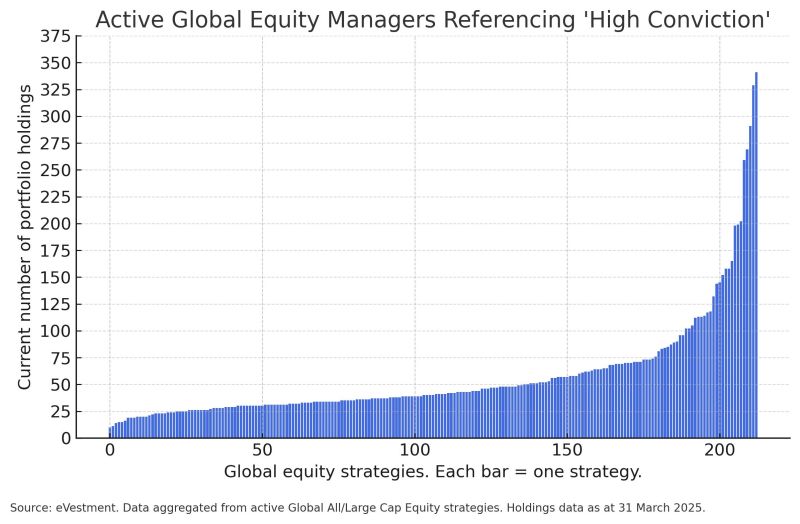
Robert Doyle of bfinance posted this graphic on LinkedIn to show how loosely a description can be used, especially one that is meant to indicate confidence.  In response, Doyle offers one possible breakdown of company counts across a broad investable universe.  What’s your definition of “high conviction”?

Growth and value

Perhaps because the value factor has been on a losing streak for quite a while, the old growth-versus-value debate seems to have petered out.  But those categories continue to drive most equity portfolio construction and evaluation — and indexes based upon them still hold sway.

Research Affiliates has released an article, “False Choices, Real Costs: Structural Flaws in the Growth–Value Duality,” which was based upon its more in-depth paper, “Fundamental Growth.”  Each provides history on how growth and value indexes have been created — and what the firm sees as the shortcomings of the current state.

Included is a visual which shows the iterations over time (using the same underlying scatterplot of stocks).  The last example shown is the one Research Affiliates proposes as the new way of conceptualizing value and growth stocks.  It abandons the completeness property, excluding those stocks that are expensive and slow-growing (which generally underperform) from either category.

True price

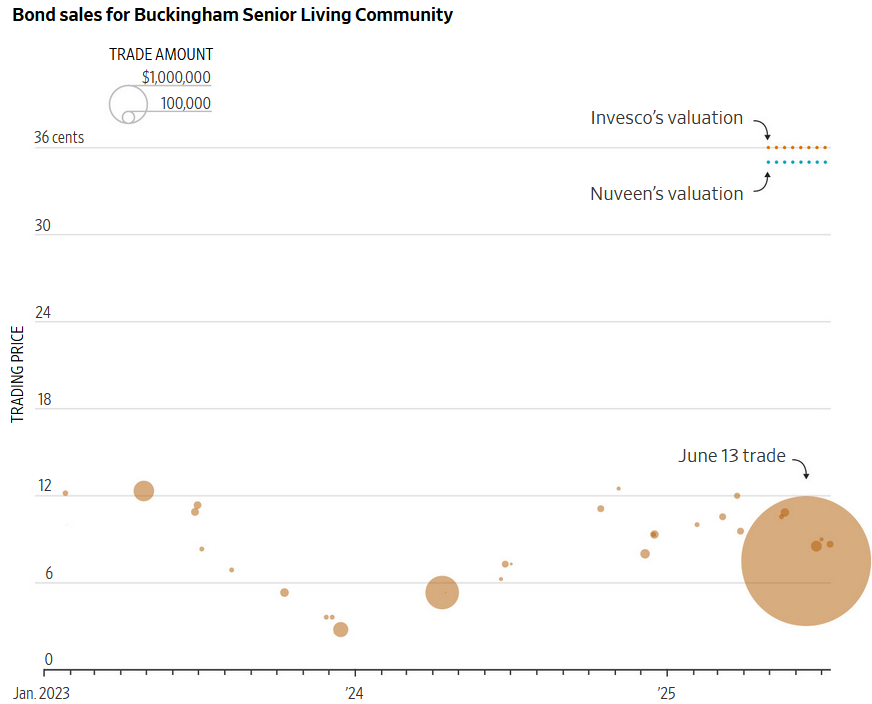
Wall Street Journal article looked at high-yield municipal bond funds, the ownership of which is “at near-record levels.”  Coming off a period when managers funded “all manner of projects,” there are no doubt some stinkers in portfolios, but “true price discovery is only possible when bonds trade in the market.”  At least that’s according to a spokesperson for a fund that declined by more than half its previous value when it had to make some sales.  And note where a couple of large firms have been marking the position shown above.

There are more and more kinds of investments that rely on managers’ marks.  Sometimes they’re too high.

Waterfalls (steep and shallow)

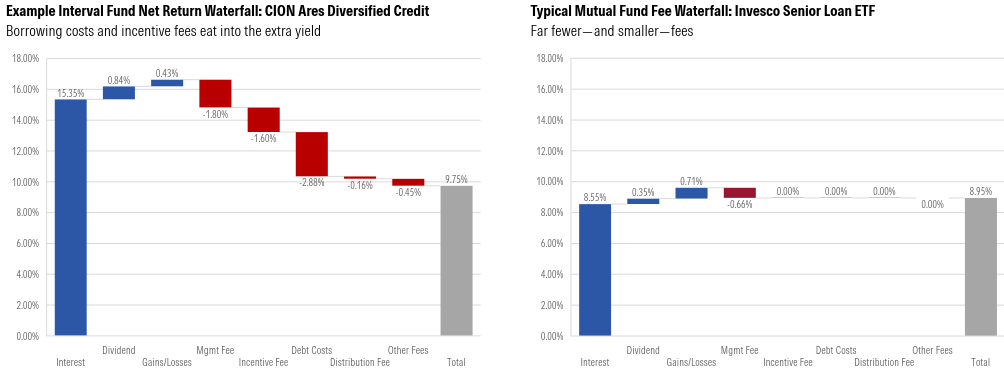
Morningstar’s report, “The State of Semiliquid Funds,” offers a number of charts and tables to illustrate one of the fast-growing areas of the market.  This one shows the significant difference in the structure of the return between an interval fund and a standard mutual fund.  It’s often said that the only thing that matters is the net return, but the components of it can tell stories.

Other reads

“Venture Capital’s Dissonance Phase: An Opportunity to Rethink & Rewrite the Next Chapter,” Rohit Yadav, CAIA Association.

If the capital input structural layer is sticky and the technology layer is on steroids, the capital outflow layer is under siege.

“The Coin That Landed Sideways,” James Vermillion, The OSVerse.  A dialog about expectations, outcomes, and models.  (“Soon, you’ll need a model to model your model.”)

“Honey, AI Capex is Eating the Economy,” Paul Kedrosky.

We are in a historically anomalous moment.  Regardless of what one thinks about the merits of AI or explosive datacenter expansion, the scale and pace of capital deployment into a rapidly depreciating technology is remarkable.

“Growth Equity: Private Capital’s Overlooked Sweet Spot,” Phil Huber, Cliffwater.

These businesses tend to have cleaner capitalization tables, stronger unit economics, and capital efficiency born out of necessity.

“Zero-sum Thinking and the Labor Market,” Kyla Scanlon, Kyla’s Newsletter.  A look at fundamental changes affecting economics, politics, and culture.

“How AI Slop Compromises Investment Decision Making,” Angelo Calvello, Institutional Investor.

The failure of current detection methods to reliably identify AI slop introduces systemic risk into any strategy relying on web-scraped data.

“To Bitcoin or not to Bitcoin: The Corporate Cash Question,” Aswath Damodaran, Musings on Markets.

I believe that it is a terrible idea for most companies, and before Bitcoin believers get riled up, my reasoning has absolutely nothing to do with what I think of bitcoin as an investment and more to do with how little I trust corporate managers to time trades right.

“Key Takeaways from the London ODD Roundtable 2025,” DiligenceVault.  An update on current issues in operational due diligence.

“Court in Natixis litigation provides a practical discussion of what constitutes a prudent fiduciary committee process,” October Three.

This case usefully illustrates the axiom that a fiduciary’s ultimate defense against a challenge to its prudence is a prudent and well-documented process.

Eternal truth

“That men do not learn very much from the lessons of history is the most important of all the lessons of history.” — Aldous Huxley.

Flashback: Earnings management

In September 1998 Arthur Levitt, chairman of the SEC, gave a speech about earnings management.  It included this:

Increasingly, I have become concerned that the motivation to meet Wall Street earnings expectations may be overriding common sense business practices.  Too many corporate managers, auditors, and analysts are participants in a game of nods and winks.  In the zeal to satisfy consensus earnings estimates and project a smooth earnings path, wishful thinking may be winning the day over faithful representation.

As a result, I fear that we are witnessing an erosion in the quality of earnings, and therefore, the quality of financial reporting.  Managing may be giving way to manipulation; Integrity may be losing out to illusion.

The following few years included some high-profile accounting fiascos, the adoption of Regulation Fair Disclosure, the Global Research Analyst Settlement, and a lot of busted stocks (many busted for good).

More than a quarter century later, with the virtual takeover of “adjusted” earnings in the analytical discourse, where are we on this front?

Mutual fund boards

An early feature of this site was called “Four for Friday,” offering four shorter items linked together by a topic.  This one from 2022 includes a quote from an earlier posting that “to be truly effective, a fund board must be an independent force in fund affairs rather than a passive affiliate of management.”  In practice, the relationships are pretty cozy, with little effort to evaluate the manager’s organization in ways that might give an indication of the future prospects for the shareholders it represents.

Thanks for reading.  Many happy total returns.

Published: July 28, 2025

Subscribe

To comment, please send an email to editor@investmentecosystem.com. Comments are for the editor and are not viewable by readers.

About Those One-Pagers

One of these days, there will be a new course at the Investment Ecosystem Academy, probably called “Communication Skills for the Investment Professional.”

The core principle:  “Don’t tell them everything you know.”

By and large, investment people are knowledgeable and detail-oriented — and too ready to regurgitate the whole story that’s in their heads, be it in conversations, presentations, or reports.

That makes effective editing a powerful lever for success, in any specific situation and over the course of a career.

There is an ever-present tension between what you know and the interests of those with whom you are communicating.

A particular area where this comes into play is in “one-pagers” of different kinds.

Evolution in résumés

Let’s start with a famous one-pager across industries, as covered in an article by Callum Borchers in the Wall Street Journal (“It’s Time to Rethink the One-Page Résumé”), which begins:

The job seeker’s gospel commands that a résumé fit on a single page.  It’s time to rethink that tenet as artificial intelligence screens more job applications.

If a machine is doing the reviewing, it doesn’t care if it’s more than one page.  That limitation was born of the human desire for the ease of review of a pile of résumés and served as a forced limit for those applicants who otherwise would go on and on and on.

But that requirement also led to a lot of bad résumés because people met the one-page standard by crowding more and more information into that page, ignoring the need for good design, reasonable-sized text, and sufficient white space, all of which lead to a positive experience for readers, subconsciously rubbing them the right way.

The bottom line in the WSJ piece is that the “rule” about résumés is fading away.  A well-crafted, concise effort is still to be desired, but helpful material need not be sacrificed (or crammed into a page) because of an arbitrary limit.

Investment one-pagers

So much of the discussion about résumés can apply to the range of investment one-pagers.  Take those produced by asset managers as an example.

Emerging managers, especially hedge funds, often include monthly returns in a table.  If they survive and you watch the one-pagers over time, that table grows and grows (and other information is added too), so the text gets smaller and smaller.

When asked why they even include monthly numbers, managers say “that’s the standard” or “that’s what people want.”  (It’s tempting to respond with the famous Steve Jobs quote about people not knowing what they want until you show it to them.  Or to suggest that those potential clients who feel like they need monthly numbers in a fact sheet are not likely to be allocating patient capital — they won’t be there when you need them.)

Most asset managers fail the test of communicating the essence of who they are in their one-pagers — theirs looks the same as all the others, so the reader naturally gravitates to the performance information, resulting in a wasted opportunity to tell their unique story.

ChatGPT offers suggestions about “a good investment one-pager . . . that lets a busy allocator grasp the essentials in 90 seconds.”  Then it recites a whole list of things that ought to be included in it, while also offering “design cues” including “readable fonts (11-point body), plenty of white space,” etc.  It is extremely hard to accomplish all of that in one page.  (We’re ignoring the one or more pages of disclosures that usually follow.)

As with résumés, those quick scans by allocators are increasingly being replaced by machine analysis (which likely will do a better job than that a human who only budgets ninety seconds for the task), so the need to get it all on one page goes away.

That provides the freedom to craft a short yet effective tool for communication, one not limited by some outmoded standard of length, but that can tell the story of who the manager is in a way that prizes brevity but not at the cost of quality in content and design.

Who knows, maybe some curious human will actually read it then, instead of just giving it a quick glance.


If this is an area of interest to you, the Investment Ecosystem has helped a variety of organizations improve a range of communication materials.

Published: July 24, 2025

Subscribe

To comment, please send an email to editor@investmentecosystem.com. Comments are for the editor and are not viewable by readers.

Total Portfolio Approach, X Games, and Vigilantes on the Horizon

The most recent essay on this site is “The Research Behavior of Professional Investors.”  It considers the need to assess the current state of investment processes in detail, especially given possible adaptations using AI:

That imitation — the swapping of human for machine — is a limited form of improvement, although it may be a realistic first move.  The greater mission is coming up with new ways of working that exceed the old, whether they include an extensive use of artificial intelligence or not.

If you aren’t signed up to receive emails when postings are published, you can do so here.

Total portfolio approach

The Total Portfolio Approach (TPA) has been around for a while, but it has had a hard time dislodging strategic asset allocation (SAA), the entrenched model used by most asset owners.  In their paper “What is Total Portfolio Approach? A Practitioner Summary,” Redouane Elkamhi and Jacky Lee summarize SAA’s dominance:

SAA’s appeal was not just in its quantitative rigor, but in its institutional utility.  It offered clarity to boards, and accountability for performance evaluation.  In many ways, SAA provided the architecture around which governance models, organizational structures, and consultant relationships were built.

But that approach involves a series of assumptions “that are becoming harder to sustain in the current investment environment.”  The authors stress that a shift to TPA requires a different mindset, concluding that:

Ultimately, TPA is less about perfect planning and more about purposeful readiness — the ability to adapt with clarity, discipline, and intent when the world doesn’t follow the script.

Elsewhere, Roger Urwin writes about the slow development of TPA:

Fast forward 20 years — where are we?  The change has been small-scale.  TPA is still in a minority position largely because it can only be implemented with a type of stretchy governance that is both very capable and nimble to make a good job of the transition an ongoing challenge.  And that type of governance is in very small supply.

And, an article that focuses on the experiences of Sue Brake and Stephen Gilmore, who have been involved in TPA transitions, notes one big stumbling block:

Implementing TPA is hard because it requires an organisation to change its culture by forcing a high degree of collaboration upon investment specialists.

Not all investment specialists react well to such changes as they often have developed their own language and processes to assess new investments during their careers.

The SAA/TPA debate — and the need to create more adaptable organizations — are not going away.  Asset owners should be exploring the possibilities.  Among the other good references are the TPA hub of the Thinking Ahead Institute and a recent report, “Rethinking Diversification: Learnings from a Total Portfolio Approach,” by Stuart Jarvis of PGIM.

X games

There have been a surfeit of stories in major publications about how individuals have become conditioned to buy the dips in risk markets — and how well it worked in response to the swoon earlier this year.  And the most extreme strategies are the hottest.

Bitcoin is setting new highs.  The volume of zero-day options is exploding.  Small, unprofitable companies are outpacing established ones.  As Jason Zweig writes, ETFs are getting narrower and narrower — and more and more leveraged.  A Bloomberg article profiled two of the purveyors of those vehicles, where “the cash keeps flowing in and the funds keep launching.”  Right now, “targeting [the] degen crowd provides a path to success.”

Saddling up

According to Treasury Secretary Scott Bessent, President Trump is “the most economically sophisticated president, certainly for a hundred years, perhaps in history.”  Maybe after explaining the calculus of his tariff proposals, the president could assess the economic implications of the three-percent cut in the federal funds rate he thinks is warranted, starting with whether long-term rates would go up or down if that were to occur.

Bessent and others seem to be auditioning for the role of chairman of the Federal Reserve, which is starting to unnerve market participants who are used to the independence of the Fed that was reasserted by Paul Volcker 45 years ago.  Loyalty to any president’s whims by the person in that chair would be a disaster.

Expect a posse of bond market vigilantes to show up if the rhetoric turns into reality.

Pulling the trigger

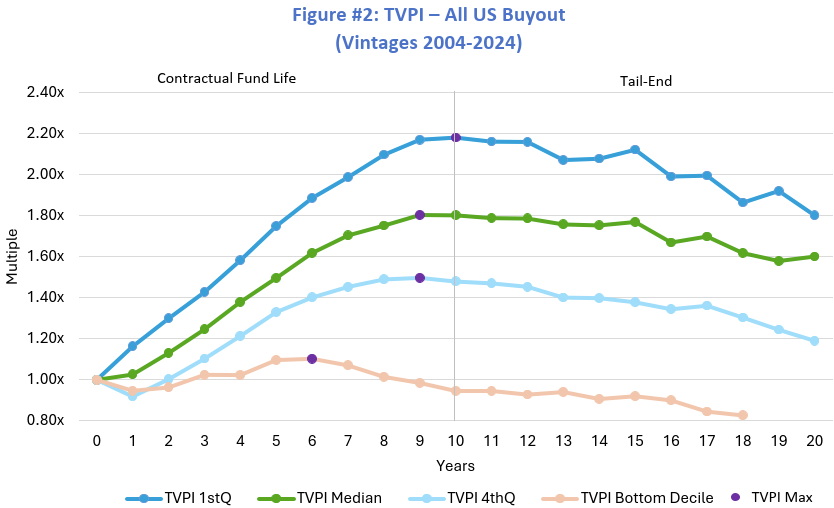
This chart comes from Upwelling Capital Group’s piece “No Country for Old Funds.”  It argues that limited partners should be more active in the management of buyout funds, specifically:

LPs should critically evaluate portfolio performance, particularly related to the impact of underperforming or tail-end portfolios.

This chart and others in the report do a good job of providing the case visually.  Given the expansion of the secondaries market, Upwelling thinks that new strategies should be employed, including reworking heuristics regarding acceptable discounts to net asset value so that investors can move on to more attractive opportunities when warranted.

The 300

“A group of leading investment professionals” make up The 300 Club.  Its reworked website includes a brief summary of the issues it sees in the markets today (including “the consultant-led best practice model” and “the herding of investors into increasingly overpriced assets”).  The expressed goal is “Thought leadership for the investment industry;” hopefully this reset is a sign of important contributions to come.

In the haystack

We are on the cusp of a new wave of research tools — within organizations and from existing data platforms and new entrants.  Maybe there will even be some created for public use.  That’s the case, at least for now, for martini.ai, which bills itself as “Your Corporate Credit Research Assistant.”  To test drive it, the CUSIP number of an obscure CCC-rated bond was entered without any other information; the “fast research” and “deep research” summaries produced were quick, useful, and appeared to be accurate.  (This is not an endorsement — just another sign of an evolving ecosystem.)

A bad bet

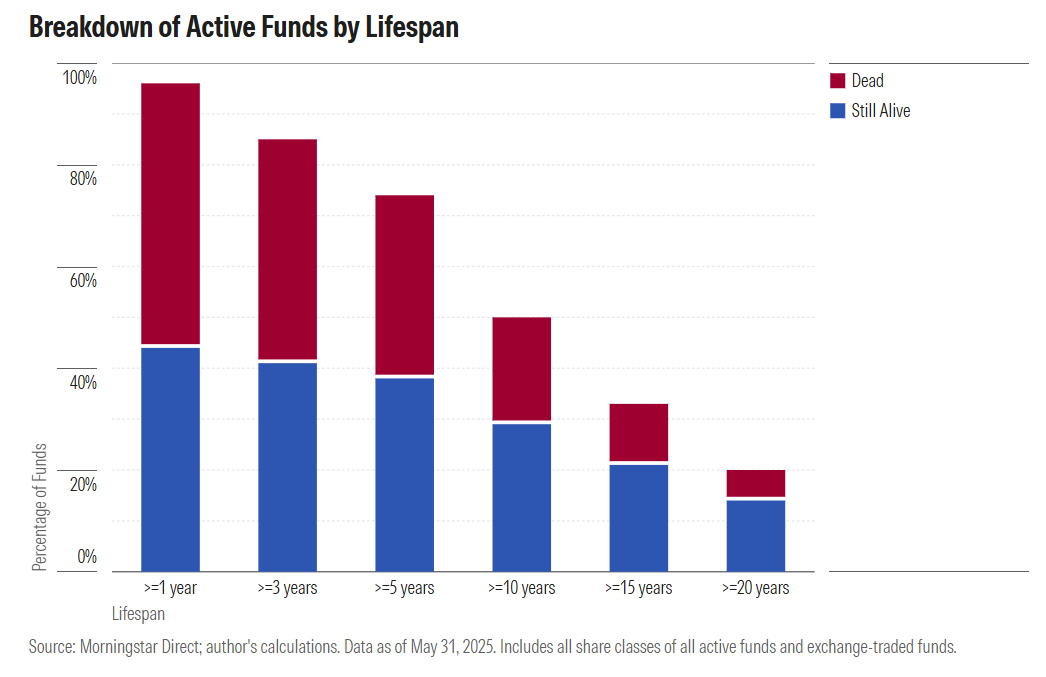
A posting by Jeffrey Ptak of Morningstar, “Bad Bet: Picking Active Mutual Funds,” points out the challenges of investing in those vehicles.  First, because of the mean reversion that leads to a small performance dispersion across funds over longer periods (with investors invariably buying during the peaks in relative performance and redeeming in response to slumps).

The second reason Ptak cites is fund mortality.  Just when the reversion could move back in a positive direction, the fund sponsor might pull the plug.  The chart above documents the lifespans of all funds (ever) that have been in existence at least as long as the time periods shown.  So, only about half have lasted ten years or more.  Of those that made it that far, about a third are no longer with us.

Other reads

“Should You Diversify, Or Should Companies Do It For You?” Byrne Hobart, Capital Gains.

The corporate finance puzzle around diversification is that there are two ways to get it:  a company can buy it for its shareholders by paying a 30% premium to buy out some other public company.  Or shareholders can pay a few basis points to diversify into that company (if they want, or to hold on to their shares if they don’t).

“SPVs, Credit, and AI Datacenters,” Paul Kedrosky.  Subhead:  “How a new credit bubble is building in AI data centers.”

“Effective GP Questioning,” Anthony Hagan, Freedomization.

“Great question,” “We have never been asked that before,” and “You ask the best and most thoughtful questions” are just a few compliments investment managers use to sweet-talk prospective LPs and help keep the conversation positively flowing.

“The Oracle of Tampa and the Modern Portfolio Theory,” Markov Processes.  An analysis of the returns over the last decade for Bowen, Hanes, an anomaly among pension fund managers.

“Stronger, Longer, Slower: Why Some Markets Just Keep Trending,” Moritz Heiden, Methods to the Madness.

Do slower biological or logistical production cycles shape how long and how strongly markets trend?

“Saylor’s latest strategy for Strategy: selling new shares to pay dividends,” Craig Coben, Financial Times.  As the subtitle says, “Isn’t there a word for that?”

“When Headcount Counts: How Investors are Pricing Scale and Story,” Drew Bowers, et al., S&P Global.

This research introduces a new framework for decomposing deal value [of late-stage AI firms] into three components: industry enthusiasm, workforce scale and firm-specific differentiation.

“Volatility is a Reliable and Convenient Proxy for Downside Risk,” Larry Swedroe, Alpha Architect.  A summary of a recent report comparing volatility with a range of downside risk measures.

Be not afraid

“Nothing in life is to be feared, it is only to be understood.  Now is the time to understand more, so that we may fear less.” — Marie Curie.

Flashback: Lehman risk management

The last Fortnightly included a flashback to the minutes of a 2006 Federal Reserve meeting that included “one of the greatest indicators of all time” — regarding the looming housing debacle that would set off the financial crisis.

Continuing with that theme, a 2007 slide deck entitled “Lehman Brothers Risk Management” offers the house view of one investment bank at the heart of the subprime mortgage machine.  The firm collapsed a year later; but for extraordinary measures, many of its competitors would have done so too.

For a short summary, check out the “Key Themes” on page five of the deck, but leafing through the whole thing is worthwhile for the specifics — as well as a vivid reminder of the need to question the narratives that are served up to you.

Also note the pages of “stress scenarios” at the end.  Thirteen past events are used in the scenario analysis, a standard if deeply flawed approach that overwhelms more important qualitative, forward-looking assessments.  The urge to tie future possibilities to history is evident earlier in the deck, when the revenue impact for Lehman of each of those events is tallied, as if that was a worthwhile guide.

What wasn’t included among the scenarios studied?  A nationwide decline in house prices.

Postings

Among the postings in the archives is “Essential Elements in External Networks,” about the complicated web of sources that feeds us as individuals — and our organizations.  One snippet:

The standard inference is that if there is good performance then there is a good process behind it — and a good network which feeds it.  But conditions change and a network that is optimized for one environment can be totally out of sync with the next, missing the transition from one to another.

Thanks for reading.  Many happy total returns.

Published: July 14, 2025

Subscribe

To comment, please send an email to editor@investmentecosystem.com. Comments are for the editor and are not viewable by readers.

The Research Behavior of Professional Investors

How do professional investors discover new ideas, investigate them (and the larger body of old ideas), and make decisions?

Tracking (lay) investor behavior

The title of this posting was mostly cribbed from a paper by Toomas Laarits and Jeffrey Wurgler, “The Research Behavior of Individual Investors.”  The authors tracked the online actions of lay investors, “including how much time they spend on stock research, which stocks they research, what categories of information they seek, and when they gather information relative to events and trades.”

To do so, they accessed clickstream data from 2007 — before the financial crisis and well in advance of the meme-stock frenzy — so it’s appropriate to consider how relevant the findings are to today’s world.  But the conclusions of the paper ring true:  in general, not much time was spent researching ideas before trades were made and decisions didn’t appear to follow classic models of financial behavior.  Surprise, surprise.

As noted by the authors, analyzing the data is not easy:

As others have pointed out, one challenge for this literature is going beyond associations and observing, at an investor level, the full line from attention to action.  The literature is also piecemeal in terms of focusing on particular determinants of attention.

There are a variety of impediments to the few studies of this type that have been conducted.  Without eye-tracking software, you can’t tell where on a page a user is looking.  And, in any case, you “cannot observe an investor’s accumulated ‘stock’ of knowledge as opposed to the flow of information exhibited by the clickstream.”

When it comes to the level of activity of investors, the authors find “a strong differentiator of research behavior.”  The takeaway highlighted most reviews of the paper:  the median time spent on research before trading was six minutes, although the average was a half hour.

Also evident was investor segmentation:

[The analysis] contrasts investors who focus on earnings, dividends, and other slow-moving fundamentals versus those who focus on news, message boards, brief summary statistics, and price charts.  The latter investors also concentrate their research in speculative stocks.

Overall, “there is a large amount of unexplained heterogeneity in research behavior.”

Tracking (professional) investor behavior

Reading that paper, it’s impossible not to think of how a similar review of the behavior of professional investors would look.  For example, since the paper tracked individual investors buying and selling stocks, imagine these questions as you might reword them to apply to the portfolio manager of an equity fund:

How much time do individual investors spend on stock research?  Which sites do they use?  Which stocks do they focus on?  When do they do their research relative to their trades or corporate events?  And, perhaps most importantly, what types of information do individual investors care about — and what do they ignore?

You can add a host of other questions in that vein.

For someone outside an organization, trying to divine the answers to any of them is very difficult.  The stylized diagrams of investment process don’t address even the basics of behavior — and most due diligence efforts are spent on consuming general descriptions of activity rather than discovering the nitty-gritty of how things are done and why.

But within an organization, the possibilities open up wide.  At one level, technologies now exist that can paint a much more finely detailed picture of “the research behavior” of the people involved.  As a 2022 posting on this site described, there are complicated issues of privacy and transparency to consider when deciding whether and how to track the behavior of employees.  The benefits from improvements gained through those observations must be weighed against the cultural impact and nth-order effects involved.

Many of the challenges mentioned in the individual investor study apply here, including the difficulty of seeing “the full line from attention to action” and understanding the interplay of what is already known with the diet of new information.  Also, the sources of ideas and data are magnitudes greater than those used by individual investors.

The imitation game

While the example provided above was of an equity portfolio manager, the concept floated here isn’t limited by investment role or type of organization.  Understanding how decisions are made (not how they are said to be made) should be a top priority, while realizing that the “research behavior of professional investors” is hard to pin down.

There is a new urgency for evaluating current behavior in detail:  the prospect of reworking investment processes using artificial intelligence tools and agents.

Alan Turing conceived of “the imitation game,” now more commonly known as the Turing test, to judge how well a machine can imitate human capabilities.  At one level, analyzing existing investment processes means identifying the elements of them that might be replicated by computing power (so those steps can be done faster and at a lower cost, as long as accuracy is not sacrificed).

That imitation — the swapping of human for machine — is a limited form of improvement, although it may be a realistic first move.  The greater mission is coming up with new ways of working that exceed the old, whether they include an extensive use of artificial intelligence or not.

That requires research, reason, and creativity.  And risk taking.

Is your organization up to the task of the day?


If you would like to discuss the possibilities, please get in touch.

Published: July 10, 2025

Subscribe

To comment, please send an email to editor@investmentecosystem.com. Comments are for the editor and are not viewable by readers.

Cognitive Diversity, the Due Diligence Dilemma, and an All-Time Indicator

The first Investment Ecosystem essay since March is “Cultural Inflections and Disruptions at Asset Management Firms.”  The posting looks at the hard-to-discern-but-ultimately-critical element of success:

A deterioration in culture is often overlooked by leaders and clients as long as performance holds up.  When things turn the other way, as they inevitably do, what looked like small tears in the cultural fabric become big rips that are obvious to all.  Mending them is hard and unfamiliar work for leaders.  The clients often choose to walk away.

Speaking of how organizations work, here’s a short summary of CUDOS, an interesting model of the best kinds of knowledge communities.  Does it describe yours?

If you aren’t getting these updates via email but would like to, subscribe here.  Now, on to the readings.

Cognitive diversity

Alex Edmans has produced a comprehensive report on an important topic:  “Cognitive Diversity in Asset Management.”  (Don’t let the title fool you; the content is of value to those in other parts of the investment ecosystem who don’t consider themselves asset managers per se.)

Talking about diversity in organizations has always been tricky and it has gotten trickier of late as the topic has become increasingly politicized.  But beliefs about diversity — both social and cognitive — shape how organizations are built and affect how decisions are made.

When asked about diversity, some leaders are quick to say that what is important is cognitive diversity, but they struggle to articulate anything meaningful about the concept and fail to demonstrate how that belief is reflected in the team that has been assembled.

Edmans’ report is long and includes overviews of a wide range of research on the topic as well as insights gleaned from interviews with investment practitioners.  The executive summary illustrates the balanced and nuanced view that Edmans provides throughout, and the short “What is Cognitive Diversity?” section that follows it includes this:

This report argues that cognitive diversity, properly implemented, can have a significantly positive effect on investment performance . . . [and] its objectives are twofold.

The first is to identify the specific benefits and costs of cognitive diversity, the types of cognitive diversity for which the benefits might outweigh the costs, and the settings in which cognitive diversity is overall beneficial or detrimental, rather than to make broad statements about cognitive diversity in general.  The second is to discuss what asset management firms can do to fully harness the advantages of cognitive diversity while mitigating its risks.

The due diligence dilemma

A paper by Yifat Aran and Nizan Packin looks at venture capital firms and the “core tension between the imperative to invest rapidly and the widespread, yet often unfulfilled, expectation that VC firms serve as effective gatekeepers through independent diligence.”

Its ultimate purpose is to explore the legal ramifications of due diligence choices, but don’t let that deter you from reading the first two sections, which effectively demonstrate how “due diligence practices evolve with market dynamics.”  That general industry problem is easiest to see in venture capital, because of “the discrepancies between the thorough scrutiny often portrayed in VC literature and the realities of investment decision-making, particularly during market peaks.”

The result is “a diligence culture skewed toward optimism” that “has created a collective action problem.”  Namely, many investors engage in “proxy due diligence,” relying on the reputations of the big-name investors who are involved as proof that proper diligence has been conducted.  That is a questionable assumption.  Euphoric times beget little scrutiny and fast, superficial decisions.

The salient case of venture capital is part of a broader issue.  Reliance on the due diligence efforts of others is built into most every part of the investment industry.  Too often the quality of work is not as advertised.

Mimetic organizations

FT Alphaville kicked off “an informal series of simple Q&A interviews” with a conversation with Gappy Paleologo of Balyasny Asset Management.  In comparing managers Paleologo said:

The key to understanding differences in hedge funds is the difference in personality of the founders, because hedge funds are incredibly mimetic organisations.  There’s an absolute leader, and the people who report to them tend to mimic the leader.  Over time they acquire the same tics and personality traits.

Among those he references are Citadel, Millennium, Hudson River, and Balyasny.  (You might also be interested in Paleologo’s Odd Lots interview with Tracy Alloway and Joe Weisenthal.)

Model flows

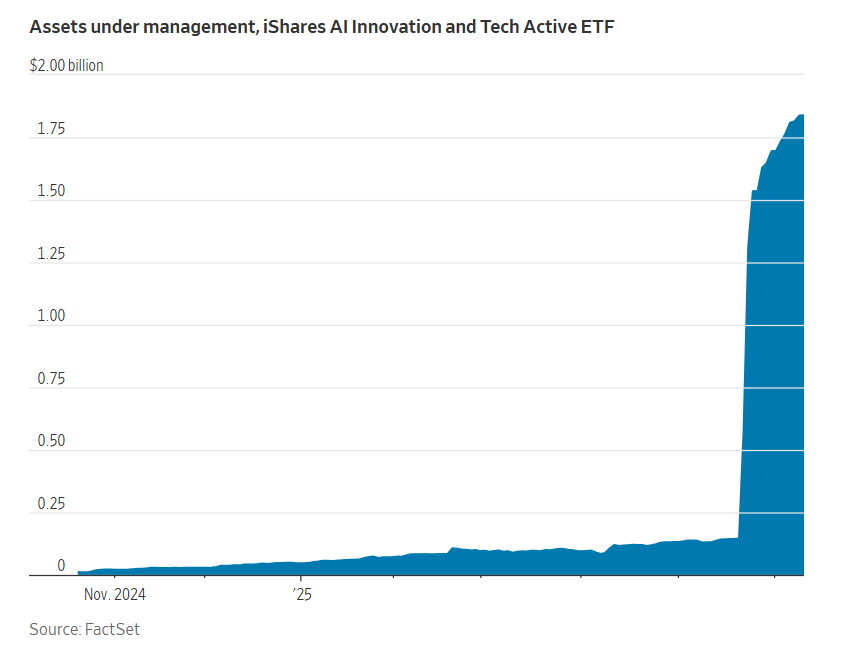
Phil Bak included this chart in a posting about model portfolios.  It shows how quickly assets can flow into a new strategy when the creator of the product, in this case BlackRock, includes it in one of its models.  (Bak added an ironic “organic flows” description underneath the chart.)

His broader point is how the move to model portfolios is changing the industry script:

Inertia is destiny.  For fund managers, if you’re not in the default, you’re not in the game.  If you’re not embedded now, every quarter that passes compounds your irrelevance.

The industrialization of the advice industry proceeds apace.

Love of the game

Devyani Aggarwal wrote a paper about the movement of private equity into new areas:

In recent years, private funds seem to be expanding their interest beyond these traditional sectors and targeting high-profile, culturally significant industries such as sports, fashion, music, etc.  Interestingly, these industries share little in common with the traditionally favored sectors that attract PE:  they are arguably unpredictable, more risky, less reliable, and engaged in the production of relatively “non-essential” services and commodities.  So where is the appeal?

She looks at the “unique legal, regulatory, financial, and governance challenges” involved, using investments in the business of sports to illustrate those challenges.  (For investors, there is also a question of how the personal excitement of investing in those areas intersects with the need to make objective judgments about the appropriate valuation of them.)

Other reads

“Thesis Drift,” Philo, MD&A.

Thesis drift is entirely psychological in nature.  It is natural to want to avoid admitting to yourself that you were wrong or that you didn’t know what you were doing, as it conflicts with your self-image as someone who is smart or has good instincts.  If you have made public pronouncements about your position, changing your mind threatens your external image as well.

“Why Do Some Assets Become More Attractive As they Become More Expensive?” Joe Wiggins, Behavioural Investment.  Strong, weak, and nonexistent valuation anchors — and “belief assets.”

“The (Uncertain) Payoff from Alternative Investments: Many a slip between the cup and the lip?” Aswath Damodaran, Musings on Markets.

If there is one takeaway from this post, I hope that it is that historical correlations, especially when you have non-traded investments at play, are untrustworthy and that alphas fade over time, and more so when the vehicles that delivered them are sold relentlessly.

“A Pioneer in Private Credit Warns the Industry Is Ruining Its Golden Era,” Miriam Gottfried, Wall Street Journal.  Have private credit shops “become factories, churning out deals with little consideration of their long-term prospects”?

“False Precision and Framing Houses,” Christopher Schelling, LinkedIn.

Math in finance is just an approximation because we are measuring results that are all based upon the behavior of market participants.  Fewer things in our industry have fixed effects like they do in the physical sciences.  We need to view results with a healthy dose of skepticism and humility.

“When looking at private investments, the past is prologue,” Joachim Klement, Klement on Investing.  Regarding a paper that shows “how interim valuations change and how stale they are provides valuable information about the future performance of assets in a private equity portfolio.”

“The Growing Index Effect in the Corporate Bond Market,” Sean Shin, et al., SSRN.

While liquidity during other periods of the trading day has declined, liquidity at index closing time has improved, resulting in a net positive effect.  However, during periods of market stress, when trading becomes one-sided, this concentration of activity diminishes the benefits of indexing and leads to higher liquidity costs.

“Outperformed by AI: Time to Replace Your Analyst?” Michael Schopf, Enterprising Investor.  The title of the conclusion:  “Master the Tools — or Be Outpaced by Them.”

“What UnitedHealth Can Do to Revive Its Battered Stock,” David Wainer and Jonathan Weil, Wall Street Journal.  Analytical standards are permeable:

The opacity wasn’t a problem for Wall Street as long as the company kept delivering.  With a steady record of beating earnings estimates and a soaring stock, investors were content to let details slide.

New or new to you?

“Everything feels unprecedented when you haven’t engaged with history.” — Kelly Hayes.

Flashback: Statues

Today’s housing market is perplexing in many ways.  Economists, investors, homeowners, and prospective home buyers are all looking for a sign of what’s to come.

Which is a reminder of a comment made during the Federal Open Market Committee meeting on September 20, 2006 by Sandra Pianalto, president of the Cleveland Fed.  From the minutes:

I heard a report yesterday morning that sales at religious stores for statues of St. Joseph have been soaring.  [Laughter]  It seems as though people who are trying to sell their homes are buying statues of St. Joseph because he’s the patron saint of real estate, and they’re burying him next to the “For Sale” sign.  Unfortunately, there is no patron saint for central bankers.  [Laughter]

It turned out to be one of the greatest indicators of all time (and no laughing matter).

Postings

You can search the archives for original essays in the categories of interest to you.  For example, a 2021 posting looks at a paper by Fidelity about the “investment innovators curve”:

The various positions along the innovators curve have their pros and cons, their (apparent) risks and returns.  Where is your organization and where do you think it should be (and why)?

Thanks for reading.  Many happy total returns.

Published: June 30, 2025

Subscribe

To comment, please send an email to editor@investmentecosystem.com. Comments are for the editor and are not viewable by readers.

Cultural Inflections and Disruptions at Asset Management Firms

A previous posting reviewed Aswath Damodaran’s book, The Corporate Life Cycle.  It dealt with the intertwined financial and strategic issues faced by companies (and their investors) across time.

This piece also considers life cycle issues of a sort, this time specifically in regards to investment organizations, and coming from a cultural standpoint rather than a financial one.  While the focus is on asset management firms, many of the ideas apply equally well to other kinds of entities.

Path dependence and change

No matter the kind of organization, knowing something of its origin story can give you clues to its current state.  Investment philosophy, structure, incentives, process, and culture all can change over time, but beliefs and narratives are often sticky.  Long-ago decisions can loom large, and if those present at the creation are still around things can be slow to change.

As Damodaran referenced, there is also a “clientele effect” to consider.  If existing clients (especially important ones) have certain expectations, they can be hard to buck.

Therefore, a key cultural assessment is the willingness to change, to be adaptable.  Frequent readers will know our position on that:  In a complex adaptive system, clinging to the status quo might work for a time, but in the end a growth mindset beats a fixed mindset.  And not just in regards to investment matters, but in terms of all aspects of organizational design and behavior.  Entropy in an organization can only be staved off by an ethos of continuous improvement.

Maintaining the ship of culture

You may have heard of the Theseus Paradox, in which these questions are asked:  If you replace all of the parts of a ship over time, is it still the same ship?  If not, at what point does it cease to be what it was?

Unlike a ship, an organization is not made up of material but of people and ideas, so change is not at all like swapping out a deck board.  Thus, an important question, posed in a Theseus-themed posting from Gapingvoid Culture Design Group:  “How do you replace people without changing the core culture?”

One simple summation of culture is “who you hire, fire, and promote.”  The perpetuation of a culture — or the destruction of one — is a direct result of individual decisions made about people.

Scale and complexity

Many asset management firms start relatively small, with a handful of people; often they have worked together at another firm.  Their immediate concerns are getting the legal and operational foundation put in place, managing the initial assets, and raising additional capital.  Culture isn’t typically on the list (other than maybe a no-bureaucracy pledge if they came from a big organization).

But even with a few people, a culture develops by default if not by design, based upon the personalities and range of capabilities of the parties involved, especially the founder.  Often the leader has a track record as an investor but little expertise or interest in the broader elements required for success, thinking that if you produce the numbers, the business will work.

There is a certain logic to that approach and some firms thrive (at least for a time) taking just that path.  But many more falter because they don’t prioritize building an organization and a culture that will be resilient in a variety of environments.

The great benefit of a small firm is the ability to focus.  There is usually only one strategy; everything is oriented to it and everyone is dependent on its success.  There is a common purpose that can’t be avoided.

Invariably, if that hoped-for success does come about, the firm will start to add people on the investment team and in other areas.  Ideally, in doing so you would want to fill in the gaps in the founders’ capabilities and to identify hires that over time have the potential to have an impact beyond their initial duties.  Instead, it is common to hire specialists who fit an immediate need and are a close match to the existing team, reinforcing the narrowness of the human capital already in place.  (Homophily — the “love of sameness” — is an easily identifiable characteristic of many investment organizations.  See this earlier piece.)

If growth continues, the next step for many mid-sized firms is the addition of new strategies, products, and teams — leading to a buildup of staff in investment, operations, administration, distribution, and leadership roles.  That transition brings about new cultural considerations that stem from the increased complexity.

A look at the biggest asset management firms sharpens the point.  Pick one with which you are familiar.  How would you describe its culture?

That’s a difficult exercise, because it can be hard to pin down a culture in a large organization.  In effect there are multiple subcultures at work, in functional areas — investment, operations, distribution — as well as by asset class, strategy, etc.

To further complicate things, an individual team might be relatively isolated from the larger organization (geographically and/or in practice) or it could be enmeshed in the broader investment function of a firm.  The cultural analysis is quite different from the first situation to the second.

Cultural inflections and disruptions

If culture is a function of those hiring, firing, and promotion decisions, then each new person coming in the door should make sense in the culture you are trying to create (while avoiding the trap of homophily and diversifying the capabilities already in place).  The resulting mix of people constantly changes, and the introduction of a few bad apples — even one — can cause havoc in the best of cultures.

Focus Consulting Group has written about the Red X:

We define the Red X as the brilliant investment professional, who clearly adds value, but lives outside of some, or most, of the core values of the firm.  In simple terms, the Red X is disruptive and can be toxic to the firm’s culture.

Great leaders know that they need to be the carriers and spreaders of cultural values, but many of those in charge are focused on the investment side of things and impatient with the demands of the organization.  In the worst cases, the leader is the Red X.

Status is a factor in every cultural realm and the differences in status among those within an investment organization — people who interact with each other every day — can be gargantuan.  How those of high status treat those without it is a very good indicator of cultural resilience in any organization.

Money can be a uniter in the early years and a divider later on.  If the foundations of a thoughtful and transparent incentive structure aren’t in place, an organization can fracture.  On what basis are individuals evaluated and compensated?  Conflicts over compensation can become poisonous, and are a warning sign that the extrinsic and intrinsic rewards are out of balance, a hard thing to get back under control.

Then there are other disruptions:  reorganizations, lift-outs, lift-ins, mergers, changes in ownership structure, etc.  To say nothing of the loss of key people (even ones that aren’t marquee names) due to retirement or other reasons.

Oh, and periods of bad performance.  A deterioration in culture is often overlooked by leaders and clients as long as performance holds up.  When things turn the other way, as they inevitably do, what looked like small tears in the cultural fabric become big rips that are obvious to all.  Mending them is hard and unfamiliar work for leaders.  The clients often choose to walk away.

As with most everything, there are cycles of culture; it waxes and wanes.  Organizations are inherently messy and things can get off track.  Leaders must be sensitive to the dips and work to avoid prolonged deterioration — and be willing to make needed changes whether things are going poorly or well.

Even firms that have had prolonged success are at risk, as a we-have-everything-figured-out mentality can take over.  If new ideas aren’t being considered or if people pushing for change are shut out, the organization will ossify.  If there is no edgework, there will be no edge.

A free-for-all environment where everyone loudly pushes their views but no one does much listening isn’t good, but the real killer is a culture of organizational silence, when people are afraid to address important issues or are just tired of trying.

The cultural life cycle

The cultural life cycle is harder to plot than the financial one that Damodaran so effectively analyzed.  A heap of issues can start to pollute the atmosphere that led to success, even as results remain positive for a time, making it hard for capital allocators to anticipate the declines ahead.

Ultimately, the competitive advantages that come from culture are most dependent on the leadership of the firm.  Those in charge don’t necessarily need to be investment experts themselves, but if they lack organizational prowess the cultural center will not hold.

Published: June 23, 2025

Subscribe

To comment, please send an email to editor@investmentecosystem.com. Comments are for the editor and are not viewable by readers.

Performance Disputes, Passive Aggressive, and a Ratings Factory

These curated readings, which come out every two weeks, identify important ideas and debates in the investment world.  Original pieces, on pause the last two months, will appear again soon.

But that’s not all we do here.  The main objective is helping organizations to identify gaps and provide innovative ideas to seize the opportunities ahead.  If that is of interest, schedule a call or virtual meeting today.  It will be worth your while.

Compared to what?

Richard Ennis has drawn the attention of the investment industry with his challenges to the orthodoxy of the day regarding alternative investments.  One of his papers, “The Demise of Alternative Investments,” was covered in a March edition of the Fortnightly.

It was recently mentioned in a piece from Verdad, which closes with this:

Ennis’s core principles are that simplicity scales and costs matter, enormously.  If institutional investors can’t justify the cost of complexity with demonstrable alpha, the rational path is clear:  in a world where long-term compounding is paramount, minimizing cost drag is not just a preference — it’s a fiduciary imperative.

And Jeffrey Bronchick of Cove Street Capital shared it and offered a famous Upton Sinclair quote as a commentary on the rush by sponsors and consultants to market alternatives to retail investors:

It is difficult to get a man to understand something when his salary depends on his not understanding it.

Which brings us to a new Cliffwater report which argues that “Alternatives made a significant positive contribution to state pension performance during this century” — challenging Ennis’ evaluations of alt performance.  His response to Cliffwater points out the reason for the divergent conclusions:  different equity benchmarks.

This brings up a critical issue for asset owners — whom to believe.  Not just in this case, but in every one of the many situations where these kinds of disputes linger.  Interested parties have different motivations for the presentation of performance information (and one of Ennis’ points is that asset owners are potentially conflicted too, since they use custom benchmarks to gauge their own performance).  Plus, there’s always a risk of pointing to past periods and using the results to form a thesis that may be completely off base under different conditions.

And then there is the pernicious problem of using internal rate of return numbers as if they were comparable with time-weighted returns.  In many industry reports, those numbers are reported together without any caveats being presented.  Often you have to dig into the fine print to identify what’s what, if a clarification can be found there at all.

At this advanced — or what we think of as advanced — stage in the investment industry, we still don’t deal very well with some of the basics.

A ratings factory

Across the investment ecosystem there are a number of small but very successful (and very profitable) entities.  What does size indicate and when does it matter?

Those questions are prompted by a Bloomberg article about Egan-Jones Ratings, which has twenty analysts and is based in a “quaint four-bedroom colonial.”  Last year the firm rated three thousand investments.  Is that too many?  Apparently some eyebrows are raised:

Egan-Jones bills itself as the biggest ratings company in private credit, one of the hottest businesses in finance today.  Time and again, people familiar with the firm say, it has declared private credit investments to be relatively sound — maybe not gilt-edged AAA, but good-enough BBB.

Is this an echo of the years before the financial crisis, when rating agencies completely misjudged the risks involved in the mortgage market that was then attracting dollars like private credit is today, or is it something else entirely?  Inquiring minds should want to know.

Passive aggressive

Research Affiliates released a paper, “Passive Aggressive: The Increasing Risks of Passive Dominance,” a topic that won’t go away any time soon.  (A version with more detailed academic references is available on SSRN.)

You’ve heard the setup before:

Passive products are indifferent to fundamental information, including sales growth, expected earnings, innovation activities, or competitive position within an industry.  They allocate based solely upon market price and recent momentum.  We explore the growing risks behind the passive boom — and what investors can do about them.

There are several charts of interest, including the one above, which shows that periods when active management outperforms cap-weighted strategies on a three-year basis have essentially disappeared, causing tsunamic flows into passive investing.  As you might expect, Research Affiliates argues for rebalancing to strategies using fundamental weighting in response (the approach for which it is best known).

But the existential question is unanswerable:

These market dynamics raise important questions about market efficiency.  While we might not be at the tipping point today, the market is flying blind.  How much passive ownership will tip the balance:  60%, 70%, more?  We simply won’t know until we get there.

What’s in a name?

Fisher Investments, best known for its saturation marketing, has rolled out the website fiduciary.com.  Quoted in an RIABiz article, Knut Rostad of the Institute for the Fiduciary Standard says the site amounts to “naked lead-generation,” an example of fiduciary-washing.  A spokesperson for Fisher calls it an educational platform.

The article notes that there are 27 references to Fisher Investments on the site and that, as one example of potential conflicts, the firm offers some index tracking funds with fees more than ten times those of identical products from Vanguard.

The word “fiduciary” gets bandied about a lot by providers across the industry, often in questionable ways.  Which side of the line do you judge the Fisher site to be on?

Mysteries

A recent Buttonwood column in the Economist was titled “Why investors lack a theory of everything.” (In print it was “Mysteries of the financial universe.”)  It concludes:

The complexity of markets is dizzying, and in complex situations even the iron laws of physics can produce surprising, unstable results (think of aeroplane turbulence).  More important still, finance is ultimately driven by people, not particles, and they do not always respond to similar stimuli in similar ways.  They look at what happened last time, try to do better, anticipate what other traders will do and seek to outfox them.  The absence of fundamental laws in markets is frustrating, disorienting — and what makes them so interesting.

Other reads

“What Would Prove You Wrong? The Most Important Question In Investing,” Polymath Investor.

In investing, as in science, how you test your ideas can make all the difference.  Treating each investment like a scientific experiment (yes, the whole thing with falsifiable hypotheses and clear criteria for failure), can improve decision-making and protect us from our own biases.

“Death is a Drag,” Jeffrey Ptak, Basis Pointing.  A follow-up to the Mauboussin/Callahan paper on drawdowns, this looks at the short-circuiting of the recovery process for mutual funds because of “life-or-death agency risk.”

“Think We’ve Seen the Last +1,000-BPS High Yield Spread? Think Again,” Martin Fridson, Enterprising Investor.

There are valid rationales for a strategic allocation to high yield bonds, including their high current yield and low correlation with both investment grade bonds and equities. . . . High yield asset gatherers consequently have no need to promote the asset class based on assertions that may not stand up to scrutiny, such as, “We will never again see a +1,000-bp spread.”

“The investment industry is a placebo,” Kris Abdelmessih, Moontower.  How long do you have to wait to know that a factor is no longer significant?

“Flyover Country, Operating Partners, and The Deal-by-Deal Play,” Shahrukh Khan, Cash and Carried.

What character does capital take on when it’s structured primarily for permanence, without considerations of social prestige?

“Created Value Attribution Whitepaper,” PJ Viscio and George Pushner, Kroll.  Subtitle:  “Whither Deleveraging? Implications of Higher Interest Rates for Private Equity Value Creation.”

“Moats, Money, and Management’s Mettle,” Todd Wenning, Flyover Stocks.

Make no mistake: culture and character evaluation is hard.  Relevant and reliable information can be hard to come by.  This type of analysis is qualitative and subjective, which can lead to biases clouding your judgement.

“Quant Firm’s $1 Billion Code Is Focus of Rare Criminal Case,” Chris Dolmetsch, Bloomberg.  Is the value of trading code “ephemeral”?  (Is every investment process?)

“After 6 weeks of intensive due diligence . . .,” Itamar Novick, LinkedIn.

This is the intellectual property theft horror story that VCs systematically use.

Keep at it

“It is better to fail in originality, than to succeed in imitation.  He who has never failed somewhere, that man can not be great.  Failure is the true test of greatness.” — Herman Melville.

Flashback: Hedge funds

Normally in this space there are flashbacks to specific articles.  This time, we bring you the 25th anniversary edition of Hedge Fund Alert, which is a compilation of excerpts from throughout the publication’s history.

You’ll see the early moves of boldfaced names, get a sense of the ups and downs of the business over a quarter century, and be reminded of strategies that went down in flames (mutual fund timing, subprime, Madoff, Allianz, etc.).

Postings

All of the previous postings are in the archives.

From 2022, “Looking in the Rearview Mirror” leverages the liability-driven investing (LDI) spasm to examine industry risk management practices.  Among them:

“Stress tests” are popular, but they often represent five or ten landmark events — what would happen if we relived a past spasm.  What’s missing?  A qualitative dreaming of what might go bad in a big way because of the particular excesses in valuation, vehicle structuring, or economic (or geopolitical) events of the moment.  And not much attention is given to the extremes of the projected distribution, even though markets are creatures with fat tails.

Thanks for reading.  Many happy total returns.

Published: June 16, 2025

Subscribe

To comment, please send an email to editor@investmentecosystem.com. Comments are for the editor and are not viewable by readers.