Second-Order Effects, Thinking Ahead, and Changing PE Beliefs

Here is a full slate of ideas for you to digest!

Second-order effects

Counterpoint Global produced a report, “AI Beneficiaries: Investing in Second-Order Effects.”  The title plays on the firm’s findings that “the best investments were often not the obvious, first-order ones but rather the second-order ones.”  In this case, they are looking at the hot topic of the moment and asking whether the big economic winners will ultimately be the users of AI.

In its initial “Culture Quant” research a few years ago, tapping an alternative dataset covering more than 300 million employees, the firm “found a strong positive correlation between high employee retention and stock price outperformance.”  The new report involves a more complicated analysis that tries to assess the net effect of changes related to the implementation of AI on corporate profitability.

Industry and company examples are included, as well as a section on company life cycles and capital allocation.  (See this earlier Investment Ecosystem posting on that topic.)  The report says that despite the sense that a life cycle only proceeds one way, firms “can revert to earlier stages when new opportunities arise.”  AI is nothing if not a new opportunity.

The report is interesting and worthwhile.  A blunt take is that head count will go down and profits will go up.  But consider the point from the firm’s earlier research about retention.  The envisioned changes from AI also will have an unprecedented effect on corporate culture, leading to unanticipated outcomes.  In other words, while Culture Quant is important, Culture Qual is unpredictable when making changes of this magnitude.

Thinking ahead

Thinking Ahead Institute (affiliated with WTW) has produced “What Asset Owners Did Next,” follow-up to a 2017 study of leading asset owners from around the world.

The “nutshell” summary says that asset owners are “buckling under peak busy conditions in which business as usual (BAU) is more complex than ever and business beyond usual (BBU) is not getting enough bandwidth.”  Thematically, competitive edge “can be maintained through focus on three key areas:  it takes a system to manage a system, the soft stuff is the hard stuff, and what gets measured gets managed.”

An incredible number of topics are covered, each using a format of “the story so far” and “what happens next.”  The sheer heft of it all indicates that these asset owners all have large organizations, but smaller entities (who can’t cover all of the bases at once) might find some ideas to put into practice.

The FT on PE

While concerns about private equity have been percolating for a while, there has been a noticeable change in tone of late, as can be seen in the stories from any financial publication.  To pick one, here are some representative stories from the Financial Times.

“Big investors look to sell out of private equity after market rout.”  This was published in early April after the downdraft in public markets following Trump’s tariff announcements.  While equities have snapped back, the underlying portfolio realities remain:  high exposure to PE and low distributions have changed the perceptions about that asset class.  In the meantime, the looming effects of changes in taxation on endowments and foundations — plus the announcements about high-profile investors reducing exposure — have reinforced the worries.

“Private equity founder warns retail investors risk being saddled with worst assets.”  The industry has been aggressive in trying to move to the private wealth channel to stay on the growth path.  Many observers have also seen that push as a way for the industry to offload companies to unsuspecting retail clients anxious to get in on the gold rush they have heard about.  It’s unusual for someone at a PE firm to state that case.

“The delusion of private equity IRRs.”  A guest column by Ludovic Phalippou runs through the problems with internal rates of return and how they are misused by providers and buyers alike throughout the industry, leading to “capital allocation distortions”:

The industry insists that institutional investors are smart and sophisticated enough to see the limits of IRR and run their own numbers.  Maybe.  But it seems more doubtful that ordinary investors will see through the theatre.

“Is private equity becoming a money trap?”  Another opinion piece comes from Daniel Rasmussen of Verdad Advisers.  In his view, over the last several years “allocations started to outpace the size of the market.”  Plus, “private equity-backed companies” — the holdings in PE funds — “are under strain.”  His conclusion is that the belief in private equity, a one-way train for decades, is changing:

The consensus on private equity is being quietly, but decisively, rewritten.  The question now is not whether the model is being broken.  It is whether the exit is wide enough for everyone trying to leave.

Target-date funds

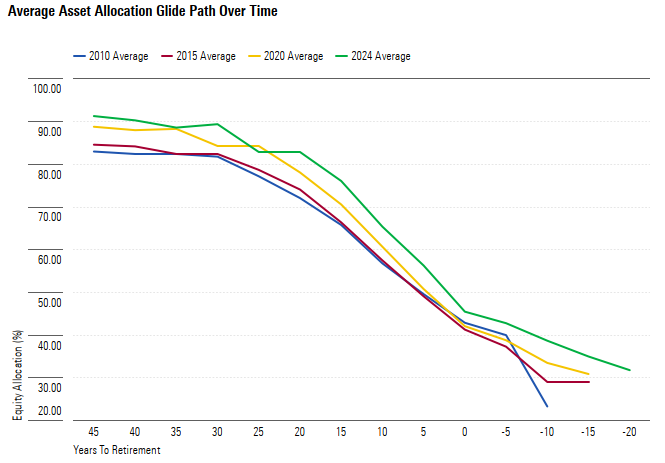
Morningstar includes a number of charts in its “2025 Target-Date Fund Landscape” report, including the one above.  It shows that (on average) the percentage allocation to equity has risen over time.  The firm chalks that up to low interest rates during much of the last fifteen years.  Now that rates have increased, will lower allocations to equity follow?

Target-date funds have been a hit in the marketplace, growing at a 30% clip since 2009, when they totaled $272 billion, to today’s $4 trillion.  The report includes looks at the largest providers (Vanguard leads by a lot), the shares of active and passive, the conversions from mutual funds to collective investment trusts, and the ongoing decline in fees.

Digging for nuggets

Rupak Ghose posted this diptych on Bluesky without commentary.

In its simplicity it represents one of the main challenges of the investment endeavor.  On a macro level there is an excess of published ideas; sorting through it can seem like an impossible task.  But large chunks of that constant stream are perfunctory and unnecessary — just think of the time spent creating and digesting predictions of one kind or another, usually to little benefit, although a realization of their ineffectiveness never seem to impede the demand or supply.

The images also fit when it comes to the documentation of an individual investment recommendation.  Leave something out and you could be accused of not doing your due diligence (either at the time of the recommendation or after the fact if it doesn’t come through as advertised).  So it’s easy for the new information, the valuable information, to get lost in a blizzard of paper or pixels.  That puts a premium on good report design, something sorely lacking in many parts of the business.

(Commercial break:  We help organizations improve their recommendation and documentation practices.  Also, you also can find The Investment Ecosystem on the Bluesky platform.)

Other reads

“Stepstone’s NAV Juicer,” Tim McGlinn, LinkedIn.

Oh, to be a Secondary PE manager in 2025, 😊 generating immediate and high-quality investment returns by buying things . . . then rinse and repeat with fresh inflows of capital . . .

“Adversarial Attacks in Statistical Arbitrage,” Richard Dewey, The Diff.  A look at the 2007 quant crisis when “there were two different systems with varying degrees of sophistication interacting with each other” — and the implications of those dynamics for the agentic AI to come.

“Leadership in Boutique Asset Management,” Sebastian Stewart, Independent Investment Management Initiative.

Little research has been conducted on leadership within the asset management industry, and even less so on the segment of the industry classified as “boutique asset management.”

The survey results suggest that around half of those in a management position in the UK’s boutique asset management sector are there by default rather than design.

“Same As It Ever Was,” Jon Petersen, Novel Investor.  Will “buy the dip” ever quit working?

“Private Funds Are Turning to Complex Bonds to Tackle Cash Crunch,” Kat Hidalgo and Scott Carpenter, Bloomberg.

But as CFOs [collateralized fund obligations] get more popular, some are concerned about the bundling of unrated private funds into instruments with top ratings.

“The Walking Wounded,” Anthony Hagan, Freedomization.  A limited partner’s “armor gets thicker and thicker” every time he or she “gets burned by a GP.”

“The Evergreen Evolution,” Zane Carmean, et al., PitchBook.

While not new, a growing share of private market investment is being allocated to evergreen and open-ended fund structures.  These help GPs avoid the lumpiness of sporadic fund launches and inopportune end-of-life liquidations in the traditional drawdown/finite-life structure.  For LPs, these funds provide a simpler way to manage private market allocations and, by gaining full allocation from the subscription date to redemption, more exposure to the benefits of compounding returns.

“The Whisper Before the Shout: Market Consequences of Implied versus Actual Recommendations Revisions,” Mark Bradshaw, et al., SSRN.  Do analysts signal changes in sentiment before they actually adjust their recommendations?

“How Teamwork Makes The Dream Work,” Brett Steenbarger, TraderFeed.

The best teams work as hard on their teamwork as on their markets.  They constantly look to improve what each person looks at, how they look at it, and how they communicate.  They work as hard on team goals as individual goals.  They review team performance every bit as much as they review their own individual performance.

Metamorphosis

“Once a majority of players adopts a heretofore contrarian position, the minority view becomes the widely held perspective.” — David Swensen (from a set of financial history quotes put together by Mark Higgins and Rachel Kloepfer).

Flashback: Big money in Boston

The last Fortnightly featured a flashback to a piece from 1970 about mutual fund complexes.  In it, Jack Bogle, then at Wellington and also chairman of the Investment Company Institute, an industry advocacy group, was quoted as talking optimistically about the cozy relationship between mutual funds and their advisors.  A few years later he would found Vanguard and become a critic of that model.

In 2013, Bogle penned a Journal of Portfolio Management article, “‘Big Money in Boston’: The Commercialization of the Mutual Fund Industry.”  More than sixty years earlier he had read a story titled “Big Money in Boston,” then “the center of the fund universe.”  He wanted in — but over time:

The fund industry that I read about in Fortune was a profession with elements of a business.  It would soon begin its journey to becoming a business with elements of a profession and, I would argue, not enough of those elements.

Bogle traces the evolution of the industry (and his own evolution in thinking), including a couple of dates “that will live in infamy” and the disparate fee paths of most mutual funds (higher and higher) and Vanguard (lower and lower) that eventually led to an unsustainable gap between the two — and increased pressure on the business models of traditional funds.

Postings

All of the postings since inception may be found in the archives.

For example, a 2022 perspective, “We Need Some New Terminology (Part 2),” deals with the fuzzy and varied uses for the term “passive investing” including:

Look around.  Some firms promote “passive” approaches — taking advantage of the salience of that term — when the strategies they offer involve layers of active choices.  Others try to hew to an ideal like Sharpe’s — and a few off them tie themselves in knots over some of the sticky implementation questions that arise when trying to reach that goal.

(FYI, Part 1 dealt with the also-fuzzy-and-varied uses of “advisor.”)

Thank you for reading.  Many happy total returns.
Published: June 2, 2025

Subscribe

To comment, please send an email to editor@investmentecosystem.com. Comments are for the editor and are not viewable by readers.

Trend Following, Playing a Bigger Game, and White Smoke

During chaotic times like these, the tendency is toward myopia, as near-term happenings demand attention.  But letting needed improvements slide increases organizational debt that needs to be tackled when things settle down.  (If ever.)

Don’t let that happen.  Reach out if you need a hand or a sounding board.

On to the readings.

Trend following

How would you describe the current trend in equities?  In other markets?  It’s been a crazy time, with abrupt shifts, the kind of action that’s not made to order for trend-following funds.

We’ve arguably already had two instances of “initial shock and position misalignment,” one of three recurring patterns that mark the strategy, as identified in a Man Group report.  The other two are “adaptive recalibration” (hard to do in back-and-forth markets) and “delivering crisis alpha.”  Three charts plot that alpha, showing the performance of large trend followers (using the SG Trend Index) versus the S&P 500 during the dot-com bust, the financial crisis, and the “inflation episode” of 2022.

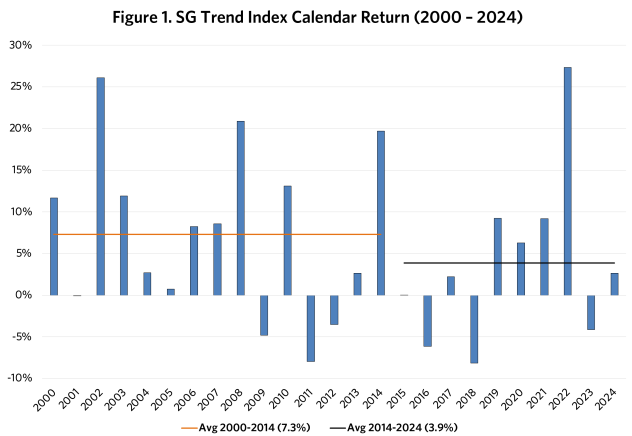
Another account, from Jim Masturzo of Research Affiliates, totals the excess returns using the same index for the three worst calendar years this century as 49.5%, 59.4%, and 46.8%!  That said, the absolute returns have downshifted during the last decade:

Masturzo writes:

At its core, the construction of trend-following strategies is a trade-off between Sharpe ratio (i.e., higher average risk-adjusted returns over time) and positive skewness.  The tail protection comes from the skew, but the Sharpe ratio should not be overlooked because it is often what allows investors to remain in a strategy during extended bull markets.

And he offers trade-offs for portfolio construction to achieve the desired balance between the two.

Additional perspectives on trend following come from AlphaSimplexMethods to the Madness, and Rupak Ghose (who offers a short history of trend-following funds).

Playing a bigger game

In “The Portfolio Problem,” a Behavioural Investment posting, Joe Wiggins writes:

What has seemingly been forgotten is that there is a yawning gulf between these two statements:

“I am investing to meet my clients’ long-term outcomes, hopefully my approach will mean I can do it better than others over time.”

and

“I am investing to beat the returns of people doing similar things to me, hopefully I might also deliver good long-term outcomes.”

That serves as a good lead-in to “Playing a Bigger Game,” a white paper by Carol Geremia of MFS.  It challenges those individuals and organizations “in the middle of the investment chain, between the end investor and the public companies in which they invest” to reconsider what they say they do versus what they actually do.

A lot of ground is covered, including the collapse in time horizons, benchmarking misalignments, the effect of passive investment, and the disconnect between investment objectives and performance measurement.

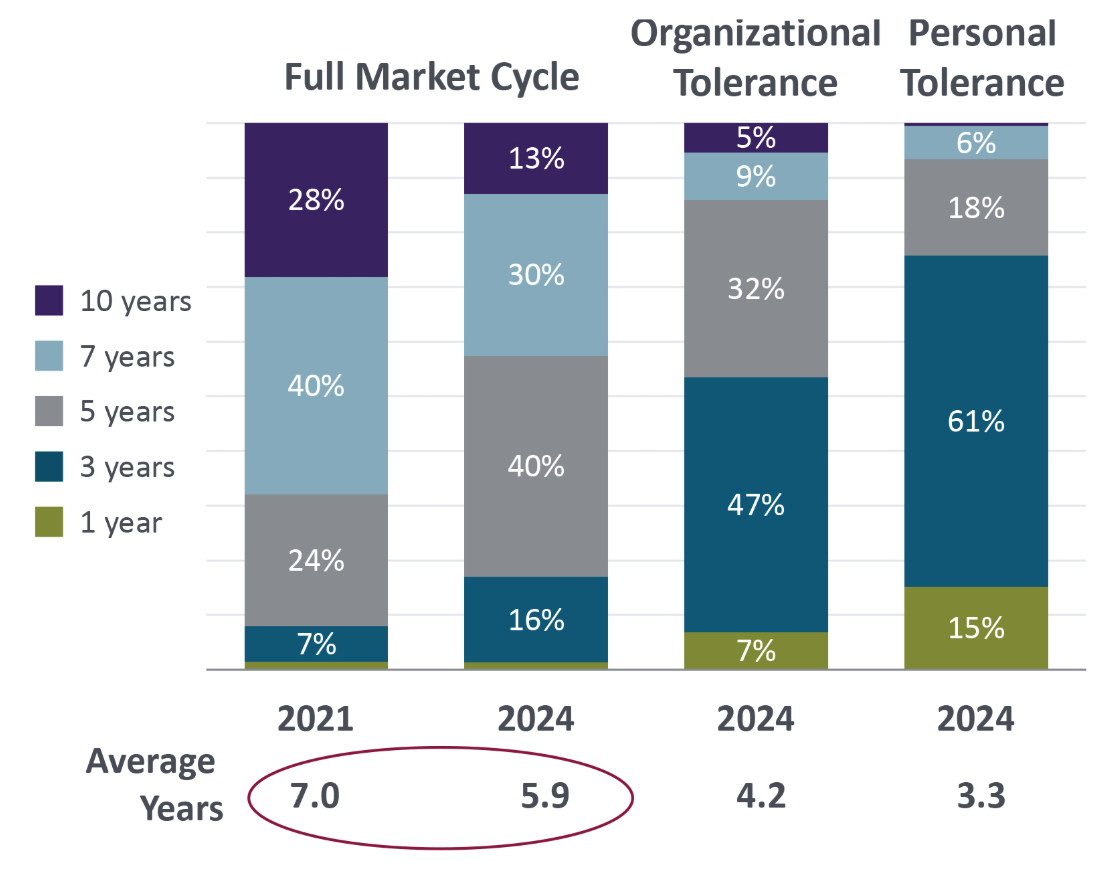
Here’s one of the exhibits, which summarizes the results of a survey of global investors:

The first two columns show that on average the assessment of those investors as to what constitutes a “full market cycle” has shrunk recently, despite the fact that those cycles have lengthened over the last few decades from what they had been historically.

But look at the last two columns.  They chart responses to the question, “How long are you willing to tolerate underperformance of active managers?”  The industry has institutionalized performance chasing rather than long-term investment, leading to the dichotomy that Wiggins summarized.

White smoke

Rajiv Sethi analyzed the betting on prediction markets in advance of the naming of the new pope.  In his posting, he wrote about the surge in the price of the contract on Pietro Parolin after the white smoke appeared (while the probability of Pope Leo being selected remained essentially at zero until the actual announcement):

Although it’s clear in hindsight that there was no leakage of inside information, this was not known to traders in real time.  They saw the price rising, and tried to interpret this.

That is, while no trader knew the identity of the new pope, they suspected that some other traders knew.  And by treating the price movements themselves as informative, traders acted in ways that amplified these movements.

Which led Sethi to this conclusion:

This episode reveals something quite general about financial markets.  It shows that momentum trading can be profitable under certain conditions, but also that too much of it can destabilize markets.

Consolidation

A Morningstar report, “Consolidation in the European Asset-Management Industry,” is subtitled “The elusive benefits of scale.”  As asset management firms — especially “traditional” ones — search for a winning formula, mergers are one option, but:

The benefits of consolidation touted by dealmakers are often hard to realize in practice . . . as consolidation presents five critical integration challenges:  cultural misalignment, leadership complexity, talent exodus, product rationalization risks, and scale disadvantages that may compromise performance.

The report compares three types of firms, which it classifies as organic growers, consolidators, and opportunistic acquirers — and looks at the outcomes of three major mergers:  Amundi, Janus Henderson, and Aberdeen.

PMs as entrepreneurs

In an usual take on the active-passive debate, Lotta Moberg and Brian Singer published “Financial Entrepreneurship,” a brief from the CFA Institute Research Foundation.

The thesis is that “active investors are the entrepreneurs of finance,” who “either create new opportunities or exploit existing ones in new ways.”  Furthermore, the entrepreneurs are those with “ultimate decision-making authority,” principally portfolio managers.  While the piece contains a variety of interesting points worth dissecting, it bathes those investors in a heroic light.  To wit:  “Wisdom is the purview of the portfolio managers.”

Other reads

“30 ‘pearls’ of wisdom from our last 30 years,” Paul Zummo, J.P. Morgan Asset Management.  A terrific list (and accompanying commentary).

“Deferred Conviction: The Illusion of Skin in the Game,” Anthony Hagan and Shahrukh Khan, Cash and Carried.

GP commitments once signaled belief.  Today, they’re often financed, waived, or deferred by fund managers raising ever-bigger funds.

“The Endowment Model Reimagined,” Jeff Blazek and Rebekah McMillan, Neuberger Berman.  An argument that what the model needs in order to be refreshed is an increased focus on the science of portfolio construction.

“A Few Questions,” Morgan Housel, Collaborative Fund.  Reflective examinations of beliefs and behavior.

“Productive versus Parasitic Finance,” Christopher Schelling, LinkedIn.  When is investment activity productive for society and the economy, and when is it just “finance for finance’s sake”?

“Even with AI, junior bankers still need the grind,” Craig Coben, Financial Times.

This is the paradox juniors face:  the work they resent is often the scaffolding for the judgment they’ll need.  AI may spare them some tedium, but it can’t simulate the slow, accretive development of instinct — the bit of intuition that only comes from having made mistakes or having seen them made.

“The Rule of 3,” Jim Ware, Focus Consulting Group.  Within an organization, can communication be improved be means of this simple idea?

“The Politics of Venture Capital Investment,” Jeffery Wang, SSRN.

VC partners are more likely to invest in startups managed by co-partisan CEOs [but] co-partisan investments underperform relative to non-co-partisan deals made by the same VC partners.

“Why can’t more financial heavyweights write letters like Warren Buffett?” Pilita Clark, Financial Times.  Principally because they don’t like to admit their blunders.

Don’t do this

“When most people give presentations, they try to squeeze two megabytes of data into a pipe that carries 128 kilobytes.”  — Steve Jobs.

Flashback: Mutual funds

“A Study of Mutual Fund Complexes” was written in 1970.  What could possibly be relevant today in a piece from that period?  More than you’d think.

Even though the industry was tiny by current standards, structurally it resembles what we see today.  And the article speaks to an issue that still exists:

The emergence of the “complex” as the dominant form of organization within the mutual fund industry has added a new dimension to the problems raised by the external management relationship between most funds and their investment advisers.

The odd “community of interest” between the funds in a complex and the management company — and many of the inherent conflicts involved — remain in place, including that “the adviser sometimes has a greater self-interest in some funds than in others.”  In practice, that can drive decision making within the management company in ways unexpected by the owners of some funds.

While the emphasis is on structural and legal matters, the footnotes are full of references to people and firms that were instrumental in the development of the industry, as well as evergreen challenges, including this one, quoted from a letter to the shareholders of the T. Rowe Price New Horizons Fund:

With most of the stocks in the Fund’s portfolio and new candidates for investment selling at prices far above our buy limits, it was simply impossible to invest the large flow of new money to advantage; consequently, management restricted sale of new shares.

Postings

All of the postings can be found in the archives.  For example, from “Challenges and Quandaries in Manager Research,” based on events at Pimco, but full of questions that apply universally, including:

Are asset management organizations different from other kinds of organizations when it comes to the methods for creating a culture that leads to sustainable success?

If so, why, and in what way?

Thank for reading.  Many happy total returns.

Published: May 19, 2025

Subscribe

To comment, please send an email to editor@investmentecosystem.com. Comments are for the editor and are not viewable by readers.

Regime Changes, NAV Loans, and the Private Equity Storm

We’re back.

After an (unscheduled) hiatus of a few weeks, things are returning to normal.  That means you’ll get a set of these curated readings (along with a little commentary) every two weeks.  In addition, occasional original pieces will look at the investment world in new ways.

If you find this compilation of value, please consider subscribing to receive it in your inbox.  (It’s free.)

And now, on to the readings.

Regime changes

Usually, transitions to new presidential administrations in the United States are not referred to as “regime changes,” but the phrase seems appropriate this time around.  Across a wide swath of foreign and domestic policies, the old order, that which has been in place for decades, is being torn up in a hurry.

That is certainly evident on the economic front.  While investors generally expected the Trump 2.0 policies to be market friendly, the severity and inconsistency of his tariff proposals have upended prices and brought into question the dominant narrative of recent times, that of “American exceptionalism.”

While that idea went well beyond the investment sphere, it was used as justification for the outsized weighting of American companies in global market indexes.  And it was the theme of many positive strategist reports in late 2024.  Now the debate has morphed into whether this is a time to “sell America,” whether the unwinding of that notion of exceptionalism will be particularly painful.

The abrupt changes in policy have led to abrupt changes in the tone and content of the writings that are fodder for the Fortnightly.  Investment organizations are trying to find their footing in their portfolios and their communications.  Given the volume of material being produced, this could be a very long section, but here are just a few links of interest.

The reaction to the president’s trade war from most investment professionals, even those who are fans of his, has been harsh.  Although the actual policy has been a moving target, to most the economic outlook includes headwinds from all directions, as represented in a graphic from Apollo.

In April, Joe Wiggins reflected back on a December piece he had written in which he was cautious about the exceptionalism narrative:

A heady mix of overconfidence in our ability to predict an always-uncertain world, stellar past performance, and expensive valuations is always a reason to worry.  At the time, the overwhelming consensus was that the US economy and stock market could only ever outperform others.  Writing that piece felt a little heretical.

He then delves into the conviction in that thesis as an example of the behavioral traps that accompany such near-universal beliefs.

In the immediate aftermath of “Liberation Day,” Owen Lamont posed an important question:  “Buy-the-dip or buy-the-bottomless-pit?”  As they have before, retail investors responded by buying the dip, which has so far worked out, but that’s a short-term conclusion.  Is there still a bottomless pit ahead?

Ultimately, at least as it concerns equities, the path of earnings (and whether a recession occurs) will be determinative.  Already companies are pulling guidance or providing multiple forecasts for different tariff scenarios.  Items from Rothschild and Apollo provide some context; when earnings expectations get slashed, stocks suffer.

We have already seen a shift out of the dominant regime of the last forty-plus years, which featured declining inflation and interest rates.  A tariff war that throws the globalization trends that supported it into reverse could have profound consequences.

Grant’s Interest Rate Observer (no link available) argued recently that  “the risk for investors today isn’t that this time will be different, but, rather, a mean reversion to the longer-term historical record.”  Meaning, a more wicked environment than the one to which we have become accustomed.  Expect the unexpected.

NAV loans

Given the increased use of net-asset-value loans by private asset general partners, here are a couple of reports that are of interest:

~ “NAV Loans: How They Are Used and What LPs Need to Know About Them,” Callan.  This provides a good overview of the financing strategy and its effects on limited partners.

Cynicism is warranted when GPs tap NAV loans to make synthetic distributions or game distributions to paid-in capital (DPI) before a new fundraise, but when appropriately used NAV financings can be an effective tool for capital structuring or portfolio support accretive to all constituencies.

~ “NAV or Never,” Felicitas Global Partners.  Subtitled “Modeling LP returns with or without an NAV loans,” it quantifies different possible scenarios.  Also:

Debt is often conveniently hidden from LPs when General Partners (“GPs”) opt to lever at the company-level, and it is in our view, one of the main reasons why there is so much controversy around NAV Loans:  debt is now plainly visible to investors.

Private equity storm

The news that Yale is planning to sell some of its buyout funds on the secondary market came as a surprise to asset owners who have followed that institution into ever-higher holdings of alternative investments.

A report by Anne Duggan of TIFF on the possibilities involved included the above chart, which shows Yale’s allocation to private assets over the last few years.  While the university has gone out of its way to say it isn’t giving up on private equity, TIFF sees it as a “canary,” out in front of the actions likely to be taken by other asset owners.

A Wall Street Journal headline proclaimed, “Private Equity World Engulfed by Perfect Storm.”  Given the dearth of PE exits, secondary sales had already picked up significantly before the Yale announcement.  In addition, according to the Financial Times, asset owners are borrowing a tactic from PE firms and using their own versions of the NAV loans discussed above.

Ted Seides crafted an opinion piece on the changing environment, “Private Equity Investing in 2030.”  He enumerates “cracks in the old playbook” and puts forth an essential question of investment beliefs:

What private equity strategy generates the highest returns:  ownership of great businesses that compound over time or ownership of businesses where sponsors buy, make improvements, and sell?

Culture

Grant McCracken asked ChatGPT “to contemplate why it is the investment world is not better at thinking about culture.”  The output does a good job of summarizing the divide that leads investors to underestimate the power of culture in the success or failure of organizations.

Convergence

Matt Levine on traditional investment firms marketing public-private products:

A dumber, more cynical version of the story might be:  Financial intermediaries get paid a lot more for managing private assets than they do for managing public assets, so they prefer private assets.

Other reads

“Hippocrates Grieved,” William Kelly, CAIA Association.

If we were a profession, would we . . .

“Time for lenders to insist on more protection in finance deals,” Sabrina Fox, Financial Times.  Will the current environment lead to tighter covenants (finally)?

“Death of the Solo Fund Manager,” Shahrukh Khan, Cash and Carried.

I wonder if the key person problem could be framed as the “existential” element of operational due diligence in the world of capital raising.

“Can Generative AI Disrupt Post-Earnings Announcement Drift (PEAD)?” Toghrul Aghbabali, Enterprising Investor.  According to the author, “old strategies may fade . . . new inefficiencies may emerge . . . and human insight still matters.”

“Valuation Policies Are A Mess,” Seth Levine, VCAdventure.

I recently helped a fund with their valuation policy, and we asked several of their LPs for a “best-in-class” valuation policy.  No one could come up with one.

We’re not closer to reporting the exact “value” of our portfolios . . . we’re further from it than ever.

“A GP’s Family of Funds — Product Proliferation Musings,” Anthony Hagan, Freedomization.  What are the issues for limited partners when managers scale up and get more complex?

“Navigating Potential Pitfalls in ‘Semi-liquid’ Private Equity,” Julien Barral and Anna Morrison, bfinance.  On dealing with the “round” peg of unlisted asset and the “square hole” of liquidity.

“What New Sorcery Is This?” Jeffrey Ptak, Basis Pointing.

By these [interval] funds’ own reckoning, they invest in hard-to-value securities . . . And yet those holdings virtually never change value?  Ever?

”Oaktree Co-CEO Sees Private Credit Trades as Low as 50 Cents,” Sonali Basak, Bloomberg.  Are there early warning signs in the hottest asset category of late?

“The Two Most Dangerous Words in Investing.” Joe Wiggins, Behavioural Investment.

The problem with the words “always” and “never” in an investing context is that they suggest a certainty that simply does not exist in the complex and chaotic world of financial markets.

“Online/Offline Complementarity,” Byrne Hobart, Capital Gains.  Why the move to remote work strengthened rather than weakened existing hubs of in-person industry activity.

The search for rationality

“Show me a man who thinks he’s objective and I’ll show you a man who’s deceiving himself.” — Henry Luce.

Flashback: Baby Berkshire

Although he had been in control of Berkshire Hathaway for more than a decade at that point, Warren Buffett’s 1977 shareholder letter is the first one included on the firm’s website.

It includes historical perspective on Berkshire’s declining textile business and the rise of its insurance operations (and the equity securities it purchased with the float).  You can see what we have come to understand as the Buffett philosophy throughout the document, including this paragraph:

We select our marketable equity securities in much the same way we would evaluate a business for acquisition in its entirety.  We want the business to be (1) one that we can understand, (2) with favorable long-term prospects, (3) operated by honest and competent people, and (4) available at a very attractive price.  We ordinarily make no attempt to buy equities for anticipated favorable stock price behavior in the short term.  In fact, if their business experience continues to satisfy us, we welcome lower market prices of stocks we own as an opportunity to acquire even more of a good thing at a better price.

With Buffett’s impending retirement, there will be much speculation about what will happen to the company that he built.  By believing in a simple vision and eschewing much of the standard business and investment playbook of the times, he created an unparalleled legacy.

(Within a few hours after Buffett’s announcement, Jason Zweig had written a wonderful summary of his life’s work.)

Postings

All of the postings can be found in the archives.

See, for example, “What Will Define the Portfolios of Tomorrow?”  That 2022 posting examined two papers about future portfolio construction.

Three years later, the ideas posed are still worth pondering.

Thanks for reading.  Many happy total returns.
Published: May 5, 2025

Subscribe

To comment, please send an email to editor@investmentecosystem.com. Comments are for the editor and are not viewable by readers.

Credit, Alternatives, Three Innovators, and Trading Networks

If your organization is looking for ways to foster or further your continuous improvement efforts, the Investment Ecosystem can help.  Change is a constant — you can either be proactive in dealing with the possibilities or reactive in picking up the pieces.  Reach out today to explore your options.

On to the readings.

Credit

Over the years, Howard Marks of Oaktree has developed a ready audience for his “memos” about the craft of investing.  His latest, “Gimme Credit,” delves into the two questions most asked by clients.

The first concerns spreads and whether they compensate for the risk inherent in high yield bonds.  In general,

The spread is a good barometer of investor psychology, or a “fear gauge.”  It’s worth noting the obvious:  the spread doesn’t tell you what the actual default rate will be, as some mistakenly say.  It tells you what investors think the default rate will be.  The thoughtful investor has to evaluate that expression of opinion against what the reality is likely to be and assess whether investors are being too optimistic or too pessimistic.

With “one of the narrowest spreads on record,” are investors being properly compensated today?  Marks thinks that concerns about spreads are “very much overblown.”  (He would probably feel even more that way now, since high yield spreads have increased by fifty basis points since his memo was published just eleven days ago.)

His rational:

~ The historical average default rate overstates the typical experience, because of a couple of rough patches along the way.  (That points to the fact that recessions are the curse for those predicting default rates, just as they are for equity analysts forecasting earnings.  Serious consequences in each case if those recessions are unforeseen.)

~ “It can be argued that the macro environment is safer.”  (There are plenty who have changed their minds about that of late.)

~ The overall credit quality of the high yield market has improved over time.

~ Spread widening (akin to volatility in stocks) can lead to better reinvestment rates and opportunistic positioning by astute active managers.

The other area of interest from Oaktree clients is private credit.  On the positive side, there are higher yields available there and managers can lever the portfolios (albeit, that’s a double-edged sword).  But there’s no ready market for many of the loans and fees are higher.

As with private equity, the stated level of volatility on private credit is “obviously unrealistic,” but not marking the portfolios to market “may be welcome.”  (Hopefully we’ll get past that charade one of these days.)  The big unknown is that “the tide has never gone out on private credit,” so “we don’t know what’ll happen if and when a difficult environment does arrive.”  On a macro basis, Marks doesn’t think that private credit poses a systemic risk.

Speaking of which, the Bank for International Settlements released a report on the “global drivers of private credit,” concluding:

From a financial stability perspective, developments in funds’ investor base, including the growing role of insurance companies and retail investors, as well as funds’ leverage and degree of portfolio concentration warrant monitoring.  This is especially relevant in light of growing interlinkages between banks and private credit.

The report covers concentration risks, specialization versus diversification within funds, the demand and supply drivers during the strong growth in the category, and the cost of capital for private credit funds as compared to banks.

Other pieces on private credit:

~ “Is the Shine Coming Off of Private Credit’s ‘Golden Age’?” Bailey McCann, Chief Investment Officer.

~ “Has Private Credit Broken the High-Yield Spread Signal?” Greg Obenshain, Verdad.

Whither alternatives?

The abstract for “The Demise of Alternative Investments,” by Richard Ennis, forthcoming in the Journal of Portfolio Management, states his premise:

Alternative investments, or alts, cost too much to be a fixture of institutional investing.

The article drives home the point:

The assets that you get when you index are pretty much like the assets that you’re invested in with all these fancy fee schemes.  So, it’s just basic arithmetic.  It’s not complicated.

Except that quote isn’t from Ennis.  It’s from David Swensen (in 2009), who most would regard as the godfather of alternative investing.

In addition to analyses of the “extraordinary cost and ordinary returns” of alts, Ennis looks at the behavioral reasons that they have taken over the landscape.  Among them are the high expected returns used for actuarial calculations (based upon suspect internal rate of return calculations), and “agency problems and governance weakness”:

The funds’ CIOs and consultant-advisors, who are responsible for formulating and implementing investment strategy, have an incentive to favor complex strategies.  They can earn much greater salaries and consulting fees advocating complex investments.  Plus, it helps burnish their reputations as shrewd investors.  And they get to do it with large amounts of other people’s money.

Ennis thinks that the endowment model will fade away over the next two decades.  That would represent a revolution in investment activity even more surprising than the one that brought us to this point.

Three innovators pass on

Worth your time are stories of the passing of three innovators — a businessman, a pioneering investment researcher, and a renowned academic:

~ Bob Kierlin founded Fastenal in his hometown of Winona, Minnesota.  His obituary in the Wall Street Journal highlighted “the Kierlin creed of extreme cost control and decentralized management,” his personal thrift, and his ten rules of leadership.  (In a video interview, Kierlin discussed his philosophy.)  An article in the Minnesota Star Tribune gave more examples of his frugality, as well as his public service, charitable contributions, and humility.  It was a formula for success:  since its 1987 IPO, Fastenal stock has returned almost 191,000%, over 22% per year.

~ The Financial Times offered a retrospective on the career of “quant-father” Barr Rosenberg.

In May 1978, the magazine Institutional Investor put Rosenberg on the cover, depicting him as a cerebral, pink-robed giant with flowers in his hair and posing in the lotus position.  Around him tiny men in suits prostrated themselves in admiration.

Through Barra, the consultancy he founded (which eventually became part of MSCI), Rosenberg led a revolution in the application of quantitative techniques to institutional investment management.  He later created a successful asset management firm, but a delay in fixing a problem with a risk management model led to the end of his career.

~ It has been a year since Daniel Kahneman passed away, but a new Jason Zweig article explores the Nobel Prize winner’s decision to end his life by assisted suicide at age ninety.  An important if unsettled reflection from someone who knew Kahneman well.

Mapping the network

It’s unusual to be able to map the information networks of a firm (a topic dealt with in a 2022 posting), but Stefan Huber, et al. were able to do something akin to that by accessing an unusual database to study “Information Flows in Trading Networks.”  From the transaction-level data that they studied from insurance companies, they come to a number of conclusions, including that “investors with larger dealer trading networks make superior trading decisions before changes in credit fundamentals and yield better risk-adjusted performance.”

Still a man’s world

Alyssa Stankiewicz of Morningstar ran the numbers on gender representation in the ranks of portfolio managers and there are fewer women today in percentage terms than in 2002.

At the same time, the percentage of funds with at least one woman manager has gone up over that time — in the U.S. and globally — because portfolio teams are larger than they used to be.  Women also have a much higher representation among passive funds than active ones.

The staffs of asset managers have always had areas where it was more common for women to be given a chance.  Marketing, for one, and certain equity research industries.  It looks like you can add “PM team member,” especially “passive PM team member” to the list.

Wannabes

At the Bloomberg Invest conference, a couple of CEOs offered comparisons of their (already successful) firms to a legendary one.  At Brookfield, “with the insurance business owning our asset management and our investment operations,” it’s “really what Berkshire Hathaway is.”  At KKR, it is trying to build what “is in some ways a mini Berkshire Hathaway.”

Other reads

“The Collaborative Model – Can’t We All Just Get Along?” Aaron Filbeck, CAIA Association.

Unlike its Norwegian, Endowment, or Maple contemporaries, TPA is not technically a “model” but instead more of an evolution in philosophy, mindset, and implementation.  Perhaps the Collaborative Model is an evolution, while TPA is a revolution.

“Specter of Stagflation Threatens RIAs,” Matthew Crow, Mercer Capital.  Will the business that has been rolling along unfazed for years be facing its toughest test?  What about those aggressive rollups?

“His Hedge Fund Imploded in Spectacular Fashion. His New One Has $12 Billion.” Gregory Zuckerman, Wall Street Journal.

Nicholas Maounis oversaw one of the biggest hedge-fund fiascoes in history.  Nearly two decades later, he is leading one of the fastest-growing funds.

“Investing Politics: Globalization Backlash and Government Disruption!” Aswath Damodaran, Musings on Markets.  Macro and micro analyses of recent developments, including the impact on Tesla (see Damodaran’s framework for analysis of it in a posting that reviewed his life cycle book).

“Rushing to Judgment and the Banking Crisis of 2023,” Steven Kelly and Jonathan Rose, Federal Reserve Bank of Chicago.

We highlight seven facts that depart from the standard account of the crisis that has developed.  We describe the crisis as a reaction to bank business models that focused on providing banking services to certain economic sectors, crypto-asset firms and venture capital, that had come under economic pressure during the preceding year.

“The ‘Why’ Question: Rebuilding Investment Theses from the Ground Up,” Polymath Investor.  Steps and questions to apply first principles to investment analysis.

“What’s Behind the Capping Changes to the Russell Indices?” Nicole Wubbena, Callan.

At minimum, there is a lot to digest (at least educationally) with this development, but also a lot that only time and the markets will reveal as the implementation date of this methodology nears and crosses.

“Why Bother? ESG and Its Discontents,” Lewis Ireland, Dasseti.  Despite the backlash — which seems to have turned into a full-scale retreat — “ESG is more relevant than ever.”

“Accounting considerations when studying private equity buyout portfolio companies,” Paul Lavery, SSRN.

During the PE holding period, portfolio company accounts are usually consolidated through one of these [acquisition] vehicles, as opposed to at the operating company level.  This can make it difficult to accurately study portfolio company performance from pre- to post-buyout.

The way

“Obstacles do not block the path, they are the path.” — Zen proverb.

Flashback: Megatrends

According to his New York Times obituary, John Naisbitt was “a struggling business consultant and trend watcher who in 1982 hit it big with Megatrends, a book that galvanized a country just emerging from a gut-wrenching recession with its prediction of a bountiful high-tech economy right around the corner.”

The book was a sensation and the term stuck, to the point that a 2024 academic paper reviewed 267 studies of megatrends publications and offered “consensus characteristics” and a “standardized approach for developing and validating megatrends.”  Consulting and investment firms continue to offer megatrends-themed predictions, including  PGIM, Nuveen, and PWC.

You can judge the accuracy of Naisbitt’s megatrends by reviewing a short summary of them.  The Wikipedia entry for him includes this quote from the book:  “The political left and right are dead; all the action is being generated by a radical center.”  That one turned out to be a clunker.

Postings

All of the previous issues of the Fortnightly are in the archives, as are essays on a wide variety of investment ecosystem topics.  As an example, “Forbearance (Regarding Performance) is in the Eye of the Beholder” considers some research into how much leeway is given to an asset manager before the business is pulled from it.  From the posting:

It is fine that the goal of the research was to describe current practice rather than assert an optimal time horizon after which the concept of forbearance is applied.  But the counterproductive three-to-five year industry time frame which drives the tone of the article is not the standard by which impatience or trigger-happiness or tolerance should be judged.

Thank you for reading.  Many happy total returns.
Published: March 17, 2025

Subscribe

To comment, please send an email to editor@investmentecosystem.com. Comments are for the editor and are not viewable by readers.

Expected Value, Fessing Up, Highly Engineered Profits, and the Natural Language of Finance

In his most recent book, Aswath Damodaran used the corporate life cycle to map out critical issues in corporate finance, value and price, investment philosophy, and managing a firm.  It’s the topic of the latest Investment Ecosystem essay, “A Panoramic Look at the Corporate Life Cycle.”

Also new is a compilation of the concepts for analyzing investment organizations that have been referenced individually in previous issues of the Fortnightly.  Plus, a 2012 posting on “assumption hunters” published on the precursor to this site was incorporated into a new article by Grant McCracken.

Expected value

Michael Mauboussin and Dan Callahan have produced a wide-ranging report on expected value,  “Probabilities and Payoffs.”  It addresses a host of issues of importance to investment professionals.  Fundamentally,

Feedback in investing and business is impeded by noise and lag time between forecast and outcome.  The way to deal with noise is to keep score using probabilities instead of words.  The way to deal with the lag time is to break down a thesis into subcomponents that are relevant over shorter time horizons.

A variant perception, or investment thesis, can almost always be distilled into outcomes that are objective, within a specific time horizon, and occur with an estimated probability.

Regarding “using probabilities instead of words” (which, remarkably, is very rare in the investment industry), if you haven’t done the exercise at probabilitysurvey.com, you should.  Here are the ranges of probabilities that others have assigned to a few of the many phrases on the survey:

The words that mean something to you mean different things to other people.  Use numbers.

That’s only one of the many insights in the report, which can serve as a framework to evaluate investment philosophy and process.  It deals with the essential “why” and “how” questions that should underlie those broader concepts — and those questions don’t get asked nearly enough.

Fessing up

Warren Buffett’s annual letter to the shareholders of Berkshire Hathaway demonstrates how he is different from other company managers.  There are examples of that fact throughout, but the very first topic — about giving shareholders the good and the bad in a straightforward fashion — shows it in spades.

That is very much not the way of the world, which Buffet has seen for himself:

I have also been a director of large public companies at which “mistake” or “wrong” were forbidden words at board meetings or analyst calls.  That taboo, implying managerial perfection, always made me nervous.

Managerial perfection is not to be found anywhere and, as we say around here, all organizations are messy.  Assuming otherwise is foolhardy.

Highly engineered profits

Also Buffett:

EBITDA, a flawed favorite of Wall Street, is not for us.

As if on cue, a Bloomberg article recounted the “disastrous buyout” of Schur Flexibles, which imploded not long after it was sold by the private equity firm Lindsay Goldberg.  At issue:  the statements of “highly engineered profits” (read EBITDA) at the center of the deal.

It’s important to understand “who’s doing the math” and what adjustments find their way into EBITDA.  That it also underscored in a posting from Stephen Clapham of Behind the Balance Sheet, “The Great EBITDA Illusion.”

He shows a steady increase over time in adjustments to EBITDA and cites a report from S&P’s Leverage Finance Group:

Our six-year study on EBITDA addbacks appears to shows a positive correlation between the magnitude of addbacks at deal inception and the severity of management projection misses.

Commenting on the Bloomberg article, Byrne Hobart said:

Sometimes, there are expenses that don’t tell you much about the state of the business, and should be removed from calculations of the company’s long-term earning power.  But if management has broad discretion about what those are, and goes looking for a counterparty that will avoid asking too many difficult questions about where the numbers come from, it can lead to a disastrous deal.

In the end, it comes down to due diligence — and don’t expect auditors and investment bankers to do that for you.

The natural language of finance

Up until the introduction of ChatGPT, natural language processing (NLP) was the most prominent artificial intelligence application in investment analysis.  While now overshadowed, it continues to be of interest.

A new paper, “The Natural Language of Finance,” by Gerard Hoberg and Asaf Manela, covers the strengths and limitations of NLP.  While it is written for academicians, it is of value to investors, especially the section on asset pricing.

Much of the work on NLP has been used to measure signals in corporate communications, including conference calls, annual reports, etc.  As mentioned in previous postings here, that has led to a cat-and-mouse game between managements and investors.  Another paper, from Jonathan Berkovitch, et al., argues that “firms strategically embed sentiment within corporate disclosures, and investors incorporate this sentiment into stock prices and trading activity.”

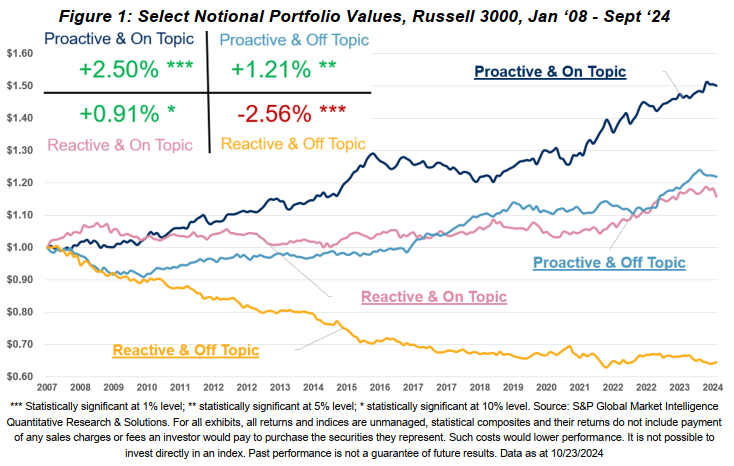
A report from S&P used NLP to look at questions from analysts about topics not addressed in the prepared remarks for an earnings call.  The analysis produced the calculations and chart below that shows responsiveness to the questions (proactive or reactive) and whether the executives stayed on topic when answering.  Striking.

Convergence concerns

Convergence between public and private investments is all the rage and product purveyors are more than willing to feed the ducks when they are quacking.

Three articles on ETFs worth reading:

~ Jeffrey Ptak of Morningstar wrote about ERShares Private-Public Crossover ETF and its SpaceX investment, which conveniently was marked up 37% a week after being added to the fund.  But the devil is in the details.

~ Eric Platt and Will Schmitt of the Financial Times covered the odd goings-on last week, when the SPDR SSGA Apollo IG Public & Private Credit ETF started trading, only to have the SEC raise questions about the fund after the fact.  Brooke Southall’s look at the issues for RIABiz provides more information — and more concern — about the “back channel” method for the fund filing and serious potential issues for those involved.

A new CAPE

According to a report from Research Affiliates, the cyclically adjusted price-to-earnings ratio (CAPE) has “performed the service of returning to the tried-and-true principle that the best predictor of future returns is starting-point valuation.”  But the firm thinks that there’s something even better:  the “current constituents CAPE.”  The revised measure uses the earnings history of the current members of the S&P 500, not the historical earnings of that index, in an attempt to mitigate the distortion from the S&P committee’s inclination to “buy high and sell low” when making changes to the index.

Other reads

“On Loopholes & Fiduciary Duty,” Steve Novakovic, CAIA Association.

I think it would be great to close the carried interest loophole, not because I wish GPs made less after-tax earnings, but because I’d like to see which GPs decide that their after-tax earnings are the most important factor in the investment process.  Then LPs can really see which GPs have a client-first mindset and which GPs are in it exclusively for their own benefit.  Maybe the trade associations were onto something.  Closing the carried interest loophole would stifle investment, just not in the way that they portray it.  It would stifle investment to GPs who are selfish actors.

“PIK and Choose,” Phil Huber, Cliffwater (via LinkedIn).  On the “lightening rod of debate” in direct lending.

“Time to come out of the turnover closet,” Simon Evan-Cook, Citywire New Model Adviser.

So, here’s the challenge to us fund buyers:  Is the ‘high turnover bad/low turnover good’ belief just a lazy assumption?

“Shoe Leather Alpha,” Christopher Schelling, LinkedIn.  Looking for winners?  You need to be willing to do the hard work of finding the undiscovered (and often “unproven”) gems rather than following the crowd.

“CalPERS board ponders the risks of TPA,” Sarah Rundell, Top1000Funds.

Under its current SAA, CalPERS currently has 11 different benchmarks.  Gilmore reflected that it is sometimes hard to see if the team has done a good job with so many benchmarks because they create different nuances.  “With a reference portfolio it is much simpler; the question is:  ‘Has management done better than a simple liquid portfolio,’ ” he said.

“The looming advisor shortage in US wealth management,” Jill Zucker, et al., McKinsey.  Advisory firms have been been on a roll for the last couple of decades, but there are “clouds on the horizon.”

“Women (and men) in finance are not typical,” Renee Adams, SSRN.

If financial firms generally do not hire women, perhaps out of concern that women will not take enough risk, then the women who end up being chosen for a position in finance may not be as risk averse as other women.

“America’s Most Famous Stock-Market Measure Is More Broken Than Usual,” James Mackintosh, Wall Street Journal.  In which a reporter for the flagship paper of Dow Jones calls out the index that carries its name.

Keep moving up the curve

“The beautiful thing about learning is that nobody can take it away from you.” — B.B. King.

Flashback: GFC

A pair of articles published late last week raised the specter of the financial crisis.  “Money Managers Return to a Levered Trade That Went Bust in 2008,” by Lu Wang and Yiqin Shen in Bloomberg highlighted the increasing popularity of portable alpha strategies:

A diversified investment strategy that seeks to juice returns through leverage is finding new love among big money managers — more than a decade after it blew up during the 2008 financial crisis.

According to the article, “advocates say they can make it work this time by improving transparency and liquidity.”  The piece ends with a quote from one such advocate of portable alpha:

It allows precise, systematic exposure management and the flexibility to integrate various strategies to meet a desired risk-return profile.

The headline of the other article, by Matt Wirz and Justin Baer for the Wall Street Journal:  “They Crashed the Economy in 2008. Now They’re Back and Bigger Than Ever.”

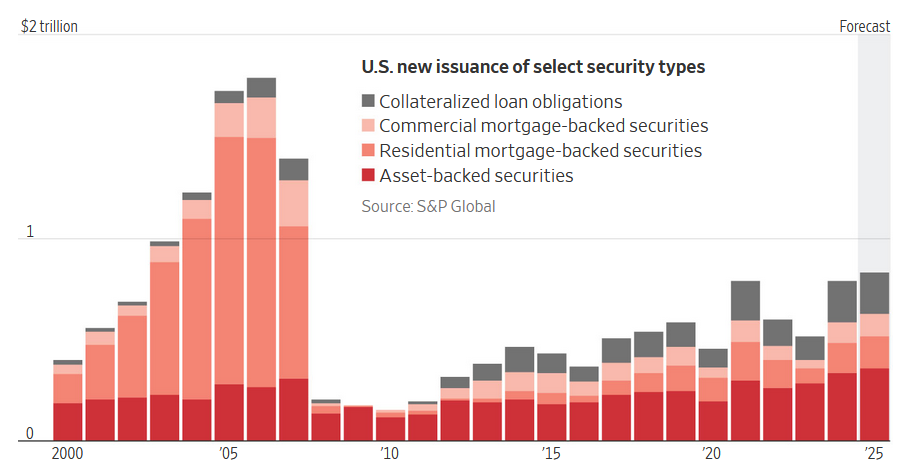
“They” being asset-backed securities, which have already eclipsed last year’s issuance.  And “they” being the hoards of people who set the attendance record last week at the structured finance conference made famous in The Big Short.

Harkening back to 2008 is easy pickings for the media, but echoes of increased leverage and sliced-and-diced credit exposures do make one wonder whether people are dancing to the same old music even though it has a new beat.  Time will tell.

Postings

All of the postings are in the archives, including one called “In the Belly of the Beast,” which summarizes two accounts from people on the front-lines during the late 1990s, one of whom came in “as an idealist and left a cynic”:

I was burnt-out, exhausted, and depressed about the current state of affairs.  I’d been both very right and very wrong in my career, but my industry was in a shambles, thanks to a potent mix of overcapacity, underwhelming demand, and good old-fashioned fraud.

Thank you for reading.  Many happy total returns.

Published: March 3, 2025

Subscribe

To comment, please send an email to editor@investmentecosystem.com. Comments are for the editor and are not viewable by readers.

A Panoramic Look at the Corporate Life Cycle

Aswath Damodaran has written extensively about corporate finance, valuation, and investment philosophies.  He brings it all together in his most recent book, The Corporate Life Cycle.

In the first chapter, “The Search for a Unifying Theory,” Damodaran says that the quest for a universal theory is a common pursuit for researchers and practitioners in disparate fields, which often leads to overreach and bias.

He then gives a concise guide to the progression of similar efforts in the three major strands of research in finance:  foundational economic theories, data-driven models and theories, and behavioral models.  None of them have provided a “comprehensive pathway to explaining market behavior, but each offers promise with regard to some aspect of it.”

Not quite a unifying theory, Damodaran uses the corporate life cycle (a concept more common to research in management and strategy than to finance) as the organizing principle for the book, writing that “while it is neither new nor the answer to all questions in finance, it has a surprisingly comprehensive explanatory power.”

The basics

Damodaran begins by describing the phases of the life cycle — start-up, young growth, high growth, mature growth, mature stable, and decline — and summarizes for each phase the business challenge, the financial picture, and the capital and ownership challenges.  From there he looks at variations in the dimensions of the life cycle (length, height, slope, and time at the top), as well as issues like competitive advantage, the trend to shorter life cycles, and the disruptors and disrupted.

The opening section concludes with a look at the key transitions from one phase of the cycle to another.  The remainder of the book uses the concepts laid out to look at the life cycle from different points of view:  corporate finance, value and price, investing philosophies and strategies, and managing a firm.

Corporate finance

Throughout the book there are more than a dozen illustrations that summarize developments across the life cycle.  Here is one that outlines the key emphases for corporate finance policies (investing, financing, and dividend/buyback) at each stage:

As with the other topics that are covered, Damodaran offers an in-depth look at the key principles involved in corporate finance, provides data to support the analysis, and gives practical examples.

For instance, the financing section looks at corporate choices regarding the use of equity or debt:

The choice of borrowing money or using equity in many businesses is still driven by what I label as illusory reasons, some in debt’s favor and some against it.

These illusory reasons are used by firms across the lifecycle and often explain seemingly inexplicable choices made by firms at each stage.

An exhibit featuring those illusory reasons is followed by one that summarizes “the real factors,” the financial trade-offs that should drive decision making.

Unfortunately, a major factor in financing policy is what Damodaran calls “me-too finance,” whereby important decisions are shaped by a peer group assessment, despite the fact that it’s all too common for companies to use peers that are only superficially similar.  Copying what others are doing might lower career risk, but it is not the way to set an appropriate policy.

Value and price

The dance between value and price is what drives markets.  Best known for his valuation work, Damodaran first lays out the process for valuing a company and then deals with the pricing of companies by investors, all the while referencing how each of those processes changes across the life cycle.

The author of an earlier book called Narrative and Numbers, Damodaran has always stressed that a good valuation is “a bridge between stories and numbers,” that to estimate the drivers for a valuation, you need a narrative about the business in question.  Here’s a summary of how the mix of narrative and numbers changes across time:

In Damodaran’s view, “the best valuations are parsimonious, relying on a few key inputs,” and he warns against doing probability distributions on too many variables.  He recommends a five-step process:

1) Tell a story

2) Run the 3P test (Possible? Plausible? Probable?)

3) Convert the valuation story into valuation model inputs

4) Value the business

5) Keep the feedback loop open

The last step is very important since it is “easy to develop blind spots and get attached to your own stories.”  Those who have followed Damodaran across the years have seen how he is much more willing to rethink his valuation assumptions than the typical analyst is.

Estimation challenges are different at each stage of the life cycle.  An analyst needs to arrive at a valuation that makes sense given the available numbers and the narrative she thinks best describes where the company is and will be.  All the while, the market is providing signals of its own:

Value is determined by cash flows, growth, and risk, and the discounted-cash-flow approach tries to bring these determinants into an estimate of the value of the business today.  Price is determined by demand and supply, and while the fundamentals (cash flows, growth, and risk) may be drivers of price, mood, momentum, and liquidity all play key roles in the pricing process.

Those dissonant perspectives provide dilemmas for investors.  From the section on high-growth companies:

Much as I would like to preserve the myth that intrinsic valuation is an exercise where the market price never intrudes, the reality is that once you value a high-growth company and come out with a value that is very different from the price, there will be the temptation to “play” with the inputs until the value converges on or at least gets closer to the price.

Pricing and valuing along the life cycle:

Among the case studies in the book is one about Tesla, for which Damodaran has published a number of valuations since 2013.  For the core valuation inputs, he gives a series of possible future values, attaching to each one the scenario that would make it probable.  So, for example, expected revenue numbers for 2032 range from $100 billion (Tesla as a “luxury winner”) to $1 trillion (“Tesla Winner-Take-All,” with almost all cars globally being electric and Tesla having 40% market share).  There are similar analyses for operating margins, reinvestment, and cost of capital.

Then comes “The Musk Effect,” in which there are three states:  Elon Musk as a Negative Force (a discount “to reflect value lost due to distractions”), as a Neutral Force, and as a Positive Force.  Recent events have shown that including this element — to account for “the sheer unpredictability of Mr. Musk” — was prescient.  Just in the last few months we’ve seen the stock explode higher because of Musk’s emerging influence on the new administration and then crater due to his questionable behavior in his seat of power and the ripple effects on Tesla sales around the world.  While in one sense those moves fall into the pricing category, Damodaran astutely identified an unusual valuation variable to incorporate into his analyses.

Investing philosophies and strategies

Investors with much different approaches have one thing in common:

Underlying every investment philosophy is a view about human behavior.

In categorizing investment philosophies, two of the key parameters are market timing versus security selection and investing versus trading (“If you play the pricing game, you are a trader, and if you play the value game, you are an investor”).  Regarding the standard categorization of value investing versus growth investing:

Put simply, the contrast between value and growth investing is not that one cares about value and the other does not, but is where in the company the investor believes the “value error” lies.

Walking through the life cycle, Damodaran covers a range of investment strategies, providing evidence about their effectiveness and observations about the gaps between theory and practice.  For instance, in venture investing, pricing mistakes tend “to spiral up and down the pricing chain,” so that “one new round of overpricing or underpricing can spawn many more rounds of overpricing or underpricing.”  (That “me-too” behavior in corporate finance?  It’s endemic among professional investors.)

In the growth stage, earnings forecasts and revisions drive most results, so being better at estimating earnings is a differentiator.  However, somewhat surprisingly, Damodaran also says that macro forecasting skills are a determinant of success, something that few growth investors would claim as part of their approach.  But recessions blow up earnings projections, so his assertion makes sense.

Value investing has seemed to be lost in the wilderness for quite a while, at least in terms of relative performance.  Damodaran analyzes four explanations (or excuses) he has heard — “This is a passing phase!  The Fed did it!  The investment world has become flatter!  The global economy has changed!” — and provides prescriptions for responding to those shifts.

He believes that “the troubles in value investing are deep” and can be summed up in this way:  “It has become rigid . . . It has become ritualistic . . . It has become righteous”:

Put simply, value investing, at least as practiced by some of its advocates, has evolved into a religion rather than a philosophy, viewing other ways of investing as not just misguided but wrong and deserving of punishment.

Managing

In the preface of the book, Damodaran writes:

The most destructive acts in business occur when companies refuse to act their age, behaving in ways that are incompatible with where they are in the life cycle and often spending large sums in this endeavor.

That theme pervades the section on managing a firm, which looks at each stage in the life cycle, identifying the most important roles that management needs to play, from “Steve the Visionary” to “Larry the Liquidator.”  Having the wrong kind of CEO at a particular stage can be damaging and even fatal.  And, while the right thing for a company to do is to “act its age,” there will be plenty of contrary advice:

Management consultants and bankers generate a large portion of their fees from their capacity to convince companies that they can reverse the aging process and getting them to act on that belief.

While Damodaran argues that acceptance of where you are is usually the best option, in some cases renewals, revamps, and rebirths actually succeed.  The odds are long, but those are the stories that get told and retold.  Conversely, when the grand plans fail, there are usually steep falls, leading to sudden death or zombieland.

The book closes with some “serenity lessons” for managers.  Among them:

As the owner or manager of a business, you need to assess, given where the company is in its life cycle, whether you should be playing offense or defense and, if the latter, the competitive advantages or moats that you will be defending.

And some lessons for investors too, including:

Choose the game that you want to play, with a sense of why you think you can win at that game, and stop deluding yourself.  In short, if you are trading, don’t masquerade as an investor or talk about value, and if you are investing, stay clear of pricing plays.

Communication lessons

Damodaran writes from the first person, with a clear point of view.  He always sets up his intentions at the start of a section (“I will . . .”), reviews what has been covered at the end (“I have . . .”), and makes similar contextual references throughout.  The reader is never lost.  (That approach fits with the recommendations of another professor, Patrick Henry Winston, in his excellent book Make It Clear: Speak and Write to Persuade and Inform.)

The power of repetition can be seen in the use of the many life cycle graphs that were included.  Each dealt with a different topic, but the cumulative effect reinforced the thesis in an atypical way.

The book is packed full of charts, but many of them serve as reminders that it is much harder to discern complicated graphs when they are presented in grayscale.  A color insert that repeated some of the illustrations drove home that point.

Recommendation

It is difficult to communicate in a short review the depth and breadth of material found in the book.  Damodaran has written an essential guide for newer analysts that weaves theory and practice together — and reveals analytical and behavioral challenges that they must face.

Experienced investors can benefit from reading it too.  Like other good books on research and investing, it can serve as a useful guide to check in on investment processes, which can get stale over time.

Taking the framework laid out by Damodaran, an analyst could map the positions of his companies along the life cycle and evaluate how they stack up.  Which ones aren’t acting their age?  Are they susceptible to the pitfalls common in the phase they are in?  How are they valued and priced (and why)?  What kinds of investors are moving in or out?  (Portfolio managers could go through the same exercise for their holdings.)

Finding new angles of inquiry — or repurposed ones — is an essential part of analysis.  Aswath Damodaran has done so in a comprehensive way.


Damodaran’s website is a gold mine.  The images from the book used here can also be found in a posting on the corporate life cycle from his blog (which is now available via Substack too).  Also on the site are information from his courses at NYU, datasets, online tools, podcasts, and YouTube videos.  One set of 21 videos explores the corporate life cycle.

An upcoming essay on this site will consider the life cycles of investment organizations.

Published: March 1, 2025

Subscribe

To comment, please send an email to editor@investmentecosystem.com. Comments are for the editor and are not viewable by readers.

Using LLMs, GP Stakes, Litigation Finance, and the Market Data Industry

The most recent piece on the site is “Common Practices, Best Practices, and Next Practices,” which explores the dynamics of established practices and innovative ones:

So the question then is whether best practices are those that have stood the test of time and are widely implemented or those that are superior to others.  In other words, what is the meaning of “best”?

To get every new posting via email when it is published, subscribe here.

Since the previous Fortnightly, the last two short items on concepts for evaluating investment organizations appeared on LinkedIn.  They are social pressure and explanatory depth.

On to the readings.

Using LLMs

Alex Spyrou and Brian Pisaneschi wrote a report for CFA Institute, “Practical Guide for LLMs in the Financial Industry.”  A “critical step”:

With the vast and evolving array of models available, financial institutions face an important decision:  choosing between open-source and closed-source options.

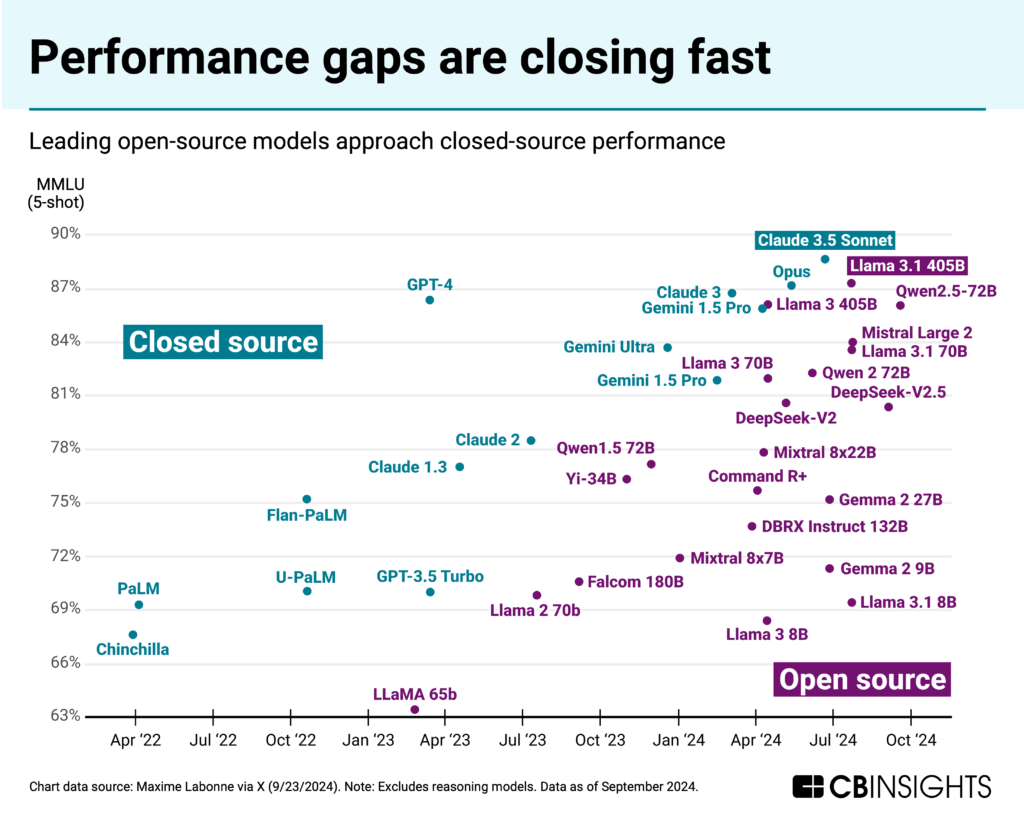
The authors outline the benefits and challenges of using open-source models versus closed-source ones.  (Along that line, a graphic from CB Insights shows how general open-source models are closing the performance gap.)  Plus they include a number of examples and considerations.

In case you’re wondering whether the Holy Grail has been found:

Stock movement prediction remains challenging for both FinLLMs and general purpose LLMs, with no model achieving consistently high accuracy.

GP stakes

Blue Owl published a paper, “The Anatomy of a GP Stakes Fund,” which breaks down the components of return from a GP stake, the elements of a transaction, the contributors to an entry valuation, and the calculation of “GP alpha.”  It also compares GP stakes investments to secondaries purchased from limited partners.

One topic given a high profile could be described as “searching for a bucket.”  Apparently Blue Owl thinks trying to figure out which asset category to put GP stakes in is something that is impeding adoption.

Of note on the sentiment front, the subtitle for the paper is “An Investment for All Seasons.”

Litigation finance

Asset managers have gotten increasingly interested in financing litigation, which makes “The Alchemist’s Inversion” by Samir Parikh an important read for asset owners.  He calls the private equity firms and multistrategy hedge funds that are active as “opaque capital,” changing the dynamics of litigation finance.  As for the title of the paper:

The Alchemist’s Inversion describes a litigation financier’s use of unethical and potentially illegal tactics to create, enhance, and marshal apparently low-value claims with the hope of turning them into gold.

By examining the move by these investors into mass tort, Parikh gives asset owners a look at the mechanics of litigation finance — and raises a potential question of whether or not they want to play the emerging game.  In that sense it fits with the theme of an earlier Investment Ecosystem posting, “Does it Matter (How the Money is Made)?”

The market data industry

The Terminalist is an excellent newsletter about the market data industry.  Its first three postings:

1 ~ What makes Bloomberg so successful.  Its “Seven Powers” and the innovations that put it ahead of every one else in the business.

2 ~ How data travels across the ecosystem and the three acts of market data — production, distribution, and activation — with detailed looks at “pure-play champions” for each (CME, FactSet, and MSCI, respectively).

As financial data journeys from creation to consumption, it flows through a value chain that forms the nervous system of modern markets, transmitting millions of signals through a complex yet structured system.

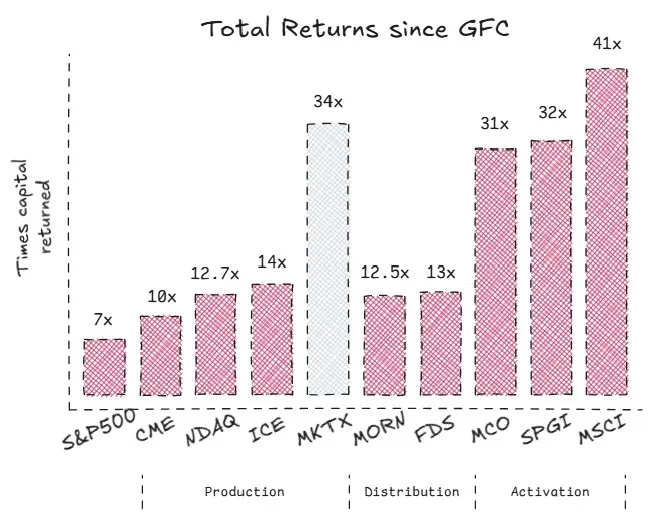
3 ~ More detail on each of those functions and companies, as well as a look at their extraordinary returns since the financial crisis, shown below.  (Left to right:  the S&P 500; CME; Nasdaq; Intercontinental Exchange; MarketAxess; Morningstar; FactSet; Moody’s; S&P; MSCI.)

By the way, the author estimates Mike Bloomberg’s return since he started his firm (a different inception date than shown in the chart) to be 10,000 times his investment in 1981.

Safety in numbers

Charles Skorina, who is in the business of executive search for investment professionals, thinks that “Safety-in-numbers seems to be the new endowment-model-norm.”  That is, everyone is using the same playbook (and it’s not working as well as it used to), including in the selection of talent:

Let’s be honest here.  If the David Swenson of 1985 had applied for the CIO position at Yale today he would not have made it past the first round of interviews.  A young untested Wall Street banker working on some exotic swap thing?  Not a chance.

Rebalancing redux

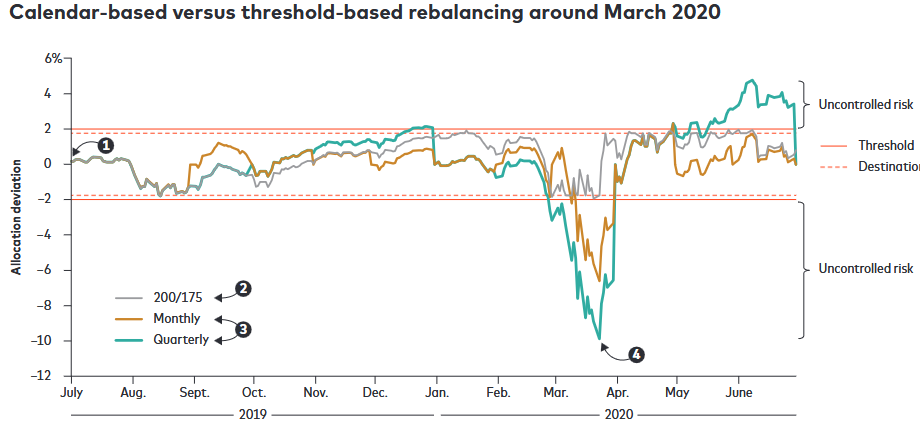
The last Fortnightly included a reading from Vanguard on threshold-based rebalancing.  Subsequently, Campbell Harvey, et al. released a paper, “The Unintended Consequences of Rebalancing,” which garnered a lot of attention in the financial press.

The authors find that “the predictability of these [calendar-based and threshold-based] trades enables certain market participants to profit by front-running the orders of large institutional funds.”

Other reads

“Slowly Melting Ice Cubes,” Phil Bak, BakStack.

Melting ice cubes are the anti-moat.  And legacy asset managers are slowly melting ice cubes.  Here is why, and here is what they should do about it.

“For junior allocators looking to be more involved in portfolio construction,” Dave Morehead, LinkedIn.  Thoughtful suggestions from Baylor University’s chief investment officer.

“It’s time to rethink due diligence,” Jay Scanlan, et al., Accenture.

This report explores exactly that: how, using technology, firms can expand due diligence beyond risk assessment to make it a springboard for creating value.

“There are several kinds of trend,” Grant McCracken, Tailwind Radar.  The cultural anthropologist offers a categorization of trends that can be adopted to the analysis of industries and the investment ecosystem itself.

“Increasing Your Hit Rate with LPs,” John-Austin Saviano, High Country Advisors.

Understanding who you are selling to, what they want, and how they will view your offering can help focus your efforts.  Marrying that initial understanding with substantial preparation will increase your likelihood of success and the overall speed of your fundraise.

“AI and the Mag 7,” Daniel Rasmussen, Verdad.

Now that they are mega-cap behemoths run by mega-billionaires trying to outspend each other, maybe the Mag 7 will be outmaneuvered by their true heirs, another group of as-yet-unknown young innovators who are toiling away all over the world in garages.

“Founder Ownership Report,” Peter Walker and Kevin Dowd, Carta.  How the typical composition of founding startup teams is changing and how equity is split.

“Private Equity Firms Are Finding New Ways to Curb Creditor Power,” Giulia Morpurgo, et al., Bloomberg.

The fight over such provisions marks the latest salvo in a power struggle between buyout firms and debt investors.

“Imbalance Sheet: Supply, Demand, and S&P 500 Financing,” D. E. Shaw.  On “an unusual, and unusually persistent, anomaly.”

“RIAs fear broaching ESG topics with clients amid blowback, but ‘do-the-right-thing’ investments are still big business, Cerulli shows,” Brooke Southall. RIABiz.

RIAs and investors are walking on eggshells around each other when it comes to discussing ESG investing amid political and financial scrutiny.

To say the least

“People have complicated utility functions.” — Cass Sunstein.

Flashback: Valuing revenues

We are within a few weeks of the 25th anniversary of the peak of the internet bubble.  Here’s the chart of Sun Microsystems for the ten years surrounding that time:

After the fall, Sun’s CEO, Scott McNealy, uttered these famous words:

At 10 times revenues, to give you a 10-year payback, I have to pay you 100% of revenues for 10 straight years in dividends.  That assumes I can get that by my shareholders.  That assumes I have zero cost of goods sold, which is very hard for a computer company.  That assumes zero expenses, which is really hard with 39,000 employees.  That assumes I pay no taxes, which is very hard.  And that assumes you pay no taxes on your dividends, which is kind of illegal.  And that assumes with zero R&D for the next 10 years, I can maintain the current revenue run rate.  Now, having done that, would any of you like to buy my stock at $64?  Do you realize how ridiculous those basic assumptions are?  You don’t need any transparency.  You don’t need any footnotes.  What were you thinking?

Fast forward to now.  Palantir is trading at 70 times projected revenues.

Postings

Search the archives for lots of great evergreen content.  The very first posting, in October 2021, was “A Case Study in Three Dimensions of Asset Manager Practice,” regarding ARK Investments:

These considerations — the role of experience, the structure of research activities, and the balance between firmly-held beliefs and the openness to other voices — are by no means limited to ARK; they should be of concern for every asset manager (and, therefore, for those who allocate capital to them).

The firm’s flagship strategy started its steep descent three weeks later.

Thank you for reading.  Many happy total returns.
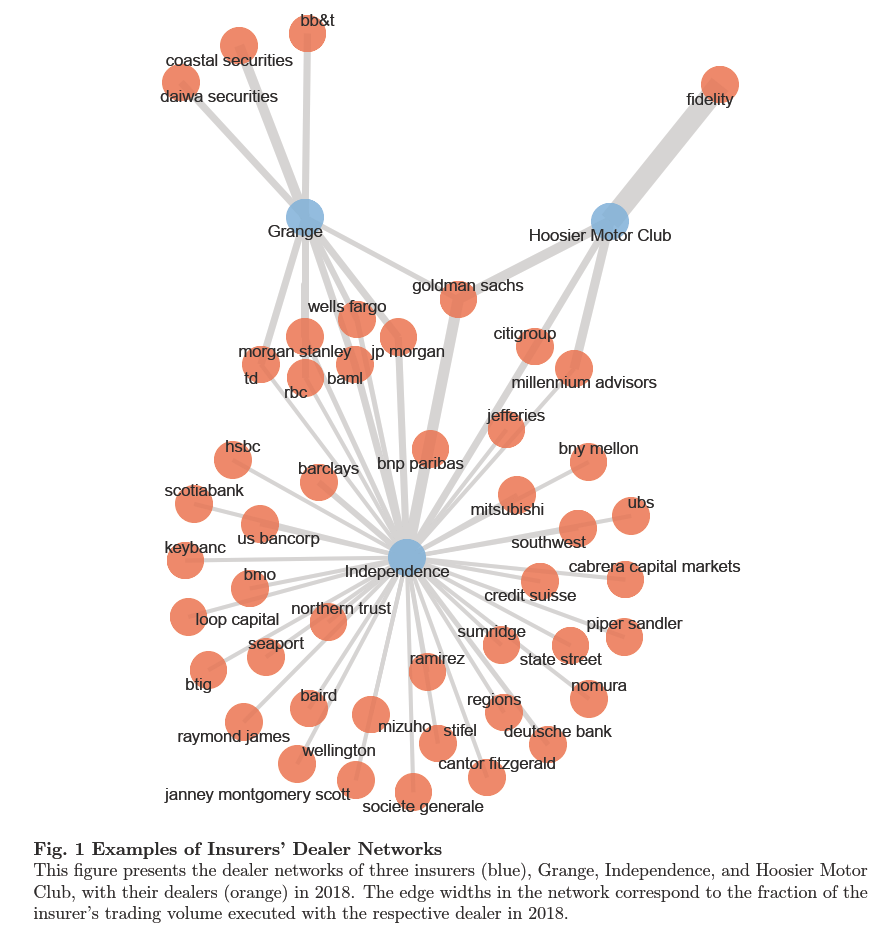
Published: February 17, 2025

Subscribe

To comment, please send an email to editor@investmentecosystem.com. Comments are for the editor and are not viewable by readers.

Common Practices, Best Practices, and Next Practices

You hear the phrase “best practices” quite a lot.

What are they?  Who sets them?  How long-lasting are they?  And, are they really best practices?

Exercise

A simple exercise is called for.  To get started, consider your role.  How would you describe what you do in comparison to the standards that are prevalent across the industry in like positions and situations?

Or, if you prefer, consider your organization’s practices versus those of others like it.

When doing an exercise like this, it’s best to write things down, so make a series of lists with these headings:

You might even insert a “bad practices” column on the left side if you want to be more complete about it.

Common practices and best practices

Let’s focus initially on the first two columns shown here.

Trying to identify the respective attributes for those categories demonstrates that often what are described as best practices amount to what most everyone else does too.

So the question then is whether best practices are those that have stood the test of time and are widely implemented or those that are superior to others.  In other words, what is the meaning of “best”?

People use the phrase in two different ways.  We could title them Best Practices (Meeting Generally Accepted Industry Standards), which in this exercise should be placed in the common-practices column, and Best Practices (Different and Better Than Others), which should be put in the best-practices column.

(“Common practices” doesn’t sing as a marketing phrase, so don’t expect to see it in pitch books any time soon.  The purpose here is organizational analysis, to identify areas where common practices are exceeded, not to develop a winning narrative.)

As practices evolve and current best practices are adopted by others, they naturally move into the common practices category.

Next practices

Which brings us to the right-most column of “next practices.”

Understanding the ongoing progression of such things and the fleeting nature of edge, innovative organizations are constantly working to improve their methods.  Identifying next practices and working toward them (while knowing that some won’t come to fruition) is part of their DNA.

Next practices are the best practices of tomorrow and the common practices beyond.

Profiles

Organizations (and individuals) tend to have one of three patterns in terms of the relative number of practices found in each category:

~ For most, the practices are heavily weighted in or exclusively confined to the common category.

~ Fast followers are eager to have some exposure to best practices as they become apparent (after being developed by others), so they have some more representation there.

~ Innovators have a mix of all three categories.

Of course, the potential risks and rewards vary materially across these profiles.  And it must be stressed that successful organizations and individuals (and failing ones) can be found in each grouping.  The “right” mix to pursue depends on circumstances; a mismatch between aspirations and the availability of necessary skills and resources will lead to trouble.

Examples and considerations

Categories of organizations differ on these dimensions.  For example, systematic quantitative firms are very much on the innovative end of the spectrum, continually looking for new techniques and signals, and expecting that the state of play will change frequently.  (One way of seeing that is to look at reports about alternative data in use by them over the years — you’ll see a clear next-to-best-to-common pattern.)

Many fundamental investment strategies have remained much more stable in approach than quantitative ones, although you can see small changes here and there within them.  It used to be that everyone had to be on earnings conference calls, then transcripts became prevalent, then natural language processing offered insight into sentiment and tone, now AI provides even quicker summaries and deeper analysis.

Speaking of AI, it is shaking things up already and there is more to come.  Right now, large-scale AI developments may be the province of the most innovative entities, but the widespread availability of large language models means that individuals from a variety of organizations are finding new ways to do their work.  Experimentation is happening more broadly across the ecosystem than is typically the case.

Importantly, to return to the semantics of it all, who is to say what is best?  It is definitely in the eye of the beholder.  (Therefore, representing what you do as “best practices” can work against you if governing bodies, stakeholders, clients, or prospects don’t see it that way.)

While introduced as something that you can do yourself, the exercise above is even better when done in concert with your co-workers.  Comparing lists can be enlightening, since there are bound to be differences of opinion, which are fodder for further examinations of the current state that can lead to new ideas for continuous improvement.

All in an ongoing quest to be the best.

Published: February 14, 2025

Subscribe

To comment, please send an email to editor@investmentecosystem.com. Comments are for the editor and are not viewable by readers.

The Conviction Mirage, Pretzel Logic, Primitive Portfolios, and That Stage of the Market

A series of short postings about core concepts for evaluating investment organizations continues on LinkedIn.  The topics covered during the last two weeks:  change, compression, maps, and mess.  (The concepts are used extensively in the Investment Ecosystem Academy’s course, “Advanced Due Diligence and Manager Selection.”)

If you’d like to get postings like this Fortnightly and original pieces on interesting ideas in the investment world, you may subscribe here.

On to the readings.

The conviction mirage

In the wake of the DeepSeek hit to Nvidia and other AI stocks, Kris Tuttle wrote a posting on Random Candy that recounted a situation when he was a sell-side analyst in the 1990s and one of his favorite stocks came under a lot of pressure.

As the drop escalated, so did the interaction with a key client (at one point during which it occurred to him “that the largest institutional shareholder doesn’t know what the company does”).  The lesson:

When stocks go up, everyone feels firm in their convictions.  But when something happens, and stocks fall sharply, their ability to articulate and believe in their own convictions often goes out the window.

(For his part, Tuttle thinks the DeepSeek developments are “a big deal.”)

Ted Merz focused on how the story “flew under the radar” for seven days before having an outsized impact:

It’s arguably the biggest dropped ball in memory on the part of financial journalists, traders and money managers.

A number of people have pointed to “The Short Case for Nvidia Stock,” published by Jeffrey Emanuel on January 25, as precipitating the big drop when stocks reopened two days later.  Why did it take so long?

As Aswath Damodaran has explained in his book Narrative and Numbers (reviewed here) and in his other writings, he links the components in his valuation of a company to its story (as he sees it) at any point in time.  He is very willing to reexamine that story and therefore the valuation (often in significant ways) as circumstances change.  In practice, his approach is quite different from the journey of faith that ensnares many professional investors.

In a recent posting, Damodaran differentiates between story breaks, story changes, and story shifts — and places the effects of DeepSeek on leading AI companies as being in the story-change category, denting the existing “happy talk” narrative.  (Although he has been an owner of Nvidia, his valuation of it is now substantially below the current stock price.)

The larger question here is how and when investors change their minds about something.  It can take a very long time for reactions to occur in real time that seem obvious in hindsight.  For example, think of the snail-paced recognition of risk as the coronavirus spread.  Even as the news grew worse and worse, there wasn’t much change in the market.  Until there really was.

For much of the investment ecosystem, risk management is statistical rather than qualitative and anticipatory.  With that approach, until the market tells you it’s problem it’s not a problem.

Pretzel logic

In a column, “Maybe ESG Is Illegal Now,” Matt Levine wrote at length about the puzzling court decision involving a defined contribution pension plan of American Airlines.  This paragraph points out the inanity of the ruling:

The result is apparently that investors are not allowed to consider risks if those risks are politically disfavored.  If you base your investment decisions on reading financial statements or drawing lines on stock charts or tracking sunspots, a judge will not demand that you prove that those techniques lead to higher returns.  But if you base your investment decisions on a theory like “climate change will lead to more forest fires that will be bad for insurance companies,” a judge will suspect that you are lying and demand that you prove it.  Some kinds of risk analysis are left to the business judgment of professional investment managers.  But some, now, are not.

Primitive portfolios

In an opinion piece in Institutional Investor, Richard Ennis bemoaned the state of institutional investment management.  As private investments soared in popularity, “the nature of investment supervision changed.”  Most “alternatives” are not really alternatives now, but the foundation on which portfolios (and behavioral norms) are built.

The result is what Ennis calls “scattershot diversification”:

There is nothing elegant about portfolio construction today.  In fact, it seems almost primitive.  Institutions own a jumble of equity things — nearly countless, largely illiquid, and beyond their control.

That stage of the market

Owen Lamont of Acadian capitalized on a David Einhorn phrase to write a piece about “the Fartcoin stage of the market.”  He sees “market nihilism;” virus-spreading memes (which he cops to contributing to himself:  “As you read these words, the idea of Fartcoin is burrowing deeper into your mind.”); stupidity; and “smart money selling to dumb money at the peak”:

I can’t believe I’m saying this, but the current meme coin mania makes the bubble of 2021 seem like a relatively sober exercise in rational valuation.

Rebalancing

This image comes from Vanguard’s report, “The rebalancing edge: Optimizing target-date fund rebalancing through threshold-based strategies.”  It illustrates what it calls a “200/175 strategy,” whereby there is a threshold of 200 basis points away from a target allocation, from which the rebalancing dials the exposure back modestly to 175 basis points from target.

The analysis is accompanied by various warnings about the shortcomings of simulations, but the firm concludes that compared with calendar-based approaches, threshold-based rebalancing results in smaller deviations from target allocations, higher annual returns, and lower costs.

While the piece directly referenced target-date funds, similar rebalancing issues are also faced by advisory firms and institutional asset owners.

Active management

Clare Flynn Levy of Essentia Analytics writes that “the investment management industry is, at its essence, selling decision-making as a service.”

Passive investing has been a juggernaut, but Levy warns that “market cap-weighted indices are becoming dangerously concentrated and no longer fit for purpose — whether that purpose is to serve as a benchmark or to provide diversified returns.”  And the historical information upon which investors base their assumptions has become “significantly less reliable” given the change in market structure.  She thinks there is hope for the beleaguered advocates of traditional active investing:

For active managers, the path ahead is narrower and more demanding, but those who can align with evolving investor needs and deliver tangible value will find that their relevance, though tested, is not obsolete.  The industry’s challenge is not survival — it’s transformation.

(See also “The Active Management Reinvention Project.”)

OCIO performance

CFA Institute released its “Guidance Statement for OCIO Portfolios,” part of the Global Investment Performance Standards (GIPS), which dictates how asset managers report their results.  An Institutional Investor article by James Comtois reported that the statement has received “mixed reviews.”

There was nothing mixed about the reaction of Brian Schroeder of OCIO Monitor.  He sees a number of problems with it, including the degree of latitude in selecting a composite range within which to compete and the ability to classify assets in a variety of ways — the end result being the ability of providers to game the system.  The statement “will muddy the waters and create false trust in OCIOs that wear the halo of being GIPS compliant.”

Other reads

“Artificial Intelligence and the Risks of Harking (Hypothesizing After-the-Fact),” Larry Swedroe, Alpha Architect.

The takeaway then is that because AI systems can produce hundreds of seemingly coherent theoretical explanations for mined empirical results, investors need to establish high hurdles before allocating to anomaly-based strategies.

“Rise in Creditor on Creditor Violence,” Ironshield Capital Management.  Subtitled, “A European perspective,” this includes explanations for the different strategies in the escalating creditor wars around the world.

“What’s Predicted Funds’ Performance? The Thing That Wasn’t Supposed to Work,” Jeffrey Ptak, Basis Pointing.

Pre-fee past performance did a very good job of predicting funds’ subsequent performance, on average, over the past few decades, almost no matter which way you looked at it.

“The Future of Venture,” Seth Levine, VCAdventure.  More and more, “fund size is fund strategy.”

“How the role of the gatekeeper is evolving,” Tania Mitra, Citywire Pro Buyer.

Part of the reason why the gatekeeper job has changed is due to the evolution of the investment industry itself.  The mutual fund is no longer the only vehicle to consider.  Product innovation has ballooned, ETFs have risen in prominence and popularity, and alternative investments are becoming more mainstream.

“Fund finance: NAV financing unlocked, Christopher Bone, et al., Partners Group.  Three perspectives on NAV financing:  LP, GP, and NAV lender.

“A decade in need of a course correction,” Roger Urwin, Top1000Funds.

Can we expect the asset owners and corporations to do the right things in the coming years?  The increasing pressure from civil society on these organisations raises my expectations that they will follow the purposeful road.

“Human traders are valuable, actually!” Robin Wigglesworth, FT Alphaville.  Is the NYSE floor “a very elaborate TV set for CNBC” or is there still something special about it?

“I am leaving my buy-side job and am fed-up with the nepotism,” Anonymous, eFinancialCareers.

It’s not just relatives of senior employees.  We’d also employ the sons and daughters of key clients.  Another graduate I worked with was the son of the CEO at a client firm.  His dad knew our senior management team.

So much for best practices

“Recognize that many of your best practices were designed for a world that no longer exists.  In the face of rapid change, past patterns don’t predict the future.” — Adam Grant.

Flashback: Trilogy Systems

Ever since semiconductors became a thing, investors have thirsted after the companies that make the latest and greatest kinds of chips.  And after entrepreneurs who have been proven money-makers.

Those two strands came together when Gene Amdahl — a leading computer designer for IBM and the founder of Amdahl Corporation — started Trilogy Systems in 1980.  Its IBM-compatible machine was to be more affordable and more powerful.  The secret?  Wafer-scale integration (WSI).

Investors ate it up, with substantial venture funding followed by a splashy IPO in 1983 that drew the biggest road show crowds during a time of hot new issues.  Unfortunately, the stock fell more than 95% in the next year, as it became clear that WSI wasn’t going to work.

More than forty years later, Cerebras has filed for an IPO.  The prospectus leads with pictures of its “wafer scale engine” and the very-large-font promise:  “Bigger chips are faster and more efficient for AI.”

(For much more on Trilogy, see part one and part two of a piece by The Chip Letter.)

Postings

All of the postings may be found in the archives.  Each posting is put into a category, but they tend to be universal and evergreen.  That way you can see possibilities across the ecosystem.

For example, “Essential Elements in External Networks,” from 2022, addresses issues regarding those networks:

In our investment-related duties, we have external networks as well as internal ones.  While a few organizations could be considered isolationist in their approach, in general the range and quality of those external networks are critical factors in determining what ideas are considered.  They also are a main driver of the social pressure that motivates many decisions.

Thank you for reading.  Many happy total returns.
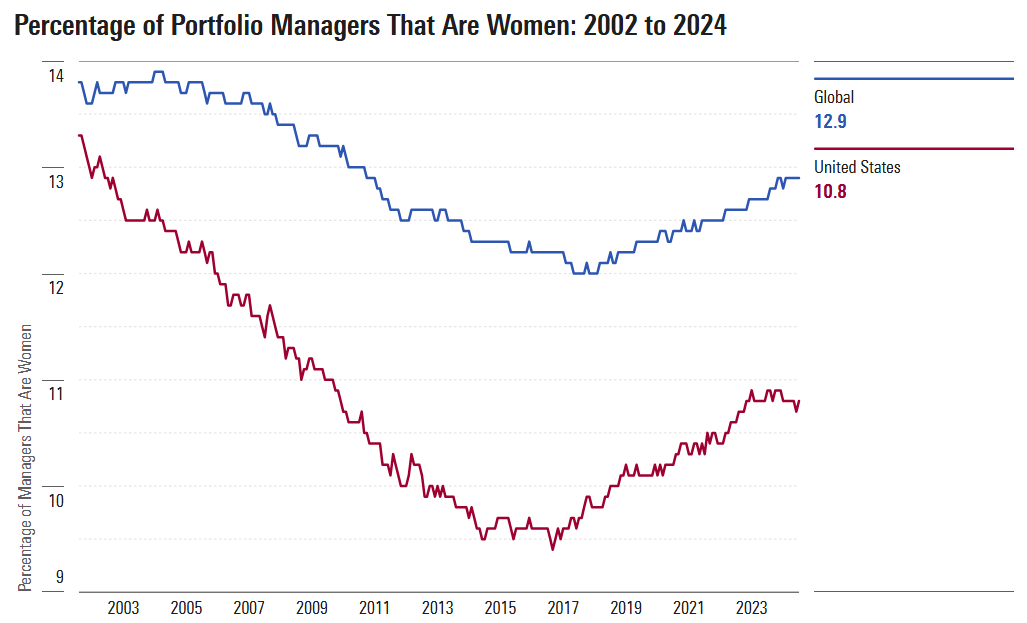
Published: February 3, 2025

Subscribe

To comment, please send an email to editor@investmentecosystem.com. Comments are for the editor and are not viewable by readers.

The Pedestal of Popularity, Analyst Angst, and Blowing in the Political Winds

The most recent Investment Ecosystem essay is “Analyzing the Due Diligence Process to Produce Better Outcomes.”  It covers a novel piece of academic research about venture capital due diligence, as well as some questions about general diligence practice that are prompted by it.

Also new are five short postings on LinkedIn about core concepts for evaluating investment organizations.  They concern categorization, performance expectations, differentiation, edge, and circle of competence.  There are six more to come.

Reminder:  If you don’t receive email versions of postings like this one, you can subscribe here.  Now, on to the readings.

The pedestal of popularity

The latest piece from Howard Marks of Oaktree is titled “On Bubble Watch,” published a quarter century to the day since “the first memo that brought a response from readers,” bubble.com.

He offers a good overview of bubbles and their characteristics:  newness, “no price too high,” but also no history on which to rely.  Some of his points:

There’s usually a grain of truth that underlies every mania and bubble.  It just gets taken too far.

When something is on the pedestal of popularity, the risk of a decline is high.

In bubbles, investors treat the leading companies — and pay for their stocks — as though the firms are sure to remain leaders for decades.

Elsewhere, in response to “a raging bitoin bubble,” Owen Lamont of Acadian offers “seven phrases of timeless relevance” with historical perspectives and references.

Another juggernaut on the bubble watch list is AI.  Doug O’Laughlin, who writes Fabricated Knowledge, explores the nature of capital cycles and the implications for AI.  Right now “it’s time for capital to chase the land grab blindly.”

Analyst angst

Bloomberg published an article on “How Analyst Job Cuts on Wall Street Are Reshaping Equity Research.”  To wit:

Regulations on how banks charge for research, a shrinking market for publicly listed companies, and the popularity of index-tracking funds have conspired to squeeze equity research in ways few could have imagined even a decade ago.  Leaps in artificial intelligence only threaten to accelerate that trend, with firms like JPMorgan already experimenting with AI-powered analyst chatbots, sowing deeper doubts about the value of fundamental analysis and whether investors will keep paying for it.

The article delves into the implications of the changes for analysts and for market behavior.  A column by Matt Levine elaborates.

Also of note:  “The Lamentation of David Einhorn,” by Robin Wigglesworth for the Financial Times, on the ripple effects of the massive flows to passive investing and other strategies that have changed the game “for people who are trying to buy undervalued things.”

Blowing in the political winds

This chart comes from a Wall Street Journal article by Sarah Nassauer.  It shows the abrupt rise of DEI as a topic during corporate conference calls and presentations starting in mid-2020 — and the marked decline from the peak.

The shape of the histogram is indicative of a broader pattern in corporate behavior.  Many companies are fleeing memberships in the net-zero initiatives that they previously embraced and ridding themselves of or deemphasizing broader ESG efforts.  Some leaders who were publicly critical of the January 6 attack on the Capital and other actions during the first Trump term are now providing funding for his second inauguration and changing (or hiding) corporate policies to curry favor.

Those aren’t universal trends, of course.  For example, the WSJ article cited above covers Costco’s reaction to a shareholder proposal regarding its diversity stance.

You might think that the reversals in response to changing political winds are terrible or you might herald them as refreshing returns to sensibility — or you might see the ebb and flow of such things as a vivid demonstration of craven decision making and wonder what that indicates about the firms and their leaders.

New sources

The last twenty years have seen an explosion of investment writing online, and there are always new sources popping up to try out.  Three recent debuts that may be of interest to you:

Jeffrey Ptak is the Chief Ratings Officer for Morningstar Research Services.  He writes about interesting ideas in the fund world at Basis Pointing.

An investment funds lawyer publishes Cash and Carried, which offers straightforward explanations of the nuts and bolts of investment products and the entities that produce and invest in them.

It is hard to keep abreast of the flood of academic writing about investments.  One way to do so is by reading Alpha in Academia.

Public funds

A team of researchers from Marquette University has published a paper, “Does the Board Engagement of Public Pension Plans Matter?” in the Journal of Financial Research.  (Christopher Merker, one of the authors, offers background on the project with links to additional material.)  Their approach:

We collect data [from publicly available meeting minutes] that reflects board engagement levels, including meeting frequency, the extent of investment discussions, attendance rates, and member turnover, among other factors.  From this novel database we create an index which captures the extent of board engagement.

The bottom line:  funds with higher index scores have better performance.

Given the size of unfunded liabilities at many public plans and the myriad ways political considerations can enter into decision making, it’s not surprising that market crises bring increased attention.  What may be surprising is that “on average, about 8 percent of state pension plans are under SEC investigation each year.”  Kangkang Zhang analyzed the effects of those investigations.

Also see:  “Pension funds dabble in crypto after massive bitcoin rally.”

Changing menu

CEM Benchmarking analyzes the holdings, costs, and performance of large pension and sovereign wealth funds around the world.  A posting from it about private credit includes this chart, showing the rapid adoption of that asset class as an asset allocation “bucket” over the last fifteen years.

Other reads

“The Who and How of Hedge Fund Risk Shifting,” Spencer Andrews and Salil Gadgil, Office of Financial Research.

Our findings illustrate that compensation considerations distort managers’ portfolio allocation decisions.

“Beyond the Blame Game: Why the Proxy System Needs to Change,” Matthew Leatherman and Olivier Lebleu, FCLTGlobal.  A call for reform, including sections on “costs to be minimized” and “value to be maximized.”

“The ‘Positives’ Section of a Due Diligence Report,” Anthony Hagan, Freedomization.

There are ways to portray conviction without putting out foolproof “best-thing-since-sliced-bread” vibes.  There is an art to highlighting positive attributes in an objectively convincing manner without sounding like you work for the fund (or deal) you are putting forth.

“This is What a Good Investment Meeting Should Look Like,” Jeffrey Bronchick, Cove Street Capital.  Unfortunately, many potential clients who want to sit in on an investment meeting of an asset manager are looking for theater when they should be looking for the messiness that is inherent in good teamwork and decision making.

“The Accuracy and Importance of Growth Guidance,” Naoki Ito, Verdad.

Our favorite motto is that investing is not a game of analysis; it’s a game of meta-analysis.  Stock prices already reflect growth projections.  In our opinion, what drives returns is the deviation between projected growth and realized growth.

“What You Don’t Know Could Sting Your Portfolio,” Jason Zweig, Wall Street Journal.  When custodian firms demand more revenue from investment advisors, clients can end up paying the price.

“The problem with marketing puffery,” Seth Godin, Seth’s Blog.

If you need to out-hype your competition, it’s a race to the bottom.  Someone is always more willing to hype than you are.

Step right up

“The large print giveth and the small print taketh away.” — Tom Waits.

Flashback: The pits

They say a picture is worth a thousand words.  Two pictures can tell a story.

To illustrate a LinkedIn posting arguing that “an AI Tsunami is coming this year in marketing,” Nick Candler posted this diptych:

It is a reminder of how profoundly the structures on which an ecosystem is built can change over time.  The trading pits and stock exchanges were the beating heart of the financial system.  No more.

To be in the room when there was market-moving news was to see and hear the world of money move.

Postings

All of the postings (now over two hundred) are available in the archives.

For example, this is from a piece from three years ago, “Capital Market Assumptions as Explored Beliefs”:

Whether home-grown or off-the-shelf or something in between, the CMAs are an expression of beliefs.  As such, in draft form they should serve as a vehicle for a discussion of those beliefs, the proposed choices, and the implications of them — well before the CMAs are adopted and implemented.

Thank you for reading.  Many happy total returns.
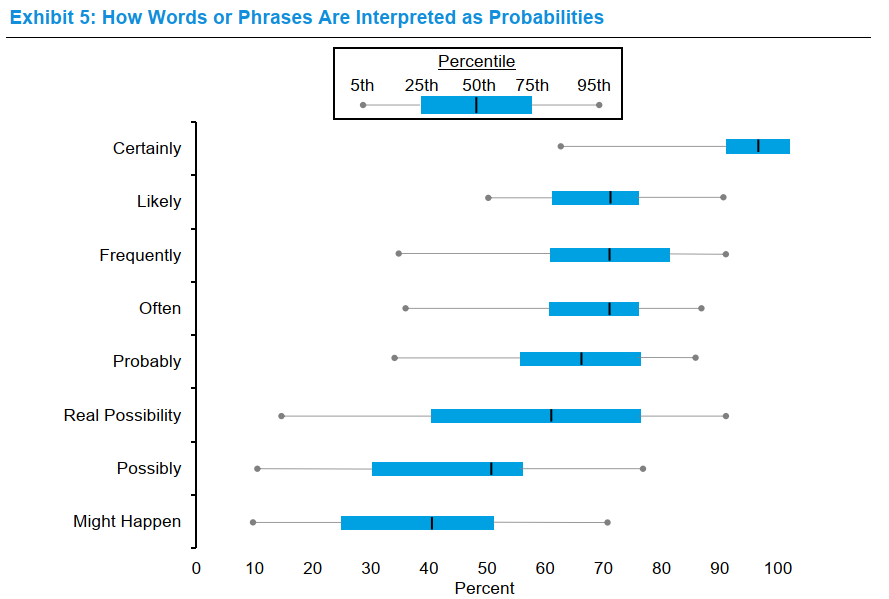
Published: January 20, 2025

Subscribe

To comment, please send an email to editor@investmentecosystem.com. Comments are for the editor and are not viewable by readers.