Active Management Blues, the Chosen Ones, and Endowment Returns

Welcome to the latest edition of the Fortnightly, connecting you with interesting developments throughout the investment world.

The most recent Investment Ecosystem essay is “Thoughts about Asset Manager Pedigree,” which explores that fuzzy but frequently cited characteristic.  Next up, a look at a famous asset management firm that provides profound lessons about narratives and due diligence.  (Sign up to receive that and other new postings.)

On to the readings.

Active management blues

The last few weeks have been overloaded with articles about the troubles facing traditional active managers.  “Index Funds Have Officially Won,” according to a John Rekenthaler column which marked the milestone of passive investment in U.S. equity funds and ETFs eclipsing active in total assets.  And outflows from notable active managers dominate the headlines (examples: T. Rowe Price; Abrdn and Baillie Gifford; equity hedge funds).

Their frustration is showing.  GMO believes “Your active managers are more competent than they look,” citing the narrowness of market leadership (see the next section below in that regard), but admits it has seen “an avalanche of questions coming in from institutions as to whether it is time to abandon active management, at least in U.S. large caps.”

David Einhorn says the markets are “fundamentally broken” as a result of the growth in passive:

Passive investors have no opinion about value.  They’re gonna assume everybody else has done the work.

So far, firms are retreating to old talking points about the benefits of active management, in the face of evidence that shows it’s mostly a losing proposition, while asset owners and investment advisors are abandoning public market active strategies.  While other market environments may be more favorable for active, a radical rethinking is in order, something that is hard to do given the long and profitable history of the established order.

The chosen ones

In a posting on “how big tech rescued the market,” Aswath Damodaran referenced the evolving names (FANG, FANGAM, Mag Seven, and other iterations) of leading stocks and the feeling that “the market would be lost without them”:

There is clearly hindsight bias in play here, since bringing in the best performing stocks of a period into a group can always create groups that have supernormal historical returns.

Today, there is one stock above all the rest, the leading beneficiary of the rush to AI:  Nvidia.  Phil Bak wrote about “La Vida Nvidia” at a time when “narratives are running the show”:

Now, for both companies and investors, the stock price itself is the product.  It’s a big game of Number Go Up.

Don’t look now, but Bryce Elder of FT Alphaville highlighted concerns about Nvidia.  The subheading of the story — “Sanctions risks, self-funded demand, customers becoming competitors . . . . Just don’t tell the shareholders” — hints at the fact that the caution comes from a credit analyst.  It is a bit of an echo from the dot-com era, when one high-profile equity analyst had to defend her Amazon number-go-up actions against warnings about the company from a credit analyst at her own firm.  Amazon ultimately became one of the biggest winners of all time, but it got crushed in the short term.

Endowment returns

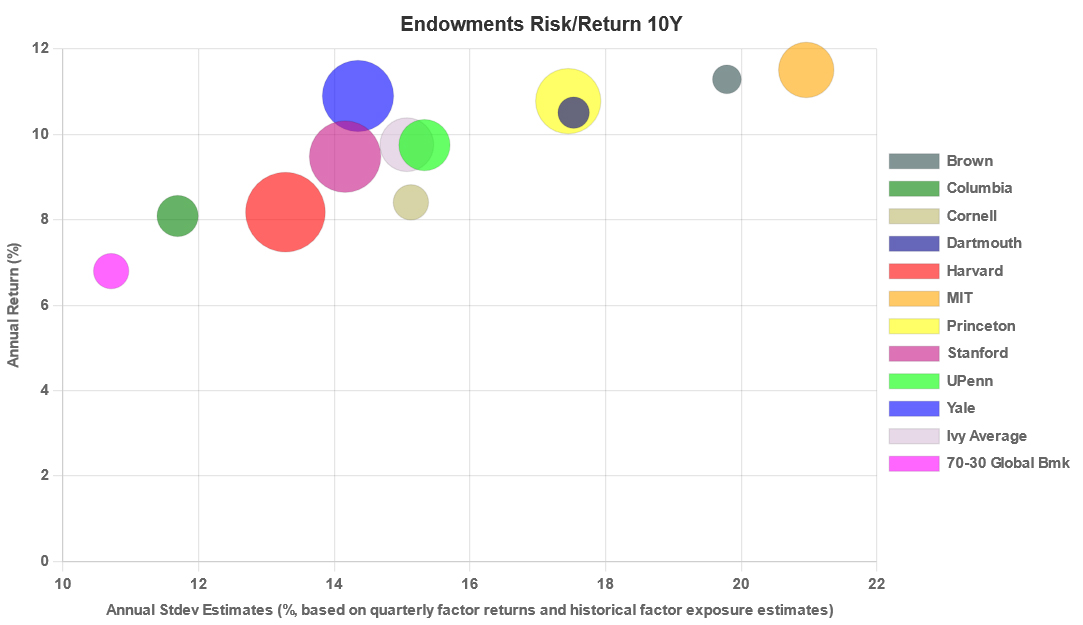
Markov Processes published a posting called “FY2023 Ivy Report Card: Volatility Laundering and the Hangover from Private Markets Investing,” which summarized the endowment returns for fiscal year 2023 for the Ivies plus MIT and Stanford.  It is important to understand that the analysis is based upon the firm’s approach, which it says “largely overcome(s) the lack of transparency shading large opaque portfolios” that report aggregate performance once a year.  Such style-based return analysis is imprecise but can be instructive.

The report delves into the volatility side of the equation as well, resulting in the chart shown above, which plots the annual returns for the last ten years versus the imputed standard deviations for each portfolio.

Two main conclusions:

Longer-term drivers of performance = more risk.  Over 10-yrs, Ivy and elite endowments show a very clear relationship between returns and risk-taking; simply put, these endowments appear to be levered versions of a global 70/30 portfolio.

Laundered risk is still risk:  Despite the masking or laundering of volatility related to investing in private markets assets, which Ivy endowment CIOs state as a benefit of the Yale model, elite endowments are significantly riskier than a balanced portfolio invested in 70% stocks.

As noted in the second item, even CIOs of major endowments make questionable statements about the volatility of private assets; see the comments from Harvard and Brown.

Also of interest is the quote from Yale’s CIO that “the Investments Office today finds itself in a market crowded with institutional investors, many of them employing similar investment strategies.”  That plus an economic regime has him looking for ways to “adapt” what has come to be called “The Yale Model.”

Credit threads

Two pieces put the history of credit research and investment in context.  A posting, “The Definitive History of Private Credit” by Van Spina of Wall Street Fintech, starts with Michael Milken (“Nearly all major players in today’s private credit landscape track their roots directly or indirectly to Drexel Burnham Lambert.”) and proceeds through the changes in regulation and the bank consolidations that led to today’s “golden age” of private credit.  In the latest issue of Financial History, Alfred Mazzorana sheds more light on the developments of the 1970s that led to “The Birth of the Fixed Income Analyst.”

“Once a Trader, Always a Trader: The Role of Traders in Fund Management,” a paper from Gjergji Cici, et. al, concludes that corporate bond portfolio managers with backgrounds as traders (rather than as analysts) “exploit short-term trading opportunities at lower transaction costs . . ., reduce credit risk during periods of market stress and take more maturity risk during periods of large interest rate fluctuations, while holding portfolios with greater convexity.”  (This brings up an interesting general question:  What kinds of backgrounds are “best” for different investment positions?)

CIO job descriptions

What is the main job of a chief investment officer?  Other than for small entities, shouldn’t it be to build and sustain an organization that makes good investment decisions?

It is surprising how often that core responsibility is not addressed directly in CIO position or search descriptions, whether from asset owners, asset managers, advisory firms, etc.  (One example of late, CalSTRS.)  Ultimately, it’s what matters.

Other reads

“Are We Baking Portfolios with Bad Ingredients?” Preston McSwain, via CAIA Association.  A straightforward look at the shortcomings of reporting and analysis that hamper the asset allocation process.

“What do MAG7 earnings and a Snickers bar have in common?” Stephen Clapham, Behind the Balance Sheet.

The rationale doesn’t matter — this is accounting shrinkflation.  A bit like how you pay the same price but get a smaller Snickers bar these days, this time you pay up for a larger, but lower quality, eps number.

“The Hare and the Tortoise: Assessing Passive’s Potential in Bonds,” Tim Edwards, et. al, S&P Dow Jones Indices.

Many of the arguments mocking indexing in fixed income have been either importantly qualified or outright refuted by empirical evidence.

“Discussion of Treasury Futures Positions Across Different Investor Types,” Treasury Borrowing Advisory Committee.  A good example of investor segmentation, how different kinds of investors use one important vehicle (and the implications of their actions).

“Increasing Returns,” Michael Mauboussin and Dan Callahan, Morgan Stanley.

In practice, it is difficult to discern whether lower costs per unit are the result of technological improvement, economies of scale, or learning by doing.

“AI Risks and Compliance Strategies,” Ken Joseph, et. al, Kroll.  The need for “policies, procedures, testing, training and recordkeeping” regarding AI implementation.

“Overcoming experimenter bias in scientific research and finance,” David Bailey, Mathematical Investor.

What is clear is that researchers from all fields of research need to take experimenter bias and the larger realm of systematic errors more seriously.

“Is Your Equity Hedge Fund Portfolio Resilient Enough for Uncertain Times?” Michele Aghassi, et. al, AQR.

The average hedge fund is unlikely to provide meaningful diversification during periods of macro uncertainty, which are also typically difficult for traditional assets.

“What is Alternative Data, and Why Does it Matter?” Byrne Hobart, Capital Gains.  The goal:  “Getting at the true unit economics of the business, and getting inside the head of people making strategic decisions.”

Conviction

“So much of what people call ‘conviction’ is actually a willful disregard of facts that might change their mind.” — Morgan Housel.

Flashback: Independent research

In late 2003, Thomson Financial published what it termed the “first and only directory of independent investment research.”  Coming on the heels of the Global Research Analyst Settlement, it heralded a new era of research on Wall Street.  (For more about the independent research part of the settlement, see this series from The Research Puzzle.)

The hefty blue book included firms, analysts, and companies covered by those deemed to be “independent,” which ranged from single person operations to long-standing, larger organizations.  The credit rating agencies were in there too; the subprime debacle a few years later would cause their independence to be questioned.

Many of the firms are long gone and the book was truly the “first and only” such guide.  It marked a time when it was thought that the old sell-side research model might be changing for good.  That didn’t happen.

Postings

Explore the archives to find nuggets like “Ascendance of the Pod Masters” from March 2023.

Thanks for reading.  Many happy total returns.

Published: February 19, 2024

Subscribe

To comment, please send an email to editor@investmentecosystem.com. Comments are for the editor and are not viewable by readers.

Thoughts about Asset Manager Pedigree

What accounts for the fame of Andy Warhol and the worth of the works that carry his signature?

Warhol was an influential figure in the history of art, who, according to Wikipedia, explored “the relationship between artistic expression, advertising, and celebrity culture.”  As Tim Harford pointed out in a 2022 posting, “Warhol loved to play with ideas of originality and authorship.”

Harford’s piece concerned some prints made by Warhol’s assistant, Gerard Malanga, who, Warhol freely admitted, “did a lot of my paintings.”  A later podcast about “Andy Warhol’s Factory of Truth” featured a conversation between Harford and Alice Sherwood, the author of the book Authenticity.  It provided more detail and context regarding the story of one set of Malanga/Warhol paintings — and about issues of authorship and reputation and how value is created.

Such considerations are important for anyone investing in art, but our goal here is not that pursuit.  Rather, it is to apply the concepts to the analysis and selection of money managers.

Authenticity

In the podcast, Sherwood explained that there are “nine levels of authenticity for a picture.”  She said that even for the works of Old Masters, “We have to deduce how much were they actually involved,” using Rubens as an example of an artist whose contribution to a work associated with him varied considerably.

The highest level of authenticity for a painting is one being made from start to finish by the artist whose name is on it.  A work “from the studio of” the artist means that it was mostly created by a student, with touchups by the Old Master himself.  (Other categories include “from the circle of” or “in the manner of” that are used to define lesser connections to the artist.  Here’s a more expansive list of attribution terms.)

Warhol disconnected the hands-on execution of a piece of art from the conceptualization of it.  As Harford wrote, “In principle, the entire process, from photograph to signature, could take place without Warhol ever touching the work.  Evidently that was part of Warhol’s point.”

Another aspect of the valuation of a work of art is its provenance.  Since that concept seemed somewhat related to the notion of “pedigree” so commonly cited in the investment world, a question was put to Claude (the AI chatbot from Anthropic), which returned several helpful paragraphs in response, which ended:

In summary, provenance provides the factual chain of ownership, location and expert opinion supporting authenticity.  Pedigree specifically assesses the reputation and prominence of the authorities involved to further reinforce cultural value and importance.  The combination paints a complete picture of validity and renown.

Provenance offers credibility, while pedigree confers social status and gravitas.  Establishing both makes a powerful statement of authenticity and clout in the art world.  They combine hard facts with elevated opinion to justify an artwork’s valuation aesthetically and financially.

(Tapping AI for inspiration seemed appropriate, since authenticity and authorship questions abound in that realm too.  There was no indication of the sources Claude used for the output — which was well structured and reasoned — or whether parts of it should have been in quotation marks.)

While the valuation of an individual piece of art is quite different than the evaluation of an asset manager, the concepts outlined above — authorship, authenticity, provenance, pedigree — come into play.

Copycats

For starters, it’s worth noting that copying what others are doing is common practice in the investment industry; appropriating successful ideas, techniques, and strategies ought to appear as a key element in the descriptions of investment process of most organizations.  But that’s rarely the case.  Instead, the word “proprietary” is often thrown around, even when there’s nothing vaguely proprietary going on.  (A random look at the “what makes us different” sections of manager websites illustrates that point.)

On the other hand, some people and firms are proud to declare their fealty to the principles of successful investors and their willingness to copy them.  Quotes from those copied are offered in presentations and letters.  Buffett and Munger are featured more than anyone else, although executing their playbook is daunting if not impossible for those who don’t get the first call on deals, don’t have a sizable pool of cheap capital, and don’t have the luxury of patient investors behind them when navigating the inevitable twists and turns of markets (and their own unforced errors).

Investing in “the manner of” gurus might seem straightforward on paper but is not easy in practice.  There are certainly strategies worthy of emulation, but it is necessary to adapt and extend them based upon the available resources and the particular circumstances at hand.  In that way, important precepts can go beyond slavish application (or use as empty narrative devices) to become the foundation of new possibilities.

Pedigree

Allocators often talk about pedigree — in some cases it’s even stated as one of the many Ps in their manager selection process — so what is it, anyway?  Background?  Track record?  Reputation?

And, are we talking about individuals or organizations?

Yes, all of the above, with a thick layer of “cultural value,” the acknowledgement by the crowd of investment acumen and status.

For individuals, it is some combination of where you went to school, what organizations you worked at, the legendary market mavens that you interacted with, and the performance that you can cite.

In cases where an individual and organization seem to be one (as with a single-manager hedge fund, for example), the pedigree of the person is that of the entity.

Large organizations (or small ones where more than one person is viewed as instrumental) try to signal the quality of the team through their backgrounds.  Firms are more attractive to allocators if the résumés of the people involved are filled with various degrees from Ivies or near-Ivies and years of experience at leading investment banks or asset management firms.  Sometimes logos of those places are used for extra effect in marketing materials.

Any direct connection to a recognized investment star in one’s background is worth extra points; an apparently close relationship provides a multiplier.  And performance matters the most — assessments of pedigree correlate closely with track records.

Authorship and ownership

Which brings us to a question.  How can we judge these elements and how should we value them?

In any organization of more than one person, apportioning credit for a track record is tricky.  From the outside, it is hard to tell who adds value (although good due diligence analysts try to ascertain that).

Who are the recognized authors of the performance record?  It depends.  Usually the lead person, maybe the team or key players together, maybe the organization.  Who “owns” the record?  Typically the organization, yet everyone involved will try to claim it or bask in it in one way or another.

Thinking back to Warhol, it is worth considering the division of labor between the conceptualization of an investment approach and the execution of it.  Each matters.  Do we care who made what contribution?  Perhaps not so long as a group stays working together, but when the inevitable splits occur, how do pedigree points get awarded?

Progeny

There are many different ways that people spin out of organizations to create new asset management firms or join existing ones.  They can start their own firm from scratch, in rare cases with assistance from their former one, but usually by leveraging their own connections.  And there are lift-outs of teams from one established firm to another.

The most famous investment family tree sprouted from Julian Robertson’s Tiger Management.  (An extensive list of Tiger Cubs, Tiger Seeds, Tiger Grand Cubs, and Tiger Great-Grand Cubs can be found here.)  Being a part of that collection — being grouped under that name — is a great example of how pedigree propagates.

To analyze the process of how that occurred — and how predictive being a part of that lineage is of subsequent success — is beyond the scope of this posting.  (Note that there is a column in the list showing whether a firm is active or inactive.  It’s impossible to avoid seeing the infamous Archegos, since it comes first alphabetically among the Cubs.)  But we can pose some general questions:

How much should working directly with Robertson matter?

In what kinds of capacities and for how long?

What does seed capital from him indicate, for those whom he knew from their time at Tiger, and for those who were outsiders?

How good was he at identifying talent?

Who was chosen to receive his blessing and why?  (Who was not?)

How good was he at training investors for the range of possible future environments?

Was he making portfolio bets, knowing that only some of the choices would turn out to be winners?

Another domain where pedigree is highly prized:  animals.  From livestock at state fairs to dogs at Westminster to horses* at the track, there is a belief that genetic attributes are passed from generation to generation.

That isn’t a concern for investors.  Even when vetting a scion of an asset management pioneer who is taking the reins, it comes down to what someone has learned from the master and whether they have the temperament to apply those learnings as conditions change.

Truth be told, a lot of portfolio managers are lousy teachers.  They expect their natural skills to rub off by osmosis and their way of investing to work no matter what — not recognizing that others will need to go through evolutions of their own rather than execute a playbook that has been passed down to them.

Something special?

All of this (and more) has to be sorted out to see whether there is something special that gets transferred — a secret sauce of sorts — or whether we are being seduced by the reflected glow of success.

For allocators who must seek the approval of others to get their ideas used, pedigree is an easy sell.  Whether the process involves convincing a chief investment officer or an investment committee that a recommendation should be given the green light and/or marketing a pick to institutions or individuals for their portfolios, playing the pedigree card can be very effective — but far too simplistic.

Many new firms (or lift-outs migrating to a new firm) struggle and even fail because people have been removed from the environment in which they thrived.  Much of what appeared to be their own success was attributable to the organization of which they had been a part.  Those who have starred in one show in a supporting role may bomb in another when they assume the lead, because they don’t understand what it takes to mount the whole production and they venture outside their circle of competence rather than building a sustainable organization.

In all of this, there is a big status game going on.  Stripping the superfluous elements of that out of the decision making process is essential.


* The “manager characteristics” module of the Advanced Due Diligence and Manager Selection course uses the analysis of thoroughbred horses as an analogy to asset managers in order to examine the concept of pedigree.

Published: February 8, 2024

Subscribe

To comment, please send an email to editor@investmentecosystem.com. Comments are for the editor and are not viewable by readers.

Rational Sustainability, Better Meetings, and the Ghost of Inflation Past

Welcome to the Fortnightly.  You can subscribe to receive this curated list of readings in your inbox every two weeks, along with occasional essays on topics of importance to investment professionals and organizations.

Rational sustainability

Where we are:

ESG is under attack from all sides.  True believers wish to keep practicing ESG but call it something different; opportunists recognize that an ESG label no longer helps launch funds or attract customers; opponents seek to ban ESG outright.  But if ESG is to be scrapped, what do we replace it with?  Retiring the term but continuing the practice fails to address the legitimate challenges to ESG; abandoning the practice throws the baby out with the bathwater.

That’s the start of an abstract from Alex Edmans.  He proposes a new label (with a new focus):  “Rational Sustainability.”  It has ten features.  The first is “Rational Sustainability is About Value Creation, not Politics.”

Another:  “Rational Sustainability Sets Boundaries.”  (Conversely, “Irrational sustainability involves trying to tick as many ESG boxes as possible.”)  Edmans uses two criteria as boundaries, comparative advantage and materiality.

At a time when investment organizations are wrestling with these issues, the paper is a useful addition to the debate.

Better meetings

You can tell a great deal about an organization by its meetings, although if you attend one as an outsider you aren’t viewing the proceedings in their normal state and you often don’t learn much.  That said, when vetting an organization, it is important to understand the different types of meetings — purpose, frequency, rules, norms, decision making process, etc.  It’s especially helpful if you ask more than one person individually; you might hear quite different stories.

Not many have clear guidelines about how meetings are to be conducted and why those guidelines exist.  An exception:  “How to Have Meetings That Don’t Suck” from NZS Capital, which outlines the firm’s method.  It offers “seven paths to better meetings,” to address the problems of ego and career maneuvering that make many gatherings of investment people more performative than productive.

For those who thrive in a traditional meeting environment but can’t make the switch to the NZS approach:

No matter how great their individual contributions might be, they must be cut out to allow the collective intelligence of the group to thrive. . . .  Firing a toxic team member, even one with superior performance, is perhaps the single most value-maximizing thing a team can do.

The ghost of inflation past
In a recent column, John Authers of Bloomberg addressed the conundrum for the Federal Reserve, which was late to the job of fighting inflation and is reluctant to accede to investors’ hopes and dreams when the economy has remained fairly strong and inflation readings are still above target.

Authers argues that “overcoming the abundance of caution requires addressing the potent lesson from the worst central banking experience in modern history.”  Translated:  “the desire not to be the next Arthur Burns must be potent.”  Burns was the chairman of the Fed from 1970 to 1978 and William Miller for two years thereafter.  The chart above shows the one-two punch of inflation that scarred investors during their times.

Jasmine Yeo of Ruffer thinks declaring victory against inflation is premature, expecting that “we have entered a new regime of inflation volatility” that will mislead investors:

The catch:  it is nearly impossible to distinguish between a “normalisation” back to a world of low, stable inflation and a disinflationary leg within a regime of inflation volatility.

On a related note, the chart below is from a posting by Greg Obenshain of Verdad that shows what corporate credit quality a 7% yield buys (for a five-year note).  At times you can get AAAs that yield that much; in 2021, you needed to reach down into the barrel for a CCC to get that sort of yield to maturity.

If this graph went back as far as the one above, the line would be at the top for most of the time from 1970 to 1985, and not just for the highest-rated corporates, but for U.S. Treasuries.

Problematic PE

An article by Sarah Rundell of Top1000funds about Oregon Public Employees Retirement Fund indicates that its private equity allocation “is at the very top end of its target range.”  That’s common right now among asset owners.

“Anemic” exit activity has caused the PE portfolio to be cash flow negative for the first time in a decade.  And the larger funds into which Oregon and other public plans mostly invest appear to have significantly underperformed smaller managers.  (Although the private markets team “noted ‘actual, crystalized IRR’ confirming smaller fund outperformance remains unproven,” an important distinction given the evidence that early IRRs are not predictive of final ones).  The plan’s board “heard how the dynamics behind private equity are changing,” yet it will stick with the previous commitment schedule.

Private equity has been a one-direction bet for years and allocations are materially different from a decade ago (Oregon’s is 28%).  Will a prolonged down cycle (there’s never really been one before) trigger a reappraisal?

In the papers

A mix of worthwhile papers of late:

“Modeling and Forecasting Cash-Flows in Private Investments,” Jean-Baptiste Guillemin, SSRN.

“Why Has Factor Investing Failed?: The Role of Specification Errors,” Marcos Lopez de Prado and Vincent Zoonekynd, SSRN.

“Stocks for the Long Run? Sometimes Yes, Sometimes No,” Edward McQuarrie, Financial Analysts Journal.

“Fund Flows and Income Risk of Fund Managers,” Xiao Cen, et. al, NBER.

“Political Connections and Public Pension Fund Investments: Evidence from Private Equity,” Jaejin Lee, SSRN.

Other reads

“The Private Party of the Corporate Credit Market,” Acadian.

Many investors who allocate to private credit do so in the hope of realizing a liquidity premium.  Yet while it is true that private credit markets have offered additional yield above their public counterparts, several pieces of evidence point to higher credit risk, not a liquidity premium, as the major driver of these higher yields.

“An Asset Allocator’s Perspective on Artificial Intelligence Use Cases,” Blair Webb, Purdue Research Foundation Office of Investments, (via LinkedIn).  From surveying other asset owners, a list of seven AI uses for improving productivity and two for generating alpha.

“Value investing: ‘The reports of my death have been greatly exaggerated’,” Matthias Hanauer, Robeco.  Ten charts on “the long-awaited comeback of the value factor.”

“Venture capital: Shedding the ‘access class’ label,” Stepstone.

Based on our experience, it is a tall order to excel at all four parts [of venture investing] and is not necessarily required to generate outsized returns.  That said, we see less differentiation in managers within the “sourcing” and “impacting” parts of the job, since most firms boast large and similar networks and tend to offer similar services.  In contrast, there tends to be greater variability in investors’ abilities as it relates to “judging” promising early-stage companies and “winning” competitive deals, which we believe are competencies that subsequently manifest as top-quartile fund performance.

“Risky business? The seven indicators of shell company risk,” Moody’s.  The red flags are jurisdictional risk, circular ownerships, atypical directorships, financial anomalies, outlier ages of principals, mass registration patterns, and dormancy periods.

“Feet to the Fire: How Should Companies Tie Executive Compensation to Climate Targets?” Ida Hempel, et. al, Stanford Business.

Ultimately, any company that is committed to achieving an objective will provide executives with a monetary incentive to achieve that goal.  Industry data, however, indicates that only a minority of companies include climate metrics in their annual bonus programs, and even fewer in the long-term program.

“Your network matters, but not always to your benefit,” Joachim Klement, Klement on Investing.  On connections, herding, and prices drifting from fair value.

“Firings and Viagra: What Your Office Janitor Knows,” Callum Borchers, Wall Street Journal.  There are people who know the real world behind the narrative.

The past and the future

“All big data comes from the same place: the past.  Yet, a single change in context can change human behavior significantly.” — Rory Sutherland, via The Daily Coach.

Flashback:  Netscape

The online archive of the Wall Street Journal starts on December 31, 1997.  One story that day was “Shares of Netscape Decline Amid Worries About Earnings,” which indicated that “Microsoft’s aggressive competition has frightened investors.”  Internet Explorer was rapidly gaining ground, thanks to it being bundled with Microsoft’s operating system.

The piece ended:

Many say Netscape won’t be able to surpass Microsoft as an Internet-server software supplier but it should be able to hold on to second or third place, still a very profitable position.

Netscape was acquired by AOL in the heat of the dot-com melt-up.  By 2001, the browser’s market share, once over 90%, was under 10% and three years later below 1%.  The last version of its browser was released in 2008.

Postings

All of the Fortnightly postings, as well as essays on a range of investment topics, are available in the archives.

In the Netscape article cited above, Mary Meeker said that the firm was “still working hard to make the quarter.”  At the time, she was an analyst at Morgan Stanley, dubbed the “Queen of the Internet.”  For a look back at that unusual period on Wall Street, check out a 2022 posting, “The Star Analyst Years.”

Thanks for reading.  Many happy total returns.

Published: February 5, 2024

Subscribe

To comment, please send an email to editor@investmentecosystem.com. Comments are for the editor and are not viewable by readers.

Easy Money, the Misunderstood and Unpopular, and Different Strokes

A couple of new essays will be up on the site in coming days.  One looks at the need to assess the provenance of a firm’s investment approach (including claims of authenticity), and the other peeks behind the narrative curtain of a famous asset management firm.  (If you’d like to receive postings via email as they are published, you may subscribe here.)

On to the readings.

The misunderstood and unpopular

Brent Beshore’s annual letter about Permanent Equity contains updates on the firm (which buys private companies in thirty-year funds) and some personal reflections from Beshore.

Of particular interest is a section titled “Culture of Buying the Misunderstood.”  It highlights a widespread issue throughout the investment world (public and private):

From the associate to the VP to the MD to the investment committee to the diligence team and the bankers, there’s a decreasing ability to spend time on the investment, decreasing risk tolerance, and escalating career risk, which creates an ever-increasing need to have the investment look good and be easily understandable.

The more I get into institutional capital markets, the more I realize it’s one big career-risk, principal-agent problem from bottom to top across LPs and GPs.

Beshore writes that “all businesses are loosely functioning disasters,” reflective of the Investment Ecosystem mantra that “all organizations are messy.”  Permanent Equity seeks to avoid the career-risk playbook and “to remain open to the weird, the ‘furry,’ and the complicated, and to create a culture that rewards taking idiosyncratic risks.”

(An echo of that in the public markets comes from Eric Cinnamond of Palm Valley Capital Management in a posting, “The Art of Looking Stupid.”  Of standing apart from convention, he says, “Instead of being embarrassed, we view our ability and willingness to look stupid as a competitive advantage.”)

Knowing a person

“How to Know an Investment Manager” is a recent piece from the pseudonymous ECAllocator.  The author recommends How to Know a Person by David Brooks as a valuable book for those who allocate capital.  Here’s why:

Do most allocators actually dig into people sufficiently to really know the person(s) they are about to allocate significant capital to, and have convictions that they possess what the allocators “likes”?

I believe the answer to be no.

While meeting managers is viewed as a critical part of the selection process, few have been trained in the art of interviewing.  (For starters, as the author reminds us, “The interview isn’t about you.”)  Importantly, the distinction should be drawn between interviewing and conversation.  They are different from each other yet offer complementary avenues for discovery, “so you can really understand a manager, and why they possess the characteristics you think are important.”

Easy money

In his latest memo, Howard Marks of Oaktree walks through the effects of low interest rates.  He uses the analogy of “the moving walkway at the airport”:

If you walk while on it, you move ahead faster than you would on solid ground.  But you mustn’t attribute this rapid pace to your physical fitness and overlook the contribution from the walkway.

Easy money encourages not just a distorted view of one’s capabilities, but risk taking and the loosening of investment standards:

I love Hayek’s word “malinvestment,” because of the validity of the idea behind it:  in low-return times, investments are made that shouldn’t be made; buildings are built that shouldn’t be built; and risks are borne that shouldn’t be borne. . . . The investment process becomes all about flexibility and aggressiveness, rather than thorough diligence, high standards, and appropriate risk aversion.

Marks extensively quotes The Price of Time, a book by Edward Chancellor, including:

The Manchester banker John Mills commented perceptively [in 1865] that “as a rule, panics do not destroy capital; they merely reveal the extent to which it has previously been destroyed by its betrayal into hopelessly unproductive works.”

We are in a time of wishful thinking, as investors argue for a return to the low rates that has framed recent experience, but Marks pushes back on the consensus:

My answer is that today’s rates aren’t high.  They’re higher than we’ve seen in 20 years, but they’re not high in the absolute or relative to history.

The impact of rates

Jesse Livermore and Ehren Stanhope produced a report for the Canvas platform of O’Shaughnessy Asset Management called “Climbing the Maturity Wall of Worry.”  The subtitle, “Interest Expense as a Source of Earnings Risk for the U.S. Equity Market,” states the authors’ goal of identifying the bottom-line impact if rates stay where they are.

The report is full of exhibits, including ones that show the dramatic changes in margins and interest rates over the last sixty years.  The conclusion of the analysis is that the effect on earnings in a flat interest rate environment will be “small to moderate” for large firms but more consequential for lower capitalization stocks and for some sectors (especially real estate).

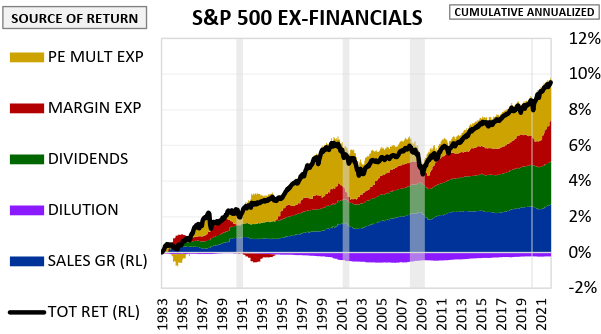
The chart above needs a bit of explanation.  At every point across time, it shows the cumulative real return to date, annualized using the entire time frame of the analysis.  That way it’s easy to see how the different components of return aggregate over time.

It’s quite remarkable that the four main components — sales growth, dividends, margin expansion, and multiple expansion — were so close together in impact, with each one contributing between 2.31% and 2.69% to the aggregate real return of 9.54%.

Different strokes

One of the biggest stories of late is the vote by the SEC to allow the trading of bitcoin ETFs.  John Rekenthaler of Morningstar wrote a column saying that “Vanguard Got Bitcoin Right” because it did not create a bitcoin ETF and does not allow trading of any of those that exist on its brokerage platform.

Rekenthaler praised Vanguard’s mindset, detailing a handful of the can’t-miss products over the years that the firm steered clear of that went on to “crash and burn.”

Franklin Templeton took the opposite approach from Vanguard, introducing a bitcoin product and adding laser eyes (a pro-bitcoin indicator for avatars) to the face of long-time corporate symbol Benjamin Franklin, who was known for his thriftiness.  The firm’s social media blitz included a tweet, “In crypto, speculation is a feature, not a bug.”  (See FT Alphaville’s take on it all.)

Unfortunately for Franklin Templeton, in a crowded field the flows into its bitcoin ETF have been almost nonexistent since its debut.

Other reads

Unpacking Private Equity Performance, Gregory Brown and William Volckmann, SSRN.

Our analysis shows that intermediate and final IRR are strongly affected by subscription line maturity, and intermediate IRR is significantly affected by deployment pacing.  Intermediate and final MOIC are strongly affected by recycle deal accounting methodology, and intermediate MOIC is strongly affected by deployment pacing and subscription line maturity.  Consequently, LPs need to be very cognizant of these issues when measuring and utilizing fund performance measures.

“Superstar Brands,” Kai Wu, Sparkline Capital.  Using trademark yields, trending product yields, and search interest yields to identify firms with brand portfolios that are undervalued by the market.

“Vintage Voodoo,” Stephen Nesbitt, Cliffwater.

Vintage year has played an important role in the traditional playbook for private asset investing.  This is a mistake, both when allocators target specific vintages opportunistically and when they purposefully parse commitments across multiple vintages in the name of diversification.

“The Puritans of Venture Capital,” Kyle Harrison, Investing 101.  A short history of VC, including the split into camps of “cottage keepers” and “capital agglomerators.”

“ESG Skill of Mutual Fund Managers,” Marco Ceccarelli, SSRN.

We differentiate between proactive managers, whose trades predict future changes in ESG ratings, and reactive managers, who change their portfolio allocation after a change in ESG ratings occurs.

“Out with the Old and in with the New: a 50% Private Markets Portfolio,” Ares, InvestmentNews.  In which a private asset manager uses sponsored content in a publication for investment advisors to argue that “a 50% allocation to private markets” is optimal.

“Too Good to Be True,” Christopher Schelling, LinkedIn.

It may sound simple, but starting from a position of no to everything makes a huge difference.  While I don’t think it’s productive to begin a professional relationship from a position of distrust, blind trust should never be presumed in this industry.  The old adage “trust, but verify” gets it backwards, I’m afraid.

“The Industry Needs Innovation. Could the ETF’s Story Be a Template?” Angelo Calvello, Institutional Investor.  A history lesson to inform the innovation “that our industry so desperately needs.”

“Large Backers of Private Equity Are Asking For Their Money Back,” Laura Benitez, et. al, Bloomberg.

“We’re now undergoing a real cultural change,” said William Barrett, managing partner at Reach Capital, a private-market fundraising firm.  “It’s the first time we’re seeing LPs being so straightforward and linking a distribution from one fund to a new commitment in another.”

Character

“Any fellow who will cheat for you will cheat against you.” — Sam Rayburn.

Postings

Thank you for reading and passing this on to others.

Check out the archives, where you’ll find other editions of these curated readings, as well as in-depth looks at ideas and developments of interest to investment professionals and organizations who want to stay in the forefront of changes happening across the industry.

Many happy total returns.

Published: January 22, 2024

Subscribe

To comment, please send an email to editor@investmentecosystem.com. Comments are for the editor and are not viewable by readers.

Organizations, Strategies, (Toxic) Jobs, and More

“Every organization faces the same dilemma, over and over:  how much to stay the same and how much to change.”  That’s the start of the most recent posting on the site, “Balancing Exploration and Exploitation in Investment Organizations,” which provides frameworks and ideas for you to use in considering whether your organization’s current balance is appropriate.

If you haven’t subscribed to receive emails of the postings, you can do so here.  Then you won’t miss any future editions of this Fortnightly — or the more in-depth essays about the investment world.

Creating effective investment committees will be one of the upcoming topics.  That means different things depending on the type of organization involved.  What are the challenges you face in that regard?  Please share your thoughts.

What the job is

An eFinancialCareers posting from September referenced an Invest Like the Best podcast featuring Will England of Walleye Capital.  England was quoted as saying that it’s hard to find portfolio managers for the firm’s multi-strategy fund.  Not because of a lack of investment talent, but because they need to be able to handle the psychological pressures involved:

The job of being a PM, whether you’re quantitative or fundamental, is psychologically extremely toxic because you’re going to be wrong basically just as much as you’re going to be right.  You’re going to get kicked in the face a lot, and you’re going to be someone who’s the smartest person that they’ve known their entire life, and then they’re just going to get beat up all the time.

That toxicity, said England, is “what the job is.”

Which begs the question in a headline for a Citywire Selector interview with David Roberts, a long-time fixed income manager, “Do fund managers get enough support with mental health?”  While jobs at traditional fund companies might not be as toxic as those at hedge funds, there are pressures — and when you’re the perceived expert (even “star”) who is supposed to project confidence, it can be hard to seek help.  Most investment cultures are competitive, not supportive, so where would you go anyway?

The closing comment from interviewer William Robins, regarding the benefits of managers commiserating with each other, is:  “You are humans, after all.”

Defined benefit investing

Investors come to the markets with different goals, mandates, and restrictions, which affect the choices that they make.  Defined benefit pension plans are a good case in point, since their concerns vary from those of many other investors.  A report from Mercer offers recommendations in four areas.

The first is “journey planning,” or “how the plan will be managed to its ultimate destination” given the rules that govern the payment of the liabilities over time.  Several different metrics come into play to map out the best path for investing to meet the liabilities depending on the funding status of the plan and whether it is slated to be terminated at some point in the future or run indefinitely (and what options exist if the plan is in surplus).

The second section considers how investment strategies are a function of that funded status and how they have been affected by recent market changes.  The report repeatedly emphasizes how private assets can reduce funded status volatility, a striking example of the ways in which the popularity of such strategies has been driven by the performance smoothing that masks the real underlying economic variability of the assets.

The last two parts deal with liability hedging and governance issues.

Rethinking due diligence

A number of BIPOC asset managers are advocating “due diligence 2.0” in response to industry practices that make it difficult for diverse managers to gain a foothold.

A list of nine recommended shifts in due diligence processes provides a good discussion framework about beliefs and current practices.  For example, do we think about track records or assets under management in ways that make sense, or are we just adhering to convention?

The posting includes the asset allocators, advisors, and asset owners who have so far made a commitment to the set of principles.

Small buyout funds

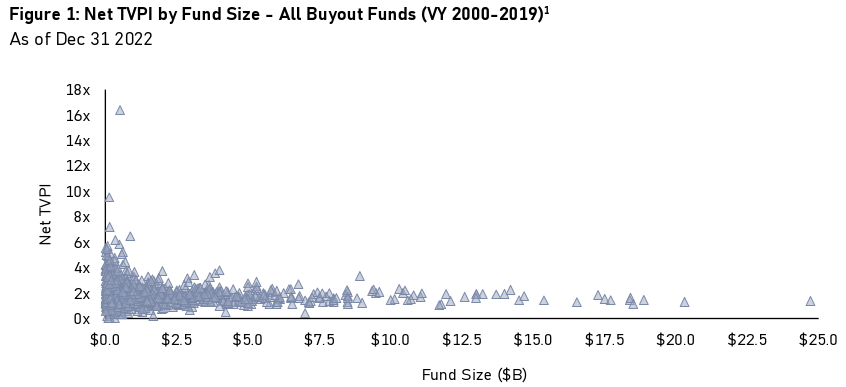
Abbott Capital creates and manages private equity programs, so it’s not surprising that a report it published, “Do Small Buyout Funds Still Belong in a Diversified Private Equity Portfolio?” answers the question with a “yes.”

The image above, charting net total value to paid-in capital by fund size, illustrates the rationale in terms of historical performance, which is further demonstrated in additional exhibits.  The focus is on the greater upside potential of smaller funds, although, “Left tail risk, that is, underperformance or loss of capital, appears more common with small funds.”

The report covers the challenges of smaller funds for allocators at opposite ends of the spectrum.  Those with a sizable private equity portfolio often find that given “the velocity at which they need to deploy capital . . . the small buyout market is too inefficient.”  Conversely, those without sufficient resources can be overwhelmed by the sheer number of small funds that have proliferated in the face of time and expertise limitations.

More important is a short section on the “why” of historical outperformance of smaller funds, which sketches out the attributes of the purchased businesses that make entry multiples lower than those for larger firms and allow for substantial improvements in results.

Also see “Proving Persistence,” an analysis from Andrés Ramos and Patrick Coleman of Nasdaq.  They use the eVestment database to examine the persistence of TVPI and IRR in subsequent funds as they grow in size.

AI concerns

Along with many articles on the promise of AI in investment decision making, operations, and marketing, there are concerns.  For instance, “Will AI Compromise Security for Institutional Investors?” is an article by Danielle Walker in Chief Investment Officer.  It deals with a range of specific issues, as well as the implications of the SEC’s proposed rules regarding the use of AI applications.

The rules will apply to many different types of firms, including those providing financial advisory services.  On Nerd’s Eye View, Ben Henry-Moreland offers perspective on the implementation issues for advisory firms, including, as one section header says, “using technology as a fiduciary means knowing how it works.”

Other reads

“Fifty Shades of Grey Swans: Timeless Risks with a Modern Twist,” Matt Tracey, Alpha Architect.  Ideas about dealing with uncertainty — and two lists of questions to evaluate your readiness for different environments and situations.

“Risk Parity Not Performing? Blame the Weather,” Markov Processes.

A less highlighted casualty of the changing stock/bond relationship, however, has been risk parity — and the pension funds that adopted such institutional-oriented strategies and products en masse.

“My Top Stock and Fund Picks for 2024, Joe Wiggins, Behavioural Investment.  “Such guidance is good for commissions and clicks, but bad for investors.”

“How Tokenization Can Fuel a $400 Billion Opportunity in Distributing Alternative Investments to Individuals,” Tyrone Lobban, et. al, Bain.

Tokenization has the potential to change how alternatives work by making it easier to distribute and invest in funds and adding investor-friendly features to help bridge the gap between alternatives managers and individuals.

“SBCERA’s Recent Outperformance: A Tale of Two Benchmarks,” Brian Schroeder, CAIA Association.  Using both broad-static and specific-dynamic benchmarks together can be an “insightful combination” for understanding asset owner performance; but looking at just a broad-dynamic policy index muddies the water.

“Is private credit a systemic risk?” Robin Wigglesworth, Financial Times.

But investors losing boatloads of money is not the same as a financial crisis.  In fact, trillions of dollars can evaporate, prominent investment funds be forced to gate and major financial institutions can go belly-up without a wider conflagration, as long as policymakers douse the flames rather than fan them.  Viz 2022-23.  Not everything is a “Lehman moment.”

“The Math of the Multi-Manager,” Brian Hurst, ClearAlpha Technologies.

The success of the multi-manager model depends less on accurately forecasting individual portfolio managers’ performance and more on reaping the advantages of diversification by implementing numerous, mostly independent strategies simultaneously.

“Bobby Jain Slashes Fees to Draw Clients Before Hedge Fund Debut,” Nishant Kumar and Hema Parmar, Bloomberg.  Why is the hottest new fund in years (at least according to reporting over many months) cutting fees again in advance of its launch?

“Burned Investors Ask ‘Where Were the Auditors?’ A Court Says ‘Who Cares?’ ” Jonathan Weil, Wall Street Journal.

One of the country’s most influential courts has asked the nation’s top securities for its views on an uncomfortable subject:  whether audit reports by outside accounting firms actually matter.

“Future Fund CIO rejects ‘macho, Darwinian’ investing culture,” Aleks Vickovich, Top1000funds.

History and life teach us that there is far more to life than conflict.  We spend far more time creating, collaborating, interacting constructively, and pursuing our passions and our curiosity than we do fighting.

Are you listening?

“Formulating an opinion is not listening.  Neither is preparing a response, or defending our position or attacking another’s.  To listen impatiently is to hear nothing at all.” — Rick Rubin.

Flashback: Think for yourself

Adams, Harkness & Hill was a Boston-based firm that specialized in covering technology, health care, and consumer stocks.  Oakes Spalding started the firm’s 100 Emerging Growth Stocks product.

In a 1984 report, he wrote:

I am a brokerage house analyst who has, I am told, some influence.  I have been in this business long enough to have become very cynical about its goings on.  I hope to become even more cynical and benefit thereby.  But it is humbling to contemplate the power that I and other “Street-side” analysts now have — power we do not deserve, but that we have because a large part of the market finds it easier to lean on our every word rather than think for itself.

Quite an uncommon thing for an analyst to say.

Postings

Thanks for reading.  Check out the archives to see all of the latest content — and things further back, like “Reviewing the Asness Peeves,” a posting that reviews a well-known Cliff Asness commentary (and asks what “things said or done in our industry or said about our industry” bug you).

Thanks for reading.  Many happy total returns.

Published: January 8, 2024

Subscribe

To comment, please send an email to editor@investmentecosystem.com. Comments are for the editor and are not viewable by readers.

Balancing Exploration and Exploitation in Investment Organizations

Every organization faces the same dilemma, over and over:  how much to stay the same and how much to change.  But each organization has its own natural spot somewhere along the spectrum between seeking change and avoiding it.  A comfort zone, if you will.

That location is a product of philosophy, leadership, life cycle stage, and accumulated norms, rules, and processes.  The penchant for change can vary in response to recent results or outside events, but it is hard to speed up or slow down an organization that is used to a certain pace of change.  That said, many organizations need to be more innovative in order to thrive in the future.

Exploration and exploitation

Before looking at investment organizations, it is good to start with some general principles.  A short report, “The dual mindset organization,” published jointly by Strategyzer and Emergn, is an excellent entry point.  It begins:

Successful companies constantly innovate and reinvent themselves.  At the same time they never neglect running a world class operation.  It’s a balance between two different cultures that can feel impossible to attain.

Dual mindset organizations are good at both exploration (“inventing the future”) and exploitation (“managing the present”).  A simple comparison in the report between those two vectors shows the contrasts in mentality and approach that are required in each.  For instance, exploration activities involve a high degree of uncertainty, but exploitation targets improvements at the margin.  The goals are not alike at all; neither are the optimal cultures and operating modes.  Juggling the disparate objectives is challenging, but:

The best organizations seamlessly toggle between these two modes and have operating models that support this duality when it comes to how innovation and the development of products happen.

The report outlines three types of innovation:  efficiency (with a near-term time horizon, focused on making existing strategies, products, and processes “more effective and efficient”); sustaining (for the intermediate term, extending the life of the current state), and transformative (those longer-horizon initiatives that will determine the future success of the organization).

It is easiest to imagine all of this in terms of a product portfolio, but the motif applies more broadly, as evidenced by six themes of operating model transformation referenced in the report:  strategy; organizational structure; processes; metrics and reward systems; skills and people; and infrastructure and the technology stack.

Risk work and uncertainty work

A posting by Vaughn Tan, “Organizational technology for uncertainty work,” also provides a helpful perspective.  It is subtitled “Or: The importance of mundane organizational processes.”  To wit:

Organization becomes a strategic technology when the approach to organizing is intentionally chosen to be appropriate for the type of work to be done.

Tan explores the difference between uncertainty work and risk work, using the standard division of those terms rather than the mushy application of them in the investment world.  That is, knowing the range of outcomes and their probabilities is “risk,” while “uncertainty” involves dealing with the unknown.

In concert with the Strategyzer and Emergn report, Tan writes:

Organizations need to do both risk work and uncertainty work to survive and succeed, but the two are fundamentally different.

Importantly, he examines the problems that arise from relying on “industry best practices,” which “secretly embed risk assumptions”:

Best practices nearly always assume that the work that needs to be done and the definition of success won’t change, and that the environment is stable.

Those kinds of assumptions manifest themselves in a hardening of approach, which shows up in ways large and small, so that a shift in mindset requires a reexamination of work throughout the organization.  As Tan points out:

Paying attention to mundane processes allows them to be thoughtfully redesigned to be appropriate for uncertainty work.  At base, this simply requires explicitly acknowledging that the organization faces uncertainty, not just risk.

Applying the ideas

Neither of those sources was written with investment work in mind, but the concepts should inform the evaluation of any kind of investment organization.  That starts with the broad sense of an organization’s philosophy about change.

Many sell stability.  Think of the notions of process that asset management firms portray — it is rare to hear anyone lead their narrative with the need for ongoing change in a process.  Few even emphasize it and most don’t reference it at all.  There are some exceptions, such as quantitative managers who acknowledge the decay in the effectiveness of strategies and highlight the ongoing research and creativity involved in staying in front of that decay.

Or consider an advisory firm, marketing a specific approach to individuals.  It may involve a simple formula (prescribing consistent exposure to cheap betas) or the opposite (embracing a range of alternative assets and chasing the “best” managers).  Projecting with confidence and armed with supporting data, either set of beliefs can be presented in ways that inspires trust among clients and prospects.  But the allegiance to a particular approach means that certain aspects of what those firms do are highly unlikely to change.

Along each main node of the investment ecosystem (in terms of organizational type), there are tendencies regarding innovation driven by the regulatory regime and rules that apply, as well as the history and culture of the particular type of entity.  And there are further differences within.  So, for example, asset owners tend to have different attributes regarding innovation than asset managers do.  That’s also true for the next layer down, in the categories of foundations, endowments, and pension plans.  Then there are the unique characteristics of individual organizations.

For any and all of them, the questions persist:  How much change should we be seeking?  Why?  How do/should the answers vary across different parts of the organization?  How do we balance the essential uncertainty of the investment endeavor, the evolution of markets (and the erosion of alpha in places where it has appeared before), and the desire for stability from clients, employees, and stakeholders?

The answers to those questions vary by organization, as should the evaluation of innovation practices and subsequent plans for organizational transformation.  Some suggestions for evaluating your own organization:

Self-assessment.  Start with an objective assessment of where you are now.  It is important to get a mix of perspectives, from across the organization and different levels of it — as well as outside views from clients, stakeholders, and others.

Pay particular attention to patterns that permeate the organization, even in functions that are remote from each other, since those are good indications of the overriding culture.  Try to assess the attitudes toward change.  Some organizations are marked by defensiveness and stasis, others by an orientation to learning, development, and evolution.

In addition to noting the similarities, acknowledging the subcultures that exist will help to identify how the exploit versus explore dynamics play out in various areas.  For example, those directly involved in the investment function can have a different orientation than the rest of the organization around it — and often are very interested in exploring for new investment ideas and quite uninterested in (and even dismissive of) other innovative pursuits.  Contrasting approaches to innovation across functions can lead to conflicts, disconnects, and turf battles.

Identification of beliefs, assumptions, processes, and habits.  The self-assessment needs to extend into an identification of the underlying principles and activities that are the foundation of your approach.  From broad beliefs (both stated and implicit) to prosaic tasks, the questions should be asked:  Is this subject to change?  Why or why not?  In what ways?  Do we look for improvement?  Do we actually improve?

Obviously, that top-to-bottom scope is an impossibly large job, but asking the questions starts to change the orientation, to thinking in terms of fixity and flux, to working toward that dual mindset across the organization.  You want to start with big matters, but if you stop there, the philosophy won’t spread as you need it to.

Look for key lynchpins that haven’t been examined in quite a while, especially watching watch out for sacred cows that people are too afraid to subject to fresh review.  And, as Rick Rubin wrote, “Beware of the assumption that the way you work is the best way simply because it’s the way you’ve done it before.”

Mapping out a strategy.  The nature of your innovation strategy will naturally be a function of your starting point.  Using the explore/exploit and risk/uncertainty spectra, think about where you are and where you want to be over the next year and the next decade.  Then map out some specific types of innovation you would like to foster and how to get them started.

Since innovation is chiefly a combination of ideas, look for ways to bring new interactions across organizational siloes and to seek out multi-disciplinary expertise internally and externally.  The imitation of admirable aspects of other investment organizations can be one element in an innovation portfolio, but playing a same-as game all the time is unlikely to lead to success.

And, as Tan indicates, altering the strategy necessarily means revisiting the organizational design and making the adjustments that are required.

Culture and leadership.  As with most things, the approach to innovation won’t change in a lasting way unless the underlying culture does — and that depends upon the relentless efforts of leaders throughout the organization.  A shift in mindset is not a one-time thing but an ongoing process, a lived belief.

At every level of the organization, there needs to be “the permission to think unconventionally,” to use a phrase from a TED talk by David McWilliams.  That implies a willingness to consider ideas that might seem heretical, to explore new concepts with open minds, and to actively investigate emerging questions of investment practice well before they become conventional wisdom.

One persistent problem is the distinction between two phrases:  “what works” and “what has worked.”  The first one indicates permanence, something that should not be assumed in an environment of uncertainty.  The second phrase acknowledges history, while leaving the door open for change.  Recognizing the inevitability of change — and preparing for it while continuing to exploit the learnings of the past — are essential for the sustainability and success of every organization.


Here are some of the areas within an organization that can benefit from a focus on innovation.

Published: January 5, 2024

Subscribe

To comment, please send an email to editor@investmentecosystem.com. Comments are for the editor and are not viewable by readers.

Pattern Recognition, Category Fraud, and New Foundations

The most recent essay on the site was “Identifying Unrealistic Expectations in Manager Selection.”  One technique — using a straightforward question, regularly asked — can frame a current analysis and improve the entire selection process over time.

On to the readings as we prepare to enter 2024.

Pattern recognition

The latest report from Michael Mauboussin and Dan Callahan looks at the “opportunities and limits” of pattern recognition:

Investors and investment organizations regularly cite pattern recognition as the basis for action.  While it can be extremely powerful and useful when applied appropriately, it can also be highly misleading and furnish fuel for overconfidence when used inappropriately.

Unfortunately for us, markets represent “wicked” rather than “kind” environments, rendering useful pattern recognition less likely than in many other pursuits.  While investment professionals are usually expected to (and expect to) opine on what will happen going forward, the landscape is full of landmines that can blow up narratives and actions.

The report offers a multi-dimensional perspective on pattern recognition and ideas to improve the process.  Reminding ourselves of the challenge is a good start, otherwise we are prone to remember the times when we saw patterns and capitalized on them for good effect — and to forget the times when they were illusory or misleading.

Category fraud

Evan Frazier of Marquette Associates offered a posting that asked the question “Is China Guilty of Category Fraud?”  The question is not really about China, but about MSCI’s treatment of it within its index family.  There are always examples of questionable categorization to be found, presenting choices about playing against an index or popular approach versus what seems right given an investment mandate.  Categories and distinctions are constantly in flux, with capital flowing as a result, so staying ahead of that sense-framing is an underappreciated part of active management.

New foundations

The sloppy fundraising environment in many area of private investment has intensified the interest of fund purveyors in targeting advisory firms where penetration is small.  Take as examples reports from KKR (“A New Foundation for Global Wealth”) and the Defined Contribution Alternatives Association (“Considering Private Real Estate as a Foundation of DC Plan Multi-Asset Options”).  The pitches include references to past performance (with smoothing) that may or may not be good indicators of future outcomes.  How solid will such promised foundations be?

Return assumptions

We’re now in the heart of the returns expectations season, as firms announce their predictions for the coming year and further out.

Of course, no one knows what the future will bring and single-point estimates don’t really provide any useful information, despite the headlines they generate.  But the underlying assumptions can be revealing as to mapping out the possibilities.

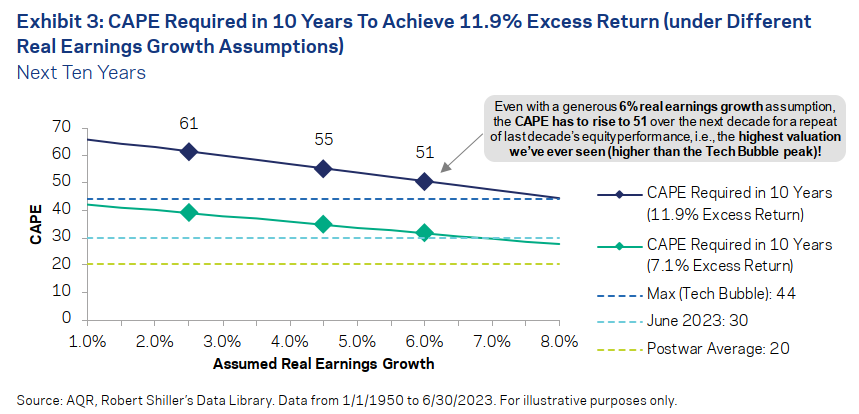
Along those lines, Jordan Brooks of AQR penned a report, “Driving with the Rear-View Mirror,” which looks at the elements of equity returns (Excess of cash return = Dividend yield + Real earnings growth + Multiple expansion – Real cash return), to answer the question, “Will we see a repeat of the past decade of U.S. equity returns?”

One of the illustrations, shown above, is a good starting point, although advocates of an AI-induced boom would argue for the X-axis to include higher numbers to the right.

Other reads

“The Difference Makers: Key Person(s) Valuation,” Aswath Damodaran, Musings on Markets.

Intrinsic value is built, not on nostalgia or emotion, but on the cold realities that key people can sometimes destroy value, that a key person in a company can go from being a value creator to a value destroyer over time and that key people, in particular, and human capital, in general, will matter less in some companies (more mature, manufacturing and with long-standing competitive advantages) than in other companies (younger, service-oriented and with transitory and changing moats).

“Interviewer vs. Criminal Lawyer,” Chenmark.  What makes for a good meeting when you are interviewing someone?

“The Rise of GP Seeding as an Institutional Asset Class,” GCM Grosvenor.

Seed and stakes investors recognize an opportunity to participate as minority owners in stable and predictable cash flows across management fees, carried interest, and balance sheet investments over a long duration.

“To Roll or Not to Roll (Forward): LP NAV Estimation for Private Equity and Real Estate,” Aili Chen, PGIM.  “For CIOs who wish to follow a consistent LP estimation approach over time, we measured cumulative estimation errors over multiple quarters.”

“What I have learnt in 37 years of financial journalism,” Jonathan Guthrie, Financial Times.  Among the lessons:

Individual incentives favour collective instability.

You do not hear the whistle of the bullet that hits you.

Stock analysts are hedgehogs not foxes.

Debt matters more than equity, unfortunately.

“Exploring Relevancy in the Family Office,” Fidelity.  A look at the relationships that are critical to creating a successful family office (and the potential pitfalls); a list of “questions executives and families should ask of themselves” is included.

“A View into New York City CRE Market Distress,” Maverick Real Estate Partners.  This look at lending in premier commercial real estate market is full of interesting illustrations.

“See the S&P 500 From a New Lens,” Paul Kenney, Syntax.

Our Know What You Own series focuses on helping investors understand the business risks embedded in commonly used benchmarks, including the quantification of themes like technology and real assets that cut across sectors.

“These Boards Are Meant to Protect PE Investors. Why Can’t Anyone Agree on How?” Alicia McElhaney, Institutional Investor.  An overview of some of the issues involved with limited partner advisory committees (LPACs), including, “The allocators on an LPAC have no fiduciary duty to other allocators in the fund.”

“Byrne Hobart, the unlikely oracle,” Shreeda Segan, Meridian.  A profile of the prolific and influential newsletter author (including a link to his  2017 posting, “How I Got Hired at SAC Capital Without a College Degree”).

“GPT and other AI models can’t analyze an SEC filing, researchers find,” Kif Leswing, CNBC.

“There just is no margin for error that’s acceptable, because, especially in regulated industries, even if the model gets the answer wrong 1 out of 20 times, that’s still not high enough accuracy,” Qian said.  [Rebecca Qian of Patronus AI.]

“Multi-manager risks & a buyside network topology,” @stwill1.  A thread exploring the dynamics of the pod shops and some implications.

Still learning

“Ancora imparo.” — Michelangelo.  (This quote, meaning “I am still learning,” was supposedly said by the great artist in his late eighties, although some dispute it.  If he didn’t say it, he could have, since he continued to create until his death in 1564.)

Flashback: Equity Funding

According to Howard Schilit in Financial Shenanigans, Equity Funding Corporation of America “began operations in 1960 with $10,000.  By 1973, the company purported to manage asset of $1 billion.”  But it was a fraud.

Raymond Dirks, a Wall Street analyst, received information to that effect, informed a Wall Street Journal reporter, and told his clients to sell the stock.  The company collapsed and some of its officers went to prison, but in the aftermath, Dirks became the most high-profile analyst on the Street and investment organizations would modify their compliance practices as a result of the ensuing debate.

Dirks was censured by the S.E.C. for violating insider trading rules, an action which he fought for a decade before the Supreme Court overturned it.  The New York Times obituary for Dirks, who died this month, quoted Justice Lewis Powell as saying the S.E.C.’s interpretation threatened “to impair private initiative in uncovering violation of the law.”

Postings

Removing the paywall on the site has opened up 150+ articles in the archives focused on the continuous improvement of investment organizations.

One example is “It’s The Political Season (Always).”  Four short items about political beliefs and how they affect investment decision making.

Thanks for reading. Many happy total returns.

Published: December 26, 2023

Subscribe

To comment, please send an email to editor@investmentecosystem.com. Comments are for the editor and are not viewable by readers.

Identifying Unrealistic Expectations in Manager Selection

When evaluating an active manager, most gatekeepers and allocators rely on the past as their guide to the future.  That’s most obvious when it comes to performance — managers whose results are below a certain threshold are weeded out by rule or tradition.

Qualitative judgments are backward-looking too.  They are seen through the lens of performance:  it is natural to praise people or process or culture when the numbers provide the validation for those assessments, even if they are based upon very little in the way of in-depth knowledge about the manager attributes in question.

Thoughtfully setting — and stating — expectations is an essential part of the manager selection process, but looking backward can lead you to the wrong conclusions.

(The examples used below reference open-ended investments that can be entered and exited at any time.  Similar issues exist for lockup vehicles but aren’t examined here.)

The question

An effective way of surfacing expectations inherent in a selection process is by posing a simple question to those involved:  “What is the probability that this manager/strategy/vehicle will outperform by an average of fifty basis points a year over the next ten years (and survive)?”

(As a self-test, you could pause here and answer the question in regard to one or more managers with which you are familiar.  That will give you an idea of how you would approach the question and the probability you think is required to warrant a selection.)

There is nothing magical about fifty basis points rather than some other level — or you could use a risk-adjusted measure instead of excess return.  The point is to provide a specific prediction.

Within an organization, having everyone who is part of a selection process state their assessment of the probability surfaces the range of opinions that exists more precisely than usually happens.  Then, a final prediction approved by the decision makers in the group grounds expectations for the future regarding performance.  Implemented across every selection decision over time, the process also yields valuable information about the accuracy of individual and group predictions.

Context

The purchase recommendation from the initiating analyst and the document reporting the final decision should state the probability and context for it, starting with the applicable base rate.  For example, only a small sliver of mutual funds in most categories outperform a passive alternative over a ten-year period, to say nothing about adding a fifty-basis point hurdle on top of that.

Reporting the base rate as a matter of course should force a discussion about luck versus skill and prompt a careful examination of the qualitative attributes of the manager:

Since a common approach is unlikely to produce the desired return, what aspects of the manager’s organization and methods are truly differentiated?

What evidence of those differences can be independently identified (exclusive of the manager’s narrative and historical performance)?

Which differences rise to the level of competitive advantage or “edge”?

Then the question shifts to the future and the crucial element of time, which is why the bottom-line question is worded as it is.  Research shows that a three-to-five year decision window is a poor framework on which to judge a manager, yet surveys and observed experience indicate it is by far the most common approach.  While even a decade isn’t long enough to show statistical significance, it is a more practical time horizon.  Using that as the foundation for predictions can help limit noise-induced transactions triggered by interim performance concerns.

The element of time brings us face to face with issues that must be addressed:

Has the attractive historical performance been the result of valuation changes stemming from the increased popularity of the underlying securities?  If so, will that revert in the coming years?

Why won’t the identified edge(s) be worn away over time?

Why will the “consistent and repeatable process” (at least as advertised) continue to work?  What are the most likely reasons that it would quit working?

What evidence is there that the management organization is making changes that will allow it to succeed in the future, rather than just continuing to do things as it has?

Shifting the orientation to the future moves the burden of analysis from the historical characteristics and performance to the qualitative assessment of the changing investment environment and the organization’s prospects for growth (in capability, not size) and its adaptability.  Those attributes are commonly underweighted in manager selection even though they are key determinants of future success.

Unrealistic expectations

There are a variety of ways that unrealistic expectations can inhibit the stated goals of manager selection.  The most basic comes from harboring a belief in active management without having the ability to deliver on that promise due to a lack of time, talent, or other resources.  (Nobody likes to admit those shortcomings and few keep records of selection success or failure that could provide helpful evidence.)

One pervasive problem is a lack of education (and ongoing reminders) about typical performance patterns.  If you want to take advantage of active management, you can’t obsess about tracking error or ignore the reality that the best managers often underperform for a fairly large percentage of the time and for extended periods.

Too often, impatience is designed into the selection and ongoing monitoring of managers because of a lack of communication about the nature of performance patterns and the inherent variability of results.  Individual clients without an investment background often don’t understand that managers shouldn’t be expected to outperform regularly, so their expectations can be unrealistic.  More surprising perhaps is that the same tendency often holds for more sophisticated parties, including accredited investors, due diligence analysts, investment committees, etc.

In fact, a firm that trumpets its unique access and ability to select the best managers in the world can often be the most impatient, since it has defined its role in a way that is unlikely to be fulfilled.  If a manager that is expected to stay in the top decile as it has in the past doesn’t do so, the story can wear thin quickly, prompting a swap for another “top-decile manager.”

Let’s get back to that question:

“What is the probability that this manager/strategy/vehicle will outperform by an average of fifty basis points a year over the next ten years (and survive)?”

Some real-world responses:

Due diligence analysts often answer the question with a number in the 65-75% probability range.

When asked what their chief investment officer or investment committee would want to hear as a probability rating before approving an allocation, responses can be more than 10% higher.

After stating that a manager was expected to outperform by two hundred basis points, one analyst was asked what the probability of that occurring was.  “Over 80%.”

Each of those examples (and others like them) point out the power of the general form of the question.

It forces you to respond by identifying the attributes that support your prediction.  More importantly, the consistent use of the question in an organization helps those involved create realistic expectations and avoid cycles of disappointment and bad decision making.


The Advanced Due Diligence and Manager Selection course dives deeply into these and related issues; see also the other postings in the due diligence category of the archives.  For information on ways to analyze your selection process, please reach out.

Published: December 18, 2023

Subscribe

To comment, please send an email to editor@investmentecosystem.com. Comments are for the editor and are not viewable by readers.

Lessons from Sports, Heads and Tails, and a few Goodbyes

Since the last Fortnightly, two postings were published on the site that leveraged the work of Richard Ennis.  The first looked at the evolution of the institutional investment consulting industry, as featured in his book.  The second explored his writings over the last few years, which have challenged the conventional wisdom regarding governance and investment policy by asset owners.

In addition, a Linkedin article summarized the Investment Ecosystem series on the social and cultural underpinnings of investment organizations and roles that was published earlier this year.

Two notes:  Make sure to subscribe for email updates so you don’t miss any of the postings — and the next Fortnightly will be delayed by a day (the normal schedule would have had it coming out on Christmas).

On to the readings.

Diamonds in the rough

We’re still a couple months away from spring training, but Bob Seawright got a jump on it with his latest piece, “Revenge of the Nerds.”  It traces the emergence of analytics as a driving force in baseball, starting with Bill James and Sabermetrics and its impact (decades later) in the professional game, recounted in the book and movie Moneyball.  The whole story serves as an analogy to developments in the investing world (and there are some direct references to it).

At the core of the Moneyball mentality is the desire to identify actual value that is greater than the perceived value in the marketplace.  (The same goes in reverse; you don’t want to pay more than you should based upon the evidence, even though that often happens in the heat of the moment.  In related news, after Seawright’s posting, Shohei Ohtani agreed to a contract roughly twice as large as any other in baseball history.  How do you judge what a generational talent is worth?)

After writing about how edges get worn away over time, Seawright closes with this:

Ongoing and consistent outperformance, in baseball, the markets, and in life, is staggeringly difficult.  Prepare and respond accordingly.  We get better and keep getting better at things by being responsive, observant, and applying what we’ve learned.  Over and over again.

Fumble-itis

Another sports-related article with an investing angle comes from the Daily Coach, this time regarding (American) football.  A famous hedge fund manager, David Tepper, bought the Carolina Panthers in 2018 and has made quite a mess of it.  The article says that Tepper “demonstrates a lack of understanding of the requirements needed to build a championship organization.”

Later, the author writes, “The ‘lone star’ model of hiring in the NFL has proven to be a failure.”  If you read the story and think about the organizational weaknesses common in the investment industry, the connections come easily.

Vanguard

Some investment firms are closely identified with one style or ethos, even after they have grown into other categories and beliefs.  Vanguard certainly fits the bill; the thoughts that come to mind are Bogle, indexing, and a focus on keeping costs low.

Last week, the firm announced it was selling its OCIO operation to Mercer.  Mercer’s press release referenced “Vanguard’s differentiated investment philosophy;” it will be interesting to see how the contrasting belief systems at the two organizations are reconciled in the coming years and what that means for current clients, who thought they were getting one thing and may end up with another.

Also of interest:  John Rekenthaler on Vanguard pitching margin loans.

Heads I win . . .

As discussed in the last Fortnightly, natural language processing and artificial intelligence have taken the parsing of language (and, in response, the crafting of language) to a whole new level.

Joachim Klement featured the chart above in a posting about Meng Wang’s research paper, “Heads I Win, Tails It’s Chance: Mutual Fund Performance Self-attribution.”

Perceptive due diligence analysts try to assess how objective portfolio managers are about assessing credit and blame.  Now there are tools that can help in that task.  Will the dialogue change as a result?

Goodbyes

The legendary Charlie Munger passed away a few weeks short of his hundredth birthday, prompting a number of great tributes, including his obituary in the New York Times and articles in the Wall Street Journal from Jason Zweig and Gregory Zuckerman.

Josh Brown’s Reformed Broker blog was interesting, unique, and fun, a mainstay of the financial blogosphere that propelled him to great success.  He’s not going away, but the site and persona are.  Here’s his farewell.

Somerset Capital Management announced it was closing after the majority of its assets were pulled by St. James’s Place.  The story illustrates how large subadvisory mandates can change the fortunes of an asset management firm, in good ways and bad.

We’re getting to the end of the year, so there are more than enough 2024 outlook pieces to read — and retrospectives on 2023, including a fun one of those from Nick Mazing that looks at the trends in conference-call words, among them “double-click.”  (Do it, don’t say it.)

Other reads

“Why Do Investors Play Low Probability Games?” Joe Wiggins, Behavioural Investment.  This is a perceptive list of reasons in answer to the question.

“Tangible change at Fordham endowment in manager re-vamp,” Sarah Rundell, Top1000Funds.

We have more managers than we need and instead of adding value they are detracting, costing us money, and in some cases, providing only benchmark performance.

“Big Ideas in Tech 2024,” Andressen Horowitz.  A variety of possibilities in different categories summarized in short paragraphs.

“How on Earth do you Allocate Effectively when the US Market has Grown so Large?” Brandes Center.  Challenges for US and foreign investors (and for readers trying to figure out Exhibit 9).

“Surveying the Medley of Sub Lines in Private Funds,” Patrick Warren, MSCI.

Given the wide range of GP behavior, it is critical for limited partners (LPs) to maintain visibility into sub-line usage when forecasting cash flows.

“The next stage of ESG evolution in the pension landscape,” Create Research.  This survey provides a good picture of the changing ESG landscape; one theme is “from virtue signaling to value signaling.”

“‘A perfect storm’: How and why top gatekeepers are adding private assets,” Tania Mitra, Citywire Pro Buyer.

“There’s immense pressure from the asset management industry for advisors to move into alternatives but there’s also an absurd amount of client demand and wealth advisors believe in it,” said Kenny Pitman, director of alternative investments at Mercer.  “So it’s coming from all angles [and] it seems like a little bit of a perfect storm.”

“Bitcoin Valuation: Four Methods,” Rob Price, Enterprising Investor.  Which, if any, of these approaches are useful in trying to put a value on the cryptocurrency?

“SEC, FASB Take Closer Look at Companies’ Statement of Cash Flows,” Mark Maurer, Wall Street Journal.

The SEC has observed that some companies “don’t dedicate the same level of rigor and attention” to the cash-flow statement compared with other statements.

“Artificial Intelligence,” Capco.  The firm’s Journal of Financial Transformation provides a number of articles, grouped within technological, operational, and organizational categories.

“How (and Why) to Ask ‘Craft Questions’,” Rob Walker, The Art of Noticing.  Important points for those conducting due diligence interviews.

“The Quality of New Entrants,” Chris Satterthwaite, Verdad.

We believe discerning among small-cap stocks on the basis of both valuation and quality remains paramount to avoid the large number of unattractive, low-quality constituents that have entered the universe in recent years.

“Investment banks and the scourge of pre-Christmas job cuts,” Sarah Butcher, EFinancialCareers.  ‘Tis the season.

“500 Questions to Ask Your Parents,” Umbrex.  It’s never too late until it’s too late.

Never stop

“I think a life properly lived is just learn, learn, learn all the time.” — Charlie Munger (from a collection of his quotes on Farnam Street).

Flashback: Memos from Ace

Bear Stearns is best known today as one of the first casualties of the financial crisis.  The demise came fifteen years after Alan “Ace” Greenberg ended his time as managing partner and CEO.  He became known for the memos he would send to his staff, some of which were assembled into a bookMemos from the Chairman, which was released in 1996.

In the forward, Warren Buffett wrote, “Ace Greenberg does almost everything better than I do — bridge, magic tricks, dog training, arbitrage — all the important things in life.”  Through Greenberg’s memos, including frequent references to the fictional Haimchinkel Malintz Anaynikal, you see his “wit and wisdom;” the ups and downs of markets and Bear’s fortunes within them; and the culture he fostered, including doing the little things right.

The most famous of the memos was about the need to save paper clips.  You can read more about them in a Washington Post article that happened to be published the day before the 1987 stock market crash.

Postings

Explore the archives and/or use search function found on every page of the site to locate postings of interest to you.  Most apply across the board in the industry despite the fact that they are divvied up into categories.  One example is “Addressing the Culture Gap.”  It starts:

An enduring question:  To what degree do ideas, theories, and principles regarding organizations apply to investment organizations?

Thanks for reading.  Many happy total returns.

Published: December 11, 2023

Subscribe

To comment, please send an email to editor@investmentecosystem.com. Comments are for the editor and are not viewable by readers.

Important Questions for Asset Owners about Investment Policy

The last posting covered the evolution of the institutional investment consulting business, as reviewed by Richard Ennis in his book Never Bullshit the Client.  It also touched on his views about a number of topics of importance to asset owners, which will be further explored here.

Since 2020, Ennis has written a large number of articles that challenge the assumptions of investment practice as commonly implemented.  Most of them can be found in the blog section of his website and on his SSRN author page; some of the links below are for articles that appeared in academic journals.

A critique

The first article, coming a decade after his retirement from EnnisKnupp, appeared in the Journal of Portfolio Management:  “Institutional Investment Strategy and Manager Choice: A Critique.”  It begins:

Institutional investors speak in reverent terms of the importance of sound policy as the foundation for their work, but that is not what drives them.  Institutional investors’ passion has always centered on identifying profitable opportunities and having the skill to exploit them.

That tension is at the heart of Ennis’ body of work, especially as it relates to the widespread use of alternatives — and the philosophical allegiance to the endowment model by almost all asset owners (and their advisors) today:

Diversification, per se, is not the problem.  Institutional trustees are fiduciaries, and prevailing diversification patterns are a manifestation of how they interpret their fiduciary duty.  In other words, observed diversification is an institutional fact of life.  The problem is the combination of extreme diversification and high cost:  a recipe for failure.

The article presaged many of the themes to come in later pieces, including the data shortcomings that make it difficult for clear and consistent evaluation of performance of alternatives, the disappearance of their diversification benefits over time, and their lagging performance versus passive exposures over the ten years ending in 2018 that were the subject of the study.  (As he would in subsequent writings, Ennis used returns-based style analysis to evaluate performance.)  Of the 46 public pension funds analyzed, one had statistically significant positive alpha while seventeen had statistically significant negative alpha.  In aggregate, the funds underperformed by 0.99%.  Educational endowments also trailed, by 1.59%.  (An October 2023 piece, “Endowments in the Casino: Even the Whales Lose at the Alts Table,” furthers the analysis of them.)

Debates with Siegel

In 2021, Ennis exchanged a series of articles with Larry Siegel — two each that were published in the Journal of Investing (all included together here) and one each in the Journal of Portfolio Management (here are the pre-print papers from Ennis and Siegel).  Quotes below (and characterizations of the content) come from those six sources.

Ennis argued that there was a Golden Age of Alts that essentially ended with the financial crisis.  Here’s what the yearly excess returns looked like for large endowments:

During that time there were huge increases in assets under management in alternative investments.  Ennis wrote, “As a result, pricing in all three of those markets [hedge funds, buyout funds, and real estate] became better aligned with public-market pricing.”  That speaks to one of the most overlooked aspects of investing, that not only do investor flows follow performance, but performance follows investor flows, as buying pressure changes the valuation of the underlying assets (and thereby affects prospective returns).  Investors who focus on performance often miss the transitory nature of that effect.  It was during that Golden Age when the belief in the endowment model spread in earnest.

According to Ennis:

Trustees of public pension funds and large endowments in the United States are in a bind.  With the help of staff, consultants, asset managers, assorted pundits, and a media chorus, they have rationalized dividing their portfolios into as many as a dozen subportfolios . . . [and] made allocations to so-called alternative investments, or alts, that are vastly disproportionate to the alts’ representation in the marketplace, . . . with more than 100 investment managers, which they compensate to the tune of 1% to 2% of the value of their assets each year.  None of this is working for them, and certainly it is not working for the stakeholders of these funds.

In contrast to the conventional wisdom, Ennis wrote that there was no diversification benefit and no alpha contribution from those alternatives after the financial crisis.  But there were high costs, plus over-diversification from a proliferation of managers, which led to a cancelation of active bets across portfolios and little chance of finding enough outperformers.

Siegel acknowledged the post-financial crisis underperformance, but held that the advantages offered to those who embrace the endowment model argued for a return to better days:

Endowed institutions and other investors, if they choose to be active rather than indexed, can benefit by considering as potential investments every asset class and strategy in the world.  Such unconstrained investing is supported by finance theory, which says that constraints on active bets are always costly in terms of return, conditional on the active management in question being successful (adding alpha) in the first place.

As they say, there’s the rub.  Who really meets that condition?  What percentage of those who are practitioners of the endowment model can pass that test?

Siegel does a good job of explaining that you need to believe that successful managers exist and that you have the ability to identify them.  If that’s the case, you should take every advantage of your skill and opportunity, willingly investing in vehicles and strategies that are difficult for others to take on, including those “between the asset classes or outside of them.”  (And, if not, he like Ennis favors indexing.)

His careful defense of the endowment model is a limited one, dependent on prerequisites, and he knowingly cites the “parody version” of it:  “Anything worth doing is worth overdoing.”  Whether we are at (or past) the point of overdoing is a valid concern.

In response, Ennis said that Siegel tried to make “a case for endowment exceptionalism,” which he thought was suspect based on both theory and evidence.  The overall discourse between them provides a useful debate for asset owners and their agents to consider.

Benchmarking

Ennis took on the “black art” of benchmarking in “Lies, Damn Lies and Benchmarks: An Injunction for Trustees.”  Of asset owners:

They use benchmarks of their own devising, typically referred to as strategic (or custom) benchmarks.  Most exhibit significant benchmark bias, meaning the chosen benchmarks underperform ones that, in fact, better represent a fair economic return given observed market exposures and risk characteristics.

The purpose of a strategic benchmark evolved over the years:  “Its original intent was not to supplant the passive benchmark, but to augment it for insight into the merit of strategic decision-making and execution.”  But,

As practice evolved, passive benchmarks have largely gone by the wayside in public reporting.  They have given way to a new breed of strategic benchmarks, which are often highly customized to fit portfolio circumstances.

Ennis recounts the long list of problems with many of those benchmarks, including complex constructions, inconsistent practices, the mixing of different kinds of return measures, lagged performance of some asset types, non-investable components, and benchmark changes directly derived from the weightings of the asset components themselves:

Strategic benchmarks are invariably subjective in their construction, often complex, ambiguously customized, fluid in composition, opaque, and all but indecipherable to readers of financial reports.

In addition, many funds are “chasing slow rabbits,” since the overall risk of the benchmarks they use are persistently out of whack with that of the plan assets.

Another problem:

Having the CIO and/or consultant, who are responsible for designing and implementing the investment program, also do the benchmarking and reporting is a clear conflict of interest and a sign of weak governance.  As a gauge of financial performance, strategic benchmarks are an economist’s worst nightmare.

And those benchmarks and their subcomponents are usually used to determine bonuses for the CIO and other staff members (and influence whether a consultant continues to be retained).

Ennis included tables that compared the reported benchmark returns for representative pension plans and endowments, which are below those of returns-based style analysis by more than a percent, allowing for easy performance comparisons — and an appendix that looks specifically at CalPERS.  (See also a recent study by other authors regarding private equity portfolios, which indicated that over the last two decades “benchmarks for US public pension funds have become easier to beat.”  Moving the goalposts.)

Bringing it together

As part of a story by Douglas Appell in Pensions & Investments, Ennis bemoaned the groupthink of the “chief investment officer-consultant-asset manager complex.”  All of those actors benefit from increased complexity — the question is whether the addition of alternatives and other kinds of complexity add value for the ultimate beneficiaries of the assets.

In “Excellence Gone Missing” (link), Ennis recounted the progression of the investment profession over the last sixty years, and repeated his beliefs, highlighted above and in the previous posting, concluding:

Missing from institutional investing today is excellence. Complexity and supposed sophistication abound. But these are not the same as excellence.

“Hogwarts Finance” (link) also detailed the “magical thinking” involved in common asset allocation policies today.  An appendix gives the recent history of the benchmarks for the New Mexico Public Employees Retirement System, which illustrates some of the issues noted previously.

“Disentangling Investment Policy and Investment Strategy” (link) addressed the distinctions that Ennis has made throughout his career between those two things.  He quotes a 1977 Financial Analysts Journal article by Doug Love to make the distinction:

Investment strategy presumes that markets are not efficient and concentrates on which risks to take and when in exploiting perceived inefficiencies.  A strategy has value for as long as it takes for it to be employed by others.  An investment policy, on the other hand, is a decision with an indefinite (though not infinite) time horizon, taken with regard to the ability to assume investment risk.  The investment policy task is to determine how much risk to take as a matter of principle, independent of current outlook.

Without a clear distinction between investment policy and investment strategy, however, it is not possible to effect a meaningful division of labor between professional investors and their clients.

The emphasis was added by Ennis, who wrote:

Investment policy is the domain of trustees.  It is the expression of the institution’s risk tolerance and liquidity requirements.  It describes what an investment manager needs to know about its client before embarking on portfolio management.  Investment strategy is the domain of investment professionals attempting to add value through various forms of active management.  The two should not overlap.

He thinks that the proper division of duties is lacking at most asset owners.  And, perhaps surprisingly given his former role as the head of a prominent investment consulting firm:

I do not believe any funds should operate with the traditional trustee-consultant model, in which the consultant advises trustees in connection with strategic decisions (as well as policy) and in performance evaluation.  Under this arrangement, the consultant faces insurmountable conflicts.

Instead, he thinks that “all trustee groups, regardless of asset size or the sophistication of their investment staff or OCIO, should use an independent consultant” to advise the trustees on policy, aid in the selection of an OCIO if one is needed, identify an appropriate passive benchmark, monitor performance and compliance with the policy statement, and provide unconflicted education to trustees.  And stay out of the strategy business, which has proven to be irresistible:

Like moths drawn to a flame, consultants have long been eager to have a hand in strategy.  Many among them now quietly acknowledge the conflicts of interest they face, realizing that they have been co-opted professionally by a combination of forces:  (a) clients’ unceasing eagerness to beat the market and (b) the awesome power of the investment management industry in selling its services.

Finally, in “An Open Letter to Investment Consultants” (link) Ennis provides a summary of advice for the consulting profession, which “can play an important role in helping its clients improve performance.”

Questions

The P&I story said:

Some asset owners view the rethink Ennis is almost singlehandedly pushing for now as a useful, much-needed exercise after a decade or more when allocations to hedge funds, private equity, infrastructure and now private debt have continued to accelerate at the expense of traditional exposures to publicly traded stocks and bonds.

Others see Ennis as more Don Quixote, tilting at windmills, than caped crusader.

Whether your inclination is to agree or disagree with his views, the ideas put forth by Ennis are of great importance and should be front and center for fiduciaries.  Here are some questions worth asking at your next meeting:

Factoring in all costs, why do we think that alternatives will outperform going forward?  Are our views distorted by one “golden age” of performance and/or the pressure of institutional behavior?

Given the lack of consensus about how to judge the performance of alternative assets, does our current approach for doing so make sense?

How have our alternatives and overall portfolio performed in comparison to passive portfolios with similar risk profiles?

Are we among the group of allocators that can identify managers who will outperform?  Is there evidence of that?  What will allow us to do so in the future?  What will inhibit us?

Do we use a consistent benchmark of passive vehicles that reflects the overall volatility preferences identified in our investment policy?

Do we need to rethink our governance approach?

What common practices of asset owners are leading us to unwise decisions?

Published: December 10, 2023

Subscribe

To comment, please send an email to editor@investmentecosystem.com. Comments are for the editor and are not viewable by readers.