The Evolution of the Institutional Consulting Business

Learning about the people and ideas that were instrumental in the development of practices in different parts of the investment ecosystem helps us to evaluate where we are now.  Why did things develop as they did?  What are the important mileposts on the road to this point?  Are there assumptions and norms that were formed along the way that have outlived their usefulness?

For one important part of the investment business, a book by Richard Ennis, Never Bullshit the Client, is a good place to start.  The subtitle is “My life in investment consulting.”  It is both a personal memoir and the story of the rise of an influential group of advisors to institutional asset owners.

One of the blurbs for the book came from Larry Siegel, who wrote that “Richard Ennis was present at the creation:  O’Brien Associates and then A. G. Becker, which in the 1970s were the gathering spots for most of the people who created the modern scientific investment management business.”  Ennis then went on to cofound one of the leading investment consulting firms.

Beginnings

Ennis started as an intern at Transamerica Fund Management, working for one of the “gunslingers” who bought the story stocks of the day.  He was thrust into the work without much training, as was normally the case at the time, well before money management became an in-demand career.  It was the era of the Nifty Fifty:  “Perhaps the most telling label for these darlings was one-decision stocks.”

He also was an early participant in the CFA program (with a charter number in the low four digits) and was “wined and dined by institutional stockbrokers” who coveted the firm’s trade flows, which were especially lucrative before fixed commissions were banned in 1975.

Along the way, Ennis became acquainted with John O’Brien and Dennis Tito, who are among the many seminal figures in the development of the investment industry to make appearances in the book.  In 1972, he joined them at O’Brien Associates, which “was never more than a very small firm,” but “it proved to be a veritable tidal pool of talent,” which included people like David Booth and Gifford Fong.

During this “transformative period” for the industry, the firm was a leader in teaching others about capital market theory, risk-adjusted performance measurement, portfolio optimization, and pension investment modeling — and it developed the first total stock market index.  The principals interacted with the academics who had created the foundations of quantitative finance, turning their theories into practice.

Becker

Tito and O’Brien had a falling out.  Tito went on to create Wilshire Associates and O’Brien joined A. G. Becker, as did Booth, Ennis, and others.  As Ennis wrote, “Becker is widely and rightly regarded as the birthplace of institutional investment consulting.”  That’s where peer performance reporting had come into being, a business Becker dominated.

Jim Knupp and Ennis were charged with extending the client relationships that existed by moving Becker into the field of investment policy advisory services, which were just starting to be offered by other firms.  The two led with pension modeling, then added investment manager evaluation and other capabilities.

Soon enough Becker, whose main business was securities brokerage, found that money managers would limit their trading at the firm if they didn’t think their products were being promoted by the consulting group.  That stoked Ennis’ interest in creating a firm that was independent of those pressures.

EnnisKnupp

At the end of 1980, Ennis, Knupp, and Ron Gold left Becker to create a new firm that would eventually be known as EnnisKnupp.  It was one of the leading institutional consultants during three formative decades when many practices that frame today’s investment landscape coalesced.  (On the other hand, changes in ownership and priorities led to Becker’s consulting arm being sold to SEI in 1983, triggering a diaspora of talent to a number of other firms that became influential players in the industry.)

The work at EnnisKnupp was first concerned with matters of investment policy, helping clients with asset allocation.  Ennis saw (and continues to see today) “a remarkable and enduring degree of confusion on the subject, including on the part of fiduciaries charged with investing the assets.”  Those fiduciaries aren’t the bearers of the risk of the portfolio, and are subject to conflicts, fads, bad advice, and peer pressure from other institutions.  In addition to providing investment policy advice, EnnisKnupp was hired to set up an investment management structure, select asset managers, and monitor them and the overall performance of the plan.

The pools of capital to be invested were from different kinds of clients:  corporations, foundations, educational endowments, cities and states, unions, religious institutions, hospitals, and nonprofit organizations.  Each had their own traditions, cultures, and legal constraints.

Over time, many of the independent consulting firms that flourished during the rise of institutional investment management were purchased by competitors.  EnnisKnupp was bought by Hewitt Associates in 2010, virtually at the same time Hewitt itself was being purchased by Aon.  (Richard Ennis retired.)  The consolidation of firms intensified over the ensuing decade, although a planned merger between Aon and Willis Towers Watson was called off for regulatory reasons in 2021.  That decade also saw the OCIO model explode in popularity, fundamentally changing the consulting industry.

Beliefs

The foundational beliefs of EnnisKnupp come out in the book.  Among them:

Ethics.  Ennis would preach a McKinsey maxim — “Put clients’ interests first, the firm’s second, and personal interests third” — to new employees, before adding his own adage that became his book’s title:  “Never bullshit the client.”

Training and development.  EnnisKnupp “felt strongly about training people ourselves,” mostly hiring them out of college, enrolling them in the CFA program and encouraging them to get an MBA, training them in business etiquette, and having them work their way through the jobs at the firm from the ground up.  The new hires also received books on writing well.  There was a coaching program — and junior employees rated senior ones on their ability and willingness to help in their development.  Ennis wrote that “it took about seven years to turn out a fully prepared, client-facing consultant.”  Given the attention and cost of the programs at the firm, someone there said, “It seems our main business is developing human talent and we earn consulting fees on the side.”

Sales.  A short section in the book highlights the value of not doing what everyone else does when trying to win new business.  Almost everyone making pitches follows the same template; doing things differently will get you noticed.

Independence.  The willingness to stand apart also becomes evident in the trends that you buck, the popular approaches of the day that you eschew.  For example, consulting firms were most often paid via soft dollars, through a broker who executed client trades for that purpose.  In contrast, EnnisKnupp asked for direct cash payments, which must have cost it business, since it was more palatable for many prospective clients to have those funds paid via the commission budget, which wasn’t scrutinized to the same degree as regular expenses.

Clarity and consistency.  No one reading Ennis’ book or his other writings would accuse him of being vague or inconsistent.  His beliefs are evident.  He wrote that “the only thing worse than smoke and mirrors in consulting is the consultant that blows in the wind.”

Ennis covered many important industry debates and developments in the book, making clear where his beliefs diverged from those common in the industry.  In addition to the ideas appearing in the main text, there is an appendix summarizing “a heuristic approach to investment policy” and one made up of selected editorials during his time as editor of the Financial Analysts Journal.

Advisory themes.  EnnisKnupp was early in recommending meaningful allocations to passive approaches.  It also warned about the over-diversification of asset managers, which Ennis termed “insidious and wasteful.”  The cure for closet indexing (by individual managers and across a portfolio) is “fewer managers, more concentrated managers, more indexing or a combination of the three.  This was our prescription.”

Manager selection.  Ennis did not hide his skepticism about the ability of asset managers to outperform or the ability of investment consultants and others to choose them wisely:

The comparatively modest fees you collect for manager search work are testimony to the fact that neither client nor consultant has confidence in the latter’s ability — or anyone else’s, for that matter — to pick market-beating managers.

There will always be clients who are “hopeful about the potential of active investing;” Ennis stressed the importance of being candid with them about the possibilities (rather than claiming the ability to select winners, as most do), so that everyone proceeds with proper expectations.  (In an email interview, Ennis wrote, “The consultants have never been able to help clients pick winning managers and remain in denial about it to this day.”)

Simplicity.  Ennis imagined that if he had started another firm instead of retiring, he would have called it Occam Asset Management, with a simple and cheap allocation scheme, using three passive vehicles and avoiding “the black art of portfolio ‘optimization’ and other forms of asset-allocation modeling.”  The idea was to strip away everything other than the core responsibility of building the long-term exposures needed to deliver appropriate returns to those bearing the risk.

Where to begin.  In formulating investment policy, Ennis believes you should start by understanding where a client is coming from, since “every investor’s risk exposure evolves over time in a context that has relevance to the investor”:

This is not to suggest I will cleave to the past.  But I want to know where the analyst that preceded me left off and to acknowledge the policy to which the investor has become accustomed.

Following the herd.  There are obvious herding tendencies among classes of institutional investors.  “The less advantaged from a competitive standpoint feel pressure to play the game of the advantaged,” even if they don’t have the same kinds of resources or chances for success.  That certainly has been the case with “the endowment model,” which has expanded well beyond the original confines that gave it its name.  In a call for papers in one of his editorials, Ennis posed a question about how trends develop and norms synthesize in the investment world:

If a class of funds occupies a distinct investment policy habitat, irrespective of variation in circumstance, what accounts for the selection of habitat?  In other words, how does the herd determine where to locate itself?

Coming attractions

Since writing his book, Richard Ennis has authored a series of articles addressing what he sees as the pressing issues for asset owners today, especially regarding the assumptions underlying the incredible herding into alternative investments.  The next posting will dive into those issues and the questions that institutional investors, now grazing in a much more complex habitat than they ever have before, should be answering.

Published: December 6, 2023

Subscribe

To comment, please send an email to editor@investmentecosystem.com. Comments are for the editor and are not viewable by readers.

Cat and Mouse Games, the Power Law, and the Most Important Chart

Thanks to all of the new subscribers since The Investment Ecosystem paywall was lifted.  This is the Fortnightly, a curated guide to good readings from around the industry, which you’ll receive every other Monday (U.S. time) if you have subscribed to email updates.

Other essays do not occur on a schedule.  The most recent posting was “The Double-Edged Sword of Manager Selection.”

The most important chart?

The title of a posting from Byrne Hobart calls this “The Most Important Chart in Finance.”

The stylized graphic illustrates “what crowding does to returns.”  The references to publication indicate that the chart comes from quantitative finance; Hobart rightly points out that the general pattern holds for qualitative strategies/fads/movements/regimes too.

Of particular interest is the “gaining popularity” phase.  (An upcoming posting will delve into the effects of popularity to a greater extent.)  As assets flow into a winning idea, the demand affects valuation and performance in a positive way.  That reinforces the emerging belief and draws even more adherents.

Eventually an inflection point is reached and the increased competition and overcrowding come home to roost.  At the bottom of the cycle, the reverse occurs.

Knowing where you are on the chart is impossible, but being aware of the forces at work is essential, which is why Hobart writes that the “picture should be printed out, framed, and hung somewhere prominent.”

Cat and mouse

Natural language processing and artificial intelligence have changed how company managers are analyzed.  Conference calls, annual reports, and other communications are parsed for indications that go beyond the words that are said or written.

Nicholas Megaw wrote an article in the Financial Times about the state of play right now, to which Matt Levine added commentary, including the emergence of this loop:

1. Executives try to trick investors.
2. Investors acquire computers that can spot the tricks.
3. Executives adapt to be able to trick those computers.
4. Investors get new computers.
5. Etc.

VC power law

Stepstone published a report that shows that “a small number of vintage years within venture capital have historically produced most of the returns for the asset class.”  The problem:

In VC, we often observe two behavioral phenomena hindering successful outcomes that are closely linked:  recency bias and the fear of missing out.  Quite simply, investors tend to allocate more heavily to the asset class during periods in which recent performance has been strongest.

That happened again in 2021, when commitments were much higher than they had been running, setting investors up for disappointment — and leaving them overexposed so that they have trouble taking advantage of the retrenchment that has subsequently occurred.

Private credit

Robin Wigglesworth captured the moment with this opener:

In a radical break from their business model of paying fines, lobbying and advising CEOs how to wreck their careers through stupid M&A deals, several banks are looking to break into the hot new phenomenon of lending money to companies.

And puts an even finer point on it to close:

History repeats itself, first as tragedy, second as farce, and third as Citi blowing itself up on the Wall Street fad of the moment.  So we’re sure this will end well.

CalPERS search

Top1000Funds.com reported that the list of applicants for the frequently vacated CIO chair at CalPERS was “55 and counting,” even though it’s early in the search.  The headhunter is quoted as saying the group “is higher quality [than last time].”

“A specially convened CIO selection sub-committee” is involved; an industry newsletter named the members of it and noted their other roles:  Principal Compliance Representative, Franchise Tax Board; Senior Environmental Scientist, California Department of Toxic Substances Control; City Council Member, Palm Springs; President, Service Employees International Union Local 521; and the California State Controller.

The last few selection processes at CalPERS would make for a good case study.

Personal trading

ProPublica published an article with the title “A Top Mutual Fund Executive Made Millions for Himself Trading the Same Stocks His Giant Fund Was Trading.”  The portfolio manager at Dodge & Cox is said to have followed requirements for advanced approval before making the trades, but the scale of the trading and its proximity to activity at Dodge & Cox raises interesting questions about what the best practices for personal trading ought to be.

Other reads

“Navigating The Information Garbage Super Highway,” Shannon O’Leary, LinkedIn.

My information consumption rules:  Go directly to primary information sources; seek out long-form writing; always search for counterpoints or a highly differentiated interpretation; never scroll headlines; and do not consume news or information you need for your day job from social media.

“Why Canadian Pension Plans Succeeded With Some of the Industry’s Largest Deals,” Alicia McElhaney, Institutional Investor.  A summary of a research paper that evaluates “four landmark transactions made by large Canadian pension funds” and how a smaller fund emulates some of their strategies.

“Schonfeld vs. Millennium: ‘Great culture, shame about the tech’,” Sarah Butcher, eFinancialCareers.

For the biggest funds, like Millennium and Citadel, technology is a differentiator in a good way.  For smaller funds, like Schonfeld, technology is also a differentiator, in less of a good way.

“The stones left unturned in the Sam Bankman-Fried trial,” Molly White, Citation Needed.  Quite a list of intriguing events yet to be explained.

“Advisors continue to complain about asset manager websites — time to do something about it?” Pat Allen, Lowe Group.

While a collective industry response may be too much to expect, here’s hoping this report finally lights a stick of dynamite under at least a few digital teams, including their development and design partners.

“Private Credit Fund Diligence — Six Considerations,” DiligenceVault.  Some basic points of evaluation for those wanting to get on the bandwagon.

“Why ESG Investing Has Been Such a Letdown,” Sloane Ortel, Invest Vegan.

Despite the promises of real-world impact, glossy brochures with pictures of solar panels on them, and a substantial weight of evidence indicating that these data can help mitigate financial risk if properly applied, the truth is that ESG investing often fails to deliver on its promises.

“Hard work pays off,” Joachim Klement, Klement on Investing.  A “probably quite flawed” study raises questions about how to measure true effort by fund managers — and how steadfast that effort is.

“Factor Zoo (.zip),” Alexander Swade, et. al, SSRN.

Our findings indicate that about 15 factors are enough to span the entire factor zoo.  This evidence suggests that many factors are redundant but also that merely using a handful of factors, as in common asset pricing models, is insufficient.

Valuable things a hedge fund employer can do for younger analysts, @hfreflection.  Some good ideas to help avoid the “sink or swim” approach that isn’t beneficial for analysts or firms.

“Confirmation Bias Writ Large,” Bob Seawright, The Better Letter.

In essence, the map/territory problem is confirmation bias writ large, whereby we see what we want to see, accept those desires as truth, and act accordingly.  As Annie Duke says, we’re built for false positives.

“We Now Need College Courses to Teach Young Adults How to Make Small Talk,” Tara Weiss, Wall Street Journal.  Will new entrants to the investment workforce come in even less prepared than prior generations when it comes to communication skills?

Be cautious of certainty

“Cherish those who seek the truth but beware of those who find it.”  — Attributed to Voltaire.

Flashback: The best and brightest

A 2018 posting on the original “research puzzle” blog looked back at the Vietnam War for lessons on organizations, culture, and behavior that are of value to those in the investment ecosystem.  One of them:

Don’t automatically believe what the generals tell you; they may not really know, may be conflicted for some reason, or may be putting on a show for your benefit.

The posting drew from David Halberstam’s The Best and the Brightest and Neil Sheehan’s A Bright Shining Lie.  The difference between the real story and the story told is also evident in Dispatches, Michael Herr’s gritty account of correspondents embedded with troops in the field during that war.  He wrote, “I’d never seen any point in asking generals heavy questions about anything; they were officials too, and the answers were almost always what you expected them to be.”

A core principle for those doing due diligence.

Postings

With the removal of the paywall, all 150+ postings are available to read.  One example:  “The Pull of Reciprocity in Decision Making.”

Thanks for reading.  Many happy total returns.


Is your organization in need of a fresh look?  Reach out about consulting and facilitation services that help you find practical yet innovative solutions to improve your chances for success.

Published: November 27, 2023

Subscribe

To comment, please send an email to editor@investmentecosystem.com. Comments are for the editor and are not viewable by readers.

The Double-Edged Sword of Manager Selection

Investors who rely on active management are implicitly expecting that value will be added by each intermediary in the chain of agents who are involved.

Consider a client giving money to her investment advisor, who invests it on her behalf in a mutual fund that in turn hires asset managers as subadvisors who actually put the money to work.  There are four levels of selection involved:  the client selecting the advisor, the advisor selecting the fund, the fund company selecting the subadvisors, and the subadvisors selecting the securities.

What are the probabilities at each step that the selection process is one that adds value?

Elusive advantages

Let’s narrow it down to a simpler case, that of an asset manager being chosen by an institutional capital allocator.  The question remains:  What are the chances that the manager has an edge over a relevant benchmark and other managers — and that the allocator has one in its selection process too?

As is well advertised, asset managers as a group fail to add value after fees in most asset categories and vehicle structures.  The selection effectiveness of institutional investors and consultants is harder to evaluate, but studies generally indicate that they also struggle to identify outperformers.

Yet despite the amount of money that has flowed into passive strategies, active management is still at the core of most institutional investment programs.  Certainly there are asset managers who outperform over short periods and a few that manage to string together attractive long-term performance.  The same goes for allocators.  But the odds are against both pursuits.

Sharpening the sword

The heart of the problem:  If managers and allocators play the game as it is normally played, they should expect to get the results that most others do.

In rebuttal, an organization might say that their people are smarter or better — so that they are like a sports team with superior talent, playing the same game but winning with regularity.  But is that really true, and will it be sustainable as times change, markets change, and people change?

Only by relentlessly moving on from what has produced attractive returns to what will produce attractive returns can an investment organization stay ahead of the evolution in the ecosystem that grinds down edges over time.  That requires a culture with an innovative mindset, including the willingness to do things differently than the crowd today and to change over time in the face of social pressures to stick with what has worked before.

Look both ways

One theme of the Investment Ecosystem due diligence course is the need to “look both ways.”  That is, allocators learning the finer points of qualitative analysis to judge asset managers should use those same principles to evaluate their own organization.  (Just a few of the topics where that is the case:  beliefs, behavior, culture, narratives, decision making, and investment process.)  The shortcomings and opportunities for assessing an allocator’s organization often mirror those for an asset management firm.  After all, they are both collections of humans trying to figure out and profit from the vast social system of markets.  Despite their different roles in the ecosystem, there is a great deal in common between them, including generally accepted practices (and generally accepted weaknesses).

One example (directly to the point of not playing the game differently than others) is the amount of time and effort spent on documenting and ingesting the stories of the entities that they research.  There’s a similarity between how analysts and portfolio managers assess companies and how allocators assess asset managers.

If you could do time studies of each party, you would find that significant chunks of time are devoted to listening to, recording, and regurgitating in various ways the narratives of those that they are responsible for evaluating (and the data provided by them or that is otherwise publicly available).  The main stream of information for active equity managers is the companies that they cover; for allocators it’s the managers that they cover.  A large part of each of those jobs is documenting that information and passing it along, for it to be parsed and interpreted and relied upon for decision making.

Thus, it is common to hear someone say, “We have done our due diligence,” only to discover that what has been done is the recording of the offered narrative and the available data, with little or nothing in the way of true discovery beyond it.  As a result, decisions are made on the basis of the same information that is given to everyone else.  It’s no wonder that outperformance is elusive.

Reorienting the quest

The goal of active management — at whatever level in the chain of agents — should be the uncovering of differential information, not the sifting through of that which is widely available in the expectation that through greater powers of discernment value will be added on a consistent basis.

Given the technology already in hand and the prospect of even greater capabilities on the way, there should be an intentional shrinking of the time spent by analysts on capturing (and endlessly re-capturing) the narrative.

The real work in well-crafted investment processes ought to be that of differential intelligence, especially of the disconfirming variety, since that is valuable given how investment stories get entrenched.  Those differentials then ought to be front and center during the decision making process.  The next time you read a research report or recommendation — or sit in on the presentation of an idea before an investment committee — judge for yourself whether there are unique elements that can’t be found in other accounts.  Usually it’s just the passing along of the narrative with an attached opinion about whether to invest or not.

To alter the orientation of the research effort, there are needed changes in the structure of roles, the nature of due diligence, the content of reports, and how decisions are made.  But such changes are resisted, because “that’s not the way things are done.”  Everyone plays the same game and unconventional thinking is discouraged, even though unconventional thinking is what animates good active management.

Two edges

The expectation is that manager selection will take advantage of two edges, that of the manager and that of the selector.  But, like the blades of a sword, each of those edges gets dull and chipped.  They need to be honed to keep them sharp — although over time they can get so thin that they become ineffective.  The sword as museum piece rather than as an advantage in battle.

Of course, the common usage of the phrase “double-edged sword” has a different meaning, referring to something that has both benefits and disadvantages.  Active management offers the possibility of outperforming the crowd, but it generally falls short, because the fee load can’t offset whatever alpha is produced.

Therefore, to have a chance to win at the game, believers in active management have to be willing to play it differently, to continually focus on improving methods in ways that others don’t.  But that is not the focus of most asset manager and allocator organizations.


Here is a selection of due diligence postings from the archives.

Published: November 16, 2023

Subscribe

To comment, please send an email to editor@investmentecosystem.com. Comments are for the editor and are not viewable by readers.

The Fund, the Trial, and So Much More

As a reminder, all of the content on The Investment Ecosystem is now free.  Dig in.

The most recent posting, “Cooking Up the Ingredients of an Investment Recipe,” reviewed a five-part description of investment strategy that offers a self-examination process for asset managers — and a way for allocators to classify and evaluate them.  Next up is “The Double-Edged Sword of Manager Selection.”  Subscribe to get it in your inbox.

Now, on to the readings.

The fund

Few books about investment organizations have gotten the attention given to The Fund, Rob Copeland’s look at Ray Dalio and Bridgewater Associates.  It has been excerpted in a number of publications, with different eye-opening stories in each one (including the New York TimesNew YorkInsiderVanity Fair, and Semafor).  There have also been many reviews and related articles, such as Robin Wigglesworth’s piece in the Financial Times.

Bridgewater’s response is in full swing — here is an Institutional Investor story — but no doubt the real action is at the firm itself and especially in meetings with its clients.  Dalio has carefully cultivated an image over time of a unique and special culture at the firm — in fact, the most unusual culture of any firm of size in the investment business.

By all accounts, the book is not much about investments, but about organizational culture, leadership, and the stories that animate the business and the flow of money within it.  It will affect the perception of the industry — or perhaps reinforce it, as it did for Mark Gimein in the New York Times Book Review:

Most of “The Fund” doesn’t feel like a book about finance.  Instead, it is about how a man of surpassing mediocrity used money to control and humiliate, and how much people abased themselves for it.  Which, come to think of it, makes it one of the better books ever written about Wall Street.

It also raise questions for the institutional investors who have built the mountain of assets at Bridgewater.  How will they find what they believe to be the truth and what will they do in response?

The trial

It didn’t take long for the jury to come to a verdict in the trial of Sam Bankman-Fried, adding a coda to yet another boom-to-bust chapter in market history.

Of particular note was the commentary from a partner at Sequoia (which had provided funding to FTX and which published a glowing profile of Bankman-Fried two months before everything fell apart).  Alfred Lin tweeted:

Immediately after FTX collapsed, we extensively reviewed our due diligence process and evaluated our 18-month working relationship with SBF.  We concluded that we had been deliberately misled and lied to.

He was “fried” in response.  For example, from Jamie Powell:

“due diligence”, my brother in christ it had no board of directors, no cfo, no head of risk and was incorporated in antigua and barbuda. 2 mins of googling would have got you there.

Chris Addy of Castle Hall Diligence arrived at a couple of big-picture conclusions from the whole affair:  that crypto “is not yet ready for institutional investment” and that “FTX raises profound questions around the venture capital investment model.”

(Learning how to crack the narrative of asset managers is at the heart of the Academy due diligence course.  The first step is wanting to do it.)

ODD and IDD

The Standards Board for Alternative Investments and CAIA Association have released a great report, “Striking the Right Balance: Navigating Operational and Investment Due Diligence in Institutional Investments.”  In a brief six pages, it covers the emergence of ODD in the wake of the financial crisis, as well as the challenges that developed during the “Goldilocks era” that followed.

Among the topics are FOMO-driven compromises to standards and the reliance on others for due diligence (or on the marketing spiels of managers).  Importantly, the resourcing and power imbalances between IDD and ODD — and the competition between them — take center stage, thus the theme of “striking the right balance,” in governance, process, resourcing, etc.

Total shareholder return

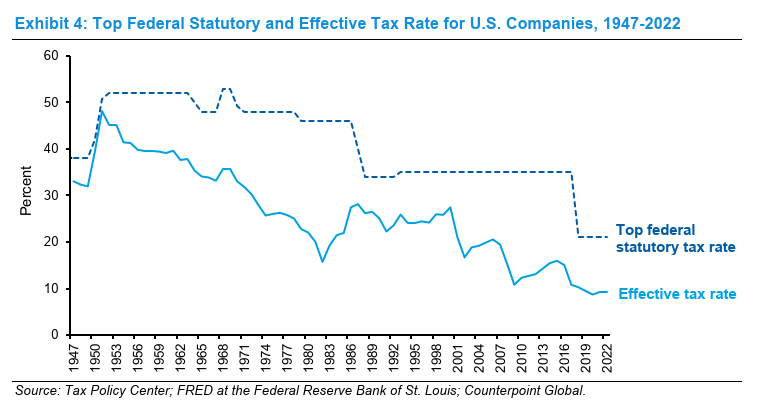
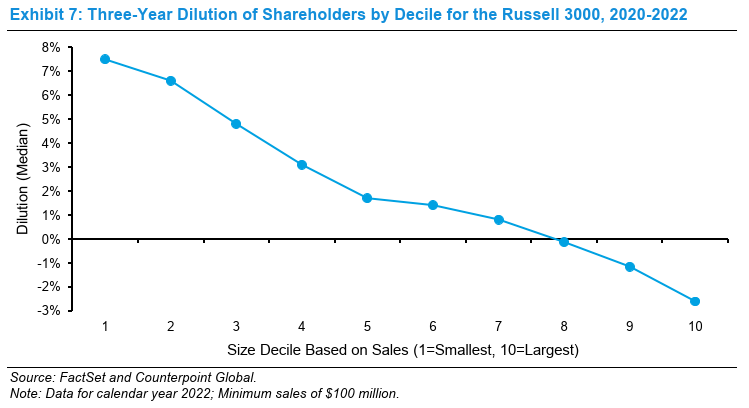
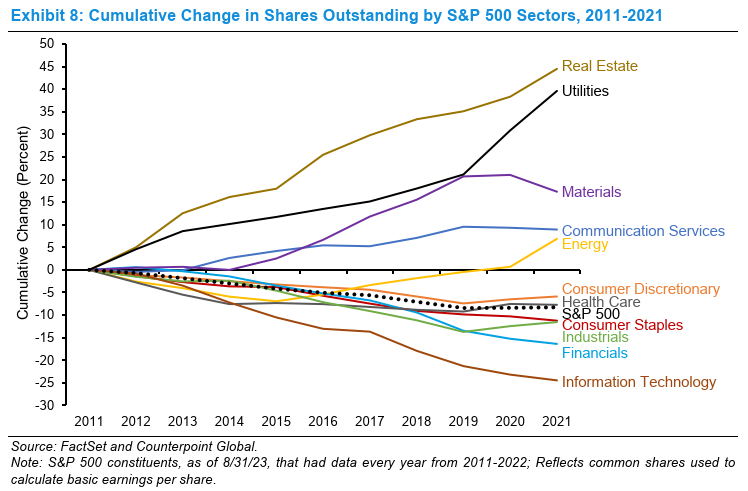
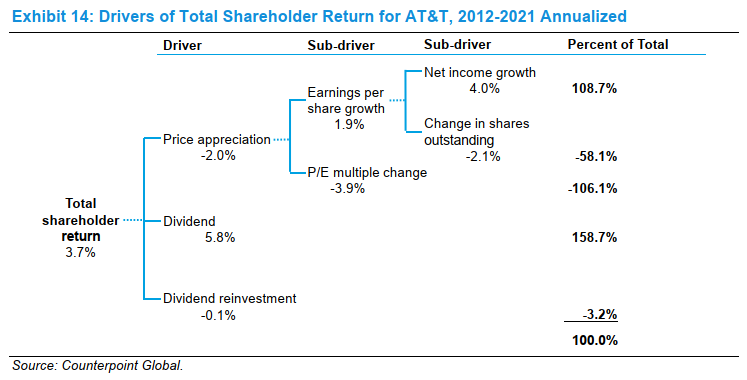
The latest research from Michael Mauboussin and Dan Callaghan is “Total Shareholder Return: Linking the Drivers of Total Returns to Fundamentals.”  As is usual for them, it contains a number of good exhibits, among them ones that show corporate tax rates across the decades (down, down, down); dilution by sales deciles (monotonic); changes in shares outstanding by sector (big differences); and the instructive drivers of total return for AT&T.  Also, there’s a checklist for assessing prospective returns.

Personalized investment

Broadridge released a report, “U.S. advisor-sold asset management: This time it’s personal,” full of data supporting its assertion:

Most asset managers are still approaching a 21st-century clientele with 20th-century business models.  Today’s U.S. investors demand an increasingly personalized approach to investing, reshaping product and distribution strategies across the industry.

The five themes emphasized are additional portfolio objectives of clients, a focus on holistic outcomes, evolution away from the “tax inefficiencies and non-customizable pooled format” of mutual funds, shifting capital markets, and increasing industry concentration.  There are a number of “action items” with details on what “successful managers” will do in the coming years to navigate the large advisor-sold market for investment products and services.

Drawdowns

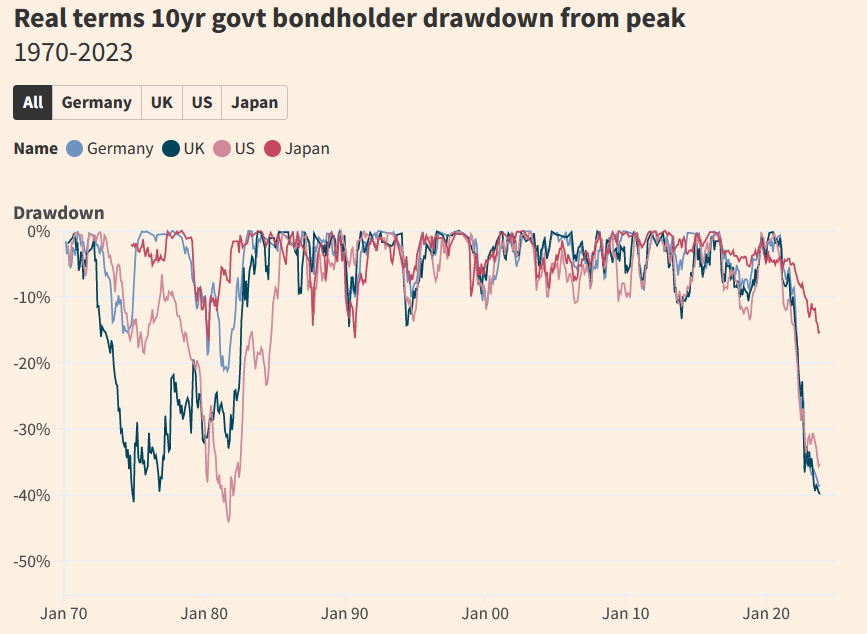
Toby Nangle started an article in the Financial Times with this:

All the worst things about the 1970s seem to be coming back.  Inflation.  Strikes.  Really silly flared trousers.  And of course double-digit bond portfolio drawdowns.

The charts provided show that the global bond bear market of late stands out “for its magnitude and pace.”  But, as the chart above illustrates, the drawdown from a half century ago lasted a good long time, prompting the description back then of bonds as “certificates of confiscation.”  Nangle’s concluding comparison of the two periods:

So while this bear market has been a shocker, we reckon we’ll need to check back in 2034 to see whether it beats the 1970s for sheer doggedness.

Other reads

“Should CalPERS Fire Everyone And Just Buy Some ETFs?” Meb Faber.  “All the time and money spent . . . Is it just CalPERS, or is it the industry?”

“How the Fearless Fund Lawsuit Is Provoking Outrage, New DEI Strategies — and Renewed Commitment,” Michelle Celarier, Institutional Investor.

With the stakes so high, the Fearless Fund case is forcing venture capitalists and allocators alike to rethink or reshape their efforts at increasing diversity, including among the companies they invest in, the managers they hire, and their own organizations.

“Big hedge funds pay ‘silly’ money, says founder of Europe’s largest manager,” Kaye Wiggins and Harriet Agnew, Financial Times.  Paul Marshall bemoans a “kind of battery-hen farming merry-go-round,” which is “not the right way to build great businesses or even to build a great industry for our clients.”  (Plus, “surfing the guarantee.”)

“The Transformation of Labor Markets,” PGIM.

For investors, the forces reshaping global labor markets will impact wages, productivity, unemployment, economic growth, inflation and fiscal deficits — creating a new roster of winning and losing industries and countries.

“Money Managers With $100 Trillion Confront End of the Bull Market,” Silla Brush and Loukia Gyftopoulou, Bloomberg.  Big active managers “have been bleeding cash” (client assets, that is).

“Thinking Broadly: Improving Active Performance Via Systematic Extensions,” Acadian.

Systematic extension strategies . . . have been underutilized for years (Figure 1) due to hazy perceptions of their underperformance around the Global Financial Crisis (GFC) and a blurry leeriness of risks associated with shorting.

“Sandy Gottesman: A Whale of a Value Investor and Philanthropist,” James Russell Kelly, article in Financial History (within the “publications panel at the bottom of the page).  On “The Buffett Group” and how it evolved, and the career of the founder of First Manhattan.

“11 Signs to Avoid Management Meltdowns,” Todd Wenning, Flyover Stocks.  Indicators of ethical collapse and factors that impede “management’s ability to make rational, ethical, and thoughtful decisions.”

“Blacklisted ‘woke’ firms like BlackRock and State Street still have a lock on AUM in oil states . . .,” Oisin Breen, RIABiz.

Perhaps not surprisingly, pension fund managers are leading the backlash against the backlash.

“Large Language Models Understand and Can be Enhanced by Emotional Stimuli,” Cheng Li, et. al, arXiv.  Can an “EmotionPrompt” improve the relative performance of LLMs?

Mutual fund performance, Jeffrey Ptak, @syouth1.  A series of revealing charts, with this conclusion:

In summary, with only a third of active U.S. stock funds beating their index before fees over the average 10-year period and with the average fund outperforming by just 0.26% p.a. (excluding dead funds), one thing seems pretty clear: Active U.S. stock funds charge too much.

Change

“In times of change, learners inherit the earth, while the learned find themselves beautifully equipped to deal with a world that no longer exists.” — Eric Hoffer.

Flashback: The Tao Jones

In 1983, Bennett Goodspeed of Inferential Focus wrote The Tao Jones Averages: A Guide to Whole-Brained Investing.  A 2010 review of it from the original “research puzzle” blog includes this:

While it’s tempting to view the book as gauzy Eastern philosophy with no practical application, its central message is that a good investment process is one of balance, and that the lopsided approach practiced by most organizations and individuals is doomed to fail.

In sync with the Eric Hoffer quote above, the last two pages of the book include a section called “The Warmth of the Herd,” which begins this way:

Wall Street has a bias in favor of logical, left-brained thinking.  Consequently, the right-brained sensing needed to decipher changing conditions tends to be ignored or overridden by reason.  As a result, the collective wisdom is often surprised.

Postings

Check out the archives (the paywall is no more) and search some of the categories.  You’ll find evergreen postings of interest.  Here’s one from January 2022:  “The Goal of Explanatory Depth.”

Thanks for reading.  Many happy total returns.

Published: November 13, 2023

Subscribe

To comment, please send an email to editor@investmentecosystem.com. Comments are for the editor and are not viewable by readers.

Cooking Up the Ingredients of an Investment Recipe

A little-noticed 2014 working paper by Boris Gnedenko and Igor Yelnik carried the intriguing title “Hypercube in the Kitchen: Reading a Menu of Active Investment Strategies.”  It proposed a method of “skill-based classification . . . to assist investors in better understanding a menu of available investment strategies as well as to help asset managers to position themselves on that menu.”

The “hypercube” in the title referenced the combination of five dimensions the authors used to characterize an asset manager’s investment approach — the “kitchen” signified the manager’s concerted effort to cook up a particular recipe of attributes that delivers tasty results for its clients.

The classification problem

A challenge with any attempt to classify a manager (or for a manager to classify and market itself) is that a firm can “implement dozens of investment processes simultaneously,” so the recipe is hard to explain or defend — and hard to decipher.  There’s more than a few ingredients.

No classification scheme is complete or final.  Boundaries move over time and new categories are created, posing a challenge for all involved, since where the lines are drawn affects the behavior of managers and allocators alike.  The dividing lines migrate, be they for asset classes or industry sectors or hedge fund strategy types or anything else.

Skills

The authors sought out a way of classifying managers that could augment existing methods of slotting them.  They proposed “a skill-based fund classification” by using five spectra, each of which is shown below.
The first classification, which the authors termed “the most fundamental,” ranges from pure arbitrage — a risk-free endeavor — to risk premia.  The left endpoint is exceedingly rare in the real world (although stories about the early days of ill-fated Alameda Research talk about the presence of pure arbitrages in cryptocurrencies).

Risk premia have been the focus of attention in public markets during the last few decades, as factors have been identified and then institutionalized into strategies and products.  They stem from “persistent heterogeneities among market participants (heterogeneity in utility functions including investment horizons, presence of different types of costs and investment constraints).”  And behavioral patterns.

But, as the authors noted, the more one moves to the right along the above dimension, toward risk premia, “the more uncertainty is associated with performance.”  The spotty record of late of some widely-used factors is causing investors to question whether they should cling to previous expectations or abandon them.  Since the paper is concerned with assessing skill, the authors emphasize that “identifying the most essential systematic risk factors and correctly estimating their current risk premia represents a special skill,” beyond the simple use of factors in a set fashion.  (An additional aspect of implementation regarding risk premia comes from the use of a single factor versus multiple ones.)

In an early draft of the paper, this scale went from “quantitative to qualitative,” but was changed to the above.  Is the information that is essential to the process available in a formalized way (think prices, reported earnings, macro data, etc.) or is it part of the continuous information flow, including news events, that feeds the market?

Crucially, gathering and processing these two types of information requires essentially different skills.  Formalized information is relatively cheap to access and interpret.  However, exactly because of this reason the universe of market participants utilizing it is extremely competitive.  On the other hand, non-formalized data is hard to comprehend and apply and if implemented on a large scale, it requires extensive text mining and processing skills.

In the years since the paper was published, the explosion of activity in the areas of natural language processing and artificial intelligence have changed “non-formalized” activities in a major way.

Intertwined with the formalization question is whether information is publicly available or not.

Public information, in our terms, is information which is acquired relatively cheaply and often comes down to data vendor subscription fees.  In contrast, obtaining private information, i.e., information not readily available through public information channels, is often associated with significant ongoing expenses, be they explicit or implicit.

On the left side of the range, “private information gathering is an expensive and often technologically advanced process.”  While not mentioned, it can also be an expensive process not because of the implementation of technology but by virtue of using time-consuming human investigation techniques (not including the abuse of insider information).

On the right, decisions are “based on information already disseminated in the marketplace.”  Cheap, but hard to gain an edge of any kind that way.

Another slice involves the commonly used characterizations of top-down and bottom-up approaches.

Obviously, the two types of analysis require very different types of skills.  In reality, however, the two are often combined in some proportions, so one can rarely see their pure realizations.  But still, one of them, where the firm has more expertise, would be dominant.

Finally, there is discretionary versus systematic management.  Discretionary strategies “are supposed to be far more adaptive to changing markets and are better suited to processing hardly quantifiable information,” but are “on average less transparent and replicable” — and it is “harder to rely on past performance.”  Systematic managers “are in general less adaptive and not so suitable for processing qualitative information” (although new techniques are making that less the case).

They are fundamentally different kinds of activities:

A discretionary manager’s trade is a one-time activity in buying/selling financial instruments.  A systematic manager’s “trade” is a modification to the trading algorithm.

Creating the recipe

In the middle of each scale is the word “hybrid,” which is where many investment processes are in practice, so that leads to a question of where to locate a process relative to the two endpoints.  Presumably the positioning for an asset manager is directly related to its beliefs about markets (and about the appropriate operation of an organization in order to profit from them), the resources available to it, and the skills it can bring to bear.  If those are out of sync, the firm is unlikely to be a success.

There are layers and nuance within each of the dimensions, making a discussion about the choices potentially revealing.  Where is the firm positioned and why?  One exercise is to have members of the investment staff independently mark where they think a) the firm is positioned on each scale and b) where their competitive advantages exist within and across the five categories.  The disparities in responses may indicate different definitions or expectations (illuminating on their own), as well as more serious lapses in strategic construction.

Then consider the element of change.  Not just how the firm has migrated over time, but how it should do so in the future to adapt to long-term shifts in the market environment.

Reverse engineering the recipe

For allocators of capital, the five classifications can serve as a mapping device and a set of ideas to dig into a firm’s strategy and process in a somewhat different way, offering uncommon questions that can lead to discovery (the ultimate goal).

Recently, the New York Times published an article by Rob Copeland from his book about Bridgewater Associates.  If his portrayal is accurate, then the narrative explanation from Bridgewater about where it is positioned on these attributes is quite unlike what is actually the case.  Searching for markers of positioning and skill falls short of the sort of process attribution that you would want to have, but is a helpful step in seeing the real picture.

Just as this framework can provide insights for asset managers that want to improve, it serves as another lens through which they can be evaluated by those who vet them.


Given significant changes in the investment environment, now is the time to focus on innovation in your organization.  Some ideas. 

Published: November 6, 2023

Subscribe

To comment, please send an email to editor@investmentecosystem.com. Comments are for the editor and are not viewable by readers.

Big News and (Always) Great Reads

The paywall on The Investment Ecosystem has been blown up.  All of the postings from the first two years of this site are now free (and all future writings will be as well).

If you have been a subscriber, you should have received an email about the change.  If you haven’t been one, now is the time to sign up to receive emails of postings or to visit the archives to see what you’ve been missing.  It’s all free all the time.

The most recent essay, “When Analysts Throw in the Towel,” looks at the social and psychological pressures that affect sell-side analysts (and other investment decision makers) when things go against them.

A new “flashback” section will now appear at the end of Fortnightly postings (like this one, which features a 2008 Howard Marks memo).

On to the readings.

AI all over

We’re coming up on the one-year anniversary of the introduction of ChatGPT to the broader world, which jumpstarted the current fervor over artificial intelligence.

“Productivity, Democracy, Power, and Truth: The Influence of AI on Markets and Investing,” a report by Inigo Fraser Jenkins and Alla Harmsworth of AllianceBernstein, is big in scope, as the title suggests.  It asks (at the end), “How can strategic asset allocation adjust to the potential for somewhat higher real growth (both earnings and GDP) but also higher long-term uncertainty?”  With higher equity exposure, higher inflation expectations, and a higher risk level overall.  (Also of note, the report includes predictions about changes in how analysts will work and think.)

Around the ecosystem:  Texas Teachers “believes AI can differentiate the fund;” J.P. Morgan Asset Management wants AI to “co-pilot” with portfolio managers, not boss them around; Angelo Calvello thinks recommendation engines will change wealth management; trading desks are gauging the risks and opportunities amid concerns about reliability; and Citywire Selector asks ChatGPT whether it will take over fund selection from humans.  Additionally, meetings are about to get weird.

Portfolio management in PE

A revealing paper, “Portfolio Management in Private Equity,” from Gregory Brown, et. al, looks at a little-explored area of a very popular asset class, revealing important patterns for investors.  According to the authors, “In spite of the centrality of the issue we study in this paper, almost no work to date has studied the GP’s investment decision through the lens of portfolio construction.”  Some of their conclusions:

The largest investments in PE funds typically have the lowest returns on average, but are also the least risky.

Managers take their biggest bets on their “safest ideas” instead of “best ideas.”

Returns within a typical PE fund increase monotonically as the investment size rank increases through the fifth largest investment made by a PE fund.

Funds start with higher-return deals.  That is, the earlier deals in the fund are of higher return and higher risk.

Funds with high-performing deals early in the fund’s life generally experience lower returns in later deals.

These results are consistent with the idea that GPs, motivated by career concerns and the incentives of limited partner agreements, approach fund investment through the lens of portfolio formation.

Given the standard marketing cycles, the changing portfolio composition as a fund ages is especially of note.

ESG

Kroll released its first “ESG and Global Investor Returns Study.”  It covers a lot of ground, but performance drives interest and “proofiness” in the industry, so the return calculations are likely to get the most attention.

The results above are for the respective MSCI ESG categories.  The colors indicate the three groupings (leader, average, grouping) used in most of the exhibits in the document, rather than the full spectrum of ratings as shown.

Advocates will no doubt use these numbers in debates with those who oppose any sort of ESG investing — at investment committee meetings, legislative hearings, etc.  But it’s a relatively short time period, there are sector mix effects to consider (and methodology to understand), and the number of companies included in the analysis doubled from 2013 to 2021.  Plus, this was a period when ESG was becoming more popular, so investor flows into highly-rated companies; reversion could mean that things look different over time.  Use with care.

The techno-optimist

Marc Andreessen got a lot of reaction to “The Techno-Optimist Manifesto,” an article which takes talking your book to a whole new level.  Among the many rebuttals are those from Ezra Klein and The Rational Walk.

Byron Wien

Wien passed away at ninety years of age.  He was widely known for his annual list of “Ten Surprises” of prospective developments unexpected by professional investors — and in later years for his twenty life lessons.

Other reads

“ETFantasmagoria,” Robin Wigglesworth, FT Alphaville.  On the explosive growth of ETFs, including “new-gen” ones far from their “passive roots,” and some thoughts about how their use will continue to evolve in more complex ways.

“CDPQ’s two-way street of efficient external manager relations,” Amanda White, Top1000funds.com.

It is important for our team to understand the knowledge gaps of the organisation, and while we better understand these knowledge gaps we work with partners and funds to see how they can help us fill those gaps.

“The art of keeping it simple, by JPMorgan’s Jan Loeys,” Bryce Elder, FT Alphaville.  An uncommon point of view for a strategist who works within a part of the industry that is paid for complexity.

“2024 Examination Priorities,” Securities and Exchange Commission.  The SEC’s playbook across the range of entities it monitors.  One interesting priority:

Adherence to contractual requirements regarding limited partnership advisory committees or similar structures (e.g., advisory boards), including adhering to any contractual notification and consent processes.

“Sharing Names and Sharing Information,” Omri Even-Tov, et. al, SSRN.  Do CEOs offer more information to analysts who share their name, especially if it’s uncommon?  Fascinating conclusions.

“Diverse Managers Are Stuck. Can Changes to Seeding and Anchoring Deals Help?” Julie Segal, Institutional Investor.

Existing diverse manager and emerging manager programs were two of the least helpful sources, in part because they take a check-the-box strategy to due diligence and their requirements often make some problems worse, including working capital.

“Wind of Change: A Favorable Environment for Hedge Funds,” Zhe Shen, TIFF.  A much different view than that expressed by Michael Rosen of Angeles in the last edition of the Fortnightly.

“We are All Quants. The New Era of Systematic Investing,” Campbell Harvey, Research Affiliates.

The machine, obviously, does not have direct behavioral biases and will not fall prey to human emotion.  Indeed, the best algorithmic strategies will observe, learn from, and profit from others’ emotional choices.

“Reality Of Working At A Hedge Fund — An Insider’s Guide,” Buyside Hustle.  Myths and realities for those trying to get their foot in the door.

“Heterogenous Discount Rates and Optimal Portfolio Diversification,” Theia Finance Labs.

The market portfolio only represents the optimal portfolio in the particular case that the investor’s discount rate is identical to that of the market, i.e. that discount functions are homogenous.

“Private credit returns are great (if you believe the marks)” Robin Wigglesworth, FT Alphaville.  Subtitle:  “A rolling loan gathers no loss.”

It’s a social science

“All investing is behavioral, psychological, social, etc.  So a lot of big investing mistakes are not because investors don’t understand finance — it’s because finance is all they understand.” — Morgan Housel.

Flashback: Marks in 2008

In thinking about 2008, the mind goes to September, when Lehman failed and other major firms were on the brink — and parts of the bond market seized up.  But things had been building beforehand, as shown by the title of a piece by Howard Marks on March 18 of that year:  “The Tide Goes Out.”

He detailed parts of the “virtuous circle” of booms and then wrote:

With things working increasingly well and investors becoming more and more excited, processes like this one seem destined to go on forever.  Of course, they cannot.  But people forget that, satisfying one of the key prerequisites for a cycle that goes to excess.  Overestimating the longevity of up legs and down legs is one of the mistakes that investors insist on repeating.

On the other side of the cycle, “Unquestioning euphoria gives way to full-blown depression.”

More than fifteen years later, it is worth rereading.  Among the topics covered:  “What’s an asset’s price?” (a question being asked about many private holdings today); when things that “should happens” turn into things that “should have happened”; how safe assets become unsafe with leverage; the problem with copying the previous success of others as conditions change; and those “high reported IRRs” — are they skill or luck or just “well-timed risk taking”?

Postings

As mentioned before, all prior postings are now open, so check out the archives and search some of the categories.  For example, if you’re interested in how investment organizations work, you’ll find a wealth of insights in this series.

Thanks for reading.  Many happy total returns.

Published: October 30, 2023

Subscribe

To comment, please send an email to editor@investmentecosystem.com. Comments are for the editor and are not viewable by readers.

When Analysts Throw in the Towel

While most finance theory assumes that decision makers are rational, anyone who has spent time in an investment organization knows that is an aspirational goal rather than a realized one.

To that point, proponents of behavioral finance have been busy over the last few decades documenting the various ways as individuals that we veer away from rationality.  The other consideration is that we are not on our own.  We operate within social structures that push us to act in certain ways.  (An earlier series on the anthropology and sociology of investment organizations provided a number of different examples of how social forces affect decision making.)

More evidence along those lines can be found in a paper, “Throwing in the towel: What happens when analysts’ recommendations go wrong?” by Kenneth Lee, et. al.  Quotes below are from the authors.

Sell-side analysts

The paper concerns sell-side analysts and what they do when their recommendations don’t work out.  Like everyone else, analysts make mistakes, but theirs are easily seen:

Every analyst will experience stock recommendation failures during their career.  Unlike many other professions, these pivotal moments occur in the full glare of clients, colleagues, equity-sales teams, and the media.

Not only are sell-side analysts monitored in real time by those parties, as a group they have been studied extensively by academics, since the quantitative elements of their work are widely available.  But such evaluations don’t provide insight into the “important social processes at play” that affect analyst behavior.

Analysts are expected to be industry experts, but some aspects of the job are performative in nature:  hold recommendations that are implicitly something else; reiterations done for promotional purposes only; earnings estimates that have over time become more and more “adjusted” in order to support a position; and target prices with varying time horizons and no clear delineation of embedded market expectations or stock-specific risk adjustments.

(If you’re interested in more readings on sell-side research, the original “research puzzle” blog featured many postings about it, including ones on the behavioral leapfrog of earnings estimates and some more leapfrogging, looking for the error price as well as the target price, and judging the best analysts.  There is also an essay from 2011 that looks at the decades of work by and about analysts, which yielded studies “of association, not behavior;” this current posting addresses the latter.)

Social structures — and the “rules of the game” — determine “the way individuals see the world and act in it.”  “Institutional and individual actors, networks, forces, and pressures” provide the environment within which choices are made.

Since the subject of the paper is the recommendations on stocks made by analysts, the authors review the academic literature in that regard.  They find “a resoundingly positive response” to the question of whether recommendation changes are “important capital market events.”  As a group, recommendations influence share prices and lead to herding behavior by investors — and much unwanted attention if they go bad.

Emotions

The interplay of two emotions affects analysts (and other market players) when it comes to decision making.  The first is confidence, “the belief that one can successfully complete a specific activity.”  Capital markets are defined by uncertainty, yet confidence is prized in the business, setting up a situation in which such confidence is shown to be unwarranted on a regular basis.

The other emotion is regret.  There is regret for decisions made that didn’t work out — and even “anticipatory regret,” which results in the avoidance of decisions that “might end up producing regret” if subsequent evidence can put them in a bad light:

Analyst recommendations would be an example of a decision where ex post a more successful alternative course of action (with a different outcome) would be very clear and so is likely to result in more intense regret if things go very wrong.

A bad call can lead to “deep-seated feelings of anxiety and shame,” so the authors argue that analysts prioritize “protecting their confidence levels and minimizing regret.”  Therefore, changing a misguided recommendation is a weighty decision.  When do you throw in the towel?

Important factors

What are “the circumstances and conditions in which revisions become more or less meaningful”?  What determines “the ‘intensity’ experienced by the analyst in a capitulation”?  The authors cite five factors that determine how much is riding on the reversal of an errant recommendation.

Franchise intensity.  If an analyst is considered the “axe” on a stock, “they are more emotional about their reputation being undermined and the perception of failure in the event of a capitulation.”  The stakes are higher or lower depending upon how influential an analyst is regarding the stock in question.

The nature of the failure.  Was the problem a “change of facts” that came out of the blue for everyone or a “flawed analysis”?  The former is dealt with much more easily.

The boldness of the recommendation.  “If an analyst has a nonconsensual position on a stock (e.g., the only buyer or seller), pressures quickly build if the recommendation is not going well.”  The more you are part of the crowd, the less it hurts when you throw in the towel.

Proximity of the recommendation.  One example in the paper cited an analyst “who started (‘initiated’) coverage of a company with a positive recommendation, marketed this heavily to the sales force, and then almost immediately had to deliver a negative message that the dividend had been cut, undermining the entire basis for the recommendation.”  A nightmare scenario for an analyst.

Reaction intensity.  Analysts operate within a social structure made up of the people in their own firms (especially those charged with marketing recommendations), the leaders of the companies that they cover, competing analysts, and clients — with their most important clients and those considered to be “the smart money” having the greatest effect on their thinking.  In considering a change in recommendation, an analyst considers how have they reacted to the previous recommendation and how they are likely to respond to a change in it:

There is both a backward-looking dimension to this (how intense was the initial reaction to the call?) and an omnipresent anticipatory element to it (how will networked others react to a future capitulation decision?).

Responses

Depending on the specific mix of those factors (and their own emotional sensitivities), an analyst may choose inaction, even in the face of trends that look to continue to go the wrong way, hoping for a change somehow (and soon).

Those who do capitulate may enter a period of paralysis.  If “the sense of failure affects them profoundly,” they can have a difficult time fulfilling their expected role:

After an intense capitulation experience, the loss of confidence an analyst experiences is antithetical to active agency.

Another possible effect after throwing in the towel is recommendation contagion.  Most sell-side analysts are industry specialists, so reversing one recommendation has ripple effects, in that the views on other covered companies may need to be reconsidered as well.  (The prospect of that contagion can be viewed as another factor that affects the capitulation decision.)

Implications for organizations

Those charged with supervising analysts need to understand the pressures and emotions that they face and to provide advice and support to them.  One of the things that draws analysts to the role is the ability to be solo practitioners of a sort and make their own choices, but they can get trapped by circumstances.  Everyone should remember that individual calls are “part of a larger, perpetual process” that can be derailed unnecessarily if one bad situation upends an otherwise sound body of work.

It is worth noting that the dynamics discussed in the paper apply to other kinds of investment professionals as well.  Consider a buy-side analyst stuck in a similar dilemma regarding a poorly performing recommendation owned in size by a number of portfolio managers.  The situation isn’t public like that of a sell-side counterpart, but the emotional toll is substantial nonetheless.

Or think about a portfolio manager who has made a big bet that is damaging performance.  Sticking with it or giving up is not just an objective decision, it’s an emotional one.

Now, imagine yourself as a client of a sell-side analyst or a buy-side one or a portfolio manager.  In the long run, gaining an understanding of their motivations and behavioral tendencies is much more important than calculating the outcome of an individual event or performance over a short time period.  It is also much more difficult.

Published: October 21, 2023

Subscribe

To comment, please send an email to editor@investmentecosystem.com. Comments are for the editor and are not viewable by readers.

NAV Loans, Due Diligence, and CEO Rewards

This edition of the Fortnightly is a week late (we took the show on the road for a bit), but it has a full load of great reads for you from around the investment ecosystem.  Back on schedule; you’ll see the next version in two weeks.

NAV loans

The opening line of a posting from Ted Seides speaks to an evergreen investment industry experience:

Financial market participants tend to stretch at the end of a cycle in ways that look silly in retrospect.

The topic is NAV loans, via which private equity sponsors borrow against their funds, a practice that is suddenly in vogue given changed circumstances in the industry.  The title of the piece asks, “Canary or the Gold Mine?”

Given that first sentence, you think the answer must be “canary,” but then Seides relates some examples that make you think he’s going to come down on the “gold mine” side.  Before choosing, he puts forth both the “pro” and the “con” arguments, making the case that NAV loans might work out well in some cases and be disastrous in others.  That said, Seides comes down on the side of listening to the canary; he echoes the words of Ana Marshall of the Hewlett Foundation that “anyone hearing about a NAV loan should shout out a warning from the mountaintop.”  Attention must be paid.

For more on this topic, see a Financial Times article which reported that the Institutional Limited Partners Association is drafting recommendations that “call for the industry to provide justification for the loans and more disclosure of their costs and risks to investors.”  And a Bloomberg piece throws shade on NAV loans and other borrowing tactics that are becoming more prevalent by referring to them as “backroom financing.”

Due diligence

Hilary Wiek of PitchBook has issued a report, “An LP’s Guide to Manager Selection,” which delves into some of the nuances of due diligence and manager selection in private strategies.  She follows the industry preference for “the Ps,” offering six of them as the foundation of her approach — people, philosophy, process, portfolio construction, performance, and pricing — while adding a seventh, potpourri, that allows her to include some other important points.

The report is full of good questions to pose to general partners, including some that are “culturally delicate to ask.”  Wiek stresses that “all [of a manager’s] responses must form a holistically coherent picture” and gives some examples of ways in which they often don’t.  Each of the seven sections includes helpful perspective for the diligence quest.

In the end, it is critical to remember that “there is no one right answer to any of the areas of due diligence” and that “it is the allocator’s fiduciary duty to perform its own due diligence, even if it seems like smarter investors have already done so.”

CEO rewards

FCLTGlobal published “The CEO Shareholder: Straightforward Rewards for Long-term Performance.”  According to the paper:

Companies need to reward leaders who create long-term value, but focusing on short-term returns as the primary metric in remuneration keeps companies stuck in short-term behaviors.

It argues that total shareholder return — which has been institutionalized as the primary approach to incentivizing CEOs (and others at a firm) over the last few decades — is a poor way to align the interests of managers with those of investors.  The organization’s theory of “remuneration design” is explained in the body of the report; a five-part “toolkit” at the end provides a nice summary of the practical application of it.

Charles Feeney

A remarkable life, making money and giving it away.

Other reads

“Generative AI: Overview, Economic Impact, and Applications in Asset Management,” Martin Luk, SSRN.  The table of contents to this long piece offers codes for the sections to indicate “must-read,” “read if you can,” and “helpful to read.”

“Investing Is a Science, an Art, and a Practice,” David Booth, Dimensional.

Financial economics is a social science.  Unlike math, which demands proofs and delivers exact answers, research in finance yields insights.  These insights allow room for interpretation.  And putting theory into practice requires judgment.  In many ways, it’s similar to medical science.

“Doing this will improve and accelerate your analysis,” Stephen Clapham, Behind the Balance Sheet.  Analysts, when was the last time you read an audit report?

“Hedge funds do not offer value to pension funds and other investors,” Michael Rosen, Angeles.

There is no combination of stocks and high-yield bonds that did not outperform hedge funds.

Fees are simply too high a hurdle for hedge fund managers to offer an attractive return to investors.

“10 Quotes That Shaped My Investment Philosophy,” Barry Ritholtz, The Big Picture.  Only one of these is specifically about investments, yet they represent a solid philosophical foundation for investing.

“The Business of Annual Letters,” Byrne Hobart, Capital Gains.

A company has a story to tell that’s best told in the form of a serialized short-term company history with near-future speculative fiction elements.  But all of those stories come to an end sooner or later.

“Politics rivals profits for portfolio influence, says Bridgewater co-CIO,” Aleks Vickovich, Top1000funds.com.  This was written before the recent events in the Middle East; even now, are politics more import than profits?  Over what time horizon?

“Adapting to Growing Private Markets: A Playbook for Practice Success,” Asher Cheses and Daniil Shapiro, Cerulli.  “Advisors can use alternative investments to differentiate practices and attract, consolidate, and retain client assets.”  (Note that the belief that a “lack of correlation to public markets” is given as a selling point.)

“The paradox of private credit,” Jared Gross, J.P. Morgan Asset Management.  (Also see:  “Insurance Companies Binged on Private Credit. Moody’s Is a Little Worried About It.”)

Private credit has “grown up” in a period of low interest rates, inexpensive leverage and limited defaults but must now adapt to an environment of high rates, costly leverage and rising credit risk.

“The alpha of ugliness,” Robin Wigglesworth, Financial Times.  Thoughts on some academic papers comparing the looks of portfolio managers and analysts with their performance.  (Maybe AI tweaks can help the prettier among us come across as “ugly beta nerds.”)

Topics of interest

“Great minds discuss ideas; average minds discuss events; small minds discuss people.” — Eleanor Roosevelt.

Factors over time

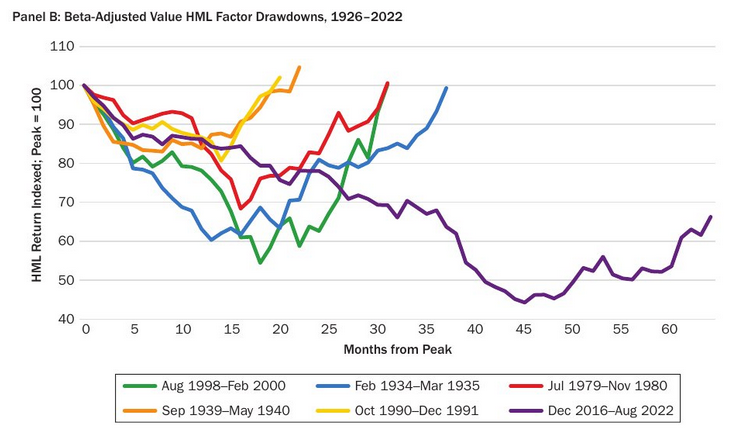
In “Trends and Cycles of Style Factors in the 20th and 21st Centuries,” an article in the Journal of Portfolio Management, Andrew Ang looks at the “time-varying trends” of the most widely-accepted style factors (size, value, quality, momentum and low volatility).

Ang uses the breakpoint of 2001 as the dividing line between the centuries of the title and finds significant differences in the returns, variabilities, and Sharpe ratios of the factors from one time period to another.  Potential causes of the changes are mentioned but not explored by the author, including “macro variables,” “constraints that induce investors to act in certain ways,” and “investor behavior biases.”  (The effects of popularity would seem to be ripe for analysis too.)

The image above shows the different behavior of late in the value factor on which so many investors have relied — a deeper and longer drawdown than those witnessed in previous history is causing debates about the nature of historical evidence and how to interpret it.

Postings

All of the content published by The Investment Ecosystem is available in the archives.

Thanks for reading.  Many happy total returns.

Published: October 16, 2023

Subscribe

To comment, please send an email to editor@investmentecosystem.com. Comments are for the editor and are not viewable by readers.

Buying Businesses, Winning in Different Ways, and Uncommon Levels

Welcome to the Fortnightly, a digest of interesting reads from around the investment ecosystem.

Buying businesses

Some stock market investors are buying stocks, while others are buying businesses.  Time horizons differ and the rationale for a purchase can vary from a trading strategy to getting exposure to a factor to holding that business forever as if you were the sole owner.

Private equity funds are clearly buying businesses, although their holding periods are rather short compared to true long-term owners.  There are also multi-decade and perpetual funds with very long horizons.

Everyone in the buying-businesses line of work needs to do due diligence and faces the challenge of sorting through the information that’s provided, as well as discovering the critical bits that aren’t.  A big company probably has a well-crafted narrative (so “cracking the narrative” is a high-value skill, as it is when analyzing asset managers).  Smaller firms usually aren’t as polished and organized, presenting a different sort of puzzle.

Permanent Equity, which invests thirty-year committed funds in small to midsized companies, recently made public its due diligence process, including a seventy-page document full of details.  Chief Investment Officer Tim Hanson explained the reasons for sharing its approach.

The craft of due diligence involves more than a checklist, since there needs to be discovery of a range of attributes that don’t fit neatly between the lines, that aren’t anticipated by buyers or willingly shared by sellers.  But the thoughtfulness and depth of the Permanent Equity approach ought to serve it well in the marketplace and should be considered by others who evaluate organizations.

On a related note, “search funds” have become popular of late.  See, for example, “MBAs Are Spurning McKinsey to Buy Small Companies” by Matthew Boyle of Bloomberg.  But the dream and the reality of running companies are sometimes far apart.  Some of the disconnects are covered in “Check Your Strategy and Capital Allocation Aspirations,” from Trish Higgins and A.J. Wasserstein.

Two ways

The latest memo from Howard Marks looks at two routes to success — fewer losers or more winners.  As he has before, Marks uses the image below to illustrate general investing principles, equities, fixed income, and the stylistic choices of avoiding losses or going for winners.

But Marks is “convinced the potential to improve on that through skill does exist in some markets and some people,” that alpha lies in “the ability to alter the shape of the distributions in the graph above so they’re not symmetrical,” as shown here:

Now we just need to find those markets and those people (and not confuse the random noise of performance with an ability to bend the distributions on an ongoing basis).

Anniversaries

It’s that time of year.  In the last couple of weeks we’ve “celebrated” the 25th anniversary of the collapse of Long-Term Capital Management (LTCM) and the 15th anniversary of the Lehman bankruptcy.

Looks back at LTCM include a posting from Marc Rubinstein (the pre-paywall section has the basics) and a Bloomberg article by Sonali Basak that includes an interview with Victor Haghani — and a reminder that the event marked the institutionalization of “the Fed put.”

That put was very much in evidence ten years later.  But what has changed since the financial crisis?  Mark Rzepczynski offered his opinions about what has changed (and what hasn’t), including that “The Fed has created the foundation for a new financial crisis.”

Other reads

“Honey, the Fed Shrunk the Equity Premium: Asset Allocation in a Higher-Rate World,” AQR.

Where “cash-plus” strategies charge performance fees, they should be on returns above a cash benchmark, just as long-only managers should be evaluated against an appropriate market benchmark.

“The Research and Development Factor,” Larry Swedroe, Alpha Architect.  “The empirical evidence demonstrates that the R&D premium remains an anomaly in all models.”

“Panel: The RIA industry is headed into a war for talent,” Daniel Gil, Citywire RIA.

A prolonged shortage of financial advisors may push hiring competition among RIAs into an all-out industry war which could sharply drive up costs to recruit and retain employees.

“The China paradox: underrepresented or too dominant in emerging market equities?” Marc Bindschädler, Vontobel.  Given uncertainties about China’s future — and its “dominant but also underrepresented” weighting in market indexes — consider five possible “patterns of investor response.”

“An oral history of the fear index.” Robin Wigglesworth, Financial Times.

“Democratising volatility trading” is something that sounds cute in an options exchange pit or Goldman Sachs trading floor, but perhaps there are just some things that shouldn’t be democratised?

“How Andy Golden Reinvented the Endowment Model for Princeton,” Alicia McElhaney, Institutional Investor.  “One team, one dream” — with an “odd and secret and unstable” decision process for what goes into the portfolio.

“Using AI in an earnings call,” Joachim Klement, Klement on Investing.

What the research found was that executives tend to hide behind boilerplate answers more when they are delivering bad news.  If they are discussing problems at their business, they obviously don’t want to go into too much detail about how bad the situation really is.

“Investment Advisers: Assessing Risks, Scoping Examinations, and Requesting Documents,” Securities and Exchange Commission.  Which firms get examined, what areas are in focus, and the (pile of) documents that are usually requested at the start.

“Thematic Analysis: Emerging Risks in Private Finance,” International Organization of Securities Commissions.

Private finance has largely grown in a period of accommodative macro-financial conditions.  This has now changed.  The sector may be tested in the medium to long term and could respond in ways that uncover hidden risks.  It is evident that private and public markets are intertwined to the degree that any one market event could have implications across both markets and, potentially, the broader financial system.

“The Real-Life Inspiration Behind The Bonfire of the Vanities,” Joseph Mysak, Bloomberg.  Cutting the cake and keeping the crumbs.

Narrow perspectives

“If everyone is thinking alike, then no one is thinking.” — Ben Franklin.  (See also Alfred Sloan.)

Uncommon levels

These charts were posted on LinkedIn (top and bottom) by Brian McAuley of Sitka Pacific Capital Management.  They offer historical context for the management of portfolios (and the behavior of clients regarding investment products of various stripes).

Is this a permanent change in the economic and market regime that started in the early eighties?  That’s the big question of the day, along with the corollary:  Which businesses, instruments, and strategies are untenable if that’s the case?

Postings

“The Paradox of Manager Selection Practices in a Changed World.”  The persistence of performance by the managers of alternative investments has declined over time, so the heuristics of the past don’t apply, and different ideas and questions become more important in manager selection.

“Becoming a Learning Organization.”  Lessons from seventy years of the CIA’s efforts to study the intelligence process and build up a fund of knowledge to help it learn from its successes and failures.

All of the content published by The Investment Ecosystem is available in the archives.

Thanks for reading.  Many happy total returns.

Published: September 25, 2023

Subscribe

To comment, please send an email to editor@investmentecosystem.com. Comments are for the editor and are not viewable by readers.

Becoming a Learning Organization

What does it mean to be a learning organization?  How do you go about creating one?

As is often the case here at The Investment Ecosystem, those questions were prompted by an unexpected source.  The Central Intelligence Agency (CIA) to be exact.

The spies have been working on a learning-organization project for almost seventy years.  The history of it is told in “Becoming a Learning Organization: Reflections on the Study of Intelligence,” by Peter Usowski.  That article appears in the latest edition of the quarterly journal from the CIA, Studies in Intelligence.

Since intelligence analysis ought to be a component of investment processes, the journal and other publications from the CIA often provide insights that readily translate to those who investigate market opportunities instead of foreign threats.  (One notable example is Psychology of Intelligence Analysis, a book by Richards Heuer.  A quick review of its table of contents reveals its applicability to investment decision making.)

History and analogy

The article walks through much detail about the foundation of a “history staff” at the CIA, the creation of Studies in Intelligence in 1955, and the establishment of the Center for the Study of Intelligence (CSI) in 1974.

The sections that appear in italics below relate the developments at the agency to the creation of a learning investment organization.

According to the author,

CIA’s leaders set out on a path, rocky at times, to conscientiously devote resources to studying intelligence and building up a fund of knowledge.

Those developments start with the establishment of that history staff in 1951, just four years after the CIA was formed, to document events for the purpose of benefitting from the successes of the organization and avoiding repeats of its failures.  The leaders of the agency wanted “an objective narrative” to inform future activities.

Those are laudable — but elusive — goals.  A rocky path is to be expected.

The “size, professional makeup, mission, output, and organizational alignment” of the history staff would vary over the coming decades in response to changing leadership and priorities at the agency, while advocates for the strategy stressed its value.  Legendary intelligence expert Sherman Kent wrote of the importance of “official memory for its own sake, [and also] for effective offensives and rear-guard actions in the great bureaucratic war within the Federal Government.”

Divergent opinions about the importance of a particular activity are part of organizational life.  Without a shared belief in the purpose of an endeavor, it can ride a rollercoaster of funding, attention, and effectiveness.

In 1980 the history program at the CIA was “on the verge of being abolished,” after having been cut back dramatically.  A report prepared at the time argued that a “fundamental premise was that a historical activity is useful to the organization.  Such an activity was not a luxury but rather an important function that could support and facilitate the agency’s work.”

This offers an easy comparison to debates within investment organizations.  Many of those directly involved in the investment process argue that more resources should be provided for their work (and not wasted on other activities that they view as luxuries), just as those immersed in the business of spying might believe.  That raises the question of what is a luxury and what is essential to long-term success.

Early on, Sherman Kent argued for the publication of the Studies in Intelligence journal.  According to Usowski, Kent believed that “the intelligence profession lacked a body of literature, a written fund of knowledge, that could be passed on to current and future practitioners.”  Kent wanted to capture “the institutional mind and memory of our discipline.”  That was echoed by CIA head Allen Dulles in an early edition of the journal:

The Studies are designed to bridge the gap between experience and inexperience, between theory and practice, and to provide for professional growth.

Coincidentally, modern finance was born around the time of that publication.  Theory and practice have expanded in innumerable ways since then, so the digestion of the existing body of knowledge is as important as the creation of new elements of it, especially as related to the work of a particular organization.  And there is a constant need to examine the intersection of theory and practice as the investment ecosystem evolves.

Sustaining organizational excellence also requires that bridging of the gap between experience and inexperience — and providing a foundation for professional growth, not just for new arrivals, but for those with years of experience whose growth often stalls when they settle into a long-term investment roles.

Upon his retirement, Kent said, “That Studies has in fact contributed to a richer understanding of the bones and viscera of the intelligence calling is beyond argument.”  But despite the wealth of information available to them, Usowski writes that “for the practitioners, the challenge today remains what it was in 1955 — finding time in a busy schedule to spend with the rich content available in Studies.”

This is a familiar dilemma for investment professionals.  It seems as if there is never enough time to spend on analytical work and the other required parts of the job, so little attention is paid to furthering a broader base of knowledge that could yield dividends over time (or, for that matter, on developing personal skills that might do the same).

In 1996, the Center for the Study of Intelligence started interviewing intelligence officers about their experiences, and then extended that practice to get the perspectives of former senior policymakers.  That furthered its goal to “document the institutional memory of the intelligence professionals, provide a forum for informed dissent, and support professional development opportunities through research, reflection, and articulation of ideas.”

Institutional learning from those directly involved in events can provide context for situations of the future.  As time passes, people move on, memories fade, and important lessons are lost — or misremembered.  After-action reports of significant events can illuminate investment dilemmas of the future and, perhaps more importantly — if objectivity versus blame drives the culture and interviews are conducted with that intent — the social and psychological factors that affected those involved.  

For CSI’s Lessons Learned program, a study team uses those interviews and the other available information to conduct “an objective interpretation and analysis to dispassionately describe what actually happened and generate findings that offer both lessons learned and best practices.”

We all feel like we inherently do this and tuck the information away in our memory banks for later retrieval, but such reflections are not dispassionate and offer one perspective that reflects only part of the overall picture.  An organizational learning process shouldn’t be overly structured, but expecting lessons learned and best practices to grow out of ad hoc reactions is wishful thinking.

In the last decade, CSI has created an Emerging Trends (ET) program, “so that the CIA could be best postured to confront the challenges or take advantage of the opportunities arising from the expected changes.”

Using an array of rigorous foresight activities, ET researchers and writers produced an impressive collection of short essays and longer monographs on a wide range of potentially disruptive changes such as ubiquitous technical surveillance, artificial intelligence, identity in the digital age, a world of abundant data, synthetic media, neurodiversity at work, the internet of things, and organizational transformation.

One of the wonderful aspects of the investment business is that those sorts of ideas are continually evaluated for their investment prospects.  But they receive much less attention in terms of how they will affect investment methodologies and the operating environment of the organization.  That should be an integral part of ongoing R&D.

In 2009, the Select Committee on Intelligence wrote, “The Committee firmly believes that for the CIA to truly become a learning organization — one in which knowledge is captured, preserved, and shared with those who can benefit — the CIA must institutionalize the lessons learned process and develop policy supporting that effort.”

One of the impediments for the agency is that the knowledge management function is inhibited by the decentralized nature of the intelligence it seeks to leverage.

Similarly, the “evidence” underlying investment decision making is often widely dispersed in an organization, stored in different locations (some communal, some individual).  And the work product of one person — especially spreadsheets — can be unintelligible to others.  Some standards for the aggregation of material can allow for easier consumption of it across the organization.

Principles

Usowski’s history illustrates the difficulties of becoming a learning organization and staying the course over time.  Budget pressures and conflicting priorities can cause an effort to wax and wane.  And practitioners may not always see the value of the initiative, unless and until it pays off on their behalf.

Thus, a clear philosophy as to the importance of the work and a lasting commitment to it are the foundation on which a learning organization is built.  A knowledge management effort that is not viewed as an essential part of organizational health and survival is likely to wither away.  And by nature it is a communal activity, existing for the organization, which is a hard sell for those who view themselves as autonomous contributors above all.

The nuts and bolts of it present knotty problems, which aren’t addressed in the article or in this posting.  The goals are desirable but the execution will be hard — and the learning will never end.

Published: September 21, 2023

Subscribe

To comment, please send an email to editor@investmentecosystem.com. Comments are for the editor and are not viewable by readers.