Dimensions of Learning for Investment Professionals

Three months ago, Frederik Gieschen of Neckar’s Minds and Markets (NMM) hosted a presentation by Prime Macaya Capital Management’s Alix Pasquet (a link to it was previously included in an edition of the Fortnightly).  A subsequent discussion between the two was made available recently.

This posting touches on a number of the topics that were addressed in those two encounters.  The first three section headings below reference the parts of Pasquet’s presentation.  Most of what is quoted comes from that, but content from the discussion is woven in as well.

If you’d like to take a deeper dive, here is the source material:

“The Learning Mindset for Investors” (NMM); video; slide deck.

“Great Investors Build Networks and Never Stop Learning” (NMM); video.

Pasquet describes Prime Macaya as “a behavioral hedge fund, and what that basically means is we seek to exploit the uneconomic behavior of market participants, specifically group behavior.”  That focus comes shining through in his observations about the customs and tendencies of investment professionals and organizations.  He says that his goal is show “rookie analysts and future portfolio managers how to use learning to improve their judgment, pattern recognition, and insight generation,” but the ideas apply no matter where someone is on the experience curve.

In fact, while “in the investment business we are paid to learn,” the propensity for learning can fade, a dangerous possibility at any time in a business where change is a given.

Problems

Some of the problems that analysts face:

The feedback loop for learning in investing is long and can be deceptive.

Analysts do not understand that there is a difference between analytical thinking and portfolio management thinking.

Even the best analysts will be wrong 40-45% of the time and many analysts can’t handle the emotions of being wrong in the early years.

Analysts tend to be desk jockeys.  They fail to conduct field research.  (“A desk is a very dangerous place from which to view the world.” — John le Carré.)

“Perhaps the single greatest error in the investment business is a failure to distinguish between the knowledge of a company’s fundamentals and the expectations implied by the market price.” — Michael Mauboussin.

Analysts tend not to understand the game theory, psychological, investment set-up or behavioral side of investing. . . . They underestimate the importance of operational skills, execution, and management.

Analysts don’t understand that they need to tailor their style, structure processes, and resources according to their own personalities and temperament.

Sensitivity to the environment is essential — both that of the market and of the organization (where ownership, legal, team, incentive, and political factors can drive decision making in unexpected ways).

One common failing at investment firms is that team design and development are haphazard or nonexistent.  Consequently, according to Pasquet, “individuals in our business don’t understand what it means to be in a team and how one can improve the performance of their teammates through their energy, communication, and actions.”

Mindsets

The presentation’s middle section starts with the statement that “human fallibility and imperfect understanding are features of the human condition.”  Or, “Mistakes are what we do.”  (Contrast that with the narrative framing of most investment firms; one is realistic and geared for improvement, the other is promotional and defensive about needed change.)

Crucially, “You want to stay within your circle of competence, but you never want to fail to expand it. . . . There needs to be R&D done.  You need to learn new tools, new strategies, new people, and new environments.”

Pasquet quotes Wyatt Woodsmall:  “Feedback, not Wheaties, is the breakfast of champions.”  Self-awareness is critical but elusive; “It’s a competitive advantage to know yourself well, your patterns, your weaknesses, your strengths, how you interact in a team, how you self-sabotage.”  We need others to reveal our blind spots.

Action steps

Pasquet offers a host of helpful recommendations about mentors, networks, knowledge management systems, “personal laboratories,” crowdsourcing, communication, personality typing, the importance of physical health, and more.

Like many others, he thinks that learning about the “greats” is important, but his take is more thoughtful than most:

You want to study great investors, CEOs, and leaders, but again, be careful of hero worship.  I think we often imagine these individuals that have qualities or abilities that are better than anyone else’s and some do, but mostly they’re schmucks like us.  They have the same weaknesses, patterns, they self-sabotage, and don’t think that they play perfectly.  Very often, they also may have gotten lucky and have gone through a certain environment.  Other times, they have support structures that we don’t see.  And you’ve got to remember also that you’re never going to be able to replicate what they’ve done.  Mostly because we’re not going to go through the same environment that they went through.  Also 5% of what these guys have done has usually given them 95% of the results.  So how should you study a hero?  You want to study their initial conditions. What was the early context circumstance and environment that shaped them?

He stresses the importance of personal networks (his thoughts complement the recent postings on this site that were focused on internal and external networks from an organizational point of view) and the need for multiple, diverse networks that span ages and geographies.

(Like many in the business, especially at hedge funds, Pasquet uses “guys” instead of a broader term for people, and it seems like all of the investors he cites are, well, guys.  Given the male dominance in the industry historically, that may not be surprising, but it is a good reminder that the biggest gap in most networks revolves around gender, despite compelling evidence that adding women leads to better decision making.)

A good network can act as “a moat and it’s also a margin of safety, to use value principles.”  It serves as a competitive advantage and a threat warning system, in addition to giving you access to resources and private information.  But watch out; working to build a value-adding network means that “you’re much more prone to falling for MNPI, material nonpublic information, so be extremely careful.”  (And don’t be shy about going to the compliance experts if you’re not sure about information that you’ve received.)

Pasquet focuses on the importance of building triads, where you match up two people in your network who don’t know each other but could benefit from being introduced.  He also emphasizes the need to get past the fear of dealing with people you perceive to be more important than you.

When you do have the opportunity to get in front of someone you’ve been trying to engage with, you want to have done your research on them.

But you also want to focus on a certain type of question.  You need to figure out how to get him to speak about his fears and frustrations, the problems he’s trying to solve, and his wants and aspirations.  What’s he working on that he’s trying to accomplish three to five years from now?  And you keep asking questions across the categories of what he’s trying to accomplish.

As is the case when doing due diligence, questions like those often reveal more than ones about investment specifics.  If you can get at their fears and frustrations and wants and aspirations, you’ve reached a higher level of understanding.

Learning

Pasquet recommends an amazing selection of books that span a much broader spectrum of disciplines than what you normally see on investment reading lists.  They address many of the holes in training and perspective that inhibit new entrants to the business and bedevil them throughout their careers.

We have the opportunity (and, really, the responsibility) to be “learning machines,” and that means going beyond the boundaries of common investment discourse to apply the best thinking from other domains in ways that can give us advantage in our own realm.

Courtesy of Frederik Gieschen and NMM, Alix Pasquet provides much food for thought — and action.

Published: December 18, 2022

Subscribe

To comment, please send an email to editor@investmentecosystem.com. Comments are for the editor and are not viewable by readers.

Essential Elements in External Networks

The previous posting explored some structural attributes of organizations and how network analytics might be used to assess the relationships and flow of ideas within them.  This one considers the networks that go beyond the boundaries of the organization.

Our networks

We are all parts of multiple networks, from those at the places that we work to our webs of family relationships, social connections, and affiliations spawned by hobbies, cultural activities, political persuasions, faith communities, etc.

In our investment-related duties, we have external networks as well as internal ones.  While a few organizations could be considered isolationist in their approach, in general the range and quality of those external networks are critical factors in determining what ideas are considered.  They also are a main driver of the social pressure that motivates many decisions.

Even in today’s wired world, cultural and geographic differences linger, although they are more muted than they were in decades past.  For example, how people thought about and approached global investing used to vary quite a bit depending on whether they were in the United States or Europe.  And there was a noticeable clustering of investment styles and strategies by city, often because they were the specialty of the dominant firm or firms in the region.  The propagation of ideas was natural — people went to the same meetings (most of which were oriented to the established interests of the biggest players), migrated from firm to firm within the area, and socialized together.

Analysts and salespeople from investment banks and research firms, while in many ways less influential than they were in the past, are conduits for a lot of ideas.  Their conferences have served for years as gathering places where networks are strengthened and extended (we’ll see whether they retain their significance post-pandemic), and the corporate access that they provide has become more important than ever (despite Reg D).

In an industry of specialization, it isn’t surprising that most networks are based upon commonalities in investment strategy, organizational type, or functional role.  They provide opportunities for learning and establishing new connections, surely, but they also create reinforcement loops of belief that can inhibit independent observation and analysis.  It’s a social system, and security analysts, asset owners, investment advisors, and all of the other kinds of investment professionals are susceptible to the pressures of the crowds around them.

One other type of network arises from the technology platforms that we use.  The platforms that include a communication element within them (think Bloomberg) can shape who you interact with — and all of them influence your world view, primarily by virtue of how investments are categorized and analyzed.  Standardized tools yield standardized views.

Analyzing the networks

The previous posting held out hope that some network analytics might provide data that is useful for considering how an organization works.  External networks present different challenges.

Information that flows into an organization (electronically) from the outside can be tracked, just as it can be internally, allowing a better understanding of where ideas come from and how they develop.  But the privacy issues highlighted in the last piece get even more complicated.  While an employee who understands how their digital exhaust will be used can decide whether the promised benefits are worth it, what about someone sending a business email from the outside?  Does an organization have a right to track and analyze the contents of it, given that the sender has no understanding of those practices?  (And, since personal and business matters often get mixed together in messages, where should the lines be drawn as to what is analyzed?)

However you address those kinds of questions, you have less ability to evaluate external networks in a systematic way than internal ones, given that the electronic evidence is limited to points of exchange.  But that doesn’t mean you shouldn’t try to understand the quality of the networks that lie outside; they are (usually) where the seeds of your actions originate.

With that in mind, how would you judge the quality of your personal external network (when it comes to investment pursuits)?  What about the whole range of those networks that your organization relies upon?

One place to start is by pondering how uniform the networks are.  Innovations in methods and ideas usually come from recombining concepts and applications in new ways; that’s much more likely when there is diversity in the sources of information and opinion.  There are benefits to imitation, but alpha comes from differentiation, and too many investment networks are tribal echo chambers.

This comes from Social Chemistry: Decoding the Patterns of Human Connections, by Marissa King:

When Yo-Yo Ma, an iconic classical musician, looked around, he noticed that “the most interesting things happen at the edge.  The intersections there can reveal unexpected connections.”  Within ecology, this is known as the edge effect.  Where the edges of two ecosystems meet, there is the greatest biodiversity.

Ma’s interest in fostering new musical amalgams might seem far afield from the investment world, but the same principles apply.  Combinations occur at the edges of asset classes and strategies, creating new categories.  Insights from other disciplines offer the potential to improve investment theories, tactics, and organizations, but are often untapped, since (despite its dynamism in other respects) the investment industry is quite insular and slow to change.

Searching for quality

One aspect of the autonomy provided in most investment organizations is that you can build your outside networks on your own without much interference.  That hands-off approach ignores the fact that many of us aren’t very good at building diverse networks of quality.  That creates weak spots for an organization; helping people analyze and improve their network of sources should be an important concern, but it rarely is.  We fend for ourselves — and usually develop narrow and conventional networks that deliver narrow and conventional ideas.

The standard inference is that if there is good performance then there is a good process behind it — and a good network which feeds it.  But conditions change and a network that is optimized for one environment can be totally out of sync with the next, missing the transition from one to another.

While a diversity of inputs is essential, assessments need to be made about the quality of work done by those in the network.  That requires looking beyond the surface level of the current idea flow (and performance); a good network is built on an understanding of how your contacts do their work and what beliefs and incentives motivate them.

That depth of knowledge takes time and comes not from osmosis during the normal investment discourse, but from purposeful inquiry of a different sort.  That is a rare and valuable practice.

This posting is part of “The New World of Investment Work” series.

Published: December 11, 2022

Subscribe

To comment, please send an email to editor@investmentecosystem.com. Comments are for the editor and are not viewable by readers.

The Next Fracture, Structural Impediments, and Losing Track of Things

Welcome to the latest edition of the Fortnightly, which contains a wide range of readings from the investment ecosystem.  (Free and paid subscription plans are available here.)

The next fracture

“Financial instability: the hunt for the next market fracture,” reads a Financial Times headline; the story reports:  “Violent, sudden price moves in one market can provoke a vicious loop of margin calls and forced sales of other assets, with unpredictable results.”

The sections in it tick off some of the current worries:  European repo markets, U.S. Treasury illiquidity, dysfunction in Japanese government markets, private debt and leveraged loan questions, and potential emerging market defaults.  Given that worries were in short supply in the risk-on years, perhaps all of this is welcome news heralding more cautious sentiment and some opportunities ahead.

But such reversals of good fortune make people nervous, and there are lots of Lehman-this and dot-com-that analogies being thrown around — especially when a previously high-flying strategy runs into some turbulence.  In the last few days, the gating of withdrawals from Blackstone Real Estate Income Trust (BREIT) has drawn attention.

Another FT article, from six weeks ago, was prescient in highlighting potential issues at BREIT before the crowd got worried.  It referenced Blackstone CEO Steve Schwarzman’s summary during the second-quarter earnings call of what an investor had said to him:

I’m a BREIT investor.  In fact, it’s the biggest thing in my portfolio and I love you people.  This is so amazing.  All of my friends are losing a fortune in the market and I’m making money.

As a chart from @EconomPic shows, the performance of the non-traded BREIT is completely different from its publicly-traded competitors.  That raises the specter of the financial crisis, when private REITs at first held up in the face of declines on those that were marked to market, only to fall hard as the crisis developed.

Investment advice

Adam Van Dusen has a good summary on Nerd’s Eye View of “101 Things That Advisors Actually DO To Add Value (Beyond Just Allocating A Portfolio).”  Broken down into seven categories, the list demonstrates the wide range of services that good advisors provide.

Across the pond, the Financial Conduct Authority “proposed significant changes to advice rules to create a new regime allowing ‘mass-market’ consumers access to simplified advice.”  A posting by James Fitzgerald for Citywire New Model Advisor lays out the basics of the proposal.

Structural impediments

Tim Hanson of Permanent Equity wrote a short but perceptive essay about recognizing when there are “simple structural elements” that might work for some people but aren’t optimal for an organization as a whole.  His example of a disconnect between the percentage of portfolio positions coming from extroverted analysts versus introverted ones demonstrates how relatively simple analytics can reveal structural impediments that should be addressed.

Due diligence

~ “Doesn’t anyone do due diligence any more?” asked Brooke Masters in the FT.

~ Chris Addy of Castle Hall Diligence wrote about operational due diligence in the crypto realm.  (Addy was featured on a recent webinar about that topic and will be participating in another next week; both via Opalesque.)

~ Sam Bankman-Fried of FTX said, “We kind of lost track.”  (Perhaps “What have you lost track of?” should find its way onto due diligence questionnaires.)

~ The latest commentary from AIM13 includes a section about “asking the right questions” in any kind of a due diligence inquiry.

Other good reads

“Venture Capital Red Flag Checklist, Bill Gurley, Above the Crowd.

It’s no coincidence that Enron [happened in 2001] and that FTX occurred in 2022.  Extended, frothy bull markets are a breeding ground for unwarranted corporate behavior.  When markets are soaring, speculation increases and as a direct result so does risk.  Also, when everything appears to work, investors are more willing to suspend belief.

“Why Good Funds Fail,” @hfreflection.  “I’m paranoid our fund will fail, since this is the typical HF ending.”

“Fun and Games: Investment Gamification and Implications for Capital Markets,” Sivananth Ramachandran, CFA Institute.

The pandemic created a new class of investors for the first time, and some of these investors had better outcomes than others.  The lucky ones might mistake their luck for skill and increase their risk taking, and the risk-taking effects may last for a long time.  In contrast, for those who lost money, their risk aversion may linger too, to their own detriment.

“How to process the FTX news — a test,” Tyler Cowen, Marginal Revolution.  More news about FTX has come out since this was written, but these are still interesting spin-off questions.

“Loss Aversion and The Impact of Daily P&L,” Cameron Hight, Alpha Theory.

For fund managers, the wear and tear of daily P&L is one of their biggest mental challenges.  One solution is to just stop looking at daily P&L.  This path can be liberating, but the pushback is that a portfolio manager must “know” their portfolio, and to do so, they must look at daily P&L (or, even worse, real-time P&L).

“Private Equity Fund Terms Research,” MJ Hudson.  Trends in terms on deals where the firm has advised either the manager or an asset owner.  Of note:  The average number of months between successive fund raises collapsed from 47 to 16 from 2015 to 2020.

“We’re too obsessed with volatility,” Simon Evan-Cook, Citywire Selector.

In short, there is no easy, industrialised way to manage risk.  Data can be useful, but it’s no replacement for a broad, human-based assessment of the real-world risks and rewards of an asset.

“Endowment Governance: Aligning Foundation Investments and Mission,” Tracy Filosa, Cambridge Associates.  The role of governance in sorting out the confusing mix of potential mission-related alignment initiatives.

“Chief Financial Officer Age and the Perverse Effect of Equity Incentives on Financial Misreporting,” Jing Fang, et. al, SSRN.  Younger CFOs with greater discretion over accounting choices are more likely to engage in financial misreporting.

“Regulatory Data Handbook,” A-Team Insight.  Tidy descriptions of more than forty significant regulatory rules in markets around the world.

A different eye

“I see all sorts of things that you don’t see.” — Diana Vreeland, legendary fashion editor.  (Alpha hunters hope that they do too.)

The explosion in crypto investments

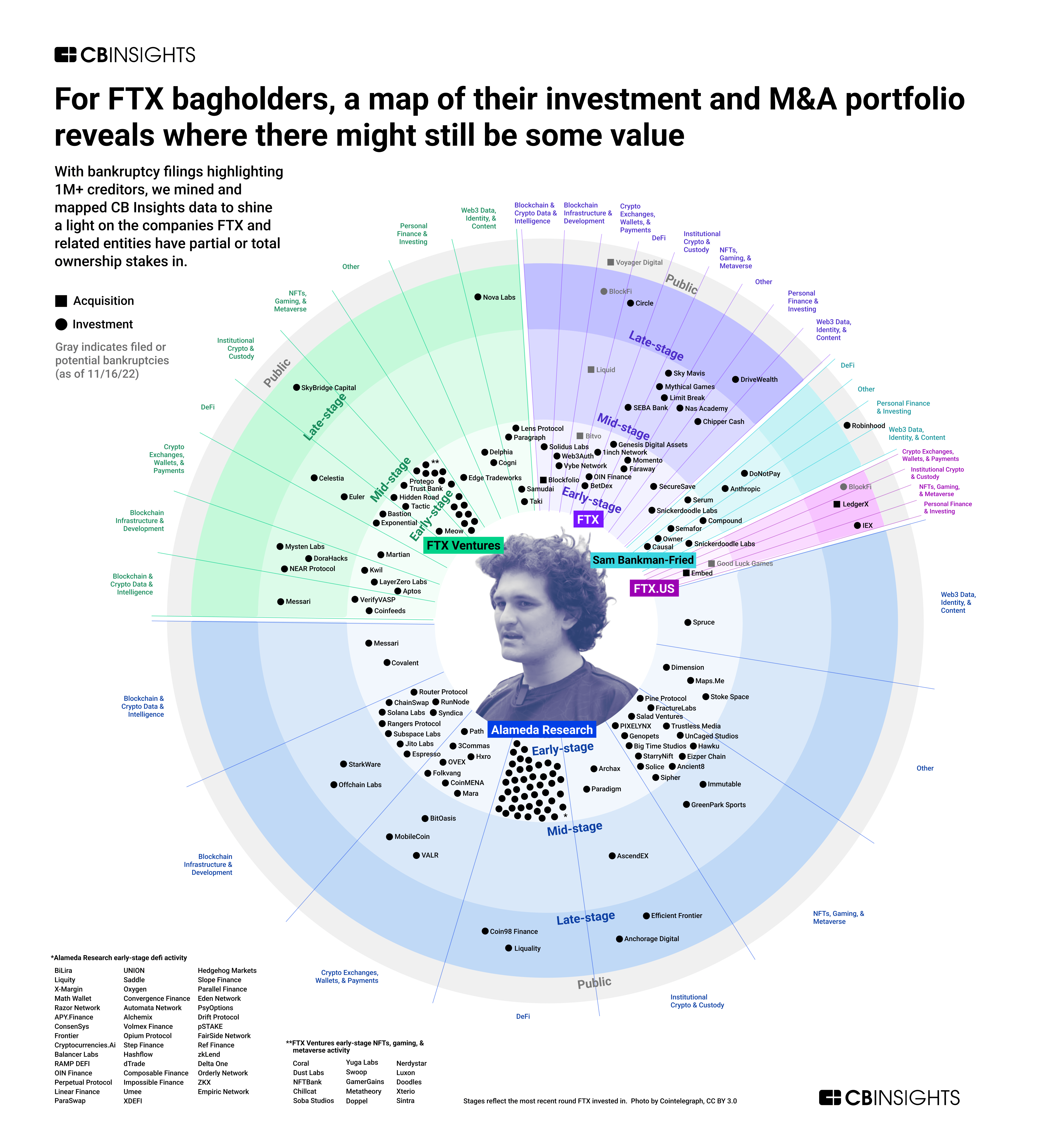
CB Insights released a compilation of “strategy maps” that show recent investments, acquisitions, and partnerships for a number of firms as evidence of what matters to them and what their strategy is.  Above is the map for Coinbase, showing its actions for just the last eighteen months or so.

One of the things that became evident in the FTX debacle (or at least seemed to be evident, given the messy state of its recordkeeping) was the degree to which it was investing in a large number of crypto-related firms.  It was not alone.  If the “crypto winter” continues, the ripple effects of it will lead to more failed firms and venture capital losses.

Posting

“Network Analytics in Investment Organizations” goes beyond the org chart (and even the “orgorg” chart) to consider emerging possibilities for the observation and evaluation of organizations.  (But beware the pitfalls.)

All of the content published by The Investment Ecosystem is available in the archives.

Thanks for reading.  Many happy total returns.

Published: December 5, 2022

Subscribe

To comment, please send an email to editor@investmentecosystem.com. Comments are for the editor and are not viewable by readers.

Network Analytics in Investment Organizations

A series on “the new world of investment work” was begun some time ago by way of postings about talent, how to find it, and how to judge it.  This piece (and a follow-up to it) will provide additional blocks of the foundation for that overall topic by focusing on networks and organizational design.

Organic organizations

If you do a search on the words “organic organization,” you’ll come upon a distinction made by Tom Burns and G.M. Stalker in their 1961 book The Management of Innovation.  The authors described the differences between a “mechanistic” organization and an organic one, which you can think of as the two ends of a spectrum.

Mechanistic organizations are centralized, hierarchical, and full of rules and standards.  Interactions are often relatively formal in nature and a lot of communication is in written form or occurs in structured meetings.  It is a network of defined positions, and status usually relates to the number and importance of those whom you manage.

An organic organization is the opposite of that:  decentralized, free-flowing, and constantly adjusting, with responsibilities changing as needed.  The paths and types of communication and the nature of relationships are hard to plot and hard to follow.  The orientation away from rigid structures allows for more ready adaptation and also a bit of chaos.

You can think about where a given investment organization is on the continuum between those two endpoints.  Certainly size plays a role in where one is located, although some larger organizations might be pretty mechanistic overall but allow for relative freedom in how individual investment teams or units function.

Using that simple framework, consider where you would map your organization (or your competitors or your agents) — and what implications might be drawn from that exercise.

The orgorg chart

About a decade ago, an Autodesk research team created something it called the organic organization (orgorg) chart.  The video that was produced got a fair amount of attention at the time.  It shows the evolution in the structure of Autodesk, day by day, for four years.

As it speeds by — you might want to slow it down to really see what’s happening — the degree of change is obvious.  There are small movements as people are added or dropped or reassigned, as well as some major disruptions, which are probably because of reorganizations or acquisitions.

The main thing the video does is to get you thinking about changing structures.  Even though many organizations are less hierarchical than they used to be, we still tend to think in terms of org charts.  No matter where an organization is on the mechanistic-to-organic spectrum, an orgorg chart could greatly increase your understanding of it.  It would illuminate the basic arithmetic of investment staffing (driven by asset levels and product additions and subtractions), the changes in structure due to modifications in approach, and how individuals are moving through the org chart.  Looking at several static org charts across time can give you a sense of that, although some things won’t show up that way.

Network analytics

But org charts and orgorg charts only tell you what the formal structure looks like (or is supposed to look like).  They often don’t tell you a lot about how an organization really works.

Buried in an org chart are people that are critical to the success of an organization, but you’d never know it by looking at a static diagram or even a dynamic one.  (In fact, sometimes those in charge don’t really know much about those folks either.)  There are undocumented, hidden networks at play — and people who are influential by virtue of their relationships with others or by their ability to broker ideas and/or connections.

The properties of organizations are increasingly being evaluated using network analytics that track the flows of information between people.  If you add in psychometric and behavioral findings — and apply the tools of natural language processing — you can take the understanding of an organization to another level entirely.  But, potential pitfalls come with that greater depth and breadth of knowledge.

A 2018 Harvard Business Review article, “Better People Analytics” examines some of the possibilities that come from the “digital exhaust” of emails, chats, file transfers, and the like, in a process the authors call “relational analytics” (and is elsewhere known as “organizational network analysis”).  They examine six “structural signatures” that indicate important attributes:

Ideation ~ which employees will come up with good ideas

Influence ~ which employees will change others’ behavior

Efficiency ~ which teams will complete projects on time

Innovation ~ which teams will innovate effectively

Silo ~ whether an organization is siloed

Vulnerability ~ which employees an organization can’t afford to lose

The network characteristics that signify each are succinctly described and real-world examples are given.  Some of them might be judged as very important for investment decision making, and others for investment operations.  The broader point is that there is much to be learned from really understanding the patterns and variations of network interactions.

But you must wrestle with the subject of a sidebar within the article, “What About Employee Privacy?”  It offers guidance as to different approaches — from using basic and fairly generic information gathering to applications that might be considered intrusive.  No matter what, everything should start with complete transparency about what information is collected and how it is be used.  That gives employees and prospective employees the opportunity to judge the trade-offs involved.

Given the ever-present need to generate performance, some organizations will be aggressive in applying networking analysis.  Leaders need to think carefully about how to balance the power of the tools and the insight that they provide with the risks that they can spawn.

You can start with these questions:  Does digital exhaust belong to the organization or the employee?  Where should the lines be drawn regarding its use?

Diagnosis and design

What you would most like to know is how ideas flow through the organization — who originates the best ones, who propagates them, who uses them to great effect, and who kills them off.  And you’d want to understand what functional needs are not being met and where there are skill shortfalls that should be addressed through hiring or training or the restructuring of roles.  Insights like those are mostly the province of observation and intuition now; network analytics may provide more concrete evidence to support design decisions that will produce the investment performance of the future.  Organizations should be examining the possibilities as part of their research and development efforts.

Published: December 4, 2022

Subscribe

To comment, please send an email to editor@investmentecosystem.com. Comments are for the editor and are not viewable by readers.

Responsible Due Diligence and Careful Decision Making (Just Kidding)

The last few weeks of a calendar year can be exciting.  Asset managers chase their benchmarks before the incentive calculator starts anew in January, while pundits are on the lookout for some action that they can call “a Santa Claus rally.”  Who knows what other crazy things are in store for us before 2023?  (If you do, please write.)

Some coming attractions on The Investment Ecosystem include using the “orgorg chart” to think about the structure of organizations and the ecosystem in general; liquidity and pacing issues; and the proliferation of natural language processing in strategies.  Plus, during the first quarter the Academy will introduce a course on communication skills for investment professionals.

On to the carnage readings.

FTX

Normally, the Fortnightly (and this site as a whole) goes for evergreen topics rather than the latest headline material.  But given our focus on due diligence (here are links to postings on the topic and to the Academy course about it), the FTX debacle is too important to pass up.

You probably know the outlines of the story, so we’ll offer links to just a few items that frame (another) one for the ages.

On October 27, Bloomberg published an article with the headline “Fidelity Says More Institutional Investors Are Holding Crypto.”  Less than three weeks later, one in Institutional Investor asked, “How Did So Much ‘Smart Money’ Get Tangled Up in FTX?”  (And there were similar items from every major financial news outlet.)

A lot of big names were involved, although Sequoia, the giant venture capital firm, has taken the biggest PR hit.  In late September, it published a glowing profile of FTX founder Sam Bankman-Fried that it had commissioned.  A truly astonishing read, which is now available online thanks to internet archiving; Sequoia took it down, replacing that expansive hype with a simple, somber update.

There were a few mea culpas offered (80,000 Hours) from some of the many who had lavishly praised Bankman-Fried, and some well-earned told-ya-sos (such as from Better Markets).

If you want to get into the weeds, check out items from milky eggs and Nansen (although there is much that is not known yet).  And, if you’d like to see where a good chunk of the money went, look at the early-stage ring of a CB Insights graphic.  Bankman-Fried was so busy betting on the future of crypto that he didn’t see that he was ruining its present.

An Opalesque webinar with Chris Addy of Castle Hall puts all of it in the context of good operational due diligence.  There are a bunch of eye-openers in his presentation.  One bullet point:  “Blatant conflict of interest when a prop fund also owns an exchange — yet this did not stop investors.”

A reminder from Tyler Cowen:  “Many of the real sources of existential risk boil down to hubris and human frailty and imperfections (the humanities remain underrated).”

And, a paragraph to summarize it all, from the incomparable Matt Levine:

I don’t want to minimize the likelihood of intentional fraud and theft.  Stuff seems bad.  But I want to say that the story of FTX also reads like what would happen if you and a few of your college friends set up a gigantic international financial exchange after like a year or two of working in finance.  Oh, your friends are smart.  They have decent intuitions about financial stuff; they have good ideas for what products to trade and how to trade them; they can code up a good-looking website.  But do they have hard-won expertise, built up over many years, in accounting controls and business processes for running a giant organization?  Are they excited about making sure all the paperwork is correct?  No, that stuff is boring.  Your friends are traders and engineers, not accountants and compliance officers.  Also there just aren’t that many of them, and they are running a huge exchange; they are too busy for paperwork.  They move fast and break things.  They break so many things.

Twitter

Speaking of breaking things, here were a couple of quotes from different New York Times articles about Twitter published on November 4:

This is a master class in how not to do it.  If you were going to rank order ways to upset people, telling them you’re going to do it in advance, without rationale, that is a particularly inhumane way to treat them.  (Sandra Sucher, a Harvard professor of management.)

“We are witnessing the real-time destruction of one of the world’s most powerful communications platforms.  Unless and until Musk can robustly enforce Twitter’s existing community standards, the platform is not safe for users or for advertisers.”  (Nicole Gill, executive director of Accountable Tech.)

That was more than two weeks ago, and it seems to have gotten worse on every front every day since then.  Elon Musk has repeatedly miscalculated in matters of strategy and of tactics.  Perhaps he can pull a rabbit out of the hat, but at this point in time it looks like he paid an ultra-premium price just to try to kill the social network as fast as he can.

It is worth your time to read Mike Drucker’s “A Rich Man Walks Into a Bar.”

Another hungry mouth

A blog by Bob Veres, “The PE Attack,” covered one of the big topics in the investment advisory realm.  At a recent conference:

People were discussing the growing flood of private equity money into the financial planning ecosystem, funding advisory firms that use these dollars to buy other advisory firms at increasingly outrageous multiples, and buying up fintech firms that advisory firms rely on.

Chief among the concerns was the fact that many larger firms are now introducing an additional greedy mouth to feed at their table, beyond the normal stakeholders of the equity owners, staff and clients.

What will the clash between the business of investment advice and profession of financial planning mean for the standards of practice in the industry?  The latest chapter in a long-running saga.

Other reads

“Cultures Clash at Salomon Smith Barney,” Rick Bookstaber, Stories.Finance.”  Going from a storied partnership to a financial conglomerate; “So, we had this intellectually-driven, collegial, all-of-us-in-the-life-raft-together culture.  Then things changed.”

“The Most Important Skill in Finance,” Ben Carlson, A Wealth of Common Sense.

It’s no coincidence that most of the all-time great investors — Benjamin Graham, Warren Buffett, Howard Marks, Peter Lynch, etc. — had the innate ability to explain their investment process in a way that everyone could understand it.

“Persistence of Margins,” Greg Obenshain, Verdad.  Margins are historically very high, but “margins and returns on assets are relatively sticky.”

“Private Equity Fund Valuation Management During Fundraising,” Brian Baik, SSRN.

I find that funds managed by low reputation GPs [based on size, age, and performance] show more dramatic forms of NAV inflation by managing upward not only valuation multiples but also portfolio firm earnings.

“Four Structural Differences to Know About the U.K. and U.S. LDI Markets,” Rick Ratkowski, Portfolio for the Future.  A concise summary of how the same concept has been implemented in different ways.

“ESG Investment Outcomes, Performance Evaluation, and Attribution,” Stephen Horan, et. al, CFA Institute Research Foundation.

If ESG considerations are to be elevated to an investment objective alongside return and risk, it must differentiate between ESG factors that increase risk-adjusted expected returns and those that do not.

“Longer, Healthier, Happier: Why Working Longer Improves Almost Everything,” Laurence Siegel and Stephen Sexauer, AJO Vista.  The United States has a structurally-outmoded retirement system — and one action can address two important problems that “stare each other in the face.”

“Illusions of precision, completeness and control (revisited),” Bob Maynard, Brandes Center.  An update of the 2014 paper:

Critics may point to the higher Sharpe Ratios more complex portfolios can generate . . . but Sharpe Ratios are useless in a fat tail/high peak world and, in fact, can drive plan sponsors to create portfolios that seek to pick up proverbial nickels while standing in front of a silently approaching steamroller; greater complexity often makes plans more susceptible to suffering devastating consequences when fat-tailed events roll through.

“Trends in State and Local Pension Funds,” Oliver Giesecke and Joshua Rauh, SSRN.  “The reported funding ratio of 82.5% falls to 43.8% under a market-based valuation.”

“Investment Bubbles and Frauds Have a Lot in Common,” Joe Wiggins, Behavioural Investment.

The life of an investment bubble or fraud is predicated on three critical aspects.  The story, the performance and the social proof.  These operate as a virtuous and vicious circle through the emergence and death of both bubbles and fraud.

“The Rise of 3rd Party Search Firms That Find Consultants,” Dusty Hagedorn, Chief Investment Officer.  “Increasingly, asset owners are hiring consultants to find consultants.”

“Fireside Chat with Jim Chanos,” Simplify Asset Management.

I teach a course on the history of financial market fraud, and one of the central tenets in that course is that the fraud cycle follows the financial cycle with a lag.  Meaning that the longer the financial cycle or bull market goes on, the more aggressive and the larger the frauds become towards the end of the cycle.

“How Belize Cut Its Debt by Fighting Global Warming,” Anatoly Kurmanaev, New York Times.  You’ve heard of green bonds?  How about blue bonds?

Ahem

“When you believe in things that you don’t understand, then you suffer.” — Stevie Wonder, “Superstition.”

Inflation and markets

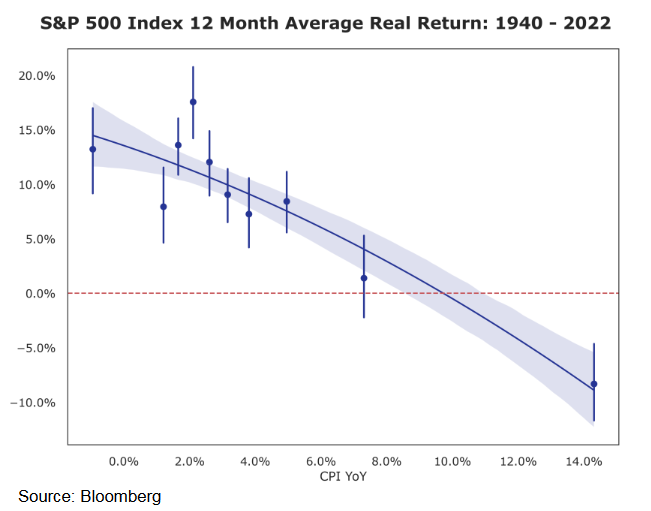
This is from a presentation, “Investing Through A Structurally Inflationary Regime,” by Steve Hou of Bloomberg.  It is full of charts like this on equity sectors and factors, other assets, and trading strategies.  It also serves as a reminder that we lack sufficient data to make emphatic statements about “what normally happens.”

Postings

You don’t need a paid subscription to read “Talent in the Investment World.”  It is a Sampler posting, open to all, that is a compilation of four July perspectives that have an investment take on Talent, a great book from Tyler Cowen and Daniel Gross.

“Creating and Sustaining Process Improvement” looks at the “physics” of change in the investment, operation, and distribution parts of an asset management firm.

All of the content published by The Investment Ecosystem is available in the archives.

Thanks for reading.  Many happy total returns.

Published: November 21, 2022

Subscribe

To comment, please send an email to editor@investmentecosystem.com. Comments are for the editor and are not viewable by readers.

Creating and Sustaining Process Improvement

In 2001, the California Management Review published an article by Nelson Repenning and John Sterman, “Nobody Ever Gets Credit for Fixing Problems that Never Happened.”  Its subtitle is used as the name of this posting.

It might seem paradoxical to leverage the ideas presented within it to think about the nature of process at an asset management firm, since the examples provided are related to manufacturing.  But the theories put forth by the authors can also illuminate the processes involved in knowledge-based work.

(In addition, analysts and portfolio managers who are trying to understand the companies they follow will find some simple concepts to apply in their research work, especially the trade-off between temporary upticks in results and more lasting benefits that come with true improvements in process.)

Let’s start with a summary of the ideas themselves before some thoughts about how they relate to asset management firms.

Improvement loops

Referencing the many management theories that come and go — and which don’t seem to live up to their promise in practice — the authors identify the nub of the problem:

Most importantly, our research suggests that the inability of most organizations to reap the full benefit of these innovations has little to do with the specific improvement tool they select.  Instead, the problem has its roots in how the introduction of a new improvement program interacts with the physical, economic, social, and psychological structures in which implementation takes place.

The article has a series of graphics that build on one another to demonstrate what they call “the physics of improvement.”  At the root of it is a choice:

The performance of any process can be increased by dedicating additional effort to either work or improvement.  However, the two activities do not produce equivalent results.  Time spent on improving the capability of a process typically yields the more enduring change.

While it often yields the more permanent gain, time spent on improvement does not immediately improve performance.

The “work harder” loop and the “work smarter” loop operate at different speeds and “the greater the complexity of the process, the longer it takes to improve;” plus, “investments in capability can be risky.”  Another loop — the reinvestment loop — tends to reinforce the chosen path, resulting in a virtuous circle when capability is being added to good effect and a vicious circle if “work harder” is always the default direction.  When that happens, shortcuts are taken; they “are tempting because there is often a substantial delay between cutting corners and the consequent decline in capability.”

When things deteriorate, those in charge are prone to an attribution error, blaming the people rather than the system and making decisions that are counterproductive:

What starts as an erroneous attribution about the skills, effort, and character of the workers becomes true.  Managers’ worst fears are realized as a consequence of their own actions.

Inattention to the underlying problems and the lack of a culture of continuous improvement cause shortfalls in process over time.  Here’s the authors’ stylized summary of the problem:

Operations and distribution

As mentioned, the article focuses on physical production and the throughput of a system, which isn’t immediately obvious as an analogue to an investment process.  But it fits well with operations and distribution, the two other main components of an asset management firm.

In each, if understaffing is an issue (and/or if inadequate technology is), the dynamics are very much as described in the article.  When things aren’t getting done on time or in the right way, the tendency is to blame the people and not the system.  (Work harder!)  That inclination is exacerbated in the many organizations where there is a wide cultural divide between the investment staffers and everyone else.

Investment process

While the notion of throughput is less obvious on the investment front, it does come into play.  For example, if an analyst is supposed to cover a hundred stocks — and to meet the firm’s requirements for models, earnings estimates, and ratings on them — that’s already a very challenging assignment if there is to be any real original research done.  When that number goes higher because other analysts leave or new issues need to be covered, a difficult load becomes even more challenging.  (Work harder!)

But the larger point when it comes to investment process is that it is often too static.  Much of that is because there’s a belief that “consistent and repeatable” is marketing gold — but also because innovation in methods is not a high priority among investment professionals.  (A recent tweet asked, “If you’re working at investment fund, do you have an R&D function?”  There absolutely should be one and not just for investment research and decision making, but for operations and marketing too.  Yet such efforts at innovation are relatively rare.)

That J curve in the upper right of the image above can be daunting — unless it’s just what you do on a regular basis.  If change is a way of life for the firm — and why wouldn’t it be, given that the markets are complex adaptive systems? — then the J curve is barely noticed given the rolling increases in capability that are flowing through.  But if stasis is the model, then the near-term hit on the way to working smarter seems bigger than it probably is.

All of this is complicated, of course, by the noisy nature of markets and the difficulty linking outcomes to process.  It’s not like monitoring the production of widgets; the feedback is not immediate and it is always murky, making it easy to avoid making needed changes.

Given the marked declines in most asset classes this year, revenues are down and firms are tightening their belts.  Often that happens first in the areas of operations and distribution, triggering those throughput issues identified in the article.  Eventually, there may be cutbacks on the investment side too.

The other thing that happens at times like these:  It’s easy to set aside those R&D ideas as some fanciful stuff that was thought about when times were good, when they are actually the seeds of competitive advantage for the firm going forward.

Continuous improvement means that you keep at it when others stop.

Published: November 13, 2022

Subscribe

To comment, please send an email to editor@investmentecosystem.com. Comments are for the editor and are not viewable by readers.

The Factor Zoo, an Industry in Flux, and Turning Water into Wine

Please share your comments regarding these postings by replying if you are reading them via email, or by sending a note if you’re on the website.  Your story ideas are always welcome too.

On to the readings.

The circular economy

While “ESG” (as variously defined) has become a high-profile battlefield, one idea that fits within it is starting to show up more frequently at the edges of investment discussions:  the “circular economy.”

Many resources about the concept are available from the Ellen MacArthur Foundation, which defines it in this way:

A circular economy is based on the principles of designing out waste and pollution, keeping products and materials in use, and regenerating natural systems.

An ISS guide says, “This matters for investors — analysis suggests that the more circular a company is, the lower its risk of defaulting on debt, and the higher the risk-adjusted returns of its stock.”  The emphasis on design is clear from the four-page section on automobile manufacturing found within it.

Investment organizations are starting to get on board; witness a Goldman Sachs Q&A on why companies should pay attention, a StepStone’s piece (“We Don’t Value Nature”), and circular economy products that have been created by BlackRock and VanEck.  And given that new design solutions are likely to come from venture capital investments, here’s a paper on that front:  “Startups and Circular Economy Strategies: Profile Differences, Barriers and Enablers,” from Wim Van Opstal and Lize Borms.

As has been displayed in the general ESG debate, the long-term financial implications of the ideas are going to be critical in determining who adopts them.  To that end, a 2021 ISS report, “The Circular Economy & EVA,” seeks to connect the concept with fundamental financial analysis.

Asset management industry

Three pieces on the asset management industry from management consulting firms:

“The New Competitive Calculus: Winning with data-driven strategy,” Broadridge:

Most recent reviews of the global asset management industry focus on the mounting challenges to its industrial model:  fee pressure, slowing growth, increased regulation, complicated client needs.

All these trends underscore the fact that too many asset managers compete in a similar fashion within a wholesale distribution model that increasingly positions their brands further away from end users.

As the title indicates, Broadridge’s “new map for organic growth” involves a greater emphasis on data to diagnose areas of competitive advantage, create a decision support system, and develop the organization for the new environment.

“The Great Reset: North American asset management in 2022,” McKinsey.  This paper illustrates the abrupt change in market trends, which present a challenge to an industry that has significantly increased costs in the last decade.

“Integrating Asset Managers: The Executive Playbook.” Casey Quirk (Deloitte).  Then:  “Historically, investment management deals favored a lighter touch on integration.”  Now:  “In today’s market, however, acquirers are more likely to apply close scrutiny to cost levels and potential duplicative activities, as they seek to deliver synergies and economies of scale.”  The firm offers a “playbook” for better combinations, but the track record for asset manager mergers isn’t good (especially for clients).

Interest rates and factors

The last edition of the Fortnightly referenced the potential ripple effects from the generational change in the economic environment, especially given “the length of the previous trends and the special power of interest rates to affect the pricing of assets and the availability of funding.”

Jules van Binsbergen, et. al, explore one aspect of that in their paper, “The Factor Multiverse: The Role of Interest Rates in Factor Discovery.”  From the abstract:

We investigate 153 discovered anomalies as well as 1,395 potential undiscovered anomalies and find that absent the decline in interest rates, the asset pricing literature would likely entertain a different set of anomalies today.

Our analysis highlights the sensitivity of the factor discovery process to this specific observed economic time period.

The so-called “factor zoo” may be populated with lots of critters that thrived in one specific epoch.

Water into wine

At a time when there is much attention being paid to the gap between the “marks” on private capital investments and the severe corrections in the prices for similar exposures in the public markets, Chief Investment Officer quoted the book, Two and Twenty: How the Masters of Private Equity Always Win, as proclaiming that PE firms perform “the financial equivalent of turning water into wine.”

Other reads

“Investing in Influence,” Kai Wu, Sparkline Capital.  Just in time for the U.S. midterm elections, a look at the outsized returns from an overlooked intangible asset, political capital:

This implies political spending has a considerably greater payout than that of other intangible investments, such as R&D or advertising.

“Credit Suisse Gives First Boston a Second Chance,” Matt Levine, Bloomberg.  In a section titled “Second Boston,” Levine gives a succinct summary of the parts of an investment bank and how they fit together.

Building Balanced Portfolios for the Long Run: A New Framework for Incorporating Macro Resilience into Asset Allocation,” Peter Shepard, et. al, GIC and MSCI.

Long-term investors face two major shifts in the investment environment. . . . Both could require a fundamental evolution of the asset-allocation process.

“Inside the library of financial mistakes,” Ray Perman, Financial Times.  Why is institutional memory so short in the financial markets?

“The Part of Your Investment Process Most in Need of Improvement,” Jason Voss, Deception and Truth Analysis.

There is one part of the typical investment process that is most in need of improvement.  Namely, how you conduct conversations with management, sell-side analysts, people in expert networks, and so on.

“Investment Consultants Reevaluate Priorities as Several Long-Tenured, Top Names Change Firms,” Debbie Carlson, Chief Investment Officer.  Changes in the business (especially the move to OCIO mandates) have upended this once-stable part of the asset owner ecosystem.

“Addressing Employee Equity Alternatives in a Bear Market,” Aon.  This is a concern for investment analysts, since the choices that companies make will affect their talent pools and financial structures — and also for anyone working for a publicly-traded investment organization who is eligible for equity incentives.

“The Social Signal,” J. Anthony Cookson, et. al, SSRN.

We attribute differences across [social investing] platforms to differences in users (e.g., professionals vs. novices) and differences in platform design (e.g., character limits in posts).

These results highlight the importance of distinguishing between social media sentiment and attention, and suggest caution when studying the social signal through the lens of a single platform.

“The perks of manager turnover,” Alex Steger, Citywire RIA.  Rajiv Jain of GQG thinks that the knee-jerk reactions to changes in a manager’s investment team are wrong, that a static group will fail over time and new blood is needed to prevent that from occurring.

“META Lesson 1: Corporate Governance,” Aswath Damodaran, Musings on Markets.

I know that my Facebook investment will ride and fall with Mark Zuckerberg’s ego, and while I have no delusions about being able to influence him, I think that at today’s prices, the odds are in my favor.  Time will tell!

“Which Popular Funds Will Hit Investors With Losses and Capital Gains Distributions This Year?” Stephen Welch, Morningstar.  A look at the numbers from that dreaded combination of the payout of previous capital gains being recognized in the midst of a market well off its highs.

“Multi-strategy hedge funds are the new, superior fund-of-funds,” Robin Wigglesworth, Financial Times.

Thoroughly analysing portfolio managers, judging how much capital their strategies can optimally manage, constantly monitoring them, and firing underperformers; management is an arduous, difficult task — even before you start thinking of how to combine them into an overall portfolio.

I suspect a lot of institutional investors are realistically not up to it, but they intuitively liked the fund-of-funds model, and now love the multistrat model.

“Revere is creating a ratings system for the venture capital industry,” Natasha Mascarenhas, TechCrunch.  “The venture capital industry is built on signals.”

The captain and the seas

“It could be stated that the average portfolio manager has more responsibility for a task than the explicit unadulterated power to accomplish it.  This statement, embracing the reflexive environment in which portfolio management occurs, accurately depicts portfolio management as an amalgam of manager decisions and market activity, much as a ship’s voyage is determined by the captain’s skill and the prevailing seas.” — Timothy Ryan, “Separating the Impact of Portfolio Management Decisions,” Journal of Performance Management (2001).

Which way is up?The art world has been abuzz because of a claim that a Mondrian piece has been hung upside down for decades.  (Here it is both ways; which makes sense to you?)  No one knows for sure which way is up and, as the person who brought the possibility to light remarked, “Who can say what Mondrian really wanted?”

That echoed a discovery in the eighties at the University of Minnesota that “Oriental Poppies” by Georgia O’Keeffe had been shown there vertically instead of horizontally for thirty years.  The museum director said, “What the heck, it looks terrific either way.”

No doubt many investment people are trying to figure out which way is up right now.  And it’s always good practice to reconsider whether something in an investment process has been oriented incorrectly for a time and no one has noticed.

Also, there are things in the market experience that seem out of order to the viewer — like “The Surprising Alpha From Malkiel’s Monkey and Upside-Down Strategies,” in which the inverse of an outperforming strategy also outperforms.  Or like “Does Past Performance Matter in Investment Manager Selection?” which shows that you’re better off investing in mutual fund losers (except the perennially bad ones) rather than previous winners.

Postings

“Lessons From a Pension Plan Soap Opera” tells the seemingly-never-ending story of the Kentucky pension system, highlighting both the out-of-norm happenings as well as some common practices to reconsider.

“Benchmarking” is a “Four for Friday” posting that looks at principles regarding benchmarks and some examples of how they can be used (and misused) by asset owners and investment providers.

All of the content published by The Investment Ecosystem is available in the archives.

Thanks for reading.  Many happy total returns.

Published: November 7, 2022

Subscribe

To comment, please send an email to editor@investmentecosystem.com. Comments are for the editor and are not viewable by readers.

Four for Friday ~ Benchmarking

At each step along the investment chain, providers are judged by performance.  Absolute measures of performance can come into play (since very strong or very weak returns are emotional triggers), but, for the most part, relative comparisons dictate who gets hired and who gets fired.

Benchmarks serve as the measuring sticks by which those judgments are made.  All too often, they are used haphazardly, with comparisons being made for periods that are far too short.  The infrastructure of the industry is built to spit out numbers and whether they arrive daily or monthly or quarterly or annually, performance against a benchmark captures a larger mindshare than any other consideration.

Principles

Almost twenty years ago, Laurence Siegel authored a monograph for (what is now called) the CFA Institute Research Foundation, Benchmarks and Investment Management.  While some references in it may be out of date, the principles aren’t.

The section on “Critiques of Benchmarking and a Way Forward” includes some thoughtful commentary and a framework for performance measurement from Peter Bernstein, providing an interesting comparison to Siegel’s own views.  One of Siegel’s conclusions is a good point from which to start a benchmark debate:

You can’t design a simple, rule-based, judgment-free portfolio that is demonstrably more efficient than the cap-weighted benchmark.

The most commonly-cited criteria for benchmarks comes from another Research Foundation bookControlling Misfit Risk in Multiple-Manager Investment Programs, by Jeffery Bailey and David Tierney.  Along the way, their “properties of a valid benchmark” were reordered for use in the CFA curriculum via the acronym SAMURAI.  Here’s Ben Carlson’s summary of them:

Specified in advance (preferably at the start of the investment period)
Appropriate (for the asset class or style of investing)
Measurable (easy to calculate on an ongoing basis)
Unambiguous (clearly defined)
Reflective of the current investment opinions (investor knows what’s in the index)
Accountable (investor accepts the benchmark framework)
Investable (possible to invest in it directly)

That serves as a good list to go back to when considering what benchmark is used in a particular situation, whether it meets those criteria, and the implications of choices that deviate from them.

Customized benchmarks

The results of large institutional asset owners are covered in the financial press, usually by comparison to customized portfolio and asset class benchmarks (see, for example, “CalSTRS outperforms in every asset class”).  In his essay, “Lies, Damn Lies and Performance Benchmarks: An Injunction for Trustees,” Richard Ennis questions that practice:

As a result of benchmark bias, the majority of funds give the impression they are performing favorably compared to passive management when, in fact, they are underperforming by a wide margin.

Ennis bemoans the move away from clear and simple benchmarks to ones that are complex, potentially misleading, and full of questionable methods.  The bottom line for him:

[Trustees] must take control of performance reporting and see that it is done right.  This means adopting a passive benchmark of the type described here and living with it — no tampering or tweaking!

Moving the goalposts

Surveying another part of the ecosystem, Kevin Mullally and Andrea Rossi published a paper, “Moving the Goalposts? Mutual Fund Benchmark Changes and Performance Manipulation.”  From the conclusion:

In this paper, we document that mutual funds take advantage of a loophole in the SEC’s disclosure requirements to provide misleading information about their past performance.  Specifically, we find that mutual funds systematically and strategically change their self-designated benchmark indexes to embellish their benchmark-adjusted performance.  Simply put, funds add indexes with low past returns and drop indexes with high past returns.  Investors respond to these changes by allocating more capital to these funds and subsequently experience persistently low returns.

Furthermore, “High-fee funds, broker-sold funds, and funds experiencing poor performance and outflows are more likely to engage in this behavior.”

Provider examples

Consultants and asset managers sometimes produce pieces where they lay out how they think certain strategies should be benchmarked.  Here are some examples:

“Benchmarking Alternative Risk Premia,” bfinance.  This covers quite a bit of ground, and includes an exhibit showing the pros and cons of the different benchmarking approaches.  It was written in September 2020 and the first of its “key takeaways” demonstrates how market events can prompt a reassessment:

As is the case with all absolute return strategies, Alternative Risk Premia strategies present a benchmarking challenge.  There is now a pressing need for investors to understand recent performance and either re-underwrite or rethink existing allocations to the space.

“Determining an appropriate benchmark for low volatility equity strategies,” RBC.  The SAMURAI elements are used to compare four ways of benchmarking the strategies:  versus a minimum volatility index; a blended cash and broad cap-weighted index; or a broad cap-weighted index, using a) returns or b) risk-adjusted returns.

“No Stone Unturned,” GMO.  The firm’s emerging markets debt team argues for a “cash-plus” approach to evaluating its results, citing that there are “two major flaws in being overly wedded to an off-the-shelf benchmark”:

There are embedded characteristics, or betas, that may not necessarily be desirable.

If a manager’s opportunity set is constrained by their benchmark, potential alpha opportunities may be de-emphasized, or even ignored completely.

Published: November 4, 2022

Subscribe

To comment, please send an email to editor@investmentecosystem.com. Comments are for the editor and are not viewable by readers.

Lessons From a Pension Plan Soap Opera

In the United States, public pension plans face challenges that other asset owners don’t, from funding and governance issues stemming from political considerations to requirements for transparency.  They are common problems but they vary considerably by jurisdiction.

(The transparency is great for those interested in learning about the investment business and/or pension plans — or in keeping up on trends in asset classes, strategies, and managers.  A wealth of information is available for anyone willing to look at the websites of the plans.)

Another facet of public plans versus most other asset owners is the attention that can be paid to the plans in the media, both locally and — due to their size and importance — nationally.

It can be a combustible mix when things go wrong.

The soap opera

Perhaps no plan typifies that more than the Kentucky Retirement System.  (“KRS” is used here to match the matters being referenced below, even though there is a new name and an altered structure.)

KRS has long been cited as the poster child for chronic underfunding of pension plans by state governments.  Unfunded mandates and a lack of contributions have led to extreme shortfalls in funding status that have persisted over time.  Those circumstances limited the investment choices available to keep the plan solvent and pay the beneficiaries over time.  One trustee commented in a 2010 meeting:

This is a fool’s errand, because no matter . . . what choice you make you can’t invest [your] way out of it.

Illiquid investments couldn’t be considered to any great extent, since they would hamper the ability to pay benefits in certain kinds of environments, and increasing equity exposure might improve the chances of narrowing the funding gap, but it would also elevate the probability of a disaster scenario.  Significant increases in contributions were needed and, well, there’s lots of politics involved whenever that’s the case.  Year after year, this part of the story line remained the same.

In regard to investment performance, the evidence was mixed.  A 2008 report from a consultant called it “unacceptable,” saying it lagged both actuarial assumptions (although they are not a good measure of performance in isolation) and peer retirement systems.  In addition, it said that “the governance structure responsible for investment oversight is inadequate; the investment portfolio has insufficient diversification of asset classes; and the investment manager structure has concentrated positions, increasing risk.”

Add to all of that frequent turnover among the cast of characters at KRS — trustees, CIOs, and staff members — plus investigations and litigations and media attention.  A foundational principle of the Academy course on due diligence is that “all organizations are messy” (and your job is to figure out how and whether it matters or not).  Some of them are really messy.

Looking for lessons

Why spend any time on KRS, since it’s an outlier in a number of ways?  Why do a posting on it?  There are lessons in its story that are broadly applicable.  A review of the decisions that were made and the process for making them provides examples of common practices that should be questioned, as well as tendencies that should be avoided if you want to lower organizational risk.

Investigation

In 2020, KRS commissioned the law firm Calcaterra Pollack to conduct an investigation into the events outlined below.  The report and attached exhibits run 2,256 pages.

Making appearances within the report are trustees and investment staff members of KRS, as well as firms and individuals providing asset management, investment consulting, fiduciary and liability guidance, and actuarial projections.  (The names are left out here for the sake of simplicity, but are there in the report for all to see.)

The report

The substantive conclusions of the report won’t be judged here, since there are more things you’d want to know before pronouncing it to be an accurate assessment.

What can be said is that it is poorly constructed, and therefore fails to effectively array information in a way that would be of greatest benefit to KRS.  Granted, those at KRS would have a better chance of following the story than an outsider can, but that shouldn’t be the standard on which it is measured.  Even a complex story can be told effectively, and the report fails on that score.

Events are addressed out of logical order, people and concepts appear without context, hundreds of pages of exhibits appear that don’t really add anything, and the exhibits in general aren’t organized and marked in a way that is conducive to comprehension.

A separate report — “the Legal Recommendations” for KRS from the investigation — has not been made public.  While that may be defensible because of attorney-client privileges, this is not:  “As required, the Legal Recommendations also provide recommendations regarding best practices for investment activities.”  While the legal considerations around past events are obviously consequential, on a going-forward basis nothing is as important for the public to know as whether “best practices” are in place to avoid future problems and to generate acceptable returns.

Legal analyses of investment matters (like those found in litigation, for example) often lack the kind of industry and market perspective that is necessary to make recommendations about best practices.  Add to that the poor quality of the report overall and it’s not hard to wonder about what has been put forth to KRS for consideration regarding necessary improvements in the investment function.

Not keeping up

The consultant assessment mentioned earlier stated that there were “two possible explanations” for the underperformance at KRS:

1) similar funds performed as poorly and no reasonable changes could have altered the situation; and/or 2) the investment world had changed its approach and [KRS] had not kept up.

It said that the latter was the reason and that “alternative asset classes should play a significant role in a diversified portfolio,” noting that the exposure to them at KRS was lower than that of its peers.  That started a drive to increase exposure to alternatives, specifically absolute return strategies, that would lead to the investigation.

Major events

A soap opera can be hard to keep track of unless you watch it regularly.  One of the challenges faced by Calcaterra Pollack in preparing the report was identifying the critical plot lines and weaving them together in a comprehensible way.  Here are the big pieces:

Multi-strategy fund.  When KRS staff examined whether to start increasing alternatives exposure, it looked at hedge funds of funds (HFoFs) and multi-strategy funds (MSFs), deciding on the latter for its first investment in its absolute returns bucket.  Two consulting firms weighed in on manager selection; the one that “played second chair” in the process (to use its own description) listed these as challenges for one MSF:  (1) newly established firm; (2) limited track record information; and (3) partial investment team structure.  But that is the firm that KRS selected, in part because the MSF was claimed to be “designed as a next generation absolute return investment which addresses the portfolio needs of pension plans.”  It also was swayed by the past performance of the MSF’s leader at another firm.

After implementation in 2010, it became apparent that a placement agent was involved in getting the business for the MSF, at a time when that had become a big issue among public fund asset owners.  So:

KRS found itself facing a barrage of negative press, internal and external audits related to placement agents and associated fees, as well as an eventual Securities and Exchange Commission investigation that resulted in no action by the enforcement agency.

The MSF was unwound.  In retrospect, the investigative report said that the whole episode was “marked by impropriety.”

The selection of FoHFs.  After that, KRS concentrated on finding a collection of FoHFs to build the absolute return portfolio.  Many documents from the process are available to review, bringing up a variety of questions about how the managers were selected.

In August 2011, the staff recommendations were presented to the investment committee, without the groundwork being properly laid by the staff.  The committee asked for further information and clarification, which was provided at another meeting two weeks later.

The report had this conclusion about the whole process:

The manner in which the Investment Staff proceeded in the FoHF process without advising the Investment Committee was improper.  The Investment Staff reports to the Investment Committee, not the other way around.

But added:

It was the Trustees’ duty to provide oversight of the FoHF selection, not simply accept whatever recommendation was made.

The trustee’s acquiescence planted seeds that, years later, became ripe for manipulation from the future CIO.

As you can tell, the plot was about to thicken, but first there was a public relations bombshell.

Onslaught of attention.  A former trustee of KRS wrote a book called Kentucky Fried Pensions: A Culture of Cover-up and Corruption, which dealt with the specifics there as representative of broader issues at public plans.  The resulting media attention and investigations related to the assertions put a further strain on KRS, as one staff member wrote in an internal note:

These gratuitous, ad-hominem attacks may make for good copy, but they create a hostile, unhappy work environment for those professionals tasked with managing the assets responsibly in the face of a constant stream of insults.

In addition, he cited extensive staff time and internal expense, as well as the cost of external experts and lawyers.

Part of the plan for using HFoFs was to “learn from them,” and to add direct hedge fund investments to supplement and perhaps eventually supplant the HFoF investments in whole or in part.  Those direct hedge fund investments had begun by this time, and the writer of the memo said that, because of the publicity, some hedge fund managers would not consider KRS as a limited partner because of the potential hassles.

The strategic partnership.  In May of 2015, the CIO recommended that KRS enter into a “strategic partnership” with one of the FoHFs, billed as lowering costs and taking advantage of an expanded range of services from the manager, including having a portfolio manager on site at KRS part of the time.

The CIO said that the three providers would be in competition for the business.  However, he set up a partnership with just one of them, noting that it was “just a trial.”  When a trustee asked, “What is the downside?” he said, “There is no downside. [It is] in the informal stage.”  But within nine months, it was all a done deal and the other FoHFs, which were “funds of one” rather than commingled with other asset owners, were being dismantled.

All of that might be viewed as a normal — if somewhat quick — progression of events, except for the presence of lots of pre-existing ties between that strategic partner and decision makers at KRS.  The CIO, two past trustees, and one very-soon-to-be trustee had been employed by the strategic partner or an affiliate or predecessor firm.  That brought into question not only the selection of it as a strategic partner, but its inclusion as one of the three FoHFs to begin with.  Emails reproduced in the report include some of the interactions of the parties with members of that firm.  The favoritism shows through.

Mayberry.  Litigation into the above matters was initially filed in 2017, in a case known as “Mayberry,” after the lead plaintiff.  From the report:

The primary allegations set forth in Mayberry are that KRS invested in funds of funds that were allegedly the product of a large conspiracy by [three FoHFs] to target underfunded and vulnerable public pension systems.  The FoHFs were described as, among other things, exotic, risky and illiquid.  Mayberry also alleged that the FoHF documents provided to KRS were misleading and false to cover up the fees being charged to KRS and that they “understood the vulnerability of Kentucky Retirement and its Officers and trustees and targeted them by offering exotic and risky investment vehicles that were marketed as ‘absolute return strategies’.”

The defendants include KRS, trustees and staff members, the FoHF providers, and investment, actuarial, and fiduciary advisors.  The litigation, a winding tale of its own, is ongoing.

Backtrack.  KRS scaled back its efforts in late 2016.  The slide deck from the presentation to the trustees says that hedge funds “as a stand-alone self-diversifying allocation makes little sense for KRS,” citing high fees and “unattractive NET returns.”  (Emphasis from the slide.)  A tabulation of funds to cut included columns for the applicable reasons for each:  excess beta, opportunity relative to fee, and AUM concern.

Communication lessons

As noted before, the Calcaterra Pollack report is a study in how not to prepare a large, complex assessment.  One wonders how the staff and trustees of KRS, for whom it was intended, have wrestled with it.

In the exhibits of the report are copies of memos and presentation materials created by KRS staff members, advisors, and investment providers.  They serve as examples of what works and what doesn’t in communicating investment information.  (Surfing the broader spectrum of public plan websites serves the same purpose.)

Aesthetics are important, since an attractive piece conveys professionalism to the reader.  Beyond that, comprehension — for the reader of a report or the observer of a presentation — is crucial.  Too often slides are crammed full of text or have charts that are too small or are hard to understand.

What’s missing to the reader years later is a sense of how a speaker used those slides, but dense text is never productive (put it in a document to be read in advance!) and charts that are hard to figure out are — whether original or cut and pasted from somewhere else — particularly annoying and unproductive.

Every organization should assess how well its communication materials measure up.  Much good work is lost in translation unnecessarily.

Due diligence lessons

A few observations about due diligence and manager selection processes:

Misplaced expectations.  The 2008 consultant report that argued for greater allocation to alternatives stated, “While aggregate returns from hedge funds are likely to be below most investors’ expectation, we are confident in the small group of managers that we work with.”  Such confidence is common, and commonly misplaced.  It would be interesting to know how the consultant’s specific recommendations would have played out.  Also, its expected return forecast for hedge funds was 8%; another consultant later said 7.5%.  Those were aggressive expectations for a mix of strategies that was expected to have a relatively low volatility of returns.

Consultant data dumps.  In the exhibits, there were four versions (produced at different times) of a consultant’s “search book” of possible managers for KRS to use.  They were essentially identical in construction.  Here’s what one of them, covering seven managers, looked like:  8 pages of data points comparing the managers; 13 pages of comparative performance; and for each manager, a page of manager-provided narrative, single-page biographies for all of the named team members, and five years of allocation and AUM data.  114 pages total and not much there, really.  Many search processes start that way, with screens and data dumps, from which users cherry-pick data points here and there but mostly look at performance.  You can’t capture the essence of a manager that way.

Differentiating factors.  In the document recommending the three FoHF providers, the “topics Staff wished to assess most in depth included firm structure, portfolio construction, operational due diligence, risk management, client service, and strategic partnering capacities.”  Do you notice anything missing?  How about investment due diligence methods, which one would expect to be of critical importance?  (In the recommendation, two clear differentiating factors were offered:  All of the FoHFs selected used a strategy specialist model and they all had PhDs heading their risk management functions, while none of the other candidates did.  How important should those very specific attributes be in comparison to other considerations?)

Meeting counts.  It’s typical for allocators to tout the number of meetings that they conduct in a given year, but that says nothing about the nature of those meetings — how they were conducted and with whom — and the quality of them.  Many meetings are too short or too narrow to really get to the bottom of things, and they can be made up mostly of the presentation of manager narratives as opposed to true opportunities for discovery.  On their own, the meeting counts can easily impress, for no good reason.

Passing along the narrative.  It’s always instructive to determine whether conclusions about a manager — and specific language used to describe its attributes — are the words of the person doing due diligence or just the manager’s narrative being passed along.  For example, where do you think these bottom-line characterizations came from?

Staff was most impressed by [manager one’s] formulaic implementation of top down views into its strategy selection parameters, [manager two’s] detailed implementation of its risk management process through position level transparency into its top-down and bottom-up decision making processes, and [manager three’s] experienced and specialist approach to making alpha-generating bottom-up manager selection decisions.

Focused on the numbers.  The Sharpe ratio holds sway, targeted volatilities are used as if they could be dialed in, and short-term results (“they are killing it”) are persuasive.  Decisions about the hiring and firing of managers are heavily dependent on past performance rather than forward-looking qualitative assessments.

Other lessons

None of us would want to have our body of work parsed by litigants or become fodder for media attention.  Public funds have a particular burden in that regard, but any organization or person could be subject to discovery (including of those telling emails) if something has gone wrong.

The KRS situation is a reminder that the governance and decision processes of organizations — from public entities to very private ones — need to be reviewed and improved on a regular basis.  The notion of good practice can veer off track over time, simply grow outdated, or never have been solid in the first place.

The investment ecosystem is fluid, with people jumping from place to place (sometimes ending up on a different side of the table than they were before), firms buying each other, new strategies coming out of nowhere, and the popularity of strategies and organizations ebbing and flowing — all while everyone is trying to keep up with their peers and competitors.  There is a web of connections among the people involved and influence games being played all of the time.  There’s a lot of money on the line.  The KRS story is one example of how it all came together.

While the names of FoHFs, standalone hedge funds, advisors, and individuals aren’t included in this review, they are all identified in the report and exhibits.  One question keeps coming up:  “Where are they now?”

Of the asset managers who are cited, which have done well and which have done poorly?  Which have not even survived?  Their assembled stories would tell a tale of a decade or so when there were significant changes in hedge funds, FoHFs, and how they are used.

The same question can be asked about the individuals on all sides of the KRS drama, some of whom are still subject to litigation, and of KRS itself.  Many changes have been made there in the last five years; will they be the foundation on which a new era — and a new reputation — are built?

The soap opera continues

It came to light that the Calcaterra Pollack report cost $1.2 million, but it wasn’t publicly available until recently.  According to one opinion writer affiliated with the Kentucky Open Government Coalition, KRS “vigorously resisted disclosure of the report, denying multiple open records requests over a span of 18 months.”  Two months ago, a judge ordered it to be released.

The next shoe to drop thereafter was a new lawsuit arguing that “there was an illegal bid-rigging conspiracy behind the hiring of the firm contracted to do the report.”  That was not unexpected after a May 2021 posting on the blog Naked Capitalism laid out concerns about Regina Calcaterra, her new (and tiny) firm that was awarded the contract, and the process for selection.

Where will the story go next?  It seems like there’s always something new to keep viewers engaged.

Published: October 30, 2022

Subscribe

To comment, please send an email to editor@investmentecosystem.com. Comments are for the editor and are not viewable by readers.

From Treat to Trick: A Tale of Two Octobers

If The Investment Ecosystem is new to you, check out the archives and the recent postings at the bottom of this piece — and please consider a free or paid subscription plan.

A year of change

Looking back a year, the investment landscape was in a completely different state.  While gamier areas of the market like SPACs and meme stocks had already been under pressure — and some indexes would continue to rally to new highs at the end of 2021 — last October was a pivot point for many of the growth stalwarts.  One by one they started to roll over during the following three months.

Very much alive a year ago, TINA (“there is no alternative” to equities) is now being pronounced dead.  (See Morningstar and RIA Advice, for example.)

The U.S. two-year note then yielded 0.4%; it’s now 4.5%, and rates everywhere have risen beyond anyone’s expectations — as has inflation, the driving force behind the moves.

A long list of it-can’t-happen-here beliefs have, indeed, happened here.  Most notable are the results for 60/40 and 70/30 asset allocations commonly used by financial advisors on behalf of their clients (and by institutional asset owners as a simple check against their more complex asset mixes), with the component parts ending up in a most unpleasant (and uncommon) cominbation.

Last October also marked the pivot for ESG.  Up until then it was a juggernaut, but the debate has changed and the previously-strong adoption indicators have been flattening out.  (Interestingly, there was a budding interest in many ESG-like topics in advance of the financial crisis, before that diminished as other concerns took precedence.  That could be a factor now too.)

Private strategies — the most red-hot of the red hots — have not been marked down anywhere close to similar public exposures, even though the anecdotal evidence would indicate that the cuts are coming.  The fondness for the structural attractiveness of lagged pricing may turn into something else.  Already, the denominator effect is causing problems (that impact on some asset owners was outlined in an August piece from Nasdaq).

The ripple effects of all of this are spreading throughout the system, as should be expected given the length of the previous trends and the special power of interest rates to affect the pricing of assets and the availability of funding.  Youngsters are even seeking advice from their elders; Rich Handler and Brian Friedman of Jefferies have responded with “A ‘Boomer’s Guide’ to Dealing with an Increasing Interest Rate Environment.”

The new dynamics

In a report, “The New Dynamics of Private Markets,” PGIM asserts that “neither the pandemic nor the subsequent inflationary shocks appear to have significantly dampened [the] momentum” that has been intensifying for the last few decades in that realm.  Regarding private credit, banks and finance companies have abandoned many forms of lending, opening up opportunities, and investors are still clamoring for yield.  Bolstering private equity, “a growing number of business models may be better suited for private markets,” and companies are choosing to stay private longer than they have before.

In addition to examining each of those areas, the implications for asset owner portfolios are covered.  Included are the need for “more flexible investment approaches given blurring across publics and privates” and “a more sophisticated understanding of liquidity risk,” plus the effects of growing ESG-related offerings.

Many of the forces that are mentioned have been in place for a while.  As such, in the light of future Octobers, the report may be seen either as a wise recommendation to stay the course or a too-optimistic marker on the path to more difficult times.

Trust

Chestnut Advisory Group has published “Trust for the Win,” in which it argues, “Trust is the leading factor behind an investor’s decision to hire an asset manager.”  The piece begins with the top five factors that drive selection.  Not included is performance, which should be number one, since hiring is almost always conditioned upon a manager meeting a past performance hurdle.

That aside, Chestnut presents a matrix using the variables of warmth and competence to consider the nature of trust; it believes that “no amount of competence can compensate for a lack of warmth.”  Competence (primarily as judged in performance) without warmth can become suspect:

At worst, investors fear that extremely competent managers may use their skills to benefit themselves at the expense of clients.  The classic example of this fear is the worry that a successful manager will not close a winning product when it reaches capacity, but will instead become a dreaded “asset gatherer,” maximizing AUM — and the manager’s income — while diluting the investment returns of their entire client base.

Some dos and don’ts are included for asset managers wanting to up their trust game.

The survival game

Speaking of asset management, Joe Wiggins thinks that the cultural environment for fund managers leads to poor incentives and mediocre performance:

There is a major incentive problem at the heart of the asset management industry, where the interests of clients and the professional investors who run money for them are often poorly aligned.

The development of this type of incentive structure means that the active fund management industry has evolved to a point where making high conviction, long-term decisions is irrational behaviour for many participants.  Even though it should be one of its primary purposes.

Other reads

“Hedge funds: The industry strikes back,”  WTW.  A look at a few positives and, despite the title, some negatives too, including:

While we welcome regulations in Europe and Australia focusing more on costs and expenses, we still witness resistance from the asset management community.  More worryingly, we have started to see some upward pressure from hedge funds on fees, and there is growing diffusion of a fee structure in the industry that we are very concerned about:  hedge funds that are set-up as expense pass-through platforms.

“Predicting Growth,” Greg Obenshain and Brian Chingono, Verdad.  Third in a series on predicting earnings growth; “The data shows that we need to be very humble when plugging a terminal growth assumption into a discounted cash flow model.”

Ashby Monk tweet:

ESG ratings purport to work like credit ratings, and condense all ESG factors down into one convenient value.  With credit ratings, the value of the rating is that it can usually be linked to probability of default.  But with ESG ratings, the analogous probability would be . . . what?

“Passive Investing, Mutual Fund Skill, and Market Efficiency,” Da Huang, SSRN.  “In this paper, I show the rise of passive investing is a reason for, rather than an anomalous outcome of, a more skilled mutual fund industry.”

“A marketing conundrum,” Mark Schoeff,  InvestmentNews.  The print cover of the magazine characterized the story in this way:  “Creativity and Compliance: New SEC regulations give advisers the freedom to advertise, as long as they follow 430 pages of rules.”

“Where Do the Golden State Warriors Go From Here?”  The Daily Coach.  Beyond the specifics regarding recent incidents, this includes the age-old investment organization question:

Is keeping talent more important than maintaining culture?

“Opportunities in Small Caps,” Thomas Garrett, Verus.  The small cap premium may be gone (or maybe it’s just been hiding), but that shouldn’t obscure the greater possibilities for active management within the category than those found elsewhere.

“Top 5 considerations for asset managers as we head into budgeting season,” Mike Carrodus, Substantive Research.

The SEC has ensured that regulatory complications in this market are back with a vengeance.  By announcing that they would not extend the no action relief that allows European asset managers to pay American brokers for research in cash, the SEC has created a massive headache for both the buy and the sell side.

“From Epsilon to Omega: Making Small Strides Toward Important Goals,” Matt Greenwood, Two Sigma.  A glimpse of some “inside language” of the firm — and the important concepts behind it.

“Leverage in Private Equity Real Estate,” Jacob Sagi and Zipei Zhu, SSRN.

With PERE, existing work provides mixed or little evidence that leverage is used to amplify skill and consistently hints that its use shifts the balance of benefits towards fund sponsors over their limited partners.

“Refresher Readings,” CFA Institute.  Available to members of CFA Institute, this includes a large number of 2023 updates to a wide variety of topics, as well as those from 2022.

A foundational principle

A posting by Paul Taylor, “Few People Get Promoted For Asking Difficult Questions,” addresses how organizations identify and attack problems.  The image below comes from a section titled “What Is An Expert Anyway?”

While the principle is illustrated in regards to hierarchies of staff, teams, and executives, it is broadly applicable in the investment world too, even where there are flatter org charts.  Despite the reality depicted, we often cling to “quite a narrow view of expertise,” relying on things like “position in the hierarchy, titles and years of service” as indicators of importance and insight.

For example, when doing due diligence, the most time and energy is usually spent with a small number of “key” people, but those highest up in an organization are skilled at promoting the narrative of how things are done.  To see how things are really done — and to try to uncover the messiness not addressed in that narrative — it pays to do the opposite.  You need to get below the water line to view the rest of the iceberg.

Speaking of due diligence

“Cynicism is attributing the worst motives to people. Skepticism is looking for the truth.” — Penn Jillette.

Postings

The four-part series on Bill Gross and Pimco, published for paid subscribers in May and June, is now available to all in a compilation posting.  It is a broad look at lessons for asset managers — and for those who evaluate them and invest with them.

Two new essays:

“Looking in the Rearview Mirror.”  We’ve seen the progression before:  Unexpected market moves leading to a blow-up and then a reexamination.  What’s really needed is a new approach to risk management.

“Revaluation Alpha and Selection Practices.”  Among the challenges for those evaluating investment strategies and managers is not being fooled by changes in relative valuation that may be transitory.

All of the content published by The Investment Ecosystem is available in the archives.  If you explore the categories of interest to you, you are sure to find some ideas that you can put to work now.

Thanks for reading.  Many happy total returns.

Published: October 24, 2022

Subscribe

To comment, please send an email to editor@investmentecosystem.com. Comments are for the editor and are not viewable by readers.