Revaluation Alpha and Selection Practices

Rob Arnott, Amie Ko, and Lillian Wu went back to the 1980s to grab the title of their recent article:  “Where’s the Beef?”  That’s fitting, in that they address an age-old problem that the investment industry never seems to solve.  It was even around when Clara Peller starred in those Wendy’s advertisements and the saying became a cultural phenomenon.

Where’s the alpha?

As noted in the abstract, Peller’s famous question sets up an analogy:

Many investors in today’s so-called smart beta strategies may well be asking a similar question, “Where’s the alpha?”

But let’s not restrict its application; the challenge goes far beyond smart beta to quantitative strategies in general, and to traditional investing as well:

The problem is data mining and performance chasing, the nemeses of all investors.  Yes, academics, “quants,” and investment professionals are all subject to those same temptations, very nearly to the same extent as retail investors.

That is something that the individual investors who hire professionals don’t realize — and professionals don’t admit.  While organizations have the data to document the chasing, few try to analyze it.

The problem of noise

Performance records are noisy — and that noise lasts longer than the three-to-five year evaluation periods of managers and strategies that are the industry standard.  Here are the authors on what that means for quantitative strategies:

Selection bias guarantees that random positive noise will be overwhelmingly the norm when performance is the basis for selection.  As a result, among many factors tested, some will appear to be statistically significant by random luck.  Moreover, the contrast between pre- and post-publication outcomes is stark, with the excess return following publication falling far short of in-sample published results.

To consider the issue more broadly, here is an altered version of the last two sentences from that excerpt, recast in a way to characterize the major hurdle in manager selection:

Among many asset managers evaluated, some will appear to be better than others by random luck (perhaps even in a way that appears to be statistically significant).  Moreover, the contrast between before- and after-selection outcomes is often stark, with the excess return following selection falling far short of the previous results.

Since very few countercyclical choices are made by allocators, because they primarily look for (historically) top-quartile managers, their most common error is extrapolating that performance and expecting it to continue.  Perhaps there is a way to gauge the risk inherent in doing so.

Revaluation alpha

The authors’ core point is that investors are fooled by what they call “revaluation alpha,” that part of relative performance that stems from changes in the relative valuation of whatever (security, manager, strategy, asset class) is being analyzed.  While they address this phenomenon in regards to factor portfolios, it applies more generally.  If performance is accompanied by a change in valuation, which it often is, “then lofty past performance may presage future underperformance.”

In contrast, the substantive part of outperformance is referred to as “structural alpha” — that which is not due to changes in valuation — and charts are included in the article that display the two concepts in regard to some of the most widely-used quantitative factors.  This fits with a previous article by Arnott and others, in which they

urged academia to demand that journal articles on new factors examine revaluation alpha so that academics are not feted for finding a “new factor” that merely “worked” by becoming more expensive.

A similar goal ought to guide everyone responsible for manager and strategy selection.  Granted, the level of difficulty varies considerably depending on the particular situation.  Assessing where mean relative valuations ought to be is an appropriate topic of debate, but assessing the direction of the changes in them is the first step.  If the components of a strategy have benefited in a significant way from revaluation, then caution is warranted unless a manager actively changes exposures in response to such moves.

Performance evaluation practices ought to highlight revaluation effects but they rarely do.  Thus, one of the few edges available to allocators requires both analytical work (gauging revaluations, which can be difficult) and behavioral commitment (being willing to avoid taking those risks at times, which can also be difficult).

Other considerations

The article also addresses implementation shortfall, “the difference between a paper portfolio’s performance and the realized performance of a live portfolio,” which is a significant issue with quantitative strategies.  “Portfolio concentration, universe coverage, turnover, and capacity” are often ignored by academic studies of potential approaches — and are downplayed by managers that bring them to market.

Another topic covered is the “expectations gap,” in this instance related to pension plans (one manifestation of a more universal problem).  The authors’ stark conclusion is that “the likelihood a pension fund can deliver 7% or more in the coming decade is under 1%.”

As important as those ideas are, if you are looking through a due diligence magnifying glass, revaluation is the concept that needs to be brought into view.

Published: October 17, 2022

Subscribe

To comment, please send an email to editor@investmentecosystem.com. Comments are for the editor and are not viewable by readers.

Looking in the Rearview Mirror

LDI entered the lexicon of many people during the last couple of weeks, following the tradition of other acronyms in years past.  It made the jump from being a topic mostly discussed by pension plans (and the investment providers who sell things to them) to being the focus of market attention.

Forced selling, margin calls, fears of insolvency, and (eventually) government intervention will do that.

The mechanics of it all have been explained elsewhere, especially in the Financial Times.  It has published a great many helpful articles about the developments, which have been centered in the United Kingdom.

The backdrop

Let’s take a broader perspective — and a step back.  Alan Greenspan said this in a 2003 speech:

The use of a growing array of derivatives and the related application of more-sophisticated methods for measuring and managing risk are key factors underpinning the enhanced resilience of our largest financial intermediaries.  Derivatives have permitted financial risks to be unbundled in ways that have facilitated both their measurement and their management.  Because risks can be unbundled, individual financial instruments now can be analyzed in terms of their common underlying risk factors, and risks can be managed on a portfolio basis.  Concentrations of risk are more readily identified, and when such concentrations exceed the risk appetites of intermediaries, derivatives can be employed to transfer the underlying risks to other entities.

As a result, not only have individual financial institutions become less vulnerable to shocks from underlying risk factors, but also the financial system as a whole has become more resilient.  Individual institutions’ portfolios have become better diversified.  Furthermore, risk is more widely dispersed, both within the banking system and among other types of intermediaries and institutional investors.

This was during a period when Greenspan was unironically called “The Maestro.”  Five years later everything came apart and, in Congressional testimony, he said that he had “found a flaw” in his previous beliefs.  (Really, the market had.)  Representative Henry Waxman asked whether he “found that your view of the world, your ideology was not right.”  Greenspan’s reply included this:

That’s precisely the reason I was shocked, because I’ve been going for forty years or more, with very considerable evidence that it was working exceptionally well.

And that’s the point of this posting — the nature of evidence and belief — as befits our focus on investment practice in organizations.

Risk management

Most “risk management” follows the script as laid out by Greenspan:  Use historical evidence to formulate beliefs about how the world works and act accordingly.  That makes perfect sense much of the time and is a huge problem the rest of the time.

When you think about it, in spite of the amount of data we now have at our fingertips, we often have remarkably little real evidence from which to work.  Lots of what passes as evidence doesn’t go back far enough to be statistically reliable (even though it might be anecdotally helpful).  Most of the data we count on comes from the last four decades, which has arguably been all one economic regime.  Plus, the structure of today’s markets are vastly different anyway.

In most investment organizations, risk management tends to be almost exclusively backward-looking and statistical.  To repeat:  That works overall but — oh, boy — when it doesn’t, it really doesn’t.

“Stress tests” are popular, but they often represent five or ten landmark events — what would happen if we relived a past spasm.  What’s missing?  A qualitative dreaming of what might go bad in a big way because of the particular excesses in valuation, vehicle structuring, or economic (or geopolitical) events of the moment.  And not much attention is given to the extremes of the projected distribution, even though markets are creatures with fat tails.

Because history seems to do that rhyming thing, we can learn some lessons.  Along that line, Seth Klarman’s observations about the financial crisis are worth reading in full; here are a few excerpts:

Things that have never happened before are bound to occur with some regularity.  You must always be prepared for the unexpected, including sudden, sharp downward swings in markets and the economy.  Whatever adverse scenario you can contemplate, reality can be far worse.

Nowhere does it say that investors should strive to make every last dollar of potential profit; consideration of risk must never take a backseat to return.

Do not trust financial market risk models.  Reality is always too complex to be accurately modeled.  Attention to risk must be a 24/7/365 obsession, with people — not computers — assessing and reassessing the risk environment in real time.

We keep living through “teachable moments” like that of 2008-9, but do we really learn?

The issue of leverage crops up in a number of Klarman’s twenty lessons, and it led to the sticky wicket of LDI.  A risk that is thought to be managed by means of leverage can become unmanageable.

A Bloomberg editorial, “UK Pension Funds Shouldn’t Be This Exciting,” called the latest episode “a novel variation on a well-known theme:  Leverage meets unforeseen events.”  (In an indirect rebuttal to Greenspan’s idea that dispersing derivatives away from banks was a good thing, the editors also wrote:  “The more leverage held by nonbanks such as pension funds, hedge funds, and insurers, the greater the chance that dislocations will proliferate and threaten the broader system.”)

Inflation

The culprit this time around is a sharp increase in (apparently non-transitory) inflation.

It’s quite understandable that investment people thought a rise of this magnitude was impossible since — over two generations — it first declined in a methodical way and then went dormant.

But, while the odds against inflation rearing its ugly head again might have been judged to be vanishingly small, the impact that it would have if it ever did should have been judged to be significant.

Rising inflation begets rising interest rates, which means that the pricing of almost everything gets affected, mostly not in a good way.  Starting out with historically low rates and high multiples on risky assets, the potential impact of inflation has been substantial for years, even if it never arrived until now.

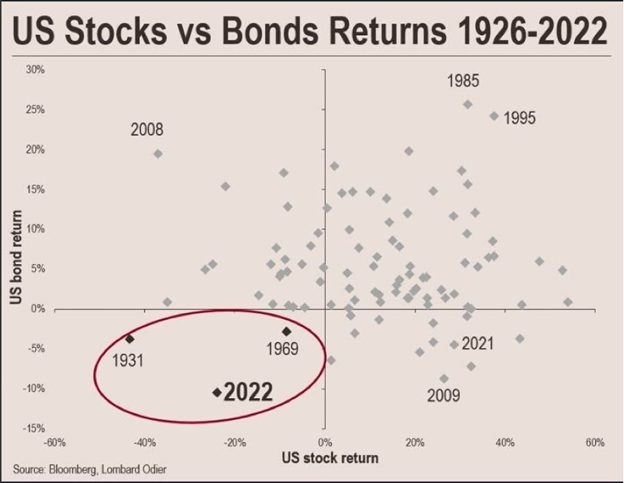
Unfortunately, when it does show up it might hang around for a time, as it did during the last cycle:

There were superb returns on stocks and bonds during the long disinflationary time charted above, but the starting valuations — very high interest rates and very low multiples — were the opposite of where they were when the current bout started.

Looking backward

As noted, understanding how markets have worked is important, but extrapolating that behavior forward — and tightly basing strategies upon it — ignores the reality of a complex adaptive system.

In When Genius Failed, Roger Lowenstein wrote that, at a critical moment, “as usual, the partners driving Long-Term had their eyes on the rearview mirror.”  With leverage.  Massive amounts of leverage, because the things they thought would mean revert had always done so before — and they had bet big and won before.

Given the demise of Long-Term Capital Management, other high-profile calamities, and the history-based modeling that drove the financial crisis, you might think that people would be cautious in their use of tools that attempt to quantify risk, but it seems that the opposite has happened.

From Wall Street to Main Street, investment ideas are judged by the numbers first and foremost.  Forecasts and policies are strongly influenced by historical record, and they are normally proposed and adopted without the qualitative context and caveats that ought to accompany them — and without much attention being paid to those fat tails.

In addition to asset allocation decisions, the affinity for statistical models drives investor demand for the very long list of products created and sold by the industry on that basis.  There is faith beyond reason in the methods.

Still dancing

Another thing that you might have thought would go away after the financial crisis was the need to keep dancing as long as the music was playing.  But that is thoroughly baked into the investment culture.

We saw that in spades a year ago, as asset managers kept throwing money at the huge winners of the post-pandemic period — and investors kept throwing money at those same asset managers, who also had been huge winners.  Woe be to you if you gave someone money to allocate in September of 2021, since it probably was put to work all at once, in stuff bunched toward the top of the performance charts.  You got the market move down and then some, as the music stopped not long after you started dancing.

To requote Klarman, “Nowhere does it say that investors should strive to make every last dollar of potential profit,” but up and down the investment chain that’s what’s most common.  True risk management is hard to find, because everything works against countercyclical actions due to the fear of walking away too soon or of being accused of unwise market timing.

Where we are

LDI is spawning lots of media attention.  (There were some early warnings, such as the July article in the Financial Times by Toby Nangle, and even a few postings about potential problems going back a decade on Risk.net and elsewhere.)  There is much speculation about where we go from here, specifically in regards to LDI, as well as the possible ripple effects from it and whether it is a harbinger of more trouble spots to come.

LDI has moved to the top of the agenda at the pension plans who have implemented it using leverage (including those who haven’t made the press yet), and will be a topic of conversation at this quarter’s review meetings for other asset owners as well.  Investment providers are busy filling the inboxes of their clients with analyses, predictions, and recommendations regarding a problem that they hadn’t otherwise highlighted.

One line of questioning for the debates to come is identified in another FT piece, titled “Liability-driven pension investing is still sound, says man who brought it to UK,” in which Dawid Konotey-Ahulu is quoted as saying:

What happened this week was the gilt market got hit by the equivalent of a category-four hurricane and the LDI system wasn’t built to withstand a weather system of that ferocity.

The immediate task ought to be to examine those strategies that will fail during certain kinds of market storms — and those that will do much worse than the base-case predictions due to an extended change in climate driven by higher interest rates (should they persist).

A recent Robeco report on five-year expected returns is called “The Age of Confusion.”  Interest rates have already blown through the end points found in most of the ten-year capital market assumptions published by consultants and asset management firms going into 2022, so the confusion is not surprising.  From the expectations of the asset-liability studies of pension plans to the financial plans prepared by investment advisors, things are off kilter in a big way.

A change in practice

Beyond the reactive firefighting, organizations need to reexamine and reorient their risk management practices.  The first step is identifying those areas in which statistical analyses and historical information are used as the foundation for high-impact decisions.

Models should be respected for what they can do but should not be relied upon for answers.  Therefore, the second step is the addition of regular and systematic qualitative risk management activities designed to trigger examinations of the potential impacts of out-of-norm events — and the maintenance of a threat matrix that isn’t static but that evolves as markets (and prices) change.

That seems obvious, and most investment professionals probably think that they do that in their heads as a part of their normal decision making.  But for the most part they don’t.  They are too busy dancing.

The leaders of organizations need to ensure that risk management gets taken to a new level, by communicating the need for change and building a culture that identifies and prepares for emerging risks before there is panic on the dance floor.

Published: October 14, 2022

Subscribe

To comment, please send an email to editor@investmentecosystem.com. Comments are for the editor and are not viewable by readers.

Drawdowns, Changing Times, and Professionalism

Markets have been eventful, to say the least.  Turn away from the flashing red numbers and dig into some of these reads.

Drawdowns

Investors are always looking for a magic solution that will identify prospectively good asset managers using historical performance information — an elusive goal to be sure, since the body of evidence lines up strongly against it.

A new search for the Grail comes from “Maximum Drawdown as Predictor of Mutual Fund Performance and Flows,” by Timothy Riley and Qing Yan.  (Quotes here are from the Financial Analysts Journal version; a working paper is available as well.)  The beginning of the abstract:

Mutual funds’ maximum drawdowns (MDDs) are persistent, indicative of manager skill, and predictive of subsequent performance.

But while long-short portfolios based upon MDD show significant outperformance, you can’t short mutual funds — and doing just the long side results in no added value.  It is worth noting the characteristics of that cohort of funds, however:

Low MDD funds, on average, have higher returns, higher alphas, and lower volatilities.  They also tend to have lower turnover and expense ratios.

Better results come from combining low MDD funds that have had strong performance previously; when you select the lowest quintile of the former and the highest quintile of the latter, significant positive alpha appears, according to the authors.

MDD is easy to understand and salient to investors.  Therefore, the second part of the analysis looks at the relationship of MDD to fund flows.

(Of course, there are drawdowns in stocks too, which feed those of asset managers.  Byrne Hobart of The Diff wrote “A Taxonomy of Drawdowns.”)

Changing times

The title of a report from KKR by Henry McVey proclaims that “The Times They Are A-Changin’.”  While endowments and foundations have experienced incredible returns (at least until calendar 2022), KKR believes that “CIOs will need to consider a new approach, including a potential overhaul of their business footprint.”

That lead item is in contrast to the general view of the E&F CIOs who were surveyed, who “indicated that they did not need to add more personnel or to make other changes.”  KKR “respectfully would disagree.”  In all, eleven short summaries cover the main topics that came out of the survey.

As in other accounts, “astute manager selection” is credited with powering recent results, although perhaps that’s a somewhat premature conclusion until we see the length and depth of the current reversion cycle.

Among many other points, this stuck out:

80% of our survey participants actually think that inflation will become embedded, creating a regime change for investing (shifting to a high inflation, lower real growth environment).

Professionalism

Following on its earlier work on “Portfolio for the Future,” CAIA Association has released “six guiding principles” called “A Renewed Professionalism.”

Here they are:

1. Cultivate a Transparent and Client-Centered Ethos
2. Start with Purpose-Driven Portfolio Building Blocks
3. Diagnose Your Client’s Values and Embed Tailored Sustainability Factors
4. Treat Liquidity as a Feature Rather Than a Benefit
5. Identify and Capitalize on Your Firm’s Edge
6. Invest with Integrity and Allocate to True Partners

You can dive into the details, but what are your own guiding principles?

Playbook

While billed as issues of “a newsletter with insights and tactical approaches for operational obstacles in small to mid-sized companies,” the “Permanent Playbook” updates from Permanent Equity offer insights applicable to organizations beyond that description.  Original content and helpful links to other sources, all presented in an engaging way.

CGM

There hasn’t been much attention given to the upcoming closing of the funds managed by Capital Growth Management.  As Jeff Ptak highlighted in a tweet, CGM Focus in particular was “a phenomenon.”  As is normally the case, the flows chased the performance, up and down.

Other reads

“The End of ESG,” Alex Edmans, SSRN.

ESG is both extremely important and nothing special.  It’s extremely important since it affects a company’s long-term shareholder value, and thus is relevant to all investors and executives, not just those with ESG in their job title.

But ESG is also nothing special.  It shouldn’t be put on a pedestal compared to other intangible assets that affect both shareholder and stakeholder value, such as management quality, corporate culture, and innovative capability.

“Softbank: Twilight of an Empire,” The Generalist.  Including an eye-opening chart of the gains and losses on the Vision Funds; the two sides of extreme risk-taking.

“Thinking About the Next Warren Buffett,” Frederik Gieschen, Neckar’s Minds and Markets.

You can’t tap dance to work if you don’t like who you’ll meet at the office.

“Funding When Capital Isn’t Cheap,” Shangda Xu, et. al, Andeessen Horowitz.  A look at the “structured deals” that are in vogue, given that “up rounds” are hard to find.

“The Illusion of Corporate Governance ‘Best Practices’,” Lawrence Cunningham, Directors & Boards.

The issue should always be what is best for a particular company and its shareholders, not what index funds, proxy advisors or policy entrepreneurs declare is best.

“Princeton University Is the World’s First Perpetual Motion Machine,” Malcolm Gladwell, Oh, MG.  In which Gladwell raises some worthwhile questions about the size and purpose of an endowment — and assumes (as most do) that investment returns won’t ever take a serious, prolonged dip.

“Racial Diversity in Private Capital Fundraising,” Johan Cassel, et. al, NBER.

Together, the results support the hypothesis that the modest representation of Black and Hispanic-owned firms in private capital stems at least partially from the nature of investor demand, rather than the supply of fund managers.

“How Has Private Equity Investing Fared for Mutual Funds?” Jack Shannon and Katie Rushkewicz Reichart, Morningstar.  “Fund companies have embraced ownership of ‘unicorn companies,’ with mixed results.”

“As Alternatives Reach Portfolio Limits for Institutional Investors and the Ultra-Wealthy, Blackstone Courts the Barely Rich,” Jonathan Kandell, Institutional Investor.

Blackstone has even created what it grandiloquently calls Blackstone University to educate the retail crowd on the merits of alternative products in real estate and private credit.

“DNA of a Manager Search: Impact Real Estate,” bfinance.  A good overview of an emerging area of interest, including explorations of five key risks.  (For extra credit, see if you can spot the poorly constructed chart in this otherwise helpful piece.)

“The 2022 Preqin Service Providers Report,” Preqin.  The ecosystem is made up of many players beyond asset owners and managers; this is a guide to some of the most popular providers.

“Further reading,” Bryce Elder, FT Alphaville.  The introduction to this edition of the every-weekday linkfest notes the “heady days” of the past and the reappraisal of all kinds of assets in a changed interest rate environment.  What used to be said, for example, regarding music royalties:

“Music as an asset class is uncorrelated to other financial assets, providing a defensive diversification opportunity,” said RBC Capital Markets.  “After all, people listen to music in the good, the bad and the ugly times.”

Perspective

“There are some things you learn best in calm, and some in storm.” — Willa Cather.

A good chart

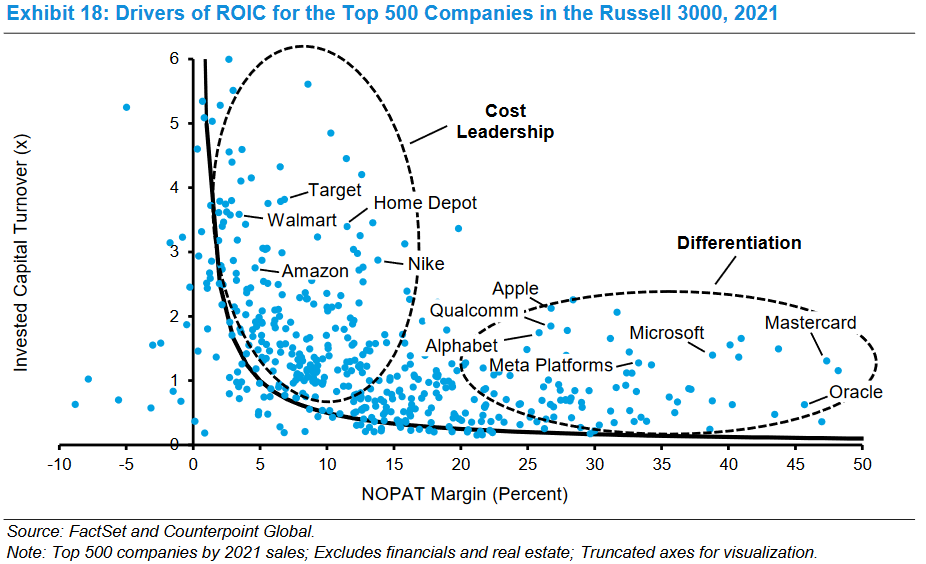
A well-conceived visualization can bring a concept to life.  Here’s one from the latest research piece on ROIC from Michael Mauboussin and Dan Callahan at Counterpoint Global.  The black line shows “the combinations of NOPAT margin and invested capital turnover that equal an ROIC of five percent.”  Are the stocks you seek cost leaders or differentiators?  How do they get there?

Postings

There weren’t any postings during the latest fortnight, which means that a fresh batch is lined up for release in the coming days.  (Subscribe now so you don’t miss any of them.)

All of the content published by The Investment Ecosystem is available in the archives.  If you explore the categories of interest to you, you are sure to find some ideas that you can put to work now.

Thanks for reading.  Many happy total returns.

Published: October 10, 2022

Subscribe

To comment, please send an email to editor@investmentecosystem.com. Comments are for the editor and are not viewable by readers.

Shock, Communication, and the Velocity of Learning

A reader responded to a recent posting with a number of interesting thoughts about it.  Your perspective is always welcome, so please feel free to follow his lead via email whenever you’d like.

He ended his note with this:  “Thanks again for always shaking my intellectual tree!”

A cheap subscription will give you access to a hundred postings in the archives and all the tree-shaking to come.  Don’t miss out.

“Everyone was shocked”

That’s the start of an Institutional Investor headline last week; the rest of it:  “Investment Committee Members Resign After Hartford HealthCare Fires Staff, Hires Morgan Stanley.”  The article quotes a statement from HHC that says of those who were banished, “The investment team’s acumen has earned national recognition from investment industry experts.”  Hmmm.

Why the switch then?  The spokesperson talked up Morgan Stanley’s “deep bench” of “research analysts, market strategists, and investment managers” and access to a “dedicated team” with “a full suite of investment management, fiduciary oversight, and operational services.”

No matter the quality of the firm, a “dedicated team” within an OCIO is different from a “dedicated team” that’s in house.  Those thinking through the trade-offs should obviously include the investment committee, other knowledgeable parties, and perhaps an outside consultant.  But the committee wasn’t even consulted, which means that the decision process was narrow by design, immediately causing the motives of those involved to come under question.

You can read the resignation email from committee chair David Roth — and reactions and theories from others about what might have happened — on Leanna Orr’s LinkedIn and Twitter postings.

A new litigation front

A number of defined contribution plan sponsors have been sued for excessive fees (including several asset management firms regarding the plans for their own employees), and some for the subpar performance of active management options.  Now a new litigation front seems to be opening up.  Megan Pacholok of Morningstar writes:

But with most plan sponsors now focused on fees, aggressive and opportunistic law firms have found a new target:  past performance.  Ten companies, typically those with more than $500 million in assets in their 401(k) plans, face allegations that they violated their fiduciary duty by only focusing on selecting a low-cost option over better-performing peers.  However, these allegations are made with the benefit of hindsight.  The argument hinges on whether the sponsors should have swapped to a top-performing target-date series in the past without knowing whether previous performance trends would persist.

As noted in a recent posting on this site, performance tests are fraught with problems, be they enforced by regulators, litigated by the courts, or adopted willingly by practitioners.

Communication

Chenmark produced a piece titled “Communication,” with a subheading that defined it as “the difference between management and leadership.”  It offers some “lessons learned along the way” that fill the gap between analysis and execution.

It links to a Yale case study, “On the Nature of CEO Communication Patterns in a Small Business.”  (One of the founders of Chenmark is a co-author.)  Don’t let the “small business” description keep you from reading it; the advice is universal.

Flashback:  The velocity of learning

In 1999, Jason Zweig authored a piece, “The Velocity of Learning and the Future of Active Management,” for Peter Bernstein’s newsletter; it is available on Zweig’s site.  The points he made still apply today — only more so.

To wit, “in money management, the cumulative advance of knowledge does not simplify the lives of those who come later.  It makes their jobs harder.”  While gargantuan businesses dominate the industry — especially for beta and quasi-beta strategies — increased scale is a quick way to lose an edge:  “Beyond a certain rate, asset growth is indistinguishable from suicide.”

Zweig saw investors continuing to expect outperformance from managers, even as they tightened up their tracking error and style box expectations, presenting “a killing paradox”:

If he wants to excel, a manager must ignore tracking error and shatter the stylistic chains the middlemen want to shackle him in.  But if he scoffs at tracking error in his quest for higher long-term returns, then he runs a much greater risk, at least in the short term, of underperforming somebody’s benchmark.

These factors continue to define the business and inhibit the quest for the bits of fleeting alpha that remain.

Other reads

“Author Talks: Gillian Tett on looking at the world like an anthropologist,” McKinsey.  On why anthropology is great training for someone trying to understand market inhabitants:

[It’s] incredibly helpful for looking at bankers for several reasons.  First, because financiers make the mistake of thinking that finance is all about money.  And your algorithm and model can explain everything.  The reality is that how money moves, what goes wrong with money, is also driven by all the social and cultural patterns that shape financiers who are operating as institutions.

“Defensive Equity and Market Downturns: Is This Time Different?” bfinance.  Things being what they are, people are looking for defensive stocks; this surveys and compares five basic types.

“In a Sign of the Times, VC Is Bragging About Being Slow and Thorough,” Hannah Zhang, Institutional Investor.  Should due diligence standards be thought of as changing with the times or as being immutable?

“It’s now a badge of honor to go slow in the diligence process,” Walne [of Manhattan Venture Partners] told II in an interview.  “The traditional method of deploying capital quickly and spray and pray . . . is completely gone.”

“Crowd Control for Fund Managers,” Anil Rao, et. al, MSCI.  Crowded stocks have done poorly over time; three strategies for adjusting a fund’s level of crowding.

“The 40 year-old hedge fund managers who feel old and decrepit,” Sarah Butcher, eFinancialCareers.

Instead of a group of high earners at the top of their games, Riach found a cohort of people hyper-conscious of their own mortality, who felt superannuated by the younger people coming up behind them.

“Selling Private Equity Fees,” Minmo Gahng and Blake Jackson, SSRN.  “Our results suggest that the reduced ‘skin-in-the-game’ from stake sales does not exacerbate agency frictions between sellers and their fund investors.”

“Masters of the Universe, Fortune Tellers, and Fate,” Charles Skorina.  Joe Dowling shares the qualities that make for a great (asset owner) investor:

They have the ability to step away from the crowd, they see patterns, they have intellectual curiosity, they are relentless networkers, they are dynamic and social, they have humility, and they can handle the politics.

“If you read this on a smartphone, you’re probably not going to understand it,” Joachim Klement.

Reading texts on a smartphone requires more concentration and is harder for your brain because the text comes along with more distracting features like the blue light emitted by the smartphone.

“Public Pensions Contend with Falling Markets and Rising Inflation,” Jean-Pierre Aubry, Center for Retirement Research at Boston College.  Only a third of major public plans provide CPI-linked COLAs, and most of them aren’t fully indexed; today’s conditions are tough on plans and beneficiaries alike.

“John Train, Paris Review Co-Founder and Cold War Operative, Dies at 94,” Alex Traub, New York Times.  Known for his investment books (especially The Money Masters), he was a Renaissance man:

His career, ranging from literature to finance to war, and from France to Afghanistan, seemed to cover every interest and issue of his exalted social class.

“A podcast curriculum for the aspiring buy-sider,” Brett Caughran (@FundamentEdge).  A great collection.

Postings

“Revisiting Beliefs about Private Equity,” first published in May, was brought in front of the paywall as a Sampler posting, open to all.  Much has changed about private equity; should the beliefs of the past still apply?

The summary for “Cliques and Claques in the Ecosystem”:

While not often taught to investment professionals, the disciplines of sociology and anthropology are essential to understanding both asset pricing and how organizations operate.

On a related note, “It’s The Political Season (Always)” surveys some research about politics and investing.  How does tribal thinking invade and distort the investment process?

All of the content published by The Investment Ecosystem is available in the archives.

Thanks for reading.  Many happy total returns.
Published: September 26, 2022

Subscribe

To comment, please send an email to editor@investmentecosystem.com. Comments are for the editor and are not viewable by readers.

Four for Friday ~ It’s The Political Season (Always)

The last posting, “Cliques and Claques in the Ecosystem,” examined some aspects of social proof and pressure that affect investment decision making and organizational behavior.

When speaking of groups — and relationships between groups and between individuals from different ones — politics comes immediately to mind.  The divisions seem to be ever greater and, in the United States, the coming midterm elections are heightening the drama and inflaming the passions even more, although the political season never ends these days.

Starting point

Public surveys regarding the economy show a sudden and sizable change in opinion whenever the presidency switches from one party to another.  Republicans and Democrats swap views about whether things are improving or deteriorating.

It’s not surprising, then, that something similar happens regarding the prospects for markets, as is found in “Political climate, optimism, and investment decisions” (Yosef Bonaparte, et. al; published version and working paper):

We show that people’s optimism towards financial markets and the macroeconomy is dynamically influenced by their political affiliation and the current political climate.  Individuals become more optimistic and perceive markets to be less risky and more undervalued when their preferred party is in power.  Accordingly, investors increase allocations to risky assets and exhibit a stronger preference for high market beta, small-cap, and value stocks, and a weaker preference for local stocks.  The differences in optimism and portfolio choice across political regimes are not explained by shifts in economic conditions or differential response to economic conditions by Democrat and Republican investors.

Given the data that is available regarding political contributions — and evidence from gleaned from natural language processing — academic researchers are increasingly exploring whether important economic actors have the same tendencies.

Companies

In “The Political Polarization of Corporate America” (Vyacheslav Fos, et. al), the authors write:

This paper establishes a new stylized fact, namely, that executive teams in U.S. firms are becoming increasingly partisan, leading to a political polarization of corporate America.  This trend implies the growing tendency of U.S. individuals to socialize and form relationships and friendships with politically like-minded individuals extends also to the highest-level decision makers in the workplace.

One example of research about how that partisanship can manifest itself is found in “CEO Partisan Bias and Management Earnings Forecast Bias,” (Michael Stuart, et. al paper):

We find that firms with CEOs whose partisanship aligns with that of the US president issue more optimistically biased management earnings forecasts than CEOs whose partisanship is unknown or not aligned with that of the US president.  Our results suggest that CEOs fall prey to partisan bias, which results in suboptimal forecasting behavior.

With any research finding, you have to ask yourself whether the conclusion makes sense.  For one, “Politically Motivated Credit Ratings” (Quan Nguyen, et. al paper) seems a little out there:  “The results indicate that [credit rating agencies] successfully use biased credit ratings as an indirect channel of political party support.”

If there are firms that are making suboptimal decisions because of political bias, you’d expect asset managers to figure that out (and not do it themselves), right?

Asset managers

From “Partisanship and Portfolio Choice: Evidence from Mutual Funds” (Will Cassidy and Blair Vorsatz paper):

Political beliefs matter for the behavior of institutional investors.  Contrary to conventional wisdom, we show that whether a mutual fund team is Republican or Democratic has a first-order effect on the fund’s portfolio choice.  The flip in trading behavior rules out conventional risk aversion-based explanations for the role of partisanship.

And from “Partisan Bias in Fund Portfolios” (M. Babajide Wintoki and Yaoyi Xi paper):

We document that fund managers are more likely to allocate assets to firms managed by executives and directors with whom they share a similar political partisan affiliation.

Of particular interest is another paper from Vorsatz, “Costs of Political Polarization: Evidence from Mutual Fund Managers during COVID-19,” which focuses on partisan versus nonpartisan portfolio management teams.  Some excerpted conclusions:

I find that strong political partisanship is associated with large costs — both lower fund returns and lower net fund flows — following the onset of Covid-19.

Non-partisans’ active outperformance is consistent with greater cognitive flexibility and their passive outperformance is consistent with greater ideological flexibility.

In terms of flow performance, non-partisans also receive more net flows than partisans.

I argue this is because investor clienteles are partisan and only non-partisans can appeal to both Democrats and Republicans.

My findings emphasize that political partisanship is more consequential for the asset management industry than previously believed . . . political polarization entails large costs [implying] that increasingly polarized US organizations may be cause for concern.

Principal-agent conflicts

In the paper cited immediately above, Vorsatz closes with a paragraph on principal-agent conflicts.  A much-different earlier version of the paper explained that:

if investor clienteles and fund managers are aligned in terms of risk attitude and risk perception, then the fund managers have simply acted as an intermediary in implementing the investors’ preferences.  If, instead, investor clienteles are both (1) unaware of the fund manager’s partisanship and (2) disapproving of how the manager’s partisanship may affect his risk perceptions and risk-taking, then partisan misalignment between the fund manager and fund investor becomes a concerning principal-agent conflict.

The newer version includes an angle that has become a political football, especially in recent months:

Political misalignment is a source of principal-agent conflicts because a politically-misaligned fund manager will express undesirable ESG and risk preferences, now and in the future, in the portfolio construction process.

Of course, the opposite misalignment is possible too.

Many investment professionals are dealing with this now, most notably employees of public pension plans and the outside asset managers who do business with them.  Political polarization has intensified and this is the issue on which it has landed with full force.

The specific topic of ESG and the broader set of hot buttons also are challenging for investment advisors.  Most firms (especially large ones) want to try to stay neutral if they can (and take everyone’s business), although some clients are looking for political alignment, so they will end up elsewhere.  For them, there are advisors who proudly wear their colors, and whose conversations and recommendations are infused with political interpretations.  Those advisors end up with a homogeneous group of clients, whether by design or not.

Trying to keep politics out of investment decision making is getting harder and harder, which could make the payoff for doing so even bigger.

Published: September 23, 2022

Subscribe

To comment, please send an email to editor@investmentecosystem.com. Comments are for the editor and are not viewable by readers.

Cliques and Claques in the Ecosystem

The disciplines of sociology and anthropology are helpful guides for investment professionals.  Social influences are an important driver of asset prices — and of the structures and strategies of investment organizations.

To examine all of the social vectors involved is an impossibly broad topic for one posting, so this is just a narrow look at two ideas represented by quite-similar words, one of them fairly common and the other quite uncommon.

Cliques

The OED defines clique as “a small and exclusive party or set, a narrow coterie or circle,” while noting that the word often gets used as “a term of reproach or contempt.”  If there wasn’t a cool kids table or hang-out area at your school, you’ve certainly seen one in a movie or television show.  Everyone knows who’s in and who’s out.

A less negative view of the term reflects our tendency toward social groupings.  Cliques in that sense form naturally around shared backgrounds and interests, without the sort of us/them boundaries and loyalty tests that lead to more adverse group behavior.  And work units at different levels of aggregation in organizations often have distinct subcultures and identities.

But groups that isolate themselves from others and favor competition rather than cooperation within their organization often cause problems over time.  (Incentives usually play a role, with the clique-versus-organization reward splits being a constant irritant in one way or another.)

In A Demon of Our Own Design, Rick Bookstaber wrote about the band of traders that subsequently went off to form Long-Term Capital Management:

They had proprietary chic.  Even sitting in the middle of the Salomon trading floor, they maintained an aura of celebrity, a clique with its own culture of inside jokes and secret nomenclature to describe the yield curve and the strategies they employed.

The isolation doesn’t have to be physical in nature, even though it often is; culture and language and attitude can build barriers, just as they do among kids who happen to go to the same school.

What are the tradeoffs between the esprit de corps that is easier to rouse in a group focused narrowly on a common purpose versus the negatives that come along with it?  After all, the best ideas often discovered at the intersection of different social or organizational groups.  (The LTCM story was multidimensional, but the insularity of the team was an important factor in its undoing.)

Some examples

A few disparate angles on this topic from around the ecosystem:

Multi-team asset management firms.  There are big differences among organizations in terms of how information flows (or doesn’t flow).  In some, there are robust exchanges of ideas between teams, even across asset classes, in ways that foster performance.  At others, because of size or geographic distance or culture, there is almost none of that.  Some firms even prohibit the sharing of information from one team to another.  Those differences matter, but are rarely highlighted by outsiders trying to evaluate the organizations.

Combinations.  Many asset managers and other kinds of providers are the products of mergers and team lift-outs and combinations of one sort or another.  The disparate parts can linger for years, the groups never really integrating as you would want them to.

Decision making.  There are org charts and then there are hidden org charts, the way things are actually done.  Someone in an apparent position of importance might not be very involved in decision making, while others who aren’t as prominent (or perhaps not even shown in the chart) have significant influence.  (To use a political construct, a “kitchen cabinet” may hold the real power, despite official appearances.)

Governing bodies.  Boards and committees can have factions that make coordinated governance challenging.  An obvious situation is a jointly-trusteed corporate pension plan, where management and labor can be at odds over policy.  Public plans may mix elected officials (sometimes from opposite sides of the aisle; another potential dividing line), employees, and outsiders, each with much different perspectives.  But while those distinctions are fairly easy to see, all groups (especially large ones) have the potential for cliques to form.  Consider an investment committee made up of some who strongly favor the use of alternative strategies and others who are equally opposed.

Diversity.  The investment industry has struggled to improve diversity overall, and there are still lots of firms where the talent pool is “pale and male” (even if there’s enough younger people given responsibility so that the “stale” part of the cliché doesn’t really apply).  Hiring and promotion practices are a reflection of culture, and the cliquishness reinforces itself over time to the point that the stated goal of rewarding merit gets obscured.

The cool kids table

You will sometimes hear that phrase, “the cool kids table,” used to refer to an inner circle of asset owners, chiefly made up of those from influential endowments.  The perception is that they have access to the best deals and if they are “in” on one, then others should follow.  Their opinions matter in investment selection processes far beyond their own organizations, and being seen as a member of the club is a huge career asset for the individuals involved.  (Another sign of the power of the clique:  many of the organizations use the same recruiter, who, according to an Institutional Investor article, “filters out superb investors based on pedigree.”)

It can be helpful for asset owners to cooperate, especially given the overall shortage of resources to do original due diligence — and the access that some have but others don’t.  The tradeoff is that a lack of independent analysis can bite you when the work doesn’t live up to the reputation.

That happened at another cool kids table during the last year, when the performance of many of the Tiger Cubs has been trashed as their one-way stocks (and presumably venture investments, although they haven’t really been marked down yet) reversed direction in a significant way.  Some followers likely missed much of the runup but got there in time for the fall.

Another kind of clique

An unusual usage of “clique” these days was quite prominent in the investment business at one time.  In the 1870s, Men and Idioms of Wall Street defined it this way:  “A Clique is a combination of prominent operators, or their brokers, to carry a stock up, each bidding higher and higher so as to get control of it.”  Published a century ago, the famous book Reminiscences of a Stock Operator has many references to “bull cliques,” “speculative cliques,” and “inside cliques.”

Market manipulation is a hard thing to prove, but no doubt there are plenty of cheerleaders in the markets, forming cliques of sorts.  In extreme situations, they can resemble cults, often with narrowing definitions of what constitutes a true believer in a security or a strategy.

Claques

Which brings us back to the OED, for a definition of claque:  “An organized body of hired applauders in a theatre.”  That seems a bit removed from the investment realm until you see that the original notion has been extended to apply to “a body of subservient followers always ready to applaud their leader.”  Immediately you flash to any number of past and current claques for company CEOs, for guru investors, or (moving from the individual to the conceptual) for particular investment approaches.  “True believers” are always ready to applaud the latest pronouncement or development, while objective observers judge ideas and actions based upon their worth.

Since the selling of ideas is layered throughout the ecosystem, it is often hard to determine the mix of analysis, faith, and salesmanship inherent in any recommendation.  And, as Michael Kitces noted in a 2011 posting, social proof drives many points of view (it’s always easiest to do what others are doing), and hired (or volunteer) “claquers” can have an outsized effect on behavior:

Have your investment or other decisions even been impacted by social proof?  Would you even notice if they were?  Do you look to what your peers are doing with their client portfolios to make decisions about what you should do?  Is that a proper form of due diligence itself, or an abdication of due diligence responsibilities?

The questions apply in the investment advisory world that Kitces writes about, and in every other corner of the business too.

Cliques and claques are foundational elements of the practice, if not the theory, of investing, which is dominated by social proof and pressure.  The investment textbooks don’t get into that, but the sociology and anthropology ones do.

Published: September 22, 2022

Subscribe

To comment, please send an email to editor@investmentecosystem.com. Comments are for the editor and are not viewable by readers.

Asset Classes, Strategies, Organizations, and Behavior

There’s quite a variety of topics explored in this issue.  Let’s get into them.

Liquid venture capital

The published research from Sparkline Capital is always interesting and informative, with plenty of helpful charts.  Its latest report, “Liquid Venture Capital,” is no exception.  From the conclusion:

The true source of venture returns is innovation, which also occurs at public companies, both large and small.  We believe that investors should extend their “innovation allocation” from venture capital into public equities.  This should help investors capture the full innovation lifecycle while enjoying greater liquidity.

In setting up the idea, Sparkline founder Kai Wu touches on power laws, the attributes of venture investments, the current glut of dollars in the asset class, and the lack of markdowns and down rounds — which are obscuring real valuations.  And, as has previously been shown with buyout funds, the paper argues that venture returns can be replicated using public securities.

After a section on the opportunities in the crypto world, the lifecycle of innovation comes into focus.  Sparkline recommends a combined approach, using classic venture capital, early-stage innovation stocks, large-cap innovation stocks, and crypto tokens.

Fixed income

Here are several good pieces on different aspects of the fixed income landscape:

“Beyond the core: A new model for allocations to fixed income supersectors,” Jared Gross, J.P. Morgan Asset Management.  This contrasts the composition of the most common U.S. benchmark, “the Agg,” with the range of fixed income sectors today; looks at those sectors against the objectives of stability, income, and diversification; and traces the index’s history back to Kuhn, Loeb:

A small seed planted by the firm’s bond research department in 1973 took hold and has grown into the mighty oak known as the Aggregate Bond Index (the “Agg”).

“Do Active Core Plus Fixed Income Managers Add Value With Sector Rotation?” Kevin Machiz, Callan.  The author adds high yield (but not the other non-Agg) sectors above to compare with the performance of the Callan Core Plus Peer Group and concludes that sector rotation on average has added value.

“Returns plus Resilience? A Closer Look at Leveraged Finance,” bfinance.  A good example of an educational read by the consultant, providing a clear outline of an emerging category.

Data alliance

Paid subscribers received a piece on Friday that highlighted some of the great content from the CFA Institute Research Foundation.  Now that entity is rapidly building up the Investment Data Alliance, “a partnership between the CFA Institute Research Foundation and various investment organizations where data and content related to data is shared with investment professionals.”  Access to some of the sources is restricted to CFA Institute members, while others are open to the public.  Quite a range of data overall.

Family offices

Jonny Lach wrote an article for Family Office Exchange, “Private Investors, Carpe Diem!”  In contrast to many other investment organizations, where there are “natural conflicts of interest” between asset owners and agents, at a family office:

The wealth owner can readily create compensation structures, governance structures and an investment office culture to align staff and committee objectives with those of the owners.

For example, a family office can pay staff based on performance of an appropriate benchmark designed to reward staff performance (i.e. not legacy investments and not market betas).

However, “If you want your staff to invest like partners, you must reward them as such.”

Whether in-house or outsourced, families need trustworthy advisors, the subject of a posting from TFOA, “How to Surround Your Single Family Office With Great Advisors.”

Portfolio manager attributes

There have been many studies about various characteristics of portfolio managers and how they relate to performance (or appear to relate to it).  Here’s a couple more:  one that finds that “managers who are born later in the sibling hierarchy take on more investment risks relative to first-born managers, but perform worse,” and the other, which says, “Fund managers who run marathons deliver higher risk-adjusted returns.”

Other reads

“The Learning Mindset for Investors with Alix Pasquet,” Frederik Gieschen, Neckar’s Minds and Markets.

If your behavior hasn’t changed, you haven’t learned.  Learning is not sitting on a desk, and cramming your brain with knowledge that you’re going to recite one day.

“These Institutional Investors Are Already Paying For Climate Change. They’re Investing to Fix That.” Hannah Zhang, Institutional Investor.  Long-term, risk-focused firms that have been ahead of the pack in altering how they invest because of climate change.

“The power of teams in investment management,” Richard Farrell, RBC.

Do we want as many experts on the team as possible?  Do we want academics, or experienced investors?  Should we have a strict hierarchy, or should we aim for no hierarchy?  How big should the team be?  How relevant are the characteristics of the team members?

“The Road Ahead: Eight Things Investors Can No Longer Rely On,” Man Group.  Profound changes in important relationships underlying asset allocation decisions.

“(Black)Rock the Vote: Index Funds and Opposition to Management,” Joseph Farizo, SSRN.

I show index funds are more likely to oppose management on contentious management sponsored proposals at firms held only by their family’s index funds than on proposals at firms co-held by their family’s active funds.  Additionally, shareholder proposals garner a greater level of support by index funds when the firm’s shares are not simultaneously held by a fund’s same-family active funds.  Consistent with “locked-in” motives to monitor, these results imply index funds participate as more engaged voters when same-family active funds avoid holding positions in a firm.

“Why we need to talk about QT,” George Steer, Financial Times.  “In other words, investors haven’t yet woken up to just how aggressive this cycle of QT is going to have to be.”

“The Myth of Open-end Fund Underperformance,” Jared Gross, et. al, J.P. Morgan Asset Management.

Evidence suggests that perpetual-life, open-end core/core-plus strategies can deliver returns of a similar magnitude to closed-end funds while offering materially better access to capital and lower risk.

“Why Fundamentals Matter,” Jamie Catherwood, Canvas.  An historical perspective on multiple change versus fundamentals.

“The Price of Time,” Laurence Siegel.  A review of Edward Chancellor’s new book, The Price of Time (and so much more).

“Right on Target? Plan Sponsors May Not Always Consider Participants’ Behavior or Needs When Selecting Target-Date Glide Paths,” Lia Mitchell and Aron Szapiro, Morningstar.

It is clear that there is too much homogeneity in off-the-shelf glide paths that employers use given the heterogeneity of their workers’ needs.

“Broyhill Book Club,” Broyhill Asset Management.  The latest edition of the firm’s terrific annual selection of books and other resources.

Not normally distributed

“Life always has a fat tail.” — Eugene Fama, quoted in When Genius Failed.

Postings

Two recent postings:

“The Red, Amber, and Green of Performance Tests” looks at recent performance tests instituted by regulators, as well as the explicit and implicit ones that guide allocator behavior when selecting managers.

Mentioned earlier in this edition, “Research Foundation Readings” surveys some of the material available from the CFA Institute Research Foundation by focusing in on important aspects of the investment ecosystem, behavioral finance, fiduciary responsibility, and the financial crisis.

All of the content published by The Investment Ecosystem is available in the archives.

Thanks for reading. Many happy total returns.
Published: September 12, 2022

Subscribe

To comment, please send an email to editor@investmentecosystem.com. Comments are for the editor and are not viewable by readers.

Four for Friday ~ Research Foundation Readings

The CFA Institute Research Foundation publishes thoughtful examinations of investment topics.  They are publicly available and therefore of use not just to CFA charterholders but anyone.

The Research Foundation’s flagship output over the years has been monographs — “in-depth studies on specific topics” — which have been augmented by literature reviews on various subjects, shorter papers, and multimedia offerings.  (Another relatively new set of offerings will be covered in the upcoming issue of the Fortnightly.)

A great breadth of content is available, matching the diversity of ideas at play in the ecosystem across asset classes and investment styles.  The content is central to the ongoing work of investment professionals, marrying the theoretical and the practical.  Below are just four topics out of many that could be highlighted.

The ecosystem

Among the monographs is The Industrial Organization of the Global Asset Management Business (Ingo Walter).  It covers the basics regarding pension funds, mutual funds, alternative assets, and private wealth management — and the implications for asset management.

The friction between “industrial organization” and the responsibilities of professionals is pervasive.  A literature review, The Principal-Agent Problem in Finance (Sunit Shah), provides an extensive bibliography of research about that problem, along with summaries of the findings; this excerpt is from the section on compensation structures:

If an investor’s incentives are not aligned with those of the manager, the manager often has both an incentive to act counter to the investor’s best interests and the ability to do so undetected.  Given the magnitude of payment generally involved in asset management contracts, misaligned incentives have significant potential to override a manager’s fiduciary responsibility to his or her clients.  Structuring such contracts optimally is, therefore, of the utmost importance.

Investment Management: A Science to Teach or an Art to Learn? (Frank Fabozzi, Sergio Focardi, and Caroline Jonas) examines the gap between theory and practice, and provides an easy guide to the status of the debate about some of the core tenets of modern finance.

Behavioral finance

Fund Management: An Emotional Finance Perspective (David Tuckett and Richard Taffler) is terrific; it maps out the emotional lives that drive the behaviors of portfolio managers.  This review gives an overview of some of the ideas that are presented.

As noted in an earlier posting, “Forces in the Ecosystem,” Popularity: A Bridge between Classical and Behavioral Finance (Roger Ibbotson, Thomas Idzorek, Paul Kaplan, and James Xiong) provides a good exposition of the battle between mean reversion and momentum — and how “if higher prices are paid for the same economic outcomes, popularity sows the seeds of diminishing future returns.”  The role of popularity in investment decision making not only sets up behavioral quandaries for market participants, but, according to the authors, is the “bridge” between the two main theories of finance these days.

Other monographs include Behavioral Finance: The Second Generation (Meir Statman), Emotional Intelligence and Investor Behavior (John Ameriks, Tanja Wranik, and Peter Salovey), and Behavioral Finance and Investment Management (edited by Arnold Wood; it is unfortunately only available in print).

Fiduciary responsibility

A Primer For Investment Trustees: Understanding Investment Committee Responsibilities (second edition, Jeffery Bailey and Thomas Richards) is an invaluable book.  The first edition (reviewed here) was published barely more than a decade ago, but it did not include any references to OCIOs, which have exploded in popularity since then.  The latest version addresses that trend and adds other updates, but still has the “takeaways” and “questions Molly should ask” on each topic that make it helpful reading for new and experienced trustees alike.

The move from defined benefit plans to defined contribution plans has changed the landscape of retirement funding.  From Defined Contribution Plans: Challenges and Opportunities for Plan Sponsors (Jeffery Bailey and Kurt Winkelmann):

Virtually everyone acknowledges that the basic DC plan design is flawed.

We wrote this book from the viewpoint of the plan sponsor seeking to improve the DC system, and it follows five major themes:  the plan participant, the plan sponsor, plan design, investments and investment managers, and asset decumulation in retirement.

Another important book in this category is Investment Governance for Fiduciaries (Michael Drew and Adam Walk).  The authors use the OPERIS acronym to spell out the steps of the governance process that they examine:  Objective, Policy, Execute and Resource, Implement, and Superintend.  There are many important concepts included, among them “the fiduciary line” (marking the division between fiduciary responsibilities and ones related to implementation) and the need for a “hierarchy of investment objectives.”

The financial crisis

The four-decade march toward cheaper capital and higher prices had a few setbacks along the way, none more important than the global financial crisis.  It was (and remains) a seminal event, shining unflattering light on the investment industry and profession and — somewhat surprisingly — continuing the trend of extraordinary market support that had begun twenty years earlier, even as there was a lot of tough talk and some increased regulation.

Insights into the Global Financial Crisis (edited by Laurence Siegel) was published in late 2009, less than a year after the nadir of the crisis.  A number of contributors, including several well-known market players, try to make sense of the events; one section is simply titled, “What Happened?”  (And one chapter, with the subheading “What Were We Thinking?” relates to the topics of behavior, principal-agent problems, and industry structure mentioned earlier.)  The essays provide a multidimensional look at the specific conditions that led to the cataclysm, as well as the age-old tendencies that drive people in markets to do similar things every once in a while.  Useful reading even now.

Time adds perspective.  Investment Management after the Global Financial Crisis (Frank Fabozzi, Sergio Focardi, and Caroline Jonas) looked at the implications for the industry in 2010, using interviews with a wide range of market participants to identify anticipated areas of change.  A 2018 conference sponsored by the Research Foundation reflected back on the crisis; the presentations are available online.  Short summaries of them can be found in a brief, Ten Years After: Reflections on the Global Financial Crisis (Laurence Siegel and Luis Garcia-Feijóo).

All of these provide the opportunity to compare what was expected to happen to what has actually happened, and to ponder whether the crisis was wasted in terms of making critical changes — and how well prepared we are for the next firestorm.

Published: September 9, 2022

Subscribe

To comment, please send an email to editor@investmentecosystem.com. Comments are for the editor and are not viewable by readers.

The Red, Amber, and Green of Performance Tests

It is a central tenet of this site (and the affiliated due diligence course) that performance distorts the manager selection process more than anything else.  In one sense that’s not surprising, since performance is quantifiable (at least after the fact) and it is what everyone most desires in their heart of hearts.

Extrapolating performance is the easiest thing there is to do.  Allocators, even experienced ones, have trouble ignoring the past numbers and focusing on the attributes that deliver future performance.

Therefore, performance tests — both explicit and implicit ones — are common.  And problematic.

United Kingdom

In 2019, the Financial Conduct Authority (FCA) instituted rules that required the managers of investment vehicles to conduct an annual value assessment for each of their products.  The analyses don’t just cover performance; here are the dimensions that must be reviewed:

Quality of service

Performance

General costs

Economies of scale

Comparable market rates

Comparable services

Charges across different vehicle classes

Last year, the FCA summarized the first assessments that were produced by managers, indicating the range of output that it saw.  The performance-related shortcomings fell into predictable categories:  gross rather than net performance; higher fee classes not being properly assessed; benchmarks being used that didn’t reflect a fund’s investment policy and strategy; questionable comparisons (as when “absolute return” funds got automatic credit because of a rising market); underperformance being attributed to a style that’s “out of favor;” and comparisons being made to peers rather than an appropriate index.

In combining the categories for an overall assessment of value, “some [manager] frameworks gave a much heavier weighting to a fund’s performance than to the other 6 considerations,” although the FCA “saw examples where little emphasis was placed on poor fund performance.”  In a self-test, you can assume that the relative weight of performance used in the overall assessment will be dependent on whether the performance was good or bad, pointing out the need for consistent treatment going forward.

An example is in order:  Baillie Gifford’s 2022 value assessment report.  This attractive document shows that a regulatory requirement can serve double-duty as a piece of marketing material.  The firm meets the terms of the FCA framework, while taking the opportunity to explain its beliefs and approach.

During the year under review (ending in March 2022), “many of the funds underperformed significantly,” yet only a few got bad performance marks, due to the explosive returns of the prior years, when the firm “acknowledged the exceptional returns were unlikely to be repeated.”

As those good years fade into the past, how will the assessments — boiled down to the colors of red, amber, and green (RAG) — change?  (Baillie Gifford uses three- or five-year periods, as appropriate for each fund objective, and most are compared to an index-plus target when assigning one of those colors.)

The colors are assigned to each dimension evaluated, as well as for the aggregate assessment of value, but our focus here is on performance.  What will happen if investors, advisors, and governing bodies see row after row of red dots in the performance column?  Concern (fear?) will be pervasive, just as comfort was when they all were green.

Australia

Another relatively new performance test is supervised by the Australian Prudential Regulation Authority as part of the “Your Future, Your Super” (YFYS) reform package.  Unlike in the UK, it has specific calculations and remedies.  The initial test was for seven years, which has now been expanded to eight.  Two July Pensions & Investments articles (here and here) address the implications of the performance test.

MySuper funds that lag by an average of fifty basis points per annum are required to “to inform their members of that fact and point them to super fund competitors with superior results.”  Not surprisingly, that “has made tracking error a first-order consideration,” leading to changes in strategy:

The propensity of super funds to allocate to contrarian, high-active-share managers has diminished in an environment where benchmarks have gone from an afterthought to being front and center.

We can argue the merits of holding managers to some semblance of performance success, but it seems that the test will result in more closet indexing, which is hardly a desirable outcome.  And consider TWUSUPER, which passed by having only 47 basis points of underperformance.  Wherever you draw a hard line there will be slim differences between those facing “severe penalties” and those who escape them for at least a year more.

Naturally, there are advocates and critics of the approach.  A 2021 Firstlinks article asked the question, “Is this really the best way to remove the super underperformers?”  On the flip side, CEM Benchmarking applied the YFYS rules to its database of pension plans and arrived at this conclusion:

Our research has found that the YFYS test, over the long term, is likely to contribute to improvement in system-wide performance.  It has also highlighted the characteristics of funds that tend to perform well (and less well).

General practice

Beyond these regulator-mandated initiatives, many organizations have performance tests of their own.  In some cases performance hurdles for existing managers are spelled out in investment policy statements (usually accompanied by “watch list” rules to be followed).  Monthly, quarterly, and yearly reviews often feature those RAG colors or some other scheme to make the presentation more salient to the reader.

You’ll also sometimes see requirements spelled out for prospective investment vehicles — that they must be in the first or second quartile, or have four or five stars.  But that’s usually not necessary for the same result to occur.  Screens filter out past losers early in the selection process, and almost no one wants to go to bat for a manager that will be challenged because of its historical results.

Explicit and implicit performance rules are often applied without consideration as to whether they add value or not — since they just seem right — even though they are often counterproductive.  Therefore, it makes sense to identify and assess them, and to design organizations to minimize the bad decisions that can result.  This is especially difficult given the chains of agents that reinforce the tendencies.

For example, an institutional asset owner may have to deal with layers of tests applied by consultants, in-house due diligence analysts, the CIO, and the investment committee.  Someone at an advisory firm may use an outside research firm for ideas, need to hew to the buy list of a centralized due diligence function, make a presentation to their investment committee — and then have to sell the idea to clients.  At each stage, performance exerts a gravitational pull on those involved.

Here’s an idea:  Deconstruct your due diligence and manager selection processes and find out where the performance tests are and whether they make sense.  You can even color the steps red, amber, and green if you’d like.

Published: September 7, 2022

Subscribe

To comment, please send an email to editor@investmentecosystem.com. Comments are for the editor and are not viewable by readers.

Procyclical Risks, Another J Curve, Hedge Funds, and Backlashes

The Academy course on due diligence and manager selection is on sale (that’s rare).  Customized training for teams is available too.  Check it out; only through September 6.

On to the readings, which highlight some of the recent happenings and writings in the ecosystem.

Taking procyclical risks

You might expect asset managers to lean against periods of excessive risk.  “Are fund managers rewarded for taking cyclical risks?” a paper by Ellen Ryan, supports the conclusion by others that managers are, on the contrary, incented to lean into those risks by the asymmetric nature of the performance derby.  A summary of the conclusions:

First, we confirm the presence of asymmetries in the flow-performance relationship for equity, government bond, corporate bond and high yield funds in the euro area.  This suggests that the flow-performance relationship typically rewards risk-taking across all asset classes.  Second, we examine how these asymmetries interact with the wider market environment.  We show that for equity funds the asymmetry of the flow-performance relationship is stronger in times when market prices are rising and when equity funds are receiving net inflows on aggregate.  Thus this type of incentive could give rise to a coordinated increase in equity fund risk appetite during periods of market exuberance.

If “performance relative to peers plays a greater role in determining which funds receive inflows during periods of market exuberance than it does outflows during a crisis,” why wouldn’t a manager dance (hard) until the music stops?

It all reads like a travelogue of the last few years, including:

This type of behaviour may be particularly problematic during periods of accommodative monetary policy, where an extended period of rising asset prices results in a build-up of risk among funds.

The disclaimer on the cover says that the paper “should not be reported as representing the views of the European Central Bank,” but comparisons to “bank-driven credit booms” and references to “policy implications” make it hard to avoid inferences about future debates regarding the systemic effects of concordant procyclical decision making by asset managers.

Another J curve

On the eve of the coronavirus pandemic, Vanguard published “The Idea Multiplier: An acceleration in innovation is coming.”  The firm couldn’t have foreseen the forced innovation that would follow because of that extraordinary event.

Now, a follow-on piece, “How America innovates,” leads with the expectation that the U.S. economy will experience “its fastest level of productivity growth in decades over the next several years.”  It includes the notion of a “productivity J curve,” which results because the effects of significant changes in technology are slower to arrive than expected — and then show up with great force.  That idea might help explain the lingering economic productivity puzzle.

Remote work is used as an example of the J curve.  The technology was in waiting, not widely adopted due to the dominance of existing practices.  Then the pandemic spawned a rapid conversion, triggering both increased productivity and debates about the old way versus the new way.

The ideas put forth in the two reports are worthy of consideration; we’ll see if the optimistic conclusions of Vanguard come true.

Hedge funds

A survey about hedge funds from SEI, “Back to the future,” says that “competitive pressure and institutional gatekeepers will continue to steer the industry toward innovation and operational excellence.”

As always with two-sided surveys of investors and managers, the gaps in responses between the groups are of most interest.  In some cases they are wide indeed.  For example, more than 80% of managers think that investors are mostly or completely satisfied with the hedge fund fee structure and expense attribution, but less than 40% of investors actually are.

As for those gatekeepers, their role is essentially described as passing the manager’s narrative on to an investor.  (If you believe that’s the way things should work, sign up for the due diligence course referenced above right away.)

Speaking of hedge funds, Julian Robertson passed away last week.  In addition to his tremendous track record, he was instrumental in the institutionalization of the business — and was the person most responsible for the focus on “pedigree” among gatekeepers.

Backlashes

The ESG backlash has started hitting the fortunes of investment firms, as indicated by “Texas accuses BlackRock of energy company boycott in ESG clampdown,” “Florida State Board bans ESG considerations in managing pension plan,” and other headlines.

That is triggering a backlash to the backlash, as investment firms fight back, arguing that all relevant factors should be considered in making investment decisions, and that a prohibition on evaluating certain kinds of risks does not fit with the precepts of fiduciary duty.

This is going to get messy for both sides.

Other reads

“The Uphill Battle Women Still Face in High Finance,” Benn Eifert, Noahpinion.

I care about this because I see the injustice of brilliant, talented women friends struggling in ways I never had to.  I see it drain them.  The field I have played this game on is wildly skewed.  Much of the best talent in the industry is pointlessly deterred by misogyny.

“Organizing your mental kitchen for information FOMO (Building A Second Brain),” Frederik Gieschen, Neckar’s Minds of the Market.  Thoughts about personal knowledge management and strategies for dealing with the overwhelming amount of information.  “Capture now, organize later.”

“And when we disagree . . .,” Seth Godin.  “The hallmark of a resilient, productive and sustainable culture is that disagreements aren’t risky.”

“Capital Group: the slow-moving giant in dangerous waters,” Brooke Masters, Financial Times.

In a sea full of predators, Capital is like a whale shark:  slow-moving, friendly and enormous.  Its collaborative culture, low fees and dedication to active stock picking make it a well-respected outlier in the increasingly cut-throat world of asset management.

“Value, Growth and the True Exposures in Your Portfolio,” Maarten Nederlof and Jeffrey Clark, Neuberger Berman.  “Assess the ‘flavor’ of available value managers carefully, and choose or diversify among them intentionally.”

“Unblurring the Boundary Between Philanthropy and Impact Investing for Families,” Nick Rees, Cambridge Associates.  The first of two postings; the second is “Implementing a Sustainable and Impact Investing Strategy — A Family Perspective.”

“Advisory Firm Paths to Side-By-Side Management and Mutual Fund Performance,” Jongwan Bae, et. al, SSRN.  There are differences in side-by-side performance (managing both mutual funds and hedge funds) depending on the origin of the firm’s business.

These patterns suggest there are adviser-level incentives to deliver strong mutual fund performance (which attracts capital from new investors) and manager-level incentives to favor hedge funds (which increases compensation).

“Evolving Our Definition of Diverse Managers,” Commonfund.  “This turned out to be no easy exercise.”

“U.S. Public Plan Asset Allocation Report,” Nasdaq (eVestment).  A good summary of exposures and trends within public plans.

“Can you tell a fake ETF from a real ETF?” Alex Steger and Alex Rosenberg, Citywire RIA.  It’s hard keeping up with all of the new flavors being created — here’s a short, fun quiz to see if you can tell the difference between the made-up ETFs and those found in portfolios.

47 years ago

“In setting realistic investment objectives, trustees should be aware that the likelihood of any professional manager producing consistently superior performance, relative to that expected at any level of risk, is small — especially in the case of large pools of capital.”  — John McDonald, “Investment Objectives: Diversification, Risk and Exposure to Surprise,” Financial Analysts Journal, 1975.

Postings

The latest Sampler posting (freely available to all) is “Two Sides of Organizational Improvement.”  It combines two pieces, previously only available to paid subscribers, concerning an essay from Michael Mauboussin and Dan Callahan about continuous improvement.  The first part focuses on asset managers and the second on those that do due diligence on them.

Two “Four for Friday” postings filled out a light late-summer calendar, regarding:

Mutual fund boards ~ questions of independence, new rules, performance evaluations, and board assessments.

The investment advisory world ~ the future of advice, dual-registered firms, portfolio gaps, and a “cutting edge technology in applied behavioral finance.”

All of the content published by The Investment Ecosystem is available in the archives.

Thanks for reading. Many happy total returns.

Published: August 29, 2022

Subscribe

To comment, please send an email to editor@investmentecosystem.com. Comments are for the editor and are not viewable by readers.