The Paradox of Manager Selection Practices in a Changed World

A report from McKinsey included this eye-opening exhibit:

Setting aside questions about the specific calculations used (which are not included in the report), the exhibit illustrates the reality that a lot of money is spent on active strategies but not much alpha is generated.  That fact ought to prompt deep discussions about beliefs, resources, methods, and outcomes among the governing body, staff members, and external advisors of your organization.

An evergreen problem is that alpha is elusive, requiring allocators to adapt over time, yet due diligence and manager selection axioms and activities can easily ossify, becoming obsolete as conditions change.

In that regard, a paper, “Manager Selection & The Paradox of Skill,” from Dan O’Donnell of Acervus Securities (an affiliate of Addepar) is worth your attention.  It focuses specifically on private market investments.

Changing conditions

In the introduction, O’Donnell writes, “Unfortunately for allocators, the process by which investors source, screen and select managers is growing increasingly complex.”  There has been “explosive growth in firm and fund formation” as investors have flocked to alternative strategies.  Coupled with that has been an increase in the expertise and experience of those involved, resulting in “the paradox of skill,” where “the dispersion of relative skill narrows” even as the “the absolute level of skill among practitioners” improves.

O’Donnell’s stated goal is “to improve allocators’ odds of successful manager selection by explicitly accounting for the paradox of skill in investment analysis.”  Because of assumed persistence in performance among the better fund firms, the go-to heuristic has been to invest only with ones that have delivered top-tier funds.  To question that premise, O’Donnell cites an article by Robert Harris, et. al, that asks, “Has persistence persisted?”

Helpful exhibits in O’Donnell’s paper illustrate that the answer is “no.”  The traditional measure of persistence — fund-to-fund performance — has declined over time, slightly for venture capital and much more for buyout funds.

A different metric, “investable persistence,” is calculated using “the returns presented for Fund N when investors must make a go or no-go decision on Fund N+1.”  Using that approach — a more realistic gauge of the circumstances under which decisions are made — the chance that a top-quartile fund will repeat that feat is no better than that of the overall population of funds.

O’Donnell:

In summary, the current conventional wisdom around manager selection was largely built upon a methodology that is not actually investable.

So a rethink is in order, especially given the conditions today.  The universe of players has exploded, with big increases in the number of asset owner organizations, allocators, and fund managers (and in the amount of invested assets) dedicated to private strategies.  And the bedrock of the selection process, chasing the best managers, no longer provides the foundation that it did, given that the paradox of skill appears to have entered the picture, just as it has in other areas of investment practice.  And to further disrupt the established order:

Complicating the matter is that very few, if any, of the investors leading firms today have practical experience with the current macroeconomic landscape — in particular, the one-two punch of rising interest rates and an inflationary environment.

Decision frameworks

The last part of the paper highlights three areas that O’Donnell stresses are needed in order to improve manager selection processes.  They aren’t revolutionary or controversial, and so wouldn’t prompt much debate on their own, but the important question is whether they are stated beliefs or lived ones.  To what extent have they formed the essence of due diligence and manager selection practices?

For each, O’Donnell offers a “foundational first principle,” some examples of how it comes into play, and a series of great due diligence questions.

Market inefficiency

The principle:  “Alternative investments exist to general alpha.”  Pretty straightforward, but the implications are profound.  Given today’s environment, how likely is it that the managers of popular strategies will be able to find mispriced assets?

Given the fee load of private market funds, managers who are not consistently uncovering mispriced assets are more likely a very expensive source of beta rather than alpha.

Does your approach assume that investments in alternatives with previously successful managers will repeat their success, or are you continually trying to put yourself in “an alpha-rich sweet spot,” with “inefficient price discovery at entry and efficient price discovery at exit”?

Edge resilience

The overriding principle here is that “markets are only growing more competitive and complex.”  If that’s the case, then maintaining a profitable edge is very difficult, so:

Allocators looking for resilient edges should seek out managers with a history of adapting quickly and fighting process inertia, even (or especially) where they are finding success.

Now, think about how drastically that recommendation contrasts with existing practice.  The allocator mantra of looking for a “consistent and repeatable process” indicates a clutching of process inertia, not an understanding of the dangers of doing so.

Holistic alignment

“Perfect alignment of LP and GP interests is the holy grail of investment governance.”  Although “perfection” is an unattainable standard, many of the relationships today don’t come within sight of it — and the parties involved don’t really try to get there.  Fund managers have long had the upper hand (especially if they are in that special quartile where persistence is said to exist), but that needs to change:

With an overabundance of options, investors should not need to compromise on economic or governance terms that are not LP-friendly.

And allocators need to have greater transparency into the organizations behind the funds, to see whether the unstated partnership terms — the way in which the fund sponsor is expected to behave and develop as a firm — are as mutually beneficial as those in the signed documents should be.

Track records

It will be difficult to break the cycle of having track records frame the decision process, even though they serve as a cracked lens through which potential opportunities are viewed.

For example, the paper includes this statement:

The data shows us that screening for strong track records is necessary, but no longer sufficient, to consistently select outperformers.

It may be necessary to observe and evaluate the track records of managers to be considered, but screening for strong ones should not be a step in the evaluation process, even if that makes for more work (and more challenging communication with those on governing bodies who have thrived in the old paradigm and want to feel like they are investing with top-quartile managers).

The greatest opportunities are for those who don’t anchor on past numbers but select managers based upon characteristics like those that O’Donnell has examined.

Published: September 15, 2023

Subscribe

To comment, please send an email to editor@investmentecosystem.com. Comments are for the editor and are not viewable by readers.

First Principles, the Missing Piece, and Winning Lessons

It’s the start of the sprint to the end of the calendar year, when activity picks up as firms and individuals try to get to the upper quartile of performance or the top of the league table.  Don’t forget to take some time to think big thoughts.  Some prompts for you:

First principles

Ted Seides published a great piece about “The Real Yale Model.”  He went back to David Swensen’s Pioneering Portfolio Management to consider the differences between Swensen’s stated beliefs and the common interpretations of the Yale model.

Among the misconceptions is that “embracing illiquidity” is at the heart of the model.  Seides says that is not a first principle:

To the extent David tilted towards illiquid assets, it was primarily because others did not.

Similar disconnects exist regarding asset allocation, active management, rebalancing, and private equity and venture capital.  Regarding those two asset classes:

It’s ironic that Pioneering Portfolio Management became ignition fuel for capital flows to private markets. . . . David essentially begged all but the most well-resourced and sophisticated investors to play a different game.

The Yale model (or endowment model, if you want to use that term) is now used by organizations and individuals who do not have the resources to implement it in the way that Swensen said was required, while trumpeting elements of their approach in Swensen’s name.  Seides effectively says, “Wait a minute.”

His summary of the real first principles:  an equity bias, diversification, the alignment of interests, and a search for inefficiencies.  The last two in particular are often overlooked by those who would otherwise seek to copy Swensen’s success as an allocator.

The missing piece

In “Harry Markowitz and the Philosopher’s Stone,” Stephen Sexauer and Laurence Siegel quote (and add the italics to) the groundbreaking 1952 article on portfolio selection by Markowitz:

The process of selecting a portfolio may be divided into two stages.  The first stage starts with observation and experience and ends with beliefs about the future performances of available securities.  The second stage starts with the relevant beliefs about future performances and ends with the choice of portfolio.  This paper is concerned with the second stage.

As for that first stage, Markowitz wrote that statistical techniques and judgments should be used to come up with the estimates needed as inputs for his mathematical model.  Sexauer and Siegel:

In this essay, we make the case that, while Markowitz adeptly solved for an optimal portfolio of stocks given accurate inputs, its extensive use today is incomplete, because almost every user — from pension and endowment boards to investment consultants and advisors all the way down to individual users — ignores or assumes away the question of whether the inputs are any good.

The article covers a lot of ground, reviewing the work of Markowitz and other pioneers of financial theory, as well as the challenges for practitioners in applying their models to the real world.  For one thing, mean-variance optimization is an “error maximizer,” which turns “bad risk and return inputs into even worse outputs (portfolio allocations).”

When pressed by practitioners to give advice on how to arrive at better inputs, Markowitz would reply, “That’s your job, not mine.”  At the end of their article, the authors offer a method for doing so.

(See also the correlation chart and discussion that appears further down in this posting.)

Winning lessons

In “An industry rearranged,” Casey Quirk outlines what it sees as the lessons learned by observing asset managers since the financial crisis.  The twenty major firms that had net new revenues over that time (those due to positive flows) increased their share of industry revenue from 24% to 32%.

The report uses the construct “Winning firms . . .” to detail common aspects of success among those firms, grouping the specific actions into investments in growth, modernizations in operating models, and the institution of financial discipline.  It is a recounting of what has worked for the biggest companies, with a focus on business outcomes rather than investment ones.  (Asset management firms, large and small, need to consider a full range of innovation initiatives to succeed in the future.)

Other reads

“The Endowment Model: Key Considerations,” The Brandes Center.  A discussion between Robert Maynard and Steve McCourt that summarizes their opposing views regarding the endowment model.

“Shining Light into the Machine Learning Black Box,” Wanjun Jin, Man Institute.

While ML models may have improved returns, investors are currently somewhat blind to where those returns are coming from.

“Future State of the Investment Industry,” Rhodri Preece, et. al, CFA Institute.  This report focuses on four areas that are already affecting the investment arena:  “diverging worlds” (deglobalization and other disruptions to the status quo macro assumptions), sustainable finance, digital transformation, and the end of cheap money.

“Comparability is crucial for informed investment decisions,” Steve Cooper and Dennis Jullens, The Footnotes Analyst.

Do not assume that financial statement data is always comparable, even if companies report under the same accounting standards.

“5 Signs of a Flyover Stock,” Todd Wenning, Flyover Stocks.  Some attributes that cause a company to be overlooked; when coupled with good financial performance, they contribute to sustained market returns.

“How Blackstone Sprinted Ahead of Its Peers in AI,” Jonathan Kandell, Institutional Investor.

With $1 trillion of assets under management spread over more than 230 portfolio companies and massive holdings in real estate, private equity, and credit funds, Blackstone owns a plethora of the proprietary data that is the lifeblood of AI.

“Negative Lollapalooza Effects,” The Rational Walk.  On the potential psychological traps that can result from making your investment ideas public.

“15 Ideas, Frameworks, and Lessons from 15 Years,” Corey Hoffstein, Flirting with Models.

If you have a portfolio and can introduce a novel source of diversifying beta, it’s not only likely to be cheaper than any alpha you can access, but you can probably ascribe a much higher degree of confidence to its risk premium.

“Making Conferences Great Again,” Adam Schwab.  Suggestions on how to improve the experience for attendees; this is specific to institutional investor gatherings, but applies to other kinds of conferences as well.

“Analysts’ Institutional Client Catering and Reputation Tradeoff: Strategic Timing of Recommendations,” Anna Agapova and Uliana Filatova, SSRN.

This catering behavior to institutional investors with an objective to aid “window dressing” of managed portfolios around reporting dates is present for actively managed mutual funds, but not other types of institutional investors.

“The Santa problem,” Seth Godin, Seth’s Blog.  How to know when you’re in an echo chamber within your group; “sooner or later reality arrives.”

“As subscription fees become popular, SEC warns investors to ‘do the math’,” Payton Guion, Citywire RIA.

The SEC urged investors to evaluate the services they’re paying for and determine if the services match the fees paid.

“The Morningstar ESG Commitment Level Landscape,” Morningstar. 108 asset managers are given qualitative ratings regarding their ESG efforts — fodder for advocates and detractors of the approach.

Human capital

“It doesn’t make sense to hire smart people and tell them what to do; we hire smart people so they can tell us what to do.” — Steve Jobs.

All over the place

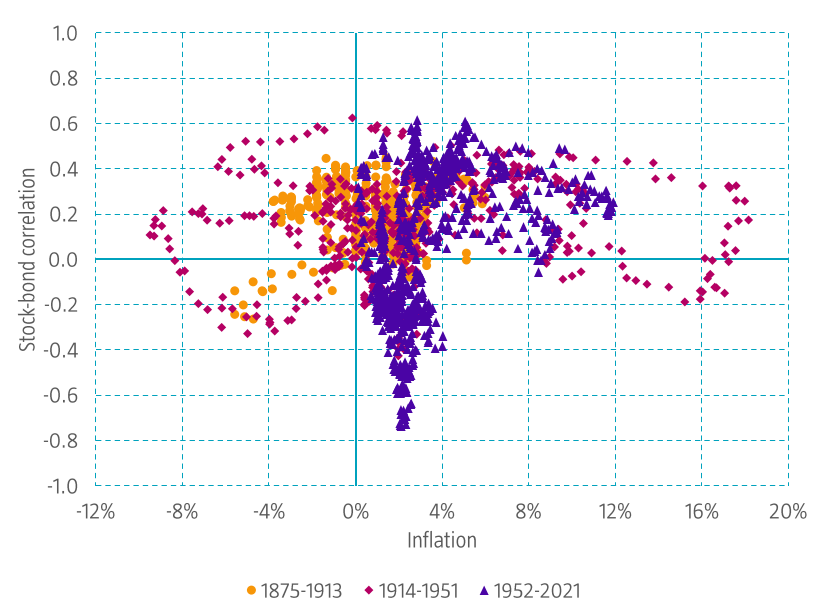
In the paper on Markowitz referenced above, the authors state that “standard deviation and correlations are typically estimated from historical data.”  The chart above, from “Empirical evidence on the stock-bond correlation,” by Roderick Molenaar and others, illustrates a potential problem:

The obstacle one faces when estimating the correlation between stocks and bonds is that it fluctuates extensively across periods.  Volatility of assets classes can vary widely inside of business cycle but remain relatively stable over longer horizons.  Correlations between stocks and bonds, on the other hand can switch signs for very long periods.

One of many good images in the paper, this shows the three-year values of average inflation and correlation mapped across time.  The earlier periods had wider ranges of inflation (and deflation, something that hasn’t been seen in a long time), but even the most recent period shows the dramatic range in the correlation between stocks and bonds.  A big unknown for portfolio construction that doesn’t receive the attention it should.

Postings

“Identifying the Complexity Risks in an Organization” looks at the gravitational pull of complexity in regard to investment choices and the complications regarding due diligence, communication, operations, technology, and regulation.

Under any circumstances, market stress can amplify organizational stress and business model stress.  Increased complexity of whatever sort means that periods of pressure can be more unpredictable than they otherwise would be.  In all respects it pays to gauge the payoff for complexity and the potential downsides involved, so a multidimensional analysis of it should be part of your strategic planning process.

All of the content published by The Investment Ecosystem is available in the archives.

Thanks for reading.  Many happy total returns.

Published: September 11, 2023

Subscribe

To comment, please send an email to editor@investmentecosystem.com. Comments are for the editor and are not viewable by readers.

Identifying the Complexity Risks in an Organization

There is a gravitational pull toward complexity in the investment ecosystem.  Among the forces continually pushing it to be ever more complicated are the relentless quest of analytical inquiry, the appeal of elaborate explanations that project sophistication, and the interests of the industry’s chain of agents, who are compensated for creating and marketing new products and services.

Investment organizations of every type have to deal with issues of complexity.  Identifying where it exists is a necessary part of organizational strategy.  In this posting, we’ll review a few of the elements an investment advisory firm should consider along those lines; many of them translate easily to other kinds of organizations.

For starters there is the reality of human behavior, the bedrock of organizational complexity.  While not a focus here, it should not be overlooked.  As one example, think of the intricacies of the advisor-client relationship and the ways it can go wrong, with the actions of one or another of the parties (and perhaps both) triggering a schism between them.  While advisor training and client education can lessen the probability of such a split, there is an inherent unpredictability involved.

Investment strategies and instruments

Despite the general tendency toward complexity, relatively simple strategies have become more popular over the last few decades, thanks in large part to the inability of active managers as a class to outperform their benchmarks.  That performance shortfall is easiest to spot when judging traditional long-only products, where the comparisons are most obvious.  In response, asset flows for them have suffered.

At the same time, demand has increased in the opposite direction, for more complex vehicles.  In part, that can be chalked up to a greater difficulty in assessing their performance; among the issues across various products are the lack of clear benchmarks, the use of different performance metrics and standards, lags in the reporting of results, and the lack of independent verification of the valuations used to calculate those results.  The absence of comparability has led to the belief that the strategies and managers of alternative investments can add value when more mainstream ones cannot.

As one example, take structured products.  Often presented to clients in superficially simple ways, they leverage “derivatives magic” (to steal a phrase from Matt Levine) to deliver nice profits for the firms that manufacture the products and fat incentives for the advisors who place them, but hard-to-decipher results for the investors to whom they are sold.

In a recent review of research on structured products, Larry Swedroe called them “financial fairy tales,” complete with “shiny features designed to entice naïve investors.”  Yet, an RIA Intel article, “Is Now the Time for Structured Notes?” cites a Cerulli report that predicts further growth because they “can provide unique terms better suited to specific client situations.”  (And the growth won’t just be coming from broker channels, since newer products “can be easily slotted into fee-based accounts.”)

Private equity exposure is also growing quickly at advisory firms.  That is likely to continue, since private equity managers have identified individuals (including their defined contribution plans) as the next avenue of growth — and clients have been pestering advisory firms to give them access to PE funds.  Advocates promote the benefits of diversification (although that is mostly illusory, driven by lags in pricing) and historically strong returns (although the conditions today are much different than those in years past).

In 2022, Don Phillips of Morningstar wrote a column in which he identified “The Four Horsemen of Investing”:

Complexity, concentration, leverage, and illiquidity are the four horsemen of the investor apocalypse, perennial threats that wreak havoc on portfolios and undermine even the best-laid plans of diligent investors and their advisors.

How do you analyze those threats?

A framework for evaluation

One method comes from a 2015 Financial Analysts Journal piece, “A Risk- and Complexity-Rating Framework for Investment Products.”  It uses the positioning of a few examples (including structured products) to illustrate how the range of possibilities could be mapped:

The complexity rating uses five factors:And a very simple grading approach:

A similar process results in a risk rating, allowing the completion of the two-by-two grid.  You may disagree with the placements of some of the examples on that grid, or you may think that the approach is rudimentary.  The point is that having a framework of some kind allows for a degree of specificity that can feed into your decision making process.

Due diligence

Many advisory firms are understaffed and undertrained when it comes to due diligence, forcing them to rely too heavily on information from the managers of products and from third-party research providers.  Any shortcomings along those lines are exacerbated when investing in new and complex areas.  There is an increased burden that comes from evaluating more complex investments because of the need to understand unfamiliar strategies and managers.  Underestimating those demands in a rush to offer new exposures to clients is likely to prove costly over time.

Communication

Talking about complex ideas with a client should always be based upon their individual knowledge and readiness.  Therefore, the discussion of an investment or strategy or plan requires an ability to adapt to the specific communication circumstances at hand, rather than relying on standardized explanations and materials to convey a particular message.  In reality, most investment-speak is counterproductive, charts and graphs that seem obvious to a practitioner can be unintelligible to a lay person, and it is challenging to simplify an investment recommendation and still convey the risks and range of possibilities inherent in it.

With complex investments, all of those issues are magnified.

In a piece on the tradeoff between liquidity and illiquidity, Phil Huber used the example of the Blackstone Real Estate Income Trust (BREIT) to illustrate an important principle.  He observed that Blackstone followed the liquidity terms in the fund documents when it gated withdrawals from BREIT, so it should not have come as a surprise to investors.  But:

What is less clear is how many of the individual investors in BREIT had the liquidity terms clearly laid out to them when the fund was presented by the advisor pitching it to them.  For some investors, it is highly likely that important details were glossed over or left out altogether.  It is exactly these gaps in communication and mismatches in expectations that can transform a feature into a bug in the blink of an eye.

That last sentence — “It is exactly these gaps in communication and mismatches in expectations that can transform a feature into a bug in the blink of an eye.” — is a powerful reminder for advisors of a foundational principle that is easy to violate.

Other issues

One of the biggest challenges for advisory firms is operational complexity.  From a business model standpoint, it is desirable to make everything routine, but meeting the individual needs of clients makes that a pipe dream.  Striking a balance between those two goals is a never-ending endeavor.

Technology is another puzzle.  A wide range of capabilities is needed to run an advisory firm and it seems that there are always shortcomings to be addressed.  Systems developed internally are usually Excel-based and prone to problems, but off-the-shelf solutions may not adequately meet the identified needs — and hiring a firm to do customized development can be very expensive and time-consuming.  No matter the chosen path there are conversion headaches during the process — and new strategies and vehicles will eventually render the final product inadequate in some way.  The hoped-for systems sweet spot is ever elusive.

There have been a number of regulatory changes affecting advisors in the last few years, so compliance concerns are compounding and examinations will be more expansive than they have been in the past.  More and more complexity being built in.

As is the case with due diligence and communication, the introduction of new investment vehicles adds layers of complexity to operations, systems, and compliance, so there is a ripple effect for the organization, with surprises occurring beyond those anticipated on the investment front.

For an unlikely example, consider ESG investing.  It was pretty smooth sailing for quite a while.  Assets were growing, performance was good, and clients who were looking to find investments that fit with their beliefs could do so via an expanding selection of offerings.  Now ESG is a political football and advisors can be caught in the middle of the battle.  Plus, there is an increasing realization that there is more to the analysis of an ESG vehicle than meets the eye.  While not quite greenwashing, putting clients into ESG investments without an understanding of the intricacies of industry rating systems and manager processes (or the systems to properly track them) raises some fiduciary questions.

Under any circumstances, market stress can amplify organizational stress and business model stress.  Increased complexity of whatever sort means that periods of pressure can be more unpredictable than they otherwise would be.  In all respects it pays to gauge the payoff for complexity and the potential downsides involved, so a multidimensional analysis of it should be part of your strategic planning process.

Published: September 9, 2023

Subscribe

To comment, please send an email to editor@investmentecosystem.com. Comments are for the editor and are not viewable by readers.

Sharks, Machines, and Pod Masters (Among Others)

As August turns into September, paid subscribers will be receiving a number of new postings, including ones regarding interviewing, investment committees, insider trading, intelligence analysis, and the challenge of complexity.

If you’re not a subscriber, sign up for a two-month free trial to see all of those and more, plus access to the complete archives.

Goldman

There is palace intrigue at Goldman Sachs, with numerous press accounts indicating that CEO David Solomon is on the hot seat.  How much of that coverage is orchestrated by insiders is hard to tell, but it has been notable that a number of high-level people have left the firm in the last few months, which seems out of the ordinary.  An article in New York offers a look at Solomon and the situation he faces.

A fascinating perspective is put forth by Gapingvoid in a posting titled “Not Everyone Wants Kinder and Gentler,” in which Goldman is compared to the French Foreign Legion:

A very unique, proud, brutal culture, born out of hardship, being uncompromising, being world class bad-asses, and being able to instill genuine fear in anyone going against them.

One school of belief about investment culture (as expressed in the posting) says, “If you’re going to swim with the sharks, removing your teeth is the last thing you need to do.”  But grooming people who will attack the market and competitors but not each other is a fine art.

AI investing

Saguaro Capital Management released a report, “From Data to Decisions: A Primer on AI in Investment Management.”  It aims to provide a guide for practitioners that avoids the “esoteric, sometimes bordering on indecipherable” approach of academic papers and the “fear or fluff” of popular articles that don’t “provide substantial examples or actionable next steps.”

The report covers a lot of ground.  As a first step, the firm says that organizations must truly embrace AI:

Embrace the flux inherent in the field, embrace its fluid nature, and embrace its relentless progress.

Beyond that, the factors for success will be the speed of adoption, the ability to surface idiosyncratic data, and the willingness and ability to adjust investment processes in response to the new capabilities.  Saguaro recounts its own development (and shares its technology stack), offering examples in the categories of idea generation, data gathering, decision making, valuation assessment, and portfolio management.  Also included are some simple questions for internal review (or for use by allocators vetting an organization), a good list of resources, a short AI history, and a glossary of terms.

While Saguaro is focusing on organizational changes and new possibilities, there are plenty of people trying to go directly to picking stocks with today’s technology.  For instance, an Insider article, “A hedge fund manager shares 2 ChatGPT prompts and the AI plugin he used to filter top stock picks.”  Elsewhere, Matt Levine took a look at the irony of AI-managed portfolios underperforming an AI-driven market because of light weightings in AI-related stocks — and offered this perspective:

Investing is pattern matching and imaginative leaps, and the AI is bad at imagination.

(Actually, large language models are quite good at imagination in many realms, but so far apparently not regarding investment problems.)

Also, for those that have access to it, the August 14 edition of Pensions & Investment has a set of three articles, plus two opinion pieces (here and here), about the adoption of AI strategies by asset owners and money managers.

Not dead yet

The social media site formerly known as Twitter has been in obvious decline since Elon Musk took over.  Most every decision that has been implemented has led to lower engagement and lower morale among those who have found the site to be a source of investment perspective and ideas over the years.

While many good contributors have left, others remain.  Here are three updates of interest from the last few days:

~ Fifteen insights from Lee Ainslie, via the Invest Like the Best podcast.

~ Nine sources of advantage, from Shane Parrish of Farnam Street.

~ “Mr. Market” and “Miss Owner-Manager” are fundamentally out of sync.  By Andrew Hollingworth, via @borrowed_ideas.

Other reads

“How Many Eggs? How Many Baskets?” Strategic Investment Group.

There is a big difference . . . between the idea that it is hard to find excellent managers and the idea that there are very few excellent managers.

Simply, the more managers an investor can research and evaluate effectively, the more managers can be in the portfolio without giving up performance.

“Intelligent vs. Smart,” Morgan Housel, Collaborative Fund.  A wonderful parsing of favorable traits that can help you consider the qualities of the people around you (and of yourself).

“Know What You Own: Your Portfolio Needs New Glasses,” Paul Kenney, Syntax.

Using individual product lines to analyze public equity managers, benchmarks, and portfolios provides investors with an enhanced level of precision, enabling better analysis of investments and embedded business risks.

“Private Credit,” Jennifer Liu, et. al, UBS.  A primer on the hottest growth area for institutional investors.

“Macro illusions — which ones are you suffering under?” Tyler Cowen, Marginal Revolution.

I am saying that various doctrines appeared to be “quite true” on a temporary basis, and yes I stress that word temporary.  Then they are not true, or at least not obviously true any more.

“What We Talk About When We Talk About Moats,” Todd Wenning, Flyover Stocks.  Discussions about economic moats should deal with three questions:  the source of a company’s advantage, how to measure it, and whether it is widening or narrowing.

”The future of ESG after the bear market,” CREATE Research.

Three in every five survey participants [comprised of 148 pension plans] believe that ESG investing is not a bull market luxury but a foundational trend.

“Private Equity’s Woes Spur Rise in NAV Loans — And Managers Offering Them,” Alicia McElhaney, Institutional Investor.  Also, a follow-up from McElhaney, “Allocators Aren’t Happy With the NAV Lending Craze.”

“The maverick and the status quo,” Seth Godin, Seth’s Blog.

The maverick isn’t the selfish gunslinger of myth.  In fact, she’s focused on resilient, useful interactions that change what we expect, pushing back against the inertia of gobbledygook and bureaucracy.

“How to sell an asset manager,” William Robins, Citywire Amplify.  “You need a culture fit, an operational fit and incentives to be aligned.”

“Understanding Changes to Non-GAAP Reporting,” Olga Usvyatsky, Calcbench.

Notably, the updated SEC non-GAAP interpretation states that metrics can be misleading even if properly disclosed.

“Identifying and measuring sources of alpha in gender factors,” Christine Cappabianca, Impax Asset Management.  A review of studies on board diversity, executive diversity, innovation, and sustainability, plus “a fascinating sub-theme” regarding risk management and accounting practices.

“The Expanded ETF Ecosystem,” Arro Financial Communications.

The goal of this guide is to serve as a comprehensive companion to the expanded ETF ecosystem, encompassing both traditional passive ETFs as well as these new semi-transparent models that are beginning to see the light of day.

“Are ‘Platform’ Teams The Key To VC Success In Down Markets?” Dale Chang, Crunchbase.  “A well-constructed platform team as part of a venture capital firm has a positive impact in both up and down markets.”

Evergreen observation

“The single biggest problem in communication is the illusion that it has taken place.” — George Bernard Shaw.

A moment of reckoning?

Two articles from the Financial Times focused on those darlings of the day, multi-manager multi-strategy hedge funds (the subject of a March Investment Ecosystem essay, “Ascendance of the Pod Masters”).

“The Big Read” by Harriet Agnew and Ortenca Aliaj asks, “Are hedge fund pioneers facing the end of a golden era?”  According to the authors, the fabulously-successful multi-manager funds are facing “a moment of reckoning” driven by capacity constraints, the escalating war for talent, some (modest) pushback on fees and lockup terms, higher interest rates, regulatory scrutiny, and concerns about whether leverage and crowded trades could precipitate problems at a firm (and perhaps beyond).

An Alphaville piece by Robin Wigglesworth expands on that and offers a number of illustrations from investment bank research reports, including the one that appears above, which shows how asset growth at the pod shops has eclipsed that of the rest of the hedge fund industry of late.

Postings

“Analyzing Internal and External Investment Networks” was brought in front of the paywall for all to see.  Check it out.

All of the content published by The Investment Ecosystem is available in the archives.

Thanks for reading.  Many happy total returns.

Published: August 28, 2023

Subscribe

To comment, please send an email to editor@investmentecosystem.com. Comments are for the editor and are not viewable by readers.

Systematic Evaluation, Nuanced Factors, and a Very Toxic Cocktail

If you like the Fortnightly, you can check out the full range of content, including all of the archives, via this link, which will give you two months of free access.

A very toxic cocktail?

“Query:  Can there be too much of an illiquid good thing?”

That inquiry animates “Alma mater over her skis,” the lead essay in the July 28 issue of Grant’s Interest Rate Observer:

Interest rates, the everything bubble, conditioned expectations, institutional forgetfulness and the wobbling secondary markets for private investment assets feature in this unfolding speculation on the latent liquidity crisis in modern endowment portfolios.

To consider the possibilities, Grant’s references Laurence Siegel’s 2008 article in the Journal of Portfolio Management, “Alternatives and Liquidity: Will Spending and Capital Calls Eat Your ‘Modern’ Portfolio?”  (A draft of the published piece is available here.)  The JOPM article — timely once again — concluded in this way:

In today’s markets, with many of the most popular asset classes being illiquid, investors need to devote substantial attention to liquidity so that the goal for which the asset pool was assembled can be achieved.

Siegel’s analysis showed the math that comes into play in bear markets and “catastrophic” ones by comparing a starting allocation to alternatives of 15% with one that begins at 50%.  At higher levels of alternatives, the percentage of liquid assets can drop to untenable levels during difficult times.

That looked to be the likely eventuality during the financial crisis, and there were some fire sales of private assets and other maneuvers in response.  But, as Grant’s notes, “A ‘V’-shaped credit recovery saved the bacon of illiquid investors far and wide.”

Advocates of private assets are quick to supply historical evidence that those investments weather downturns well (and, due to lagging prices, cushion bottom-line portfolio returns).  But the few data points to date do not represent the full spectrum of future possibilities.  Grant’s quotes an unnamed endowment manager:

If you have even moderately higher inflation, not much equity market return, and you’re already compromised from a liquidity standpoint, that’s a very toxic cocktail.

Evaluating systematic managers

Dimensional released a short set of recommendations on the process of “Systematically Evaluating Systematic Managers.”  They include an outline of criteria to use before hiring a manager, broken down into the areas of research, design, process, and track record, as well as a section of to-dos after hiring, including judgments about premium capture, risk management, and total costs.

The firm is, of course, talking its own book:

If done well, a systematic active approach can be more reliable and less costly than a traditional active approach without sacrificing the greater diversification and easier monitoring typical of indexing.

The before- and after-hiring breakdown is a bit artificial, since most everything in either category should also be included in the other one.  Taken together, all of the bullet points represent a good blueprint for analysis, even though they are topic-level lists.  Layers of important details aren’t included (but there are a number of links to other materials).

When asset managers issue a this-is-how-we-should-be-graded scorecard, it can help the parties to identify common expectations.  But allocators need to find the elements that are missing from that self-test — and to independently judge each attribute — so that they are free from the manager’s own conclusions.

Nuanced factors

Chenmark buys small businesses.  That may seem far afield from your part of the investment ecosystem, but its latest weekly newsletter deals with a universal issue.  The piece compares two companies that Chenmark had the opportunity to buy and explains why it selected the firm with a lot of hair on it rather than the one in which everything seemed perfect.  The trade-offs are analogous to the choices that investors make regarding stocks, bonds, private assets, investment managers, etc.  There is no absolute rule of thumb:

There are plenty of examples of businesses that are “cheap for a reason” that end up being even worse than expected, and there are certainly businesses that are worth every penny of a high valuation.

The key thing we try to remember is that in any deal, business quality, price, and the associated expected return are all highly nuanced factors that can intersect with each other in ways that can be counterintuitive.

Other reads

“What managers get right (How to get that 2nd meeting),” Shannon O’Leary, LinkedIn.

Check your ego at the door.

Understand the organization.

Articulate your special sauce.

Show up as true thought partners.

“How bonds ate the entire financial system,” Robin Wigglesworth, Financial Times.  “A very short, very wild history of the market that will shape the next financial crisis.”

“The Price of Risk: With Equity Risk Premiums, Caveat Emptor!” Aswath Damodaran, Musings on Markets.

I have an obsession with equity risk premiums, which I believe lie at the center of almost every substantive debate in markets and investing.

“Private Debt Yield Decomposition,” StepStone.  Starting with a “base case loan,” estimated adjustments for capital structure, loan to value, leverage, EBITDA, ownership, and covenants.

“Expanding private markets are redefining their public counterparts,” Satyajit Das, Financial Times.

The rise and rise of private equity and debt is reshaping public markets with consequences we are only beginning to understand.

“Why the Biggest Target-Date Funds Have Underperformed,” John Rekenthaler, Morningstar.  Bottom line:  Allocations to foreign stocks have hampered performance versus traditional balanced funds that have most or all of their assets in the U.S.

“Building portfolio resilience in the face of uncertainty,” Amanda White, Top1000Funds.com.

A group of investors came together in London to share their ideas on how to best assess risk and position their funds for both the challenges and opportunities in this increasingly demanding and puzzling market.

“The Term Structure of Machine Learning Alpha,” David Blitz, et. al, SSRN.  Alpha after transaction costs for machine learning models has declined over time, but varies depending on the horizon selected.

Longer-horizon strategies select slower signals and load more on traditional asset pricing factors but still unlock unique alpha.

“The partisan portfolio divide,” Joachim Klement, Klement on Investing.  The increase in political polarization is reflected in portfolios, which have become weighted according to those views — an unfortunate development.

“Ideas are Dimes a Dozen: Large Language Models for Idea Generation in Innovation,” Karan Girotra, SSRN.  Two of the factors that are likely to lead to profound changes in innovation practices:

In short, the productivity race between humans and ChatGPT is not even close.

In most innovation settings, we’d rather have 10 great ideas and 90 terrible ideas than 100 ideas of average quality.

“Regression is a tool that can turn you into a fool,” Wesley Gray, Alpha Architect.  “Behold, my magical alpha!”

The order of things

“Left unchecked:  Organizations default to bureaucracy.  People default to distraction.  Both result in a lack of focus and speed.” — Shane Parrish.

A single decision

These charts are from an article in the Wall Street Journal, “AI Mania Triggers Dot-Com Bubble Flashbacks.”  The ascent of Nvidia as AI has taken hold of the imagination has been stupendous, on top of big gains before that.  But the specter of high fliers past makes “investors question whether the stock can live up to the hype.”

Nvidia’s price/sales is compared to Cisco’s a quarter century ago.  That stock demonstrated that a super-high valuation can lead to underperformance even when earnings rise over time.  (A famous quote from Scott McNealy talked about the improbable math facing the stock of Sun Microsystems when it was trading at a mere ten times sales.)

Ted Seides wrote a piece about the challenges faced by asset managers because of the “Magnificent Seven” stocks, including Nvidia, that dominate the market capitalization indexes against which managers are measured.  How much of the seven you own is the “single decision” that determines how you will be judged — a no-win situation, making this a unique time:

It’s less about what to do and more about how to educate your constituents on the choices at hand and expected outcomes to come.  Proper communication is necessary because the one decision will in fact determine relative performance in equities.

Posting

“Examining the Investment Memos Produced by Asset Owners” summarizes research from Addepar about the structure of institutional investment memos and provides observations about typical shortcomings within them that impede good decision making.

All of the content published by The Investment Ecosystem is available in the archives.

Thanks for reading.  Many happy total returns.

Published: August 14, 2023

Subscribe

To comment, please send an email to editor@investmentecosystem.com. Comments are for the editor and are not viewable by readers.

Examining the Investment Memos Produced by Asset Owners

A report published by Addepar, “Investment memos and decision-making,” begins with this paragraph:

Investment memos are the foundation of most investment processes.  Yet despite their importance, there’s practically no published research in either academia or industry on best practices in crafting or using investment memos.  Our findings illustrate new methods and processes in the crafting and use of memos.

The focus of the report is on the internal memos produced by institutional asset owners, specifically those assessing private funds.  Other asset classes and fund structures may require different content, and there are many kinds of analyses and recommendations produced by advisors, securities analysts, and other investment professionals that fall outside of the scope of the Addepar report.  However, the themes and principles addressed apply equally to that broader spectrum of situations and documents, making it a worthwhile reference for professionals and organizations beyond the primary audience.

A foundational belief of the work of The Investment Ecosystem is that success in investment roles depends on “analysis plus communication,” and that the importance of the communication component of that equation is generally unappreciated by most investment professionals and organizations.  (The Investment Ecosystem will be introducing a new course, tentatively titled “Communication Skills for the Investment Professionals,” later this year.)  The Addepar report, authored by Barbara McEvilley, Ashby Monk, and Dane Rook, is a welcome review of an influential but largely unexamined branch of the industry’s communication tree.

Valuable windows

As the authors indicate, investment memos “serve as valuable windows into the inner workings of an organization’s decision-making,” exhibiting the assumptions, logic, and processes that come into play when investments are being selected.  The corpus of memos provides evidence of the lived beliefs of an organization (which may or may not comfortably align with the stated ones).

Given the tools now in hand to analyze large numbers of documents, organizations have the ability to make better judgments about the quality of their decision making and to look for patterns of success or failure in the selection process (applying the capabilities described in the last posting, “The Dawning Era of Qualitative Analysis,” in a different way.)

Structure and process

Of the 54 organizations surveyed by the authors, 97% “have a formal investment memo template and process.”  The common template includes the “proposed investment, people involved (both internally and externally), prospective deal terms, associated risks, performance benchmarks, and an opportunity’s fit within the investor’s broader strategy or portfolio.”

In addition, the Addepar report outlines steps in the process of producing memos, including screening (using a draft as a gate “to avoid wasted time and effort”); writing the complete memo; critiquing it within the organization (which may involve red-teaming the opportunity); rating the key components of the investment, often according to a specific scoring discipline; and approving it within the decision rules of the governance structure.

After the fact, there are three more (potential) steps.  The storing of the information (and the future accessibility of it) can vary greatly, depending on the sophistication of the technology environment.  Also variable is the subsequent learning that comes from the decision process.  As indicated by the authors, the majority of organizations surveyed do not “have structured processes for ex-post analysis of memos . . . which is noteworthy in that it reveals how much value is not being captured in current memo processes.”  Finally, there are ideas for improving the production of memos, including suggestions about which elements could be refined (the actual writing of a memo is a common pain point).  Plus, the authors indicate that at some organizations the governance, oversight, and approval of memos should be reexamined because the pieces don’t seem to fit together as they should.

Typical shortcomings

The primary purpose of the Addepar report is descriptive, identifying how things are done now and providing some areas to address going forward — as well as issuing a general call to action.

Here are some additional ideas about the composition of reports from The Investment Ecosystem’s online due diligence course and workshops within organizations conducted by it:

Structure.  In addition to the required elements that an organization agrees should be in an investment memo, there is the question of length.  Some long memos can be well-crafted and illuminating, but many are long and boring and not very revelatory.  The tendency is for the authors to tell everything they know, which impedes effective communication.  Editing for readability and clarity is essential.

Documentation and discovery.  The due diligence process often gets bogged down with the collection of information to the point that little real discovery about the manager is occurring.  Memos provide the evidence of that — and suffer from that lopsided allocation of attention.  Documentation is necessary as a part of the due diligence process, but that doesn’t mean it all needs to be part of an investment memo, where it can bury the most important information (the identification of the differentiated attributes of the firm in question and the discoveries during due diligence that support those conclusions).

Narrative dominance.  The major problem with investment memos is that they largely reflect the narrative of the manager about its qualitative attributes instead of the conclusions of the allocator.  The reflected narrative dominates sections of most memos and there’s not a clear divide between “what they say” (that is, the manager) and “what we think” (from the allocator) about what the manager says.  The members of an approval body often can’t tell that large sections of what they read in a memo is mere reporting of the manager’s story rather than an independent analysis of it.

The need to sell the idea.  All asset management firms are messy and have things that they need to improve, but you wouldn’t know it from reading most investment memos.  The lack of discovery of that mess during due diligence is compounded by the need for those working on an idea to sell it within their own organization.  The best organizations are unafraid of voicing shortcomings and of taking a realistic, balanced view of a manager — warts and all — and coming to an informed decision.  Within many other organizations, too much talk about the kinds of challenges and gaps and needs that an asset manager has will scuttle a recommendation’s chances.  Unrealistic expectations of perfection on the part of managers impedes sound selection practices.

Sunk costs and rubber stamps.  There is nothing worse that doing a great deal of work and having it derailed by what you think is bad information, political maneuvering, or a flawed process within an organization.  But the opposite kinds of problems may be more prevalent.  Because of the amount of work that can go into due diligence and memo writing, a recommendation can take on a life of its own.  The sunk costs of time and resources can distort what should be objective decision making.  And by the time something comes up for final approval, it can be a fait accompli, rendering the approval process meaningless.

The Addepar research is an important step in drawing attention to the critical role investment memos play and the need to vet — and work to improve — their quality and effectiveness (something that The Investment Ecosystem has done on behalf of a number of asset owners).

Published: August 9, 2023

Subscribe

To comment, please send an email to editor@investmentecosystem.com. Comments are for the editor and are not viewable by readers.

Life Cycles, Faded Giants, Operational Improvements, and AI Hype

If you’re not a subscriber already, you should sign up for the free tier to receive future Fortnightlies and a few other postings — or try out all of the content for two months without being charged, by using this link.  (It’s not very obvious from the form, but the first two months will be free.)  You’ll also get access to the archive of 150+ essays.

Private equity operational improvements

Dan Rasmussen of Verdad published a posting regarding the operational performance of companies bought by private equity funds to see whether this narrative of the managers shows up in the numbers:

Private equity firms earn high returns by improving the operations of the companies they buy.  By taking majority stakes and installing an engaged board, private equity firms can add significant value to often undermanaged small companies.  Or so goes the industry marketing spiel.

Verdad’s conclusion?  “We don’t see any evidence” of it.  Of all of the charts that track the before and after conditions, the only one that really stands out displays the big change in leverage.  Thus, “there is a new paradigm to understand the PE model, and it’s very, very simple.  By and large, as an industry, PE firms take control of businesses to increase debt.”

A subsequent Q&A addressed questions submitted by readers about the original review.  It includes a variety of additional charts.

Life cycles

The latest report from Michael Mauboussin and Dan Callahan is “Birth, Death, and Wealth Creation: Why Investors Need to Understand Corporate Demographics.”  It begins, “Valuing the equity of a public company is a bold exercise,” since standard valuation techniques derive much of a company’s value from distant years:

A thoughtful valuation requires confronting some empirical realties:  most companies do not live that long and do not generate good returns for shareholders while they are alive.

The report examines “how companies are born and how long they live, why they die, and patterns of shareholder returns.”

Faded giants

Speaking of life cycles, while we know it can happen, it’s always a bit surprising when large, admired investment funds wither away.

In 2016, the Global Absolute Return Strategies product from Standard Life product was a juggernaut.  It was the largest open-ended fund in the UK, and counting versions of the strategy in other channels, it had £45 billion in assets.  Now, with AUM at just 3% of that, it’s being merged out of existence by Abrdn (which combined with Standard Life in 2017).  A story from Citywire Selector provides the play-by-play, as seen by retired allocator Bob Boyda.

Another big name, Sculptor (née Och-Ziff) Capital Managements is being sold to Rithm Capital.  According to an article in the Financial Times, the firm still was managing more than $30 billion in assets, but the price of its publicly-traded shares was off more than 90% since its listing in 2007.

A great piece by Marc Rubinstein covers the tumultuous times of the firm.  He writes that “as a public company, Sculptor opened the veil on the inner workings of a hedge fund”:

The sixty 10-Qs and 10-Ks it filed with the Securities and Exchange Commission along the way tell a story of how money is made and lost in the industry, how the spoils are shared and how challenges are managed.  If you want to understand the business of hedge fund management, Sculptor is a good case to study.

The reasons for the declines of these giants are familiar:  scale issues, fights over money, and changes in people, strategies, and the markets (of GARS:  “their alpha stream ran dry”).

Questions

A posting from Gustavo Razzetti of Fearless Culture, “The 50 Most Powerful Questions Smart Leaders Can Ask,” is not just for “leaders.”  The questions are good prompts for anyone at any level of an organization — and serve as excellent probes when doing due diligence.

Other reads

“Generative AI: Hype, or Truly Transformative?” Goldman Sachs.  A nice mix of information and interviews, including one with Gary Marcus, who thinks that “the intelligence of AI systems is being overhyped”:

At the core of all current generative AI tools is basically an autocomplete function that has been trained on a substantial portion of the internet.

“Does Lowball Guidance Work?” Jing Chen, et. al, The CLS Blue Sky Blog.  On the competing theories of “earnings uncertainty” and “market appeasement” in earnings guidance; the research suggests that “there are short-term capital market benefits to issuing lowball guidance, but the benefits dissipate eventually.”

“Which Regulatory Filings Are Most Truthful?” Jason Voss, Deception and Truth Analysis.

If you are an investor relying on 10(k)s and (q)s in your due-diligence work then you should know that companies score as more deceptive in the second quarter, and especially in the third quarter.

“The junior bankers who are embarrassed and offended by $300,000 offers,” Daniel Davies, eFinancialCareers.  “Of all the strange practices of the investment banking industry, ‘on-cycle recruiting’ for private equity firms is possibly the silliest.”

“Mining for Alpha with Index Funds,” Daniel Sotiroff and Jonathan Baikov, Morningstar.  These days, many funds “are passive in the sense that they track an index, but they are active in the risks they take and rewards they seek.”  (More on the continuing problem of confusing terminology.)

“A Cautionary Tale For Pension Funds Piling Into Private Markets, Leo Kolivakis, Pension Pulse.

When you own an [infrastructure] asset like this, you need to think and act like the Germans, not like Macquarie.

“There’s a Gaping Hole in the Subscription Lending Market,” Alicia McElhaney, Institutional Investor.  Subscription lines have been used increasingly over the last few years (boosting IRRs), but supply is declining.

“When Hindsight Becomes Foresight: Replicating Investment Performance,” Nicolas Rabener, Enterprising Investor.  Can you replicate long-short hedge funds using just the S&P 500 and cash?

“The Problem With Performance Attribution,” Clare Flynn Levy, Essentia Analytics.

If you’re an allocator of capital to equity managers, it’s worth asking any manager on your shortlist to show you their decision attribution analysis before you invest.

“How the Fed Saved Structured Note Issuance,” Michael Ashton, E-piphany.  “Not everyone hates higher rates!”

“Legal and travel expense drafting in LPAs,” Colmore.

For the majority of the LPAs we reviewed, funds were silent on private air travel, leaving LPs potentially exposed to excessive expense obligations of this nature.

“The State of Organizations 2023,” McKinsey & Company.  “Ten shifts that are transforming organizations — and what to do about them.”

(Shameless plug >>)  “‘You have to get past the narrative’: How to shine a light on fund shops’ culture,” Tom Brakke and Alex Steger,  Citywire Pro Buyer.

Just right

“A great way to think about a model is to use the Goldilocks analogy.  A model should not be too complex or too simple.  Too complex with too many variables and we have an overfit problem.  Too few variables and we are left with a problem that an unspecified factor will drive predictions.” — Mark Rzepczynski.

Playing the hype

Sparkline Capital’s latest research picks up on the AI-hype theme:  “Drawing lessons from the dot-com bubble, we show how ‘intangible value’ can help investors navigate the hype cycle.”  A couple of pictures show how Sparkline divided (in retrospect) the internet stocks into expensive and cheap cohorts.

The cumulative excess return for each varied during the season of hype and, especially, after the bust.

Disaggregating the total return of the cheap stocks versus the expensive ones, the story is pretty obvious.  The expensive ones did show stronger sales growth, but they had been so over-hyped that their valuations (in terms of multiples of sales) had nowhere to go but down — and it was a long way down.

In a similar fashion, Sparkline divides the AI plays into two buckets, arguing that playing the expensive ones will not work this time either.

As with all of Sparkline’s research, this piece is full of interesting charts and ideas.  It also includes a look at a hot topic of the day, the exposure of various jobs to AI.  The exhibit, “Financial Advisor AI Exposure,” will be of interest to those in the advisory world.

Postings

Once or twice a year, a paywalled posting is made available for all on LinkedIn.  The most recent one to be so featured is “Orbiting the Asset Management Hairball,” which explores the tangled web of convention and the possibilities of creativity.  (While you’re on the site, reach out to connect.)

“The Dawning Era of Qualitative Analysis” recounts the need for qualitative assessments of asset managers (the core of the due diligence training and services provided by The Investment Ecosystem) — and the emerging tools that can aid that process.

All of the content published by The Investment Ecosystem is available in the archives.

Thanks for reading.  Many happy total returns.

Published: July 31, 2023

Subscribe

To comment, please send an email to editor@investmentecosystem.com. Comments are for the editor and are not viewable by readers.

The Dawning Era of Qualitative Analysis

A commonly-asked question from those considering due diligence training from The Investment Ecosystem is, “What proof is there that this intensive focus on qualitative research results in better manager selection?”

The straight answer is that there is no “proof,” in the sense that there are no studies that have attempted to do such an analysis in any kind of a thorough way.  We know what doesn’t work — performance chasing — although that hasn’t stopped allocators from gravitating toward those managers that have the best historical performance.

There are a few other quantifiable factors that have been studied which provide important evidence, the strongest of them being the level of costs charged to the investor.  But none of those indicators is fail-safe, so “proof” is evasive.  Furthermore, the body of evidence for some quantitative rules of thumb is often limited in scope, being primarily based upon the attributes of equity mutual funds, especially those in the United States.  Other asset classes and geographies have not been studied to the same extent.

Analyzing qualitative factors is exponentially more difficult.  While allocators talk extensively about the importance of the qualitative assessment of a manager, very few of them codify or analyze their findings in an in-depth, systematic way.  Therefore, while the impressions of those qualitative factors may be leveraged in the selection process, they aren’t tracked by individual allocator organizations (and if they are they aren’t shared externally), making more global examinations of manager characteristics out of the question.  There is no “proof” because the raw information needed to buttress such a claim has never been collected or disseminated.

Analyzing private equity funds

Before we return to that theme, let’s look at a new paper, “Limited Partners versus Unlimited Machines; Artificial Intelligence and the Performance of Private Equity Funds,” by Reiner Braun and four co-authors.  They analyzed around four hundred private placement memorandums (PPMs) from private equity firms, using econometric and machine learning methods to study fund performance and fundraising success.

The evaluation of private equity firms presents some hurdles for investors:

Private markets are characterized by non-standardized disclosures and significant information asymmetries between managers and investors.

Unlike mutual fund databases, private equity datasets are thin.  Moreover, PE fund managers have considerable degrees of freedom to frame their track records at the time of fundraising.

The authors find that the quantitative information provided in the PPMs does not predict future performance.  But that lack of corroboration does not hinder allocations, since “PE firm reputation (as proxied by size and number of funds previously raised) as well as past performance are significantly related to fundraising success.”  Unfortunately, the research also shows that fundraising success is “unrelated to future performance.”  Popular fund offerings don’t outperform.

On the other hand, using natural language processing and machine learning techniques allowed the researchers to report “the central contribution of our paper:  the analysis of qualitative information.”  Some of their conclusions:

Our main results show that the three machine learning algorithms are remarkably effective at predicting fund performance.

One interpretation of the results is that institutional investors do not incorporate qualitative information but do incorporate the quantitative information provided to them.  And as a direct consequence, quantitative information is unrelated to future performance, but qualitative information is.

In our view, this pattern of finding provides evidence that qualitative information is a valuable tool to learn about fund manager skills and may be one of the reasons why some LPs are better at this exercise than others.

Our findings suggest that the average investor does not seem to take into account relevant qualitative information when selecting fund managers.

Methodology and future analyses

The paper outlines in detail the approach taken by the researchers.  Their process concentrates on the strategy part of the PPMs.  Most of the other sections show a high degree of consistency in content, since “lawyers tend to largely copy-paste across PPMs.”  In contrast, firm principals are involved in laying out the strategy description, so there is more variability from which to draw inferences.

As the authors state:

The application of new techniques to the analysis of private markets is just beginning. . . . There are certainly other areas of potential improvement as the disciplines of textual analysis and machine learning are growing rapidly and will provide even more powerful methods to be applied in the context of private capital markets.

Larger datasets are needed, closer inspection of some of the non-strategy sections of PPMs might yield discoveries, and other kinds of documents from managers which provide additional qualitative information may prove to be valuable.  Also, the “marginal influence of features” on ultimate outcomes needs to be analyzed further; everyone wants to know which manager attributes truly matter.

This is just one study, so its conclusions shouldn’t be overemphasized, but doesn’t it whet your appetite?

Untapped possibilities

Which brings us back to the opening theme.

Allocators are sitting on a gold mine of information that can be analyzed.  Materials sent by managers across the years can be studied in ways that they couldn’t be before — and the same can be done with investment memos about those managers.  What would such an analysis reveal about the process of selection by allocators and the attributes of manager success?

All of this points out the need to start documenting qualitative characteristics, so that selection preferences can be judged and modified over time.  While we are a long way from the ever-elusive “proof,” the techniques to evaluate qualitative attributes of managers (and of allocators) are now at hand.

Here’s that list of training options.  You might also take The Basis Point Test.

Published: July 27, 2023

Subscribe

To comment, please send an email to editor@investmentecosystem.com. Comments are for the editor and are not viewable by readers.

Growth, Value, Indexing, and Evolutionary Investing

The Investment Ecosystem is all about the continuous improvement of investment professionals and organizations.  If you are looking for some useful ideas for problems or initiatives on your plate, schedule a  Zoom session or phone call during Tom Brakke’s open office hours.

On to the readings . . . .

Investment beliefs in action

Stuart Dunbar of Baillie Gifford wrote a piece five years ago called “Let’s talk about actual investing,” which laid out the what the firm saw as a drift in the asset management industry from the real mission of what “actual investors” do:

Hence beta became the default investment portfolio and “outperformance” of that became the value proposition of the active management industry.

This, in turn, led to active managers focusing less and less on fundamental investment analysis, and more and more on the completely circular activity of trying to marginally outsmart each other.  In this marginal world the definition of investment success became a relative one, along with costs and transparency.

In a recent podcast (a transcript is provided), Dunbar reiterated the firm’s philosophy that actual investing concerns “companies and capital allocation.”  The discussion includes ideas about the link between interest rates and growth investing (“it’s overplayed”); the difficulty of predicting what companies are going to do well in the years to come (some failures are noted); and whether you should just let stocks ride no matter how giddy investors get:

We’ve looked back at if we should have done more at the beginning of 2021 to lock in what was a sort of crazy performance in 2020.  And the answer on the whole is no.

Oaktree is a much different kind of investment firm than Baillie Gifford, but in his latest memo (“Taking the Temperature”) Howard Marks laid out two tenets of its founding investment philosophy that struck a similar note:

Number five:  “We don’t base our investment decisions on macro forecasts.”

Number six:  “We’re not market timers.”

The memo is about the exceptions to those rules, the five times over his long career when Marks thought the macro environment was such that it made sense to alter the firm’s normal approach.  But, in contrast to Baillie Gifford’s views:

It’s easy to say you don’t invest on the basis of macro forecasts, and I’ve been saying this for decades.  But the truth is, if you’re a bottom-up investor, you make estimates regarding future earnings and/or asset values, and those estimates have to be predicated on assumptions regarding the macro environment.

What we never do is project that the macro environment will be distinctly better than normal in some way, making winners out of particular investments.

That’s something that growth investors are prone to do (since selling optimistic assumptions is baked into that part of the industry), even if they say that macro isn’t important in their process.  In contrast, Marks references Oaktree’s “usual emphasis on defensiveness” which stems from its value orientation.

Two firms, each very successful, with contrasting beliefs in many respects, but they intersect in that they generally avoid market calls.  Too often a lack of understanding by investors of how asset manager beliefs translate into actions — and into patterns of performance in different market and economic regimes — leads to reactive performance chasing (and fleeing).

Formulas

If you search online for information about the CFA Program, you’ll probably run into aggregations of formulas you need to know to prepare for it.  As examples, here are ones for the Level 1 exams, from Wiley (99 pages worth) and ICICIdirect (numbered 1 through 199).

An interesting exercise would involve marking up the lists as to which items really matter to pass the test and, more importantly, which ones really matter for success in the investment profession.  With machines able to do the heavy quantitative lifting — and according to the news of the day, much more than that — memorizing the formulas has never seemed less important.

Books, etc.

Two firms (with different sensibilities) have released lists of books and other content sources that might be of interest to you.  Broyhill Asset Management issued the latest annual edition of its book club (links to the previous ones are included in it).  Another good list comes from Andreessen Horowitz, which leads off with the masterful novel Trust, by Hernan Diaz.

Other reads (and a listen)

“Value Restoration Project,” Seth Klarman and James Grant, Grant’s Current Yield Podcast.  A discussion about the latest edition of Security Analysis and the application of its principles in today’s environment.  Klarman:  “I’m deeply worried about the effects of higher rates.  The world got used to low rates; it became a habit.”

“Sex, Drugs and Spreadsheets: Dr. Glazer Treats Wall Street’s Addiction Surge,” Matt Wirz, Wall Street Journal.

Most are traders, fund managers, investment bankers and corporate lawyers.  Almost all are men who are afraid to tell their employers about their ailments, much less ask for medical leaves.

“The Keys to Sovereign Development Fund Success: Innovation, Collaboration & Commercial Focus,” Carter Casady, et. al, SSRN.  Will “the collaborative investment model” join the Yale, Norway, and Canadian models in the pantheon?

“Can Evolutionary Biology Inform Investing?” Laurance Siegel, AJO Vista.  A thoughtful review of a book that addresses key forces in the investment ecosystem.

“No Right Way,” Jonathan Clements, HumbleDollar.

The bottom line:  Almost nobody indexes in the theoretically correct way.  Instead, we make all kinds of judgment calls as we wrestle with eight key questions.

“What not to say on an earnings call,” Joachim Klement, Klement on Investing.  “The market seems to pick up on” non-answers by company executives.  (But aren’t non-answers actually the most honest ones in some situations, or is bluffing better?)

“Quant funds move into unfettered pink sheet stock trading,” Nicholas Megaw and Madison Darbyshire, Financial Times.

So-called quant hedge funds and proprietary traders are being drawn towards this corner of the market by a combination of improved liquidity and the increasing difficulty they face making money in the large-cap markets they have previously focused on, say investors, market makers and exchange executives.

“Endowment Spending Amid Record Inflation,” Tracy Abedon Filosa, Cambridge Associates.  The effect of inflation on endowment health hasn’t been a consideration in forever (but now is), casting spending policies and operating costs in a new light.

“The Most Successful ETF Launch of All Time Raises Questions,” Jeffrey Ptak, Morningstar.  Like others, the fund’s dollar-weighted returns have lagged its total returns, but it differs in that almost half of it is held by affiliated entities (which also include the fund in the model portfolios they provide to advisors).  It will be an interesting ongoing case study.

“Make Doing Nothing the Default,” Joe Wiggins, Behavioural Investment.

For investors it is undeniable that there is a powerful and inescapable assumption that we should be constantly active.  Why is the idea so pervasive?

“Giant Asset Managers, the Big Three, and Index Investing,” Dorothy Lund and Adriana Robertson, SSRN.  “We demonstrate that it is a mistake to equate passive investing with index funds; index funds with the Big Three; and the Big Three with giant asset managers.”

“A Boomer’s Guide to What Happens When You Can Earn 5% on Your Bank Deposits,” Rich Handler and Brian Friedman, Jefferies.

In previous letters, we discussed at length the complications caused by free money.  It artificially pushes investors further and further out on the risk curve in search of the elusive yields required to match their assets with their liabilities.  But the further you are out on the risk curve, the heavier the inevitable toll is when you need to re-mark your portfolio to the new reality of 5% risk-free rates.

“A Few Questions,” Morgan Housel, Collaborative Fund.  Including, “What in my field do I think is a law (works all the time) but is actually just a rule (works some of the time)?”

“Edward Fredkin, 88, Who Saw the Universe as One Big Computer, Dies,” Alex Williams, New York Times.  This fascinating obituary contains a description of Fredkin’s paradox, which can come into play in investment decision making.

Different ideas

“It is a good rule, after reading a new book, never to allow yourself another new one till you have read an old one in between.  Every age has its own outlook.  It is especially good at seeing certain truths and especially liable to make certain mistakes.  We all, therefore, need the books that will correct the characteristic mistakes of our own period.  And that means the old books.” — C.S. Lewis.

Subscription lines

In the initial posting of a series about subscription lines of credit, Burgiss offers three images that track the increasing use of those borrowings by the managers of private investment funds.

One chart (not shown) displays the fraction of funds using a sub line in a given quarter.  From 0% in every category at the turn of the century, real estate was the early mover in tapping lines, ramping up that activity much more quickly than other kinds of partnerships did.  Buyout and debt funds took off in 2010, and now, like real estate, are in the mid-30% range in terms of number of funds using a line each quarter.  Venture capital usage is much lower, less than 10%.

But those aggregate numbers hide the story that it’s a front-end-loaded practice, as is evident in the chart above, which shows the percentage of one-year old funds using subscription lines.  VC still lags the other categories, each of which has risen to 60% or more.

The game plan has changed — and IRR is something different than it was before.

Postings

“The Banality of Investment Process” — a Sampler posting previously available only to paid subscribers but now out from behind the paywall — uses a documentary about the Beatles to provide instructive examples of team performance and the difficulty of describing the real process behind the scene.

“Intellectual Laziness and Illusory Success” leverages an excellent essay about General Electric from MD&A to look at a critical attribute of organizational culture.

“Orbiting the Asset Management Hairball” concerns the (historically one-sided) tug-of-war between convention and exploration, for individuals and firms.

All of the content published by The Investment Ecosystem is available in the archives.

Thanks for reading.  Many happy total returns.

Published: July 17, 2023

Subscribe

To comment, please send an email to editor@investmentecosystem.com. Comments are for the editor and are not viewable by readers.

Orbiting the Asset Management Hairball

The first section of the most recent Fortnightly posting cited some readings about the asset management industry and the pressures bearing down on it.  As mentioned:

Drawing conclusions about the state of “asset management” can be tricky, since there are different trends at work among traditional long-only managers, hedge funds, and the purveyors of private capital strategies.

That said, overviews of the industry often lump them all together, as is the case with the newly-released 2023 Global Asset and Wealth Management Survey from PwC, which garnered headlines due to its prediction that one-sixth of the organizations would be gone by 2027.

The report stated that “a set of existential challenges exceeding those of any previous era” would require “industry players . . . to adapt to the new context or fail.”  It’s a message you’ve heard before.

Rather than repeat the details here, let’s take a more fanciful journey.

Flights of creativity

In 1998, Gordon MacKenzie published a quirky little book with a quirky title, Orbiting the Giant Hairball.  The subtitle provides a bit more context:  “A Corporate Fool’s Guide to Surviving with Grace.”

MacKenzie worked for Hallmark, the greeting card behemoth.  When founder Joyce Hall was creating a new company (and a new industry) in 1910, he “had to base many of his decisions on common sense, intuition and creative instinct.”  MacKenzie’s book is about the dilemmas faced by organizations and the people within them when a small entity grows into a large one and its learned lessons create “a Gordian knot of Corporate Normalcy,” i.e., the Hairball.

Notions of normality tend to suffocate originality.  The elements that are thought to have led to success become entrenched — and policies, procedures, and structures are created:

Every new policy is another hair for the Hairball.  Hairs are never taken away, only added.  Even frequent reorganizations have failed to remove hairs (people, sometimes; hairs, never). . . . The Hairball grows enormous.

In that environment, an act of creation — of standing apart from orthodoxy — can seem heroic, but without people willing to take such actions, failure is on the horizon.  MacKenzie argued that people need to learn to orbit the Hairball, for the sake of the organization’s health and their own sanity:

Orbiting is responsible creativity:  vigorously exploring and operating beyond the Hairball of the corporate mind set, beyond “accepted models, patterns or standards” — all the while remaining connected to the spirit of the corporate mission.

To find Orbit around a corporate Hairball is to find a place of balance where you benefit from the physical, intellectual and philosophical resources of the organization without becoming entombed in the bureaucracy of the institution.

In practice, that’s hard work:

Unfortunately, while the heart of Hallmark sings the virtues of creativity, the company’s intellect worships the predictability of the status quo and is, thus, adverse to new ideas.  This incongruity creates a common corporate personality disorder:  The organization officially lauds the generation of new ideas while covertly subverting the implementation of those same ideas.

So what does all of this greeting-card fluff have to do with asset management?  Hairballs are found in every organization — because of human nature; career risk concerns; “contrived travails;” the limiting containers of job descriptions and normative expectations; and the tendency to create to-dos that are “culturally appropriate” but “functionally inappropriate” for the business at hand.

The implications of these tendencies for an asset management firm depend on where it is in its life cycle.  Large, well-developed organizations have well-developed hairballs.  While being in completely different businesses, the nature of the bureaucratic challenges at Hallmark cited by MacKenzie are similar to those found at mature asset managers.

Emerging firms are like the Hallmark of the early days; while it may not seem to be the case, “countless hairs” stemming from business decisions and policies are building up.  Therefore it’s important for leaders to think about how to manage and minimize the tangled mess that will develop over time.  That’s complicated by the fact that they have their hands full, so choices often are made on the fly, with the ramifications to be sorted out down the road.

Looking at the asset management industry as a whole, regulation poses a challenge for everyone, making a certain amount of bureaucracy unavoidable.  And then — to extend MacKenzie’s analogy — there is one more hairball to consider.

The other hairball

This other sphere of orthodoxy is that of the asset management industry itself.  A series of conventions have evolved over time that entrap organizations in webs of conformity that are defined by their respective asset classes, geographies, and style boxes.

That conformity can be easily seen when lining up the managers of a given cohort for evaluation, starting with the incredible similarity in how they communicate through their one-pagers, quarterly reports, websites, presentations, etc.  The reason given for this commonality is the “ease of use” for current and prospective clients, who are said to want to see information in a certain way.  Asset managers choose to follow convention and eschew potential improvements that veer away from it.

That urge to comport to the industry’s ways extends to matters of structure, investment style, fees, and most everything else, meaning that the qualitative distinctions between organizations tend to be minor.  Everyone is in the hairball together, so the selection of managers is dominated by performance considerations (even if obligatory narratives on this and that are included in due diligence reports).

The asset management business model has been so wonderful for so long that it seems stupid to rock the boat, even if accepting the current condition amounts to rolling the dice on the vagaries of performance-chasing clients in a business where results are dominated by noise.

One of MacKenzie’s concepts applies here.  Like people within a bureaucracy, firms find themselves “wrapped in a cocoon of realities” that has evolved over time, which provides a sense of security.  But that cocoon “is also a shroud that binds and cripples us.”

While the goose is still laying golden eggs at established asset management businesses (look at those margins and compensation packages!), it might be time to launch some exploratory missions intended to orbit the hairball of industry convention, even if it’s only in a minor way, to a low orbit rather than one further out.

It’s worth noting that some organizations are more disruptive by nature, willing to attempt moon shots that escape the pull of the hairball.  If you follow the threads of today’s established categories far enough back in time, you’ll find the moon shots that marked their beginnings — and the people who now look like visionaries but whose ideas were doubted, laughed at, or ignored at the time.

For both investment strategy and business strategy, there is a question of what kinds of risks to take, of how aggressive to be.  Let’s assume that PwC is right in thinking that one-sixth of the current firms will be gone in a few years.  It seems logical that they will mostly be run-of-the-mill organizations caught in the hairball.

Individuals within an organization are constantly gauging the risk of being different and adjusting accordingly.  If the status quo is comfortable, most opt for that.  The same goes for organizations, especially asset managers, for whom following a well-trodden path that has been “verified, confirmed and accepted by the establishment” (to use Mackenzie’s words) has been so lucrative.

There is comfort in settled ways, but the risk of being the same is increasing, while the risk of being different is always daunting.  Which path will you choose?

There are many dimensions of innovation that should come into play as a part of what we call “Investment Organization R&D,” as indicated in this short PDF.

Published: July 15, 2023

Subscribe

To comment, please send an email to editor@investmentecosystem.com. Comments are for the editor and are not viewable by readers.