
Markets have been eventful, to say the least. Turn away from the flashing red numbers and dig into some of these reads.
Drawdowns
Investors are always looking for a magic solution that will identify prospectively good asset managers using historical performance information — an elusive goal to be sure, since the body of evidence lines up strongly against it.
A new search for the Grail comes from “Maximum Drawdown as Predictor of Mutual Fund Performance and Flows,” by Timothy Riley and Qing Yan. (Quotes here are from the Financial Analysts Journal version; a working paper is available as well.) The beginning of the abstract:
Mutual funds’ maximum drawdowns (MDDs) are persistent, indicative of manager skill, and predictive of subsequent performance.
But while long-short portfolios based upon MDD show significant outperformance, you can’t short mutual funds — and doing just the long side results in no added value. It is worth noting the characteristics of that cohort of funds, however:
Low MDD funds, on average, have higher returns, higher alphas, and lower volatilities. They also tend to have lower turnover and expense ratios.
Better results come from combining low MDD funds that have had strong performance previously; when you select the lowest quintile of the former and the highest quintile of the latter, significant positive alpha appears, according to the authors.
MDD is easy to understand and salient to investors. Therefore, the second part of the analysis looks at the relationship of MDD to fund flows.
(Of course, there are drawdowns in stocks too, which feed those of asset managers. Byrne Hobart of The Diff wrote “A Taxonomy of Drawdowns.”)
Changing times
The title of a report from KKR by Henry McVey proclaims that “The Times They Are A-Changin’.” While endowments and foundations have experienced incredible returns (at least until calendar 2022), KKR believes that “CIOs will need to consider a new approach, including a potential overhaul of their business footprint.”
That lead item is in contrast to the general view of the E&F CIOs who were surveyed, who “indicated that they did not need to add more personnel or to make other changes.” KKR “respectfully would disagree.” In all, eleven short summaries cover the main topics that came out of the survey.
As in other accounts, “astute manager selection” is credited with powering recent results, although perhaps that’s a somewhat premature conclusion until we see the length and depth of the current reversion cycle.
Among many other points, this stuck out:
80% of our survey participants actually think that inflation will become embedded, creating a regime change for investing (shifting to a high inflation, lower real growth environment).
Professionalism
Following on its earlier work on “Portfolio for the Future,” CAIA Association has released “six guiding principles” called “A Renewed Professionalism.”
Here they are:
1. Cultivate a Transparent and Client-Centered Ethos
2. Start with Purpose-Driven Portfolio Building Blocks
3. Diagnose Your Client’s Values and Embed Tailored Sustainability Factors
4. Treat Liquidity as a Feature Rather Than a Benefit
5. Identify and Capitalize on Your Firm’s Edge
6. Invest with Integrity and Allocate to True Partners
You can dive into the details, but what are your own guiding principles?
Playbook
While billed as issues of “a newsletter with insights and tactical approaches for operational obstacles in small to mid-sized companies,” the “Permanent Playbook” updates from Permanent Equity offer insights applicable to organizations beyond that description. Original content and helpful links to other sources, all presented in an engaging way.
CGM
There hasn’t been much attention given to the upcoming closing of the funds managed by Capital Growth Management. As Jeff Ptak highlighted in a tweet, CGM Focus in particular was “a phenomenon.” As is normally the case, the flows chased the performance, up and down.
Other reads
“The End of ESG,” Alex Edmans, SSRN.
ESG is both extremely important and nothing special. It’s extremely important since it affects a company’s long-term shareholder value, and thus is relevant to all investors and executives, not just those with ESG in their job title.
But ESG is also nothing special. It shouldn’t be put on a pedestal compared to other intangible assets that affect both shareholder and stakeholder value, such as management quality, corporate culture, and innovative capability.
“Softbank: Twilight of an Empire,” The Generalist. Including an eye-opening chart of the gains and losses on the Vision Funds; the two sides of extreme risk-taking.
“Thinking About the Next Warren Buffett,” Frederik Gieschen, Neckar’s Minds and Markets.
You can’t tap dance to work if you don’t like who you’ll meet at the office.
“Funding When Capital Isn’t Cheap,” Shangda Xu, et. al, Andeessen Horowitz. A look at the “structured deals” that are in vogue, given that “up rounds” are hard to find.
“The Illusion of Corporate Governance ‘Best Practices’,” Lawrence Cunningham, Directors & Boards.
The issue should always be what is best for a particular company and its shareholders, not what index funds, proxy advisors or policy entrepreneurs declare is best.
“Princeton University Is the World’s First Perpetual Motion Machine,” Malcolm Gladwell, Oh, MG. In which Gladwell raises some worthwhile questions about the size and purpose of an endowment — and assumes (as most do) that investment returns won’t ever take a serious, prolonged dip.
“Racial Diversity in Private Capital Fundraising,” Johan Cassel, et. al, NBER.
Together, the results support the hypothesis that the modest representation of Black and Hispanic-owned firms in private capital stems at least partially from the nature of investor demand, rather than the supply of fund managers.
“How Has Private Equity Investing Fared for Mutual Funds?” Jack Shannon and Katie Rushkewicz Reichart, Morningstar. “Fund companies have embraced ownership of ‘unicorn companies,’ with mixed results.”
“As Alternatives Reach Portfolio Limits for Institutional Investors and the Ultra-Wealthy, Blackstone Courts the Barely Rich,” Jonathan Kandell, Institutional Investor.
Blackstone has even created what it grandiloquently calls Blackstone University to educate the retail crowd on the merits of alternative products in real estate and private credit.
“DNA of a Manager Search: Impact Real Estate,” bfinance. A good overview of an emerging area of interest, including explorations of five key risks. (For extra credit, see if you can spot the poorly constructed chart in this otherwise helpful piece.)
“The 2022 Preqin Service Providers Report,” Preqin. The ecosystem is made up of many players beyond asset owners and managers; this is a guide to some of the most popular providers.
“Further reading,” Bryce Elder, FT Alphaville. The introduction to this edition of the every-weekday linkfest notes the “heady days” of the past and the reappraisal of all kinds of assets in a changed interest rate environment. What used to be said, for example, regarding music royalties:
“Music as an asset class is uncorrelated to other financial assets, providing a defensive diversification opportunity,” said RBC Capital Markets. “After all, people listen to music in the good, the bad and the ugly times.”
Perspective
“There are some things you learn best in calm, and some in storm.” — Willa Cather.
A good chart
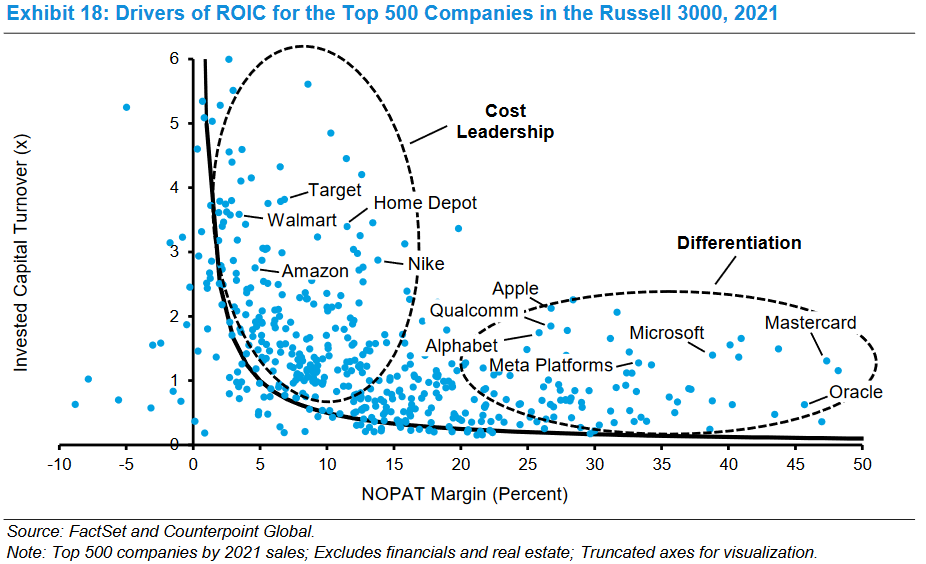
A well-conceived visualization can bring a concept to life. Here’s one from the latest research piece on ROIC from Michael Mauboussin and Dan Callahan at Counterpoint Global. The black line shows “the combinations of NOPAT margin and invested capital turnover that equal an ROIC of five percent.” Are the stocks you seek cost leaders or differentiators? How do they get there?
Postings
There weren’t any postings during the latest fortnight, which means that a fresh batch is lined up for release in the coming days. (Subscribe now so you don’t miss any of them.)
All of the content published by The Investment Ecosystem is available in the archives. If you explore the categories of interest to you, you are sure to find some ideas that you can put to work now.
Thanks for reading. Many happy total returns.
Published: October 10, 2022
Subscribe
To comment, please send an email to editor@investmentecosystem.com. Comments are for the editor and are not viewable by readers.