
July is often a fairly quiet month in the markets. Not this year.
Some sectors and even countries (here’s looking at you, South Korea) had violent moves up and down. A high-flying fund had its wings clipped. Long bond yields blew out. There were reports of artificial intelligence models breaking out of their “sandboxes.” And more. So much for the summer doldrums.
Don’t forget to check out the latest edition of Clippings for some good charts from around the investment ecosystem. Now, on to the readings.
Artful dodges
It came to light recently that insurers controlled by Mark Walter had been misrepresenting the nature of some of their investments. The news was prompted by a whistleblower complaint that led to a subpoena and finally the admission by the firms that had been marking affiliated investments as non-affiliated ones. Not a big deal though, right?
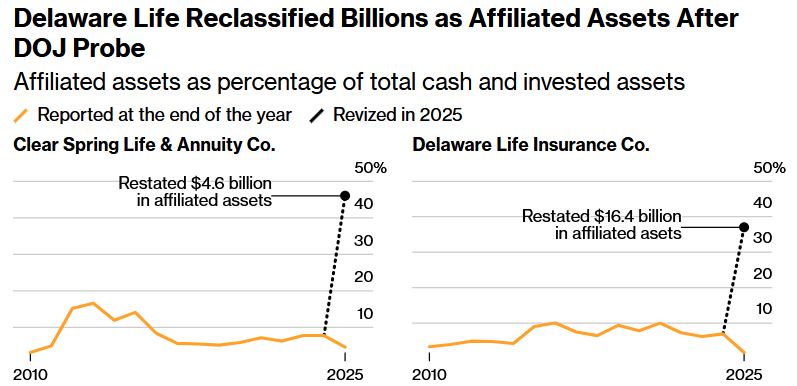
This graphic is from an Odd Lots article by Tracy Alloway (“Private Credit Has an Affiliation Problem”) that shows the magnitude of the adjustments the firms made in response to the probe. Those new levels of exposure will trigger greater scrutiny from regulators and analysts (and hopefully policyholders, although they are usually left in the dark about the investments behind their policies).
Among the good overviews of the situation are a piece in the Wall Street Journal and a posting from Nick Nemeth of Mispriced Assets that gets into some of the plumbing details.
Because private equity has popularized the use of insurers as permanent capital vehicles, there is a growing body of academic work on those linkages, including:
~ “Why Do Private Equity Groups Partner with Insurers?” Xinxin Zhang and Oleg Gredil. The authors make a distinction between insurers that are private equity portfolio companies and those that are captives.
~ “Private Credit’s State Backstop How Private Equity Socializes Risk Through Insurers,” Pranjal Drall and Andrew Granato. A more detailed “why” for the attractiveness of captive insurers:
In life insurers, PE has found an ideal host body from which to issue illiquid, risky, and opaque private credit investments. Substantial media commentary has focused on how long-duration life insurance contracts generate “permanent capital” for PE firms to deploy, but we emphasize another feature of life insurance: the guaranty-fund insolvency allocation system that permits PE firms to socialize the downside risk of their private credit portfolios without a sufficient financial-regulation regime to stop them.
~ “Rating Without Market Discipline,” Xuelin Li, et al.
We show that private ratings systematically understate credit risk and depress required capital. . . . Within the same rating, privately rated bonds are twice as likely to impair than publicly rated bonds, yet are downgraded less often, not more.
Walter’s firms, like others, are extensive users of private ratings, including those issued by Egan-Jones. From an article by Lee Harris of the Financial Times:
A large portion of Delaware Life’s affiliated investments were rated by the small rating provider Egan-Jones, according to a person close to the insurer, even as other insurers have sought to distance themselves from Egan-Jones due to questions over the quality of its marks.
Removing guidance
Aswath Damodaran covered two changes in guidance practices which are of importance to investors. The SEC proposal to remove the requirement for quarterly earnings is now under review, while Kevin Warsh’s move to limit communication from the Federal Reserve is in process. Damodaran covers each in some depth.
He bemoans the “disclosure diarrhea” that has led to “more disclosure perversely making for less information,” and the quarterly earnings game that sucks up investor time and distracts from the process of long-term investment. Despite those qualms, he believes that the SEC should preserve the current requirement. But he thinks that less disclosure from the Fed would be a good thing:
There will be some who feel that markets will be lost without Fed guidance, but I don’t think so. After all, financial markets set interest rates and stock prices before the guidance era, and did a pretty good job. In fact, I think that the surge in guidance from the Fed has led many in markets to abdicate their responsibility for paying heed to fundamentals and gauging what interest rates should be.
So far the market has not liked Warsh’s moves. The potential problems with his communication plans are summarized by Greg Ip of the Wall Street Journal and the Financial Times editorial board.
Situational awareness
“Stop me if you’ve heard this one,” Tom Waits sang to Bette Midler a half century ago. That could be said over and over in the markets, from cycle to cycle and from generation to generation. The same stories repeat with new names attached.
Perhaps you’ve heard the one about the wunderkind who put up big numbers and received fawning media treatments only to find out that there are two sides to the risk coin.
Leopold Aschenbrenner of the inappropriately-named firm Situational Awareness is the latest entry in the roster of mavens to have been laid low. Unfortunately, things came undone as “his wedding guests were arriving.” Among the many stories about how it all happened was one from Bloomberg which began, “He was hailed as the ‘Nostradamus’ of AI — a young oracle with a bold prophecy for the future.” A thread from Quantian is revealing. Ultimately, Citadel pounced as the fund cratered. Matt Levine:
A crude but useful characterization is that Situational Awareness is really really good at thinking about the long-term implications of AI, and Citadel is really really good at thinking about funding risk. So now Citadel owns Situational Awareness’s long-term AI bets.
(FYI, a short 2009 posting on the research puzzle blog was about situational awareness and how investors go through “periodic bouts of disorientation.”)
Follow-ups
Some topics addressed in previous editions of the Fortnightly are worth revisiting.
SpaceX (June 8)
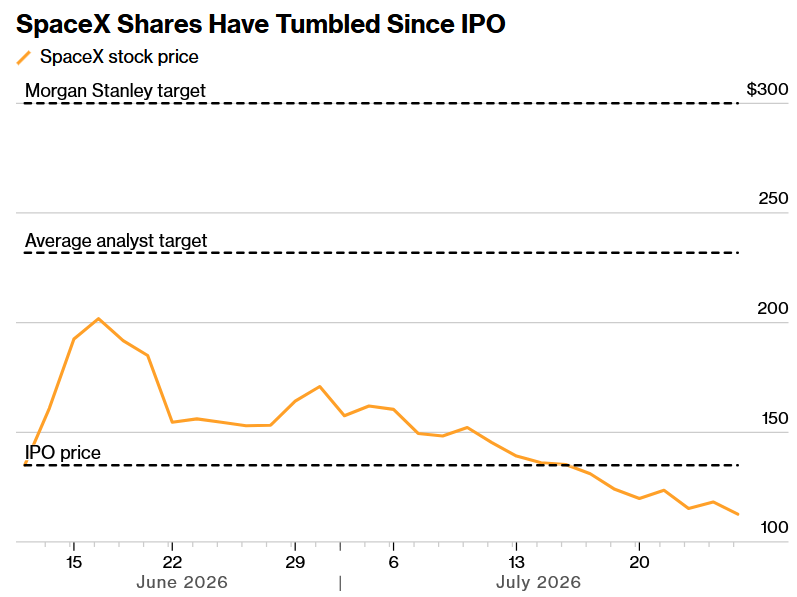
After surging in the immediate aftermath of its IPO, shares of SpaceX have come under severe pressure and are trading under where they were priced. So far, the offering has been good for one thing: making fun of sell-side hype. See the chart above for the Morgan Stanley target price; an article about the Raymond James’ somewhat higher one ($800!); and Carl Quintanilla’s snapshot of Deutsche Bank’s report title (“Apex of Civilizational Ambition”) and prediction that SpaceX will be “bending the arc of history to make humans multiplanetary.”
Flows (July 21)
In the last Fortnightly, we said that “we’re partial to flow-based explanations, since flows distorting performance (both on the upside and the downside) trip up capital allocators all the time.”
Big flows not only bend performance numbers, they can make or break firms, products, and teams. A couple of recent examples, highlighting the risks in concentrated exposures from single entities:
Artisan Partners is winding down every strategy run by its US Value team after the unit’s AUM fell by 75% in a month, largely as a result of it being dropped as a subadvisor on an Edward Jones Bridge Builder fund. (Tania Mitra, Citywire Pro Buyer.)
UBS helped trigger a wave of withdrawals from a flagship Blue Owl fund that the Swiss bank had helped build into one of the industry’s largest retail offerings after it advised overexposed clients to diversify away from private credit. (Alexandra Heal, et al., Financial Times.)
Fundsmith (March 30)
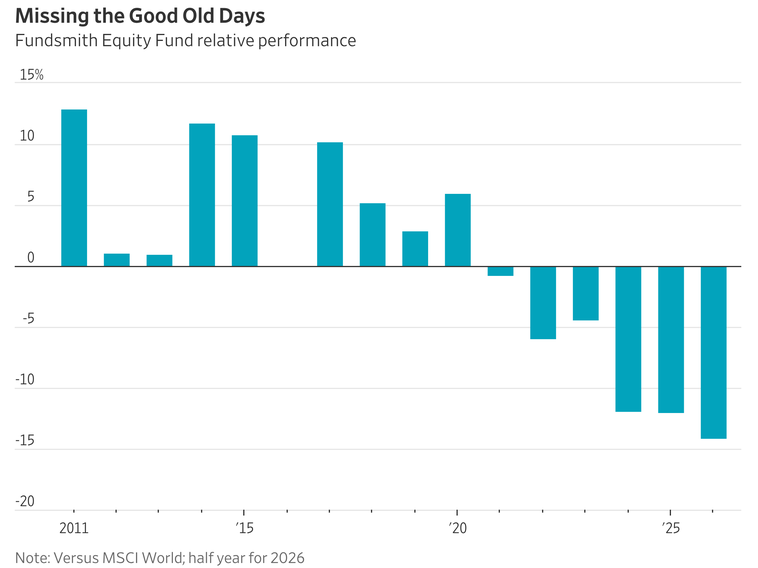
When Terry Smith published Fundsmith’s semiannual letter to shareholders, it prompted a wave of critical reactions. His “investment mantra” (“buy good companies, don’t overpay, do nothing”) served his clients well for a time, but not any time recently. (By virtue of the fees the fund still produces, it has continued to serve him well throughout, a point made in many of the critiques.)
It’s the “do nothing” part of the process that Smith publicly backed away from in his letter. He promised to be more active, to “take more account of momentum,” and to be “much less willing to deploy the time-honoured technique of buying quality companies when they hit a glitch.”
In his column that included the chart above, Spencer Jakab of the Wall Street Journal made an analogy to Julian Robertson’s closing of Tiger Management right when the dot-com bubble peaked. Robert Dee provided a wide-ranging overview of the issues involved, including this:
Strip it back far enough and none of this is really about the market, or momentum, or passive flows. It’s about what happens to a good investor’s discipline when the business underneath the philosophy starts to fail.
And Cyril Bosch of LSEG gave a similarly dire warning on LinkedIn:
If you pivot at the point of maximum pain, it’s over. Fund management is not a startup.
Other reads
“Speculative Supply Chains and the Madness of Crowds,” Mark Higgins, Investing in Financial History.
A speculative supply chain is a network of financial intermediaries whose incentives, over time, become increasingly aligned toward the continuous deployment of capital.
“Repriced, Not Differentiated.” JunkBondInvestor. The details make all of the difference in how the debt of data centers will trade.
“SpaceX, PE, VC, and Quacking Ducks,” Harvey Sawikin, The Falling Knife.
As fiduciaries, fund managers also have, in my opinion, a professional obligation to protect investors from themselves. Yet their track record in doing so is poor, even when it’s in their own best interests. If that’s so, how much less likely is it that non-fiduciary financial entrepreneurs will be looking out for the little guy?
“Will it Ever Be a Stockpicker’s Market Again?” Old Rope Research. On the cycles of allocator preferences.
“Scenario Analysis vs. Sensitivity Analysis: Why the difference matters and the risks of getting it wrong,” Shubham Tyagi, Alpha.
The distinction between scenario analysis and sensitivity analysis sounds like terminology. In practice, getting it wrong changes what your numbers are actually capable of telling you, and who they are useful for.
“Total Portfolio Approach: The Plumbing Beneath the Philosophy,” Chen Sui, FactSet. On the implementation of TPA (with an analogy to agile software development).
“The Covenant Is a Lagging Indicator,” Lukas Swid.
The activity beneath the statement can now be read as it happens, which means the deterioration a covenant reports after the fact can be seen while it is still forming.
Pervasive problem
“Most people do not listen with the intent to understand; they listen with the intent to reply.” — Stephen Covey.
Flashback: The Internet Fund
Byrne Hobart resurfaced a 2000 article about Ryan Jacob:
Ryan Jacob used to be famous. Not Andy Warhol famous, perhaps, but in the hothouse world of Internet stocks he was something of a rock star. . . . He had his own fan club; his pouty visage graced the cover of personal finance glossies; he was a fixture on CNBC, and mothers wanted to set him up with their daughters.
He was the manager of the Internet Fund who rode the dot-com wave up and down (“the dips kept dipping”). In size it was tiny compared to the Situational Awareness fund (and lacked its leverage), but you can see a familiar pattern. Jacob, like Aschenbrenner, was lavished with the attention and resources of the Street — and adulation in the media and among allocators wanting in, at least for a time.
Private equity transparency
A 2021 posting on this site reviewed a paper by Ashby Monk and others that proposed “a new paradigm for reporting by the managers who serve as the general partners (GPs) of private equity funds, offering greater transparency to the asset owners who are their limited partners (LPs).”
In the heady days of the following year, when performance was strong, it was easy to brush off the recommendations. Now? Not so much. Maybe it’s time for GPs to look back at the authors’ recommendations as a way to recharge interest in the flagging category.
We are, going on five years later, right where we were then:
It may be tempting for the industry to accept opacity as a natural, permanent, and even desirable characteristic of private market investing. Certainly it’s the way of the world now.
The misalignments of interest that have resulted are presumed to be intentional, since the GPs are the beneficiaries of the design. That design has been accepted and institutionalized with the tacit consent of the LPs, who are, with rare exceptions, price-takers when it comes to the terms of the partnerships.
Thanks for reading. Many happy total returns.
Published: August 3, 2026
Subscribe
To comment, please send an email to editor@investmentecosystem.com. Comments are for the editor and are not viewable by readers.