
The latest batch of images from our “clippings” file, available via Substack, is fronted by an interesting correlation chart courtesy of Wei Li of BlackRock. Also included are a dozen other things to ponder from across various asset classes.
And now, here are some readings to dive into.
Market players
In their paper, “Who Killed the Random Walk? How Extrapolators Create Booms, Busts, Trends, and Opportunity,” Victor Haghani, et al. “develop a multi-agent simulation model of the stock market that provides unified, intuitive explanations for many central puzzles of stock market behavior.” That’s a pretty tall order. The approach:
Our model features three primary investor types with heterogeneous beliefs — valuation-driven investors, static asset allocators (possibly a novel addition to this class of model, and arguably the largest investor group in today’s marketplace), and extrapolators — plus four additional types (momentum, short-term reversal, value-and-momentum, and anticipatory).
One interesting section of the paper deals with the difference between extrapolators and momentum investors, since to most they seem the same but their results vary significantly. Here’s how the authors describe each:
Extrapolators adjust their allocation continuously as a function of a squeezed risk premium derived from past returns — they are always leaning into or away from the market. Momentum investors, by contrast, make a binary decision: they are either overweight or underweight relative to their baseline, with the switch triggered by whether the past year’s return exceeds or falls short of the initial expected return.
As you might gather given the title of this site, the notion that “the ecosystem matters” resonates with us and that the “prevalence of various investor types” in a market is the main driver of its performance characteristics.
While the focus is on stocks, the model can be applied across markets, with the degree to which extrapolators predominate being an important variable. Along those lines, the authors paraphrase Antti Ilmanen’s work:
Since bond markets communicate primarily through yields, investors in fixed income develop a more forward-looking, contrarian orientation. Stock markets, by comparison, frame discussions around price movements and trailing returns, which naturally pulls equity investors toward backward-looking analysis and extrapolation when thinking about expected returns.
Flows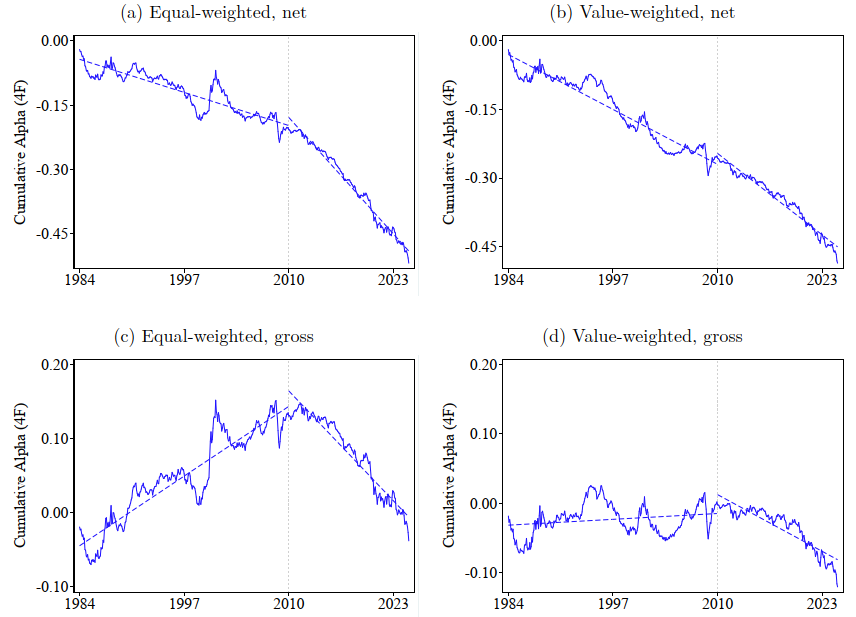
The impact of increasing flows into passive equity strategies on legacy active managers has been a topic of much debate over the last decade and a half, as those flows have become dominant.
Of late, a paper by Hannah Unterberg, “Passive Flows, Active Woes: Passive Investing and the Decline of Active Mutual Fund Alpha,” has garnered a great deal of attention from academics and investors. From the abstract:
A flow-driven framework shows that capital reallocations toward passive funds generate asymmetric price pressure, penalizing funds’ active tilts. Flow-induced demand significantly impacts fund returns, with the effects of passive flows persisting over multiple years. Controlling for flow-induced trading can explain the negative Active Share-performance relationship, suggesting that underperformance reflects structural demand headwinds rather than declining manager skill.
The charts above illustrate that that active performance appears to have hit a sort of tipping point around 2010. The deteriorating results seem to contradict the beliefs of those who thought that active investing would become more successful as the passive juggernaut kept chugging.
Robin Wigglesworth, writing for FT Alphaville, pushes back on Unterberg’s conclusion, thinking that:
Active management is getting harder because active managers are getting better, and there are simply fewer patsies around the [market] table. This strikes Alphaville as a better overall explanation for the apparent “passive flows, active woes” paradox.
It’s likely both. But here at The Investment Ecosystem, we’re partial to flow-based explanations, since flows distorting performance (both on the upside and the downside) trip up capital allocators all the time. (That’s a theme in our online due diligence course.)
Common language
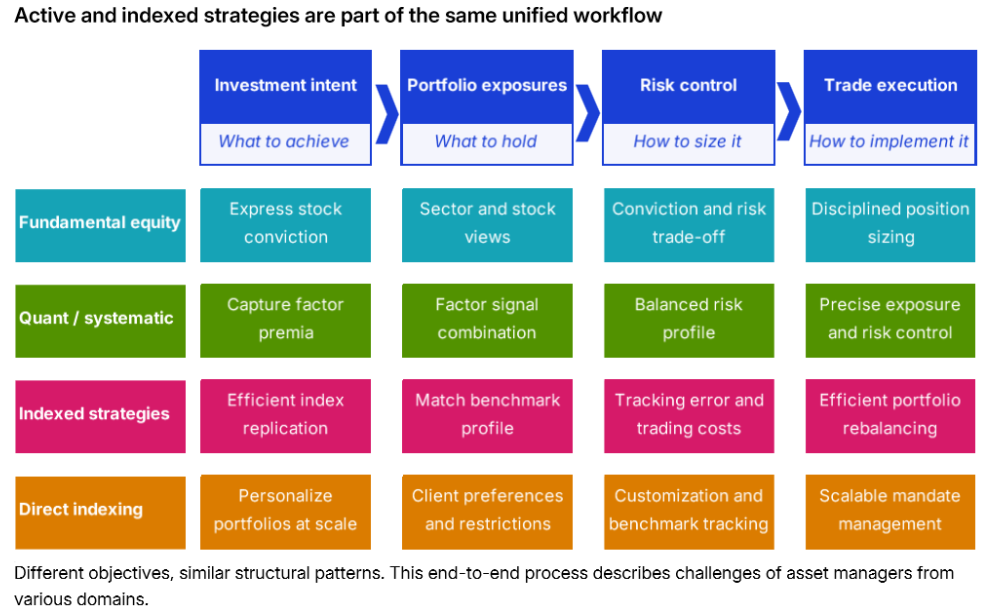 Dominik Zvara of MSCI published “The Common Language of Portfolio Construction.” He posits that across seemingly different investment strategies “a common optimization workflow reveals which constraints bind, how trade-offs are resolved and where strategies can be improved.”
Zvara walks through the workflows for four types of investment professionals, using that overall framework:
1. a fundamental equity manager balancing high-conviction stock picks against unintended risk
2. a quantitative investment strategist testing multifactor signals in a realistic construction setting
3. an indexed manager navigating the cost of replication
4. the head of a direct-indexing desk scaling hundreds of custom mandates without adding headcount
Hoisington
ChatGPT provides this summary of one of the most distinctive investment philosophies around:
For most of its history, Hoisington Investment Management has been a macroeconomic, theory-driven fixed-income manager built on the belief that excessive debt ultimately suppresses growth and inflation, making long-duration U.S. Treasury securities the most attractive asset over the long run. That philosophy remained remarkably consistent for more than three decades, even as it often ran counter to prevailing market consensus, until the firm’s recent reassessment of the structural inflation outlook.
The firm’s recent reversal in strategy was covered in a Bloomberg piece that included this chart, which reflects that its approach has made it “a top performer during market rallies and a severe laggard in selloffs.”
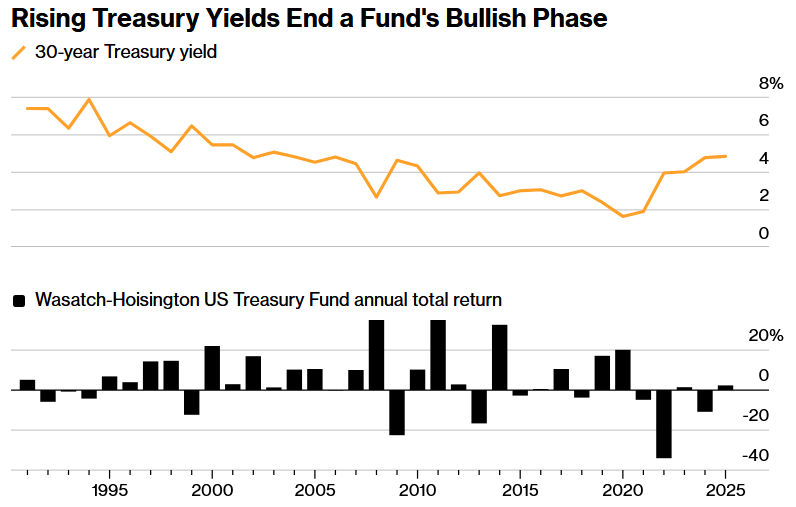
Even before the time shown, Hoisington was known for having only two investment states: either very long duration or essentially no duration. Much different than almost any other firm around.
Parking the bus
Given the outcome of its World Cup semifinal against Argentina, England’s strategy of “parking the bus” has come under widespread attack. Had the result been different, it could have been hailed as brilliant. But, wouldn’t you know it, there’s actually a paper that says “an extremely defensive playing style may be detrimental.” Also, it’s notable that all three of these were at work in the match:
~ leading teams are most cautious with a one-goal lead
~ leading teams are more cautious near the end of matches
~ leading teams are more cautious if they are perceived as the weaker team
Other reads
“Dear CIOs: We need to talk about capital profile,” Dan Mikulskis, IPE.
Long-duration, growing, compounding capital is valuable. Yet in our conversations with managers, opportunities are often presented through standard structures that were not designed with this type of investor in mind.
“Building a next-generation asset manager,” Michael Sidgmore, Alt Goes Mainstream. Do the acquisitions of Janus Henderson and Russell Investments portend more radical revamps of asset management firms (centered on the use of AI)?
“Good Business, Good Stock, Good Investment: Three Words We Keep Confusing,” Bogumil Baranowski.
We use these words as if they were interchangeable. Business. Stock. Investment. In casual conversation, in headlines, even during investment committee discussions, they blur into one another until they sound like synonyms for the same thing: a company worth owning. But they are not the same.
“MFS: ‘We Told You So” Is Something We Refrain From Saying; Yet, Here We Are,” The Unicus Investor. Market Financial Solutions filed for administration, leading to a ripple effect at other financial services companies; is that a sign of future systemic problems related to private credit? (The current state: “Every failure gets reclassified as idiosyncratic after the fact.”)
“Private wealth funds ditch the middleman for more alternatives exposure,” Alexander Davis, PitchBook.
The line between wealth manager and alternative asset manager is blurring in both directions.
“5.5 Lessons at 55.5.” Ted Seides, Capital Allocators. The “soft side” of the investment game is always more important than advertised.
“On Data Quality,” Abraham Thomas, Pivotal.
Data quality. We love it, we want it, we praise it, we aspire to it. . . .
It’s a pity, then, that nobody seems to know what data quality is.
“When even the safest insurance companies aren’t safe — MassMutual,” Rod Dubitsky. Is the firm rated correctly given the risk on its books?
“You Just Hired a Million Bad Employees,” George Sivulka, It’s time to build (Andreessen Horowitz).
Managing AI is harder than managing people, because AI scales dysfunction instantly.
Not going to happen
“Have no fear of perfection — you’ll never reach it.” — Salvador Dali.
Flashback: Ten attributes
In 2016, on the thirtieth anniversary of his start on Wall Street, Michael Mauboussin published “Thirty Years: Reflections on the Ten Attributes of Great Investors.”
The cover page highlights a number of the ideas, among them that the “single greatest error” is not distinguishing between fundamentals of a company and its price in the market. Also:
Accounting is the language of business and you need to understand it to appreciate economic value and to assess competitive positioning.
Investors face a slew of psychological challenges. Perhaps the most difficult is updating beliefs when new information arrives.
Position sizing and portfolio construction still do not get the attention they warrant.
The substantial shift from active to passive management has profound implications for the investment industry.
Plus, there are certain factors of an organization’s investment process that are often overlooked but which compound to great effect. 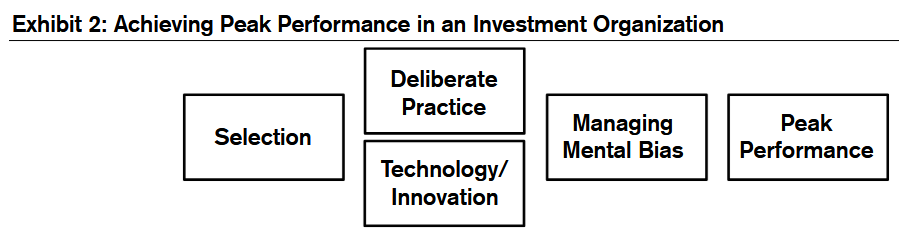
Each of those four elements is examined in addition to the ten attributes of the title.
The art of interviewing
To close out a series on Talent (a book by Tyler Cowen and Daniel Gross), a 2022 posting related their recommendations for interviewing job candidates to that of someone doing due diligence on an investment firm. One excerpt:
Most due diligence interviews, like most job interviews, proceed in a fairly predictable manner — resulting in equally predictable answers that hew to the narrative of the person being interviewed and those of his or her organization. According to the authors, “You can do better.” But that requires rethinking the standard approach, taking risks, and leaving out certain topics that others might view as essential. Is your goal documentation or discovery?
Thanks for reading. Many happy total returns.
Published: July 21, 2026
Subscribe
To comment, please send an email to editor@investmentecosystem.com. Comments are for the editor and are not viewable by readers.