
How will the use of artificial intelligence change the nature and structure of investment organizations?
For one view, you can go to LinkedIn and find a bunch of infographics showing how to use AI agents to replace analysts. Such simple substitution is appealing from a financial standpoint (assuming token prices are reasonable), but many other important factors (reliability, accountability, the quality and uniqueness of analysis, etc.) need to be considered.
Many organizations are experimenting with AI in a piecemeal fashion, to augment and/or replace the work of humans in various parts of their investment processes, but we haven’t heard much about more radical design ideas.
Into that vacuum comes a fascinating paper from Bernd Wuebben, “The AI-Native Asset Manager: Institutional Cognition as Competitive Advantage.” Wuebben “oversees the Quantitative Research Group for Fixed Income” at AllianceBernstein, and his ideas reflect a deep understanding of the nature of asset management organizations, as well as a willingness to think far outside of the box of industry orthodoxy:
This paper argues that the next generation of dominant asset managers will not be firms with better models in the narrow sense, but firms that have built a superior epistemic operating system: a machine-augmented cognitive architecture organized around the lifecycle of belief under uncertainty.
(While the recommendations provided by Wuebben are directly related to asset management firms, the conceptual framework could be applied to asset owners and other kinds of organizations. The concepts also fit across asset classes.)
Inverting the stack
According to Wuebben, for a half-century, “the competitive architecture of asset management rested on a stable hierarchy” — made up of information, then analysis, then portfolio construction, then distribution — which “encoded a tacit theory of where scarcity lives in the investment process.” He believes that “artificial intelligence is inverting this hierarchy,” and the existing architecture of “team structures, incentive systems, technology budgets, and governance frameworks” needs to be reformed:
The AI-native asset manager is not a traditional firm with better tools, but a fundamentally different kind of organization: one whose competitive advantage resides in its cognitive architecture — the designed system by which beliefs are generated, challenged, calibrated, expressed as capital allocation, and recursively improved through structured learning.
It’s easy to write about the need to rethink organizational design, but unlike most commentators, Wuebben offers a conceptual infrastructure and specific recommendations for implementation.
The belief factory
Wuebben posits asset management firms as belief factories and he sees problems in the current structural norm:
Most asset management firms are organized in ways that systematically degrade the beliefs they produce — through information loss between departments, through social dynamics that reward conviction over calibration, and through the absence of any mechanism that connects outcomes back to the original beliefs that generated them.
In practice, the analyst’s nuanced uncertainty about an issuer’s refinancing risk is compressed into a buy/sell/hold recommendation. The portfolio manager’s regime view, rich with conditional dependencies, is reduced to a set of position sizes that the risk system treats as scalars. The trader’s real-time information about liquidity and flow never reaches the analyst whose thesis it might invalidate.
The alternative for Wuebben is a firm “organized around the lifecycle of belief” that involves seven stages: observation, hypothesis, challenge, probabilistic forecast, portfolio expression, outcome attribution, and model update.
In the conventional firm, there is information loss all over the place. Among the issues: “compression at handoff boundaries” (e.g., an analyst has a nuanced view of an investment but the portfolio manager hears “we like the name”); “social dynamics that distort calibration” and result in “a systematic overstatement of confidence;” “absence of a challenge function;” and “broken attribution and learning loops.”
Those issues are widespread across the industry. One way of using Wuebben’s work is to ask why those problems are so common and whether there are ways to solve them short of adopting the AI-native approach that he espouses.
A table compares how the seven stages of lifecycle belief are handled in a conventional firm versus an AI-native one. For example, at the challenge stage:
Rather than relying on social norms to produce dissent — norms that are fragile in hierarchical organizations — the AI-native firm embeds challenge into its computational architecture.
There are significant implications for organizational design:
If the firm’s primary product is calibrated belief, then the organizational chart should be redesigned to minimize impedance in the belief pipeline rather than to optimize departmental efficiency. Research, portfolio management, risk, and trading should not be conceived as sequential stages in a waterfall process but as concurrent services available to beliefs as they move through their lifecycle.
Narratives
A key part of Wuebben’s construct is “narratives as a first-class object.” Meaning:
Prices do not respond to fundamentals directly; they respond to interpretations of fundamentals, and those interpretations are organized by narratives. Understanding this distinction is essential for the design of the AI-native asset manager, because the firm’s cognitive architecture must be built to process not only data about the world but data about the market’s beliefs about the world.
This is a key distinction. One example given is how a 3.2% CPI report would have “entirely different price implications depending on the prevailing interpretive regime.” The market reaction when a “sticky inflation” narrative is dominant would likely be much different than if a belief in “immaculate disinflation” ruled the day.
This is not a novel observation about discretionary investing; it is an articulation of what the best discretionary managers have always done intuitively. What is novel is the recognition that this meta-forecasting skill, long considered irreducibly tacit and unteachable, can be partially decomposed, measured, and augmented by AI systems.
A “narrative taxonomy” is proposed, based on how valid a narrative really is, how fully has it been priced in the market, and “how crowded is the associated positioning.” What results are three main categories: “true and early;” “true but over-owned;” and “false but dominant”:
The critical skill across all three categories is the ability to separate narrative truth from narrative crowding.
Of course, those assessments don’t come easily. There are many factors to consider; one example offered, a narrative that “the Fed is behind the curve,” involves economics, policy, media, market microstructure, and “behavioral history.” Not only has weighing all of that “historically exceeded the capabilities of conventional quantitative methods,” but there are a variety of other forces at work, including reflectivity and the incentives and social pressures that push investment professionals to act.
Layers of return
Wuebben also rethinks the nature of returns as:
A three-layer return decomposition that separates the return on any security into a beta/narrative layer, a cross-sectional factor layer, and an idiosyncratic issuer layer — each governed by a different epistemology, a different model class, and a different validation standard.
Each layer has its own characteristics. The beta layer is dominated by narratives, the cross-sectional one is “the natural domain of quantitative asset management,” and the idiosyncratic layer is “where firm-level stories matter.” They are different and require different approaches:
The three-layer decomposition reveals a fundamental mistake that pervades much of the asset management industry: applying the same validation standard to all three layers.
That results in “the industry’s most common epistemological error,” that of category confusion. Firms need “three distinct epistemic engines, each with its own model class, validation procedure, talent profile, and governance structure,” and a way to synthesize them. The need for that synthesis leads to “the most difficult question of all: given the current market environment, which layer should dominate sizing?”
The cognitive architecture
Wuebben next develops the “cognitive architecture” that he recommends for an asset management firm. It is very detailed; here are a few quotes of note (these are separate observations, not one continuous section):
The adversarial validation layer is the most important and least developed layer in most investment organizations.
A thesis can be true in world terms but fail in narrative terms (the classic “right but early” problem), or succeed in narrative terms despite being wrong in world terms (a momentum-driven overshoot).
The forecasting and uncertainty layer transforms validated theses into quantitative inputs suitable for portfolio construction. This is where the gap between aspiration and reality is widest in the investment industry.
The key innovation is the use of epistemic fragility — the process that produced a belief, not merely the belief’s point estimate — as a direct input to position sizing.
Legacy firms optimize risk-return. The AI-native firm optimizes risk-return-robustness-learnability: every position must not only have an attractive risk-return profile but must be backed by a robust epistemic process and must generate information that improves the firm’s future decision-making.
The learning and memory layer is the ultimate moat of the AI-native firm. Most investment organizations remember their profit and loss but not their reasoning. The thesis that generated a trade, the counterarguments that were considered and dismissed, the assumptions that were load-bearing, the regime conditions that prevailed — all of this is typically lost within weeks of position exit, surviving only as fragmentary oral tradition.
All of this is part of the overall goal of developing a cognitive architecture that serves as competitive moat.
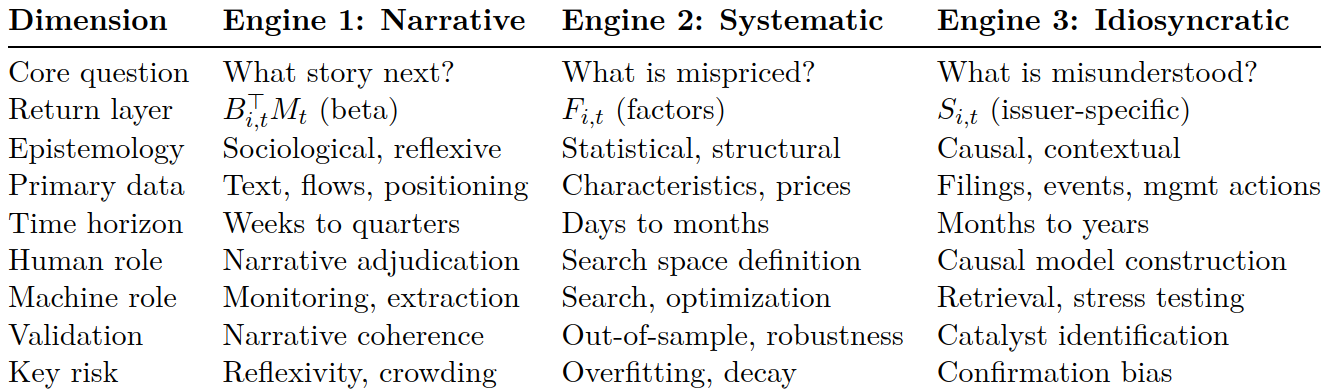
Three engines drive the organization, matching the three return components: a regime/narrative intelligence function that’s “not a research side product but a first-class production function;” a quantitative function that’s “regime-aware, execution-aware, and epistemically disciplined” for the cross-sectional layer; and a securities research approach focused on the question of “what is misunderstood about this issuer, and what catalyst will reveal it?” The meta-integration layer brings the work of the three engines together and judges which one should dominate at any time. There are also a series of feedback loops that foster learning across the engines. A schematic of the system: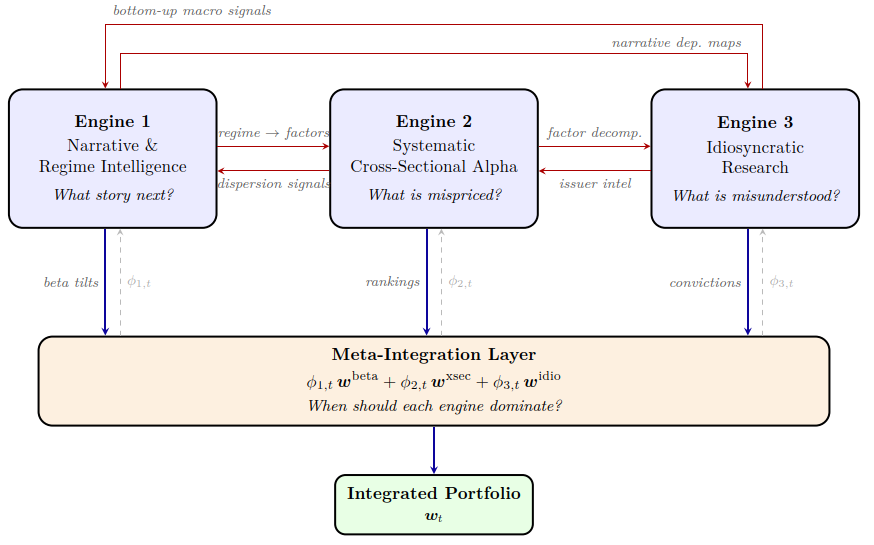
And “a comparison of the three engines along key organizational dimensions”:
Humans and machines
A section of the paper deals with the respective capabilities of humans and machines (and the combination thereof). Each has strengths and weaknesses that need to be considered as part of the design process.
For example, “The most valuable human skill in investment management is recognizing that the generating process has changed before the evidence is statistically conclusive.” But, “Human analysts suffer from recency bias, availability bias, and simple fatigue.” And:
No human team can sustain the discipline of systematically challenging every view from every angle; the cognitive cost is too high and the social cost — challenging a senior colleague’s thesis — is real. Machines have no ego to bruise and no career to protect.
Ultimately,
The central insight is not a static allocation of tasks but a dynamic one: the winning institution raises the level at which humans operate. When machines handle retrieval, monitoring, attribution, and challenge generation, humans spend less time on mechanical cognition and more time on the highest-value activities: adjudicating between competing world models, recognizing structural breaks, and making irreversible commitments under genuine uncertainty. The firm’s competitive advantage lies not in its machines or its humans separately, but in the quality of the interface between them.
Metrics
All of this requires a change in how asset managers are analyzed:
The asset management industry remains largely tethered to a measurement regime designed for a simpler era — one in which a portfolio manager’s output was a set of returns, and the firm’s quality could be assessed by comparing those returns to a benchmark. For the AI-native firm, whose competitive advantage resides in institutional epistemology rather than individual genius, the traditional scorecard is dangerously incomplete.
The traditional metrics should be “the floor, not the ceiling” for analysis. In addition, there should be epistemic metrics (forecast calibration, belief revision speed, false-positive research rate, and others); organizational learning metrics (thesis documentation rate, postmortem completion rate, analogical retrieval rate, mistake repetition rate, and memory persistence after personal turnover); and search-efficiency metrics (idea generation breadth, signal conversion rate, marginal alpha per research hour, and alpha attribution by source).
This requires a grand rethinking of data collection about how decisions are made. And, “Metrics without consequences are merely decorative.” So, the metrics “should carry weight independent of short-term returns” in the evaluation of those involved:
This principle — evaluating process quality alongside outcome quality — is the institutional instantiation of the distinction that Kahneman draws between decision quality and outcome quality, and it is foundational to building a firm that learns.
Scale
Size has generally been the enemy of alpha, but that observation “rests on an implicit assumption about what scale buys.” But that may not be the case going forward:
In the traditional firm, scale buys more analysts, more portfolio managers, more trading desks, and more distribution capacity. Each additional unit of headcount adds coordination costs that grow superlinearly, while the marginal analyst’s contribution to alpha is subject to diminishing returns. The diseconomies of scale are, in essence, diseconomies of human coordination.
If it is “the ability to fund the construction and maintenance of the best internal civilization for producing justified conviction” that matters in the end, then large firms may win in the emerging environment
Problems and governance
Wuebben outlines six “principal failure modes” that could derail the AI-native organization he envisions, and proposes governance features to combat them. The “central governance problem” is “ensuring that the institution becomes more truth-seeking over time rather than merely more persuasive to itself”:
This distinction — between truth-seeking and self-persuasion — is the central epistemic problem of the AI-native firm. It arises because the same capabilities that enable genuine learning also enable sophisticated rationalization. A system that can identify subtle patterns in data can also find patterns that are not there. A system that can generate compelling narratives can also generate compelling but false narratives. A system that can rapidly update its beliefs can also oscillate without converging. The boundary between learning and confabulation is not always visible from inside the system.
Ultimately:
The firms that solve this problem will not merely be better asset managers. They will have demonstrated something of broader significance: that it is possible to build institutions in which artificial intelligence makes collective human judgment more truth-seeking rather than less — institutions in which the technology’s power is genuinely aligned with the institution’s epistemic mission rather than subtly undermining it.
Wrapping up
The proposals are holistic and detailed, making implementation a daunting prospect, so Wuebben offers a three-year roadmap that is “informed by the organizational learning literature and by the practical constraints of institutional asset management.”
In conclusion, Wuebben writes:
A traditional asset manager is a collection of teams managing money. Each team applies its own expertise — macro analysis, credit research, quantitative modeling, trading — and the firm aggregates their outputs into portfolios, collects fees, and reports performance. The organizational logic is departmental. The knowledge architecture is implicit. The learning loop, to the extent one exists, operates through the slow channels of personnel turnover, post-mortem reviews conducted under political pressure, and the informal transmission of institutional lore from senior to junior professionals.
This paper has argued that such a firm is fundamentally misdesigned for the epistemic environment now emerging. When information is abundant rather than scarce, when analytical capacity can be replicated at near-zero marginal cost, and when the half-life of any identifiable edge is compressed by the speed at which competitors adopt the same methods, the binding constraint on investment performance is no longer the quality of any individual input. It is the quality of the system that transforms inputs into justified conviction and justified conviction into capital allocation — and that learns from the gap between its convictions and the world’s responses.
An AI-native asset manager is something categorically different from a traditional firm equipped with better tools. It is a designed system for recursive improvement in belief formation under uncertainty.
The “central question”:
The deepest question this paper poses is whether it is possible to design a firm in which alpha emerges not from smart people or clever models alone, but from the architecture of disciplined disagreement, institutional memory, and machine-augmented judgment itself.
This question has no precedent in the asset management literature. The traditional framing, inherited from Grinold and Kahn, treats alpha as the product of individual skill — the information coefficient of the analyst or portfolio manager — multiplied by breadth and translated into portfolio positions through transfer coefficients. The AI-native framing treats alpha as an emergent property of the system. Individual skill remains necessary, but it is no longer sufficient, and perhaps no longer even the primary driver of long-run performance.
Observations
While this has been a long piece in comparison to other essays posted on this site, there is much more to be found in Wuebben’s paper. Given the importance of the ideas for the future of the asset management industry, it is worth your time to explore it in depth and consider its implications.
The two tables within the text and the thirteen at the end are especially good at summarizing the key concepts. That might be a place to start after reading this summary.
The leaders of asset management firms are conservative by nature, largely for fear of asset owners pulling their funds because of changes to structure, process, and people. And analysts, portfolio managers, traders, etc. are loathe to change methods from those that have shaped their careers.
So what is the likelihood that any large firm will take a big swing at the kind of architectural renovation that Wuebben recommends? To be a bit impertinent, will AllianceBernstein (Wuebben’s employer) take him up on his ideas?
There are aspects of his ideas that are already in use at firms, but only a little here and a little there, as opposed to a comprehensive, integrated approach. It seems much more likely that this new kind of organization will be created by an upstart, and if Wuebben is on the right track, it could be enormously rewarding for the disrupters of the established order.
If you are interested in these kind of ideas, check out our posting on “The Active Management Reinvention Project” from 2024.
Published: June 29, 2026
Subscribe
To comment, please send an email to editor@investmentecosystem.com. Comments are for the editor and are not viewable by readers.