
We skipped our regularly scheduled issue two weeks ago, but we’re back in force. As always, we’d love to hear from you with reactions and ideas to consider.
Also check out the latest edition of our “Clippings” on Substack, full of great investment visuals from across the ecosystem.
And now, on to the readings.
The everything trade
Inigo Fraser Jenkins of AllianceBernstein began a recent report in this way:
Artificial intelligence (AI) is all-consuming in terms of investors’ attention. Its demand for capital is creating linkages across asset classes that make diversifying AI exposure significantly harder.
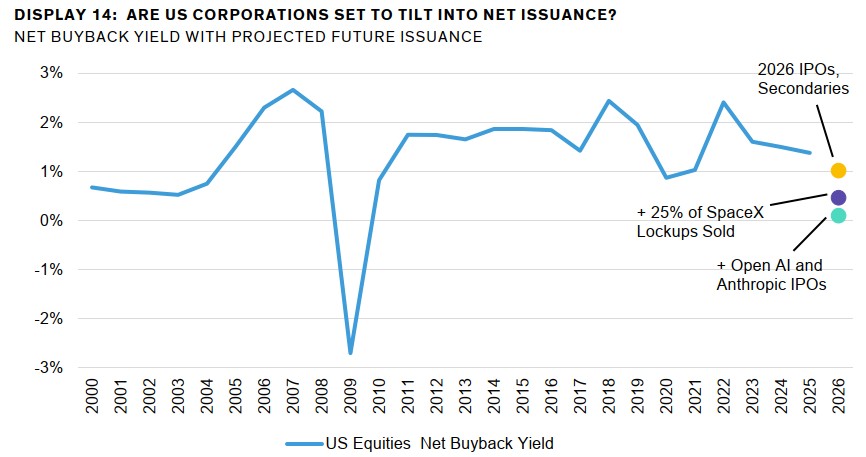
The author is careful to say that the piece is a not a directional call, but “it is a call for portfolio robustness in the face of the all-encompassing capital demands of AI.” He covers a range of issues across various assets. For equities, that includes the strong earnings narrative (“the increase in earnings expectations in recent years might therefore be troublesome if not sustained”) and the possibility that companies might go into net share issuance mode for the first time in many years (chart).
In “Rules of relevance,” Jason Thomas of Carlyle uses “the preselectivity of all perception” — based upon “our background, experiences, and analytical methods or intellectual discipline” — as a concept to examine the AI trade. To wit:
Analysis does not begin with the conscious interpretation of a fact, but in the act of noticing one fact rather than another.
There are a number of interesting charts in his paper and some recommendations at the end in a section titled, “What’s an asset allocator to do?” But this in particular squares with the views of Fraser Jenkins, who forecasts increased volatility:
When an interpretive framework is shared among market participants, volatility is bounded; uncertainty attaches to the next realization of a variable, not to which variables matter. But when the framework itself is at issue, valuations disperse and asset prices become susceptible to “jumps” as the same phenomenon gets viewed through a new lens.
(Also of note, the actions of AI companies are coming under increased scrutiny and their collective action problems have led to a number of game theory diagrams. Here are three examples from Polymath Investor, Paul Kedrosky, and AP Research. How would you assess the investment implications under each of the four outcomes?)
Private conflicts
“Private Credit’s Private Conflicts,” a paper by Michael Rand and Melinda Roth, explores, as the subtitle states, “Agency Costs, Conflicts of Interest, and the Convergence of Private Equity and Private Credit.” From the abstract:
Many of the largest alternative asset managers simultaneously operate private equity funds, private credit funds, direct lending vehicles, Business Development Companies, insurance subsidiaries, and affiliated financing platforms under common ownership and management structures. These overlapping arrangements increasingly blur traditional distinctions between lender, owner, sponsor, and fiduciary.
The authors believe that “the existing legal architecture, constructed for an era when lending and equity funding were operated via distinct institutions, is structurally inadequate to address these internal entanglements”:
Perhaps most problematically, due to the moral hazard issue involved in capital funding, GPs are incentivized to decide according to what provides the highest return for them, as opposed to the LPs co-invested in the respective funds.
Academic alpha
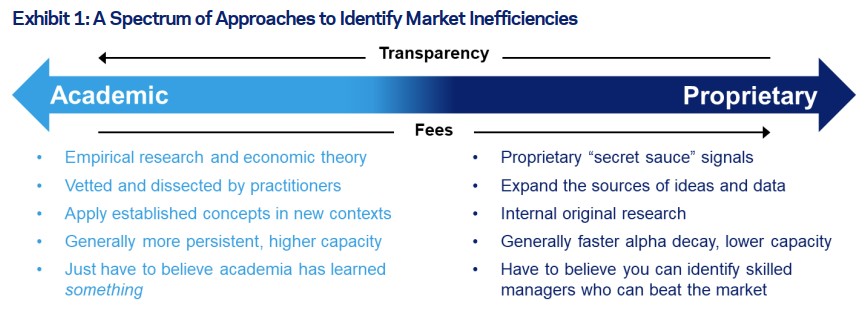
Thomas Maloney and Tobias Moskowitz of AQR wrote an article, “Academic Alpha: A (Re)Introduction to Style Premia Investing”:
These sources of return are often called “alternative risk premia” but we like the term academic alpha, which emphasizes their grounding in well-established research without getting into the debate between risk-based and behavioral explanations.
The image above provides the attributes of widely available strategies versus those that are proprietary and not published. While it seems unlikely that well known approaches could continue to work in a market that wears away edges, they have (like proprietary approaches) benefitted “from a wave of innovations in signal measurement, new ideas and techniques, portfolio construction, and implementation.” And:
The most valuable academic alpha signals have a demonstrated ability to deliver returns even when they are well-documented and well-known to market participants. How? Because each has a persistent “other side.”
To that point, see the paper by Joseph Engelberg, et al., “Giving Users What they Want: Social Media and Anomalies.” It studies the behavior of users on the social investing site StockTwits. The visual evidence: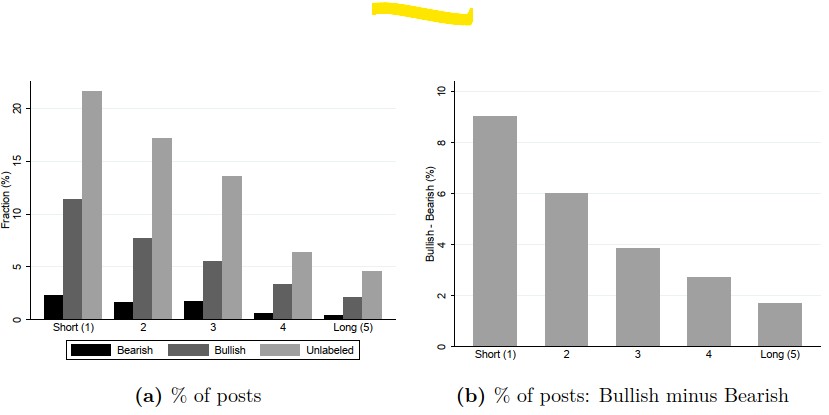
The degree of attention — and of bullishness — by the users is monotonic, but backwards in comparison with what established research has shown to be successful.
The tall bars (marked “short”) on these graphs are the “short legs” of return anomalies, that is, the positions to bet against. Yet that is where the action is among the users, while the “long legs” that add value get the least love.
Other reads
“Dear CIOs: Let’s talk about the asset owner-isation of the UK,” Dan Mikulskis, IPE. (Applicable elsewhere as well.)
This is where the role of asset managers must evolve. The old model of siloed products sitting on a shelf and selected from buy-lists is increasingly inadequate. Large asset owners need integrated solutions rather than individual products. They need asset managers who can connect capabilities across global teams, work collaboratively on strategy design and adapt as the asset owner’s own operating model evolves.
“Late Summer Letter,” Shinya Deguchi, Present Value of the Future. Reflections on what was copied from David Swensen and what was missed.
“Who forecasts how?” Joachim Klement, Klement on Investing.” A review of an interesting paper that concludes with this:
Our findings are consistent with a model of heterogeneous beliefs, where naive investors extrapolate past returns, rather than past dividends, while sophisticated investors are close to rational.
“The Target Is Not the Benchmark,” Courtney Scharff, MSCI. Regarding the ongoing challenge of benchmarking private asset performance.
“Estimating Yield Impacts of Treasury Demand and Supply Changes,” Daniel Beltran and Canlin Li, Federal Reserve Board.
We find that the Treasury market has become increasingly price-sensitive over time, driven by the declining participation of less price-sensitive foreign official investors and the rising role of more price-sensitive hedge funds and other private investors.
“The Art of the Curveball Question,” Harvard Business Review. This short posting covers simple but powerful tips for those doing due diligence.
“Nonbank traders make Wall Street’s old guard up their game,” Christopher Whittall, International Financing Review.
The rapid growth of nonbank firms such as Jane Street and Citadel Securities has made investment banks accelerate the overhaul of their fixed income trading operations and even look to emulate some of the practices of this new breed of competitor.
“One of the Biggest Unpriced Risks in Private Markets is Human Capacity,” Georgina Tzanetos, CAIA Association. Are allocator organizations “structurally under-built for what they are asked to do”?
“It’s the pitfalls and pratfalls that make a career,” Craig Coben, Financial Times.
The good stuff and the bad stuff aren’t separate line items on the career balance sheet but arise from the same conditions: intensity, chaos, accidents and emergencies, serendipity.
Unhelpful wishes
“As long as you have certain desires about how it ought to be you can’t see how it is.” — Ram Dass (via The OSVerse).
Flashback: Buffett and Salomon
Richard Dewey wrote a retrospective for the Financial Times about “The day Warren Buffett saved Salomon Brothers.” It was Sunday August 18, 1991.
When Buffett arrived at Salomon that morning he faced three sets of overlapping and intertwining problems: Find out the true nature and cause of the crises; convince regulators to let Salomon keep doing business; and figure out who would run the bank, after its CEO, president, and vice-chair had all resigned in the last 48 hours.
Buffett had made a large investment in Salomon and was on the board, but the head of government bond trading there had been engaging in “deliberate overbidding” at Treasury bond auctions. If the firm’s ability to serve as a primary dealer was pulled, it could be its death knell.
Dewey does a great job of recounting the events and connecting them to subsequent traumas on the Street, including the Long-Term Capital Management blowup and the financial crisis. (There are a couple of videos in the piece that are worth watching, including one about the Salomon situation and another regarding LTCM.)
In contrast to so many leaders who immediately play defense (and often cover things up), Buffett went on a mission of transparency. John Macfarlane, the firm’s corporate treasurer:
I didn’t realize it at the time, but probably the single most important thing Buffett did was to waive attorney-client privilege. Buffett accelerated discovery and that let us get a faster resolution . . . Buffett was determined to find out everything as fast as possible, even the bad stuff.
And then he took out big ads in the leading newspapers and went to Congress to testify, getting the story out. The video about the crisis in the article shows the first part of his testimony; a longer clip includes his statement that, while he didn’t think that the industry was rife with rule breakers, “huge markets attract people who measure themselves by money.”
The implication is that it’s hard for some people to stay on the right side of the fence. Buffett’s Salomon investment had been a surprise to people since he had always shied away from investment banks before (and his partner Charlie Munger famously hated the culture of the industry).
He found himself where he didn’t want to be — but showed how to deal with a crisis. Something lost on most others.
Foundational elements
A 2022 posting covered four elements for asset owners to consider: simplicity, communication, expected returns, and OCIO offerings (then mostly used by smaller institutions but which increasingly are being used by organizations with large pools of money).
Thanks for reading. Many happy total returns.
Published: September 29, 2026
Subscribe
To comment, please send an email to editor@investmentecosystem.com. Comments are for the editor and are not viewable by readers.