
It’s late August, so here’s a shorter-than-normal version of the Fortnightly, our collection of curated links from around the investment ecosystem. Rest up for the resumption of activity next week as things return to normal. (Although, what is “normal” these days?)
For more good visuals, check out the latest edition (“Down in the hole”) of Clippings.
Jane Street
“What is Jane Street?” asked the title of a Financial Times article by Daniel Davies. He posed a few questions, prompted by Rupak Ghose’s earlier posting, “Is Jane Street a hedge fund or a PTF?” (Ghose: “What is clear though is that the level of risk that Jane Street is running is higher than what any of us thought.”)
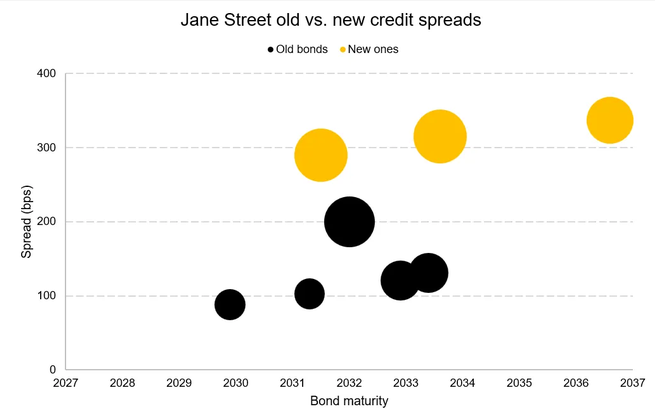
It’s been quite a last couple of months for the firm. First, it refinanced its public debt into private debt, with most people thinking it was doing that only to limit the number of eyes that could see its results, since the refinancing increased its borrowing costs. Here’s a graphic from JunkBondInvestor that shows the spreads of the new debt versus the old:
Then it came out that Jane Street lost $15 billion during July, some of which was due to a long-term investment in the Situational Awareness fund that suffered a huge loss.
The fascination with Jane Street has taken a turn away from the gobs of money it has been earning — and its rapid growth — to interest in how the firm makes that money.
Rod Dubitsky’s take is more pointed, thinking that Jane Street has become systemically important and is “making increasingly large and risky bets.” Add that to “accusations of insider trading and market manipulation” and you have the potential for more troubling scenarios.
A winning way
Perhaps no public pension plan can match the long-term record of the South Dakota Investment Council. While other successful styles spawn copycats, the plan’s approach is a bridge too far for most institutional investors.
In an interview with Christine Giordano of Markets Group, CIO Matt Clark explains the organization’s contrarian philosophy and the pain that must be endured to stick to a valuation discipline when the crowd prices assets too high or too low.
Everyone wants the track record but not the pain.
Leveraged ETFs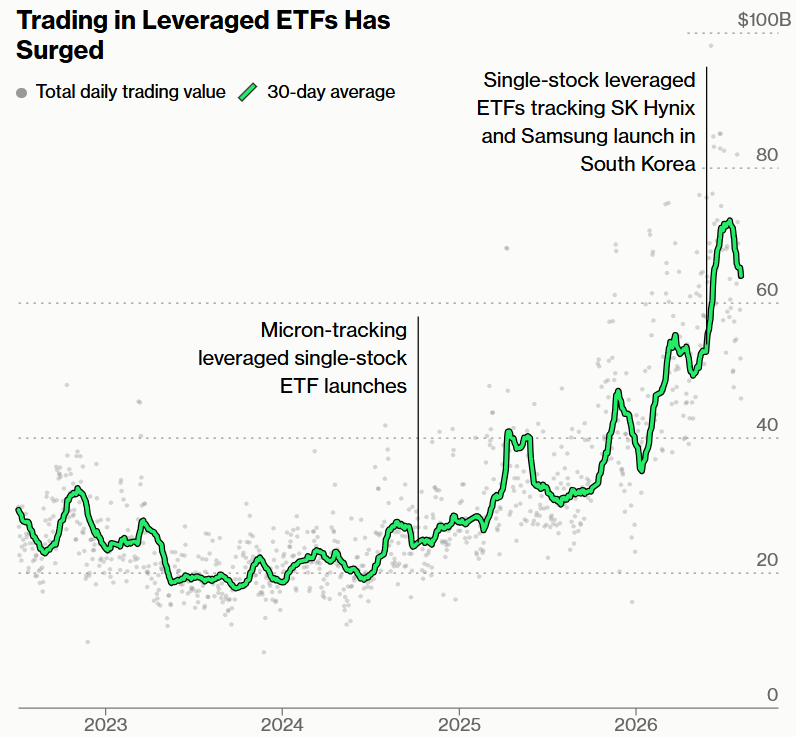
The chart above was through August 6. The Bloomberg article that includes it refers to “a hectic bout of deleveraging in the wake of the Korean drama has cut the total money invested in leveraged ETFs.” That has continued. In response to new regulations in Korea, the use of the vehicles there has collapsed during the month. But they remain popular in the United States.
The single-stock leveraged ETFs are concentrated in those names that make headlines in the technology sphere. (A series of charts in the article demonstrates that dominance.) While the amount of money in play is “small compared to the global equity market,” it’s another sign of the degree of speculation at work now.
Consultants’ hedge fund picks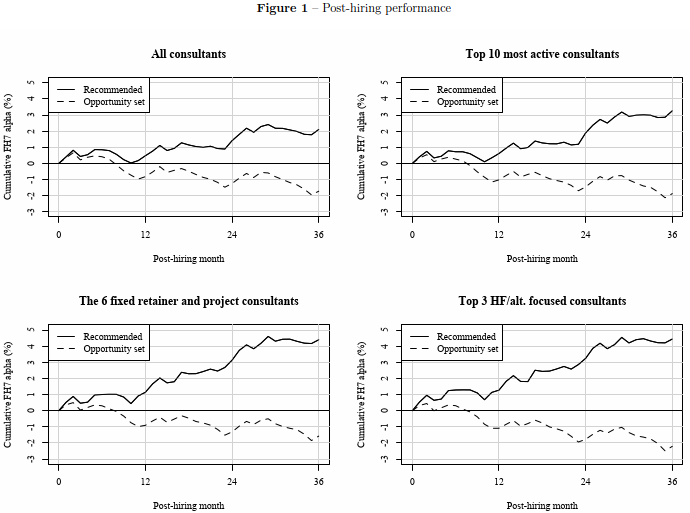
Previous studies have shown that consultants don’t do a great job of picking managers. However, in asset classes like “hedge funds” (if you want to call that an asset class) not all managers have been in the databases used for those studies.
That’s why a paper by Juha Joenväärä, et al. is of interest. The image above shows that using a larger sample of hedge fund mandates yields a much different conclusion — that consultants add value (at least over the short time frame shown). Why?
The evidence points to two complementary channels. First, consultants expand investors’ feasible opportunity sets by providing access to institutionally oriented managers that are often closed to new investors or absent from commercial databases. Second, consultant recommendations contain information beyond observable fund characteristics, operational-risk indicators, and access proxies, consistent with costly information acquisition, due diligence, and manager-selection ability. These gains are not offset by crowding effects: recommended funds do not experience persistent inflows, and performance does not deteriorate following increases in scale.
Dissonance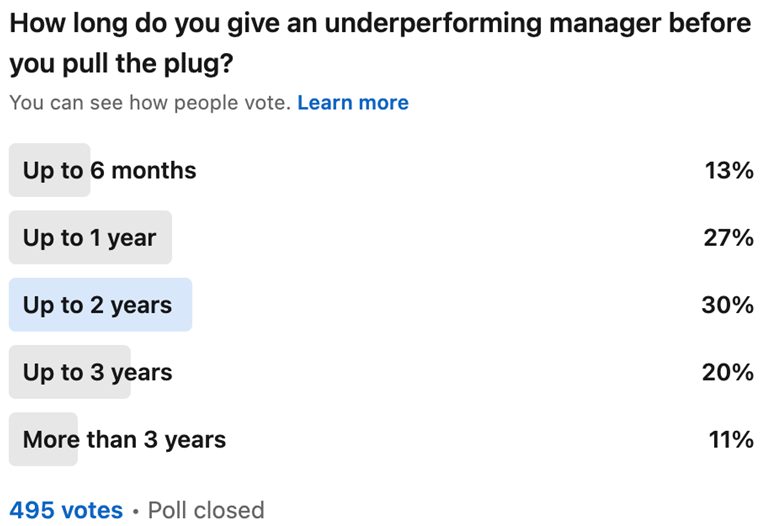 Harald Berlinicke posted a series of polls about manager selection practices on LinkedIn. A Substack posting from him aggregated them and added commentary.
The results of the fifth poll are shown above. The only possible response: LOL.
It is bracketed by polls asking about the hardest judgment in manager selection (skill versus luck was the most popular choice) and which lesson takes the longest to learn (“process over performance”).
The three don’t fit together, do they? Yet the results are broadly in line with other surveys over time. The biggest problem in manager selection is this dissonance, abetted by poor governance practices that fail to institutionalize processes that minimize the destructive chasing of recent performance. (Of course, there is training available that aims to correct that shortcoming.)
Culture headlines
The latest in the long-running war between the founders at Two Sigma, from Bloomberg:
 Also, there’s a new piece on the Two Sigma website that the founders might find helpful:

Other reads
“Is the ‘semiliquid’ label misleading, or just an uncomfortable reality?” Alexander Davis, PitchBook.
Doing away with the semiliquid label won’t erase the perception problems stemming from caps on redemptions. Some things remain the same no matter what label is used. Advisers and their clients will always need to familiarize themselves with terms and conditions attached to any investment.
“If this is true, the hyperscalers are toast,” Joachim Klement, Klement on Investing. Will the availability of effective small language models alter the current AI landscape?
“‘The Wealth of Nations’ at 250: Adam Smith’s Achievement,” James Grant, Wall Street Journal.
Though no great hand at economic analysis, Smith was a propounder of economic doctrine. He stood for enterprise, individual liberty and free trade, and against the tyranny of state-sponsored monopolies.
“The Collateralized Fund Obligation,” Shahrukh Khan and Andrew Sommer, Cash and Carried. Subtitled: “How do you receive cash back for a private equity interest without selling it?”
“Private Equity’s Accountability Deficit: The Case for Mandatory Disclosure,” Jeffrey Gordon and Dorothy Lund, SSRN.
Without accountability, the private equity sector risks significant resource misallocation, akin to an earlier era where management teams built large and inefficient conglomerates that contributed to slow economic growth.
“You Probably Own This 7-Eleven (and That’s Why It Looks So Sad),” Joseph Lawler, The New Atlantis. A very interesting look at real estate financing structures and their impact on communities.
“Confessions of a former star M&A reporter,” Ed Hammond, Financial Times.
Success means getting scoops and that means finding leaks. Here’s how I got mine.
Not Dolly
“Everybody thinks when he gets rich he’ll be a different kind of rich person from the rich people he sees around him; later on he finds out there’s only one kind of rich person, and he’s it.” — Thornton Wilder, The Matchmaker.
Fidelity Contrafund
Early in this publication’s history, there were occasional “Charts” postings, including 2022’s “Steppingstones and Clues for Further Research,” about a slight downgrade by Morningstar of Fidelity Contrafund (managed since 1990 by Will Danoff).
With Danoff set to retire at the end of the year, it’s a good time to take a look back. The posting concludes in this way:
These kinds of charts are best used not to come to conclusions but as the impetus for forming good questions for further research. They aren’t presented here to put forward any point other than that longitudinal information can provide important steppingstones for the analytical process — and good visualizations often reveal clues otherwise buried in a pile of numbers.
Thanks for reading. Many happy total returns.
Published: August 31, 2026
Subscribe
To comment, please send an email to editor@investmentecosystem.com. Comments are for the editor and are not viewable by readers.