
There are some good graphics in this edition. For a regular diet of such images, you should also subscribe to our Clippings postings on Substack.
The wisdom of crowds
The latest research from Michael Mauboussin and Dan Callahan is “The Wisdom of Crowds in Markets.” It explores crowd behavior in a range of money-related settings.
The conditions for crowd wisdom are important. First, there is the need for a diversity of perspectives:
Effective collective decision-making relies on cognitive diversity, which captures how group members differ in their information, knowledge, heuristics, representations, and mental models.
Unfortunately:
Diversity is the most likely condition to be violated in financial markets because investing is an inherently social activity.
It’s a mystery why investment organizations pay so little attention to this problem. Not only are investment professionals in most organizations not socially diverse, there’s usually not much cognitive diversity either. People gather with others that look like them and have similar backgrounds, and they also prefer to be around those who think like they do.
Beyond the “walls” of an organization, the industry itself has cycles of belief:
Investors say they feel the pull to conform. The CFA Institute surveyed more than 700 investors and learned that “being influenced by peers to follow trends” was the bias that had the largest impact on their decision making.
The other key conditions to produce wisdom from a crowd are an effective aggregation of the crowd’s opinions and appropriate incentives for those involved.
The authors look at how those conditions apply in four market settings: prediction markets, sports betting, parimutuel betting, and stock markets. In comparing them:
Of the markets we have reviewed, the stock market is the most likely to flip from the wisdom to the madness of crowds.
(One interesting tidbit concerned the use of social circle polling to predict the winner of the 2024 presidential election. That kind of poll “does not ask participants who they intend to vote for, but rather who they think their neighbors will vote for.”)
Also:
~ Mauboussin announced on LinkedIn that a number of websites related to his work have been relaunched. Of particular note is the probability survey, which can quickly reveal one of the main problems in communicating ideas within organizations and throughout the investment ecosystem.
~ Harvey Sawikin wrote a piece on his site The Falling Knife, “The Stupidity of Crowds?”
Then again, part of me wonders whether the gamification of retail investing by Robinhood et al. could be undermining “The Wisdom of Crowds” that has been in effect and has, in my view, been keeping the U.S. market more efficient since the mid-90s. If young investors are taught to be even more short-term oriented than the mutual funds, moving as a herd into anything that looks hot and using leverage to do so, what we may wind up with is not the wisdom but “The Stupidity of Crowds.” Then stock picking will be easy again.
Sell-side analysts
Two papers about analysts:
~ “Beating the Earnings Game: Why Do Prediction Markets Outperform Professional Analysts?” by Daniel Rabetti, et al. The authors compare earnings contracts with analyst estimates and find the former to be more accurate. They believe that’s because of analyst biases and conflicts of interest; continuous information updating; the wisdom of crowds; and firm-specific rather than industry-wide movements.
~ “Disclosure Without Dialogue? An Empirical Analysis of Sell-Side Analyst Questioning Behavior During Earnings Calls Following ICFR Material Weakness Disclosures” by Alexander Gass. Do analysts ask questions on earnings calls about “disclosed material weaknesses in internal control over financial reporting”?
The answer to the research question is unambiguous: across all 119 assessable calls, not a single analyst raised the material weakness or any related topic. The analyst engagement rate was 0.0%.
Commitments behind the curtains
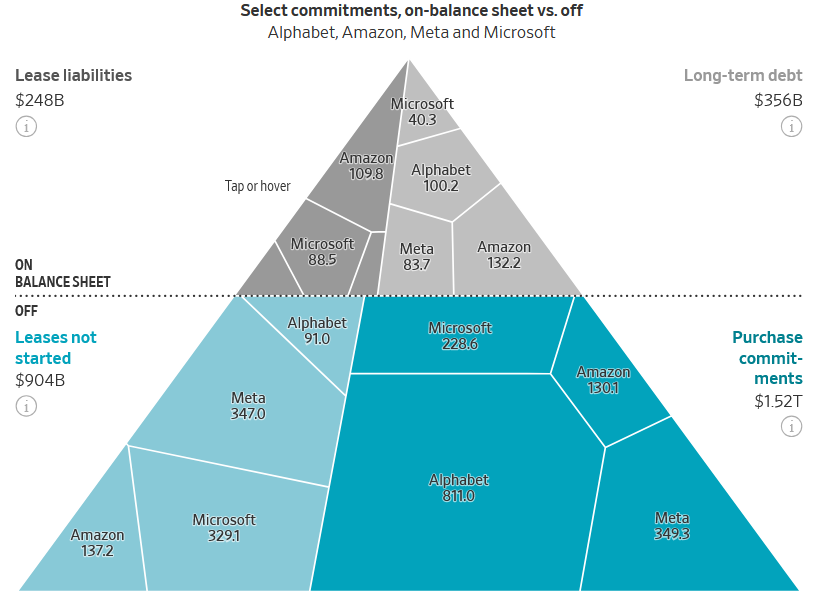
Not all commitments appear on the balance sheet.
Of the massive level of financing activity by the big tech companies in response to the AI buildout, some of it is easy to see and some is not.
This image is from “Why Big Tech’s AI Spending Is $3 Trillion Higher Than It Seems,” an article by Peter Rudegeair and Peter Santilli for the Wall Street Journal. The piece also includes company by company information and the mapping of one particular deal.
See also “Bond Traders Are Agonizing Over $70 Billion of Shadow Credit Backstops For AI Companies,” from Paula Seligson and Davide Barbuscia of Bloomberg.
(If you have a time machine handy, let us know how this all shakes out in five years.)
Questions for private advocates
Jason Zweig’s most recent column is “What to Ask When Your Adviser Pushes Private Funds.” Given the industry is trying hard to put private assets in the portfolios and defined contribution plans of individuals, this selection of questions should be standard fare for those trying to decide whether that’s a good idea.
Codependency
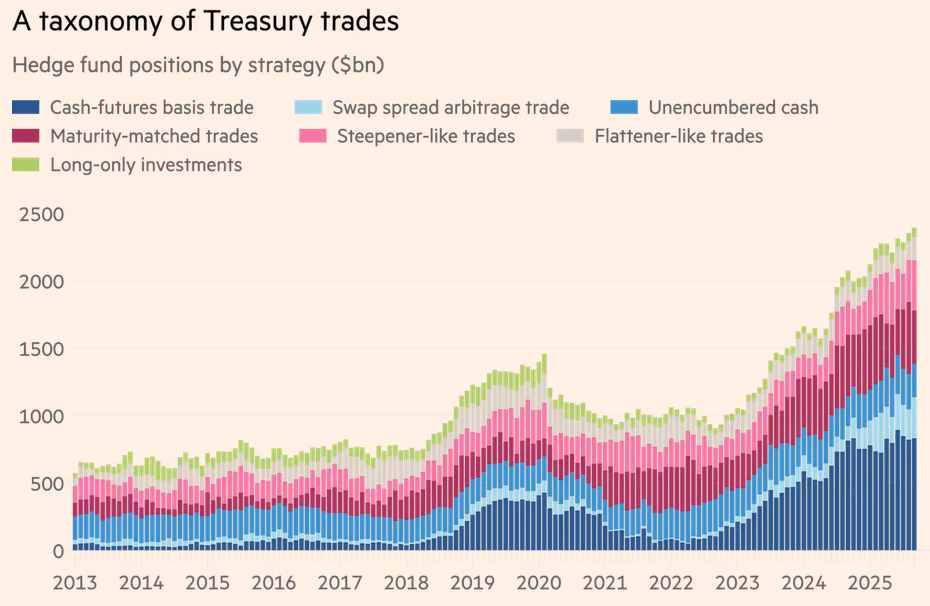
Robin Wigglesworth wrote an article for the Financial Times that examined the big increase in Treasury positions at hedge funds. In it, he quoted a Federal Reserve report:
The combination of large scale, high concentration, and elevated leverage creates the potential for systemic stress if multiple strategies face simultaneous pressure or if severe shocks affect the largest participants.
Of course, “oodles and oodles of leverage” are involved. (Rev up that time machine again.)
Peak fund
Ryan Boothroyd thinks that we have reached “peak fund,” and that asset management firms need to move away from a product mindset and to a solutions one. From his LinkedIn post:
Funds aren’t going away. But for large institutions, flexibility is becoming more and more valuable, while much of the industry remains optimised for standardisation.
CAPE
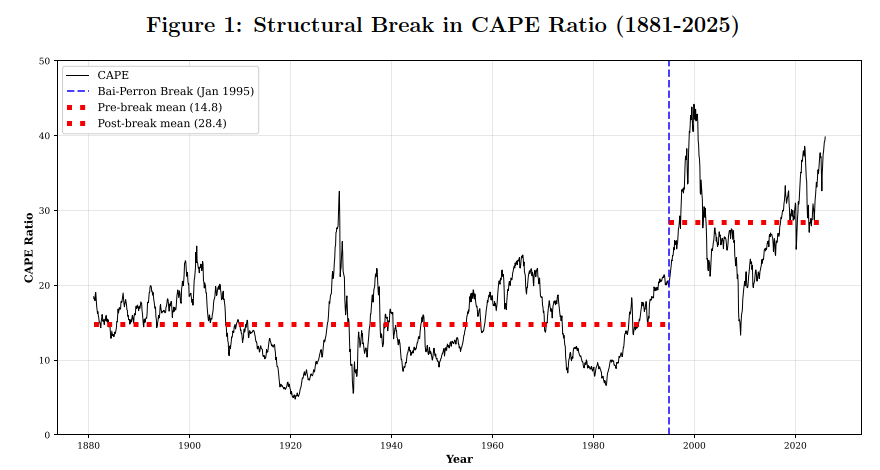
The title of a paper by Dino Palazzo, “The CAPE That Cried Wolf,” is reflected in this chart, which shows the CAPE ratio’s shift higher around the turn of the century, “persistently signaling mean reversion that failed to materialize.” Why?
This apparent breakdown can be largely attributed to systematic earnings distortions arising from accounting changes interacting with intangible capital growth.
Palazzo offers an alternative measure, “a historically-comparable CAPE,” using adjusted earnings. It does not shift to the higher levels when traditional CAPE does. However, the signals from the two measures are no longer divergent:
As of December 2025, both measures deliver aligned signals predicting elevated tail risk across horizons.
Other reads
“The Unrecognized Holder: How Stacked Special Purpose Vehicles Sold Pre-IPO Exposure That Issuers Never Agreed to Recognize,” Alexander Parker.
The result is a class of companies among the most valuable in the world, financed in part by tens of thousands of people, none of whom receive an audited financial statement, a proxy statement, or a periodic report; many of whom cannot identify the entity that holds their shares; some of whom hold interests in transfers the issuer has declared void; and a meaningful number of whom purchased from persons who were required to register and did not.
“The Situational Awareness Fund Blow-up: Collateral Damage from Investment Conviction!” Aswath Damodaran, Musings on Markets. Reflections on the consequences of conviction.
“Private-Credit Firms Clamp Down on Loan Sweeteners in Fear of ‘Shadow Defaults,’ ” AnnaMaria Andriotis, Wall Street Journal.
Private-credit executives say it is also getting harder for underperforming companies to get loan modifications that allow them to defer interest payments, or to extend those deferrals, unless their private-equity owners make sizable concessions to satisfy lenders.
“Texas ERS reallocates to managers to help navigate concentrated equity market,” Sarah Rundell, Top1000funds.com. One large asset owner is looking for “a more diversified set of uncorrelated alpha streams” in a top-heavy equity market.
“The Long Game: Structural Change and the Case for Patient Active Management,” Myles Danielsen and Orin Wicks, Pathstone.
We believe the conditions for skilled active managers to outperform over the coming decade are historically compelling, however, the path will require tolerating at time painful periods of relative underperformance.
“Total Portfolio Approach: A Critical Literature Review,” Redouane Elkamhi and Jacky S.H. Lee, CFA Institute Research Foundation. A good summary of the evolution of TPA and links to studies about it.
“Private markets benchmarks enter their next era,” Kathy Gordon, Preqin.
Historically, benchmarking in private markets was largely focused on peer comparisons and manager rankings. Today, investors are using benchmarks in a much broader context.
“Federal Data Terminations Tracker,” dataindex.us. A variety of datasets historically produced by the U.S. government have been eliminated; here’s a site that tracks information no longer being collected (some of which may have been of use to investors doing research).
“The second job you didn’t sign up for,” Claudia Quintela, The Emerging Manager.
Søren [Hæstrup] put it plainly: “it’s two different things to run a business and run a portfolio.” The second is the one nobody warned you about. You become a jack of all trades overnight.
The importance of doubt
“We absolutely must leave room for doubt or there is no progress and no learning.” — Richard Feynman.
Flashback: Great memos
We usually provide a link to something in the past that seems important to reflect upon, but this time we have a whole menu of choices for you, courtesy of the site Great Memos.
They span the centuries and “memo” is a stretch for many of them. Pliny the Younger probably didn’t think, “It’s time to write a memo.”
There is an impressive range of works that can be downloaded from the easy-to-review main page. Which ones do you find most interesting or relevant to today?
Cultural life cycles
A 2025 essay, “Cultural Inflections and Disruptions at Asset Management Firms,” explored cultural changes over time (most of which affect other kinds of investment organizations too). For example:
Money can be a uniter in the early years and a divider later on. If the foundations of a thoughtful and transparent incentive structure aren’t in place, an organization can fracture. On what basis are individuals evaluated and compensated? Conflicts over compensation can become poisonous, and are a warning sign that the extrinsic and intrinsic rewards are out of balance, a hard thing to get back under control.
Thanks for reading. Many happy total returns.
Published: August 17, 2026
Subscribe
To comment, please send an email to editor@investmentecosystem.com. Comments are for the editor and are not viewable by readers.