
The most recent Clippings posting included a wide range of charts including ones on the long run of technology concentration, elevated valuations (and some deflated ones), a turnaround in rate expectations, cutting back on tokens, and the K-shaped economy.
Expectations (1)
Byrne Hobart titled a recent piece “Investors are Always Miss-Excited at the Peak.” He began by recounting a number of examples (stretching back over decades) of new technologies living up to the excitement investors expected of them in terms of economic and cultural impact — but failing to match the investment results that were anticipated:
In a way, this pattern has to be universal: if investors, in the aggregate, were always able to identify not just which tech trends mattered but which layers of the stack would collect the most value, markets would have to be pretty close to perfectly efficient all along. But a tech-driven boom is an exploratory process for technological capabilities, the most cost-effective way to deliver them, and the optimal way to charge for them.
We are in one of those exploratory processes now. AI promoters say that this could be the mother of them all, but even if that’s the case it doesn’t mean today’s leaders will be the big beneficiaries (despite investing huge amounts during the pursuit).
Expectations (2)
“The Machinery of Conviction,” a posting from The Punchmark, opens with a look at Nvidia:
The question is not whether NVIDIA is great. The question is whether a $5.5 trillion valuation prices greatness, or prices the indefinite persistence of greatness at unprecedented scale under conditions that have never been sustained. (Spoiler: It’s the latter.)
That provides the foundation for a wonderful exposition of the cultural capital that gets embedded in valuation. A couple of well-known fundamental building blocks:
Shiller traced narrative transmission: economic stories spread through populations the way epidemics do. Think infection rates, latency periods, and the characteristic acceleration of a belief that has become too widespread to need a reason. Soros named the feedback loop that follows: rising prices generate confidence, confidence drives buying, buying drives prices.
The author extends those concepts to include “cultural gravity,” which is defined as:
The pull a company exerts once it has accumulated enough cultural capital that capital of every kind — financial, reputation, talent, relational, and political — flows toward it on terms its measured fundamentals do not, on their own, explain.
Outsized expectations are cultural in nature:
A company with weak cultural meaning is priced inside its category. A company with strong cultural meaning is priced against a future it does not yet occupy. The multiple is a permission structure, and culture writes the permission.
Stories with cultural gravity are built layer by layer. The piece includes summaries of how those layers are formed, via expectations about addressable market; growth duration; margin durability; risk (“A company that feels inevitable is forgiven its uncertainties — concentration, geopolitics, governance, delayed profit — because the story files them as temporary obstacles on a fixed historical path.”); and cost of capital.
For Nvidia, there is history (and a different kind of gravity) to wrestle with:
Every dominant infrastructure provider in a capex supercycle has returned roughly nothing to shareholders in the decade after peak — railways, the 1920s utilities, IBM, the fibre boom — even when the technology was real and the company survived.
And:
That’s the danger a great company carries when it’s priced as the sole instrument of history. What corrects is the story, not the earnings — and the more gravity the market put behind the story, the farther the fall when it stops believing.
Expectations (3)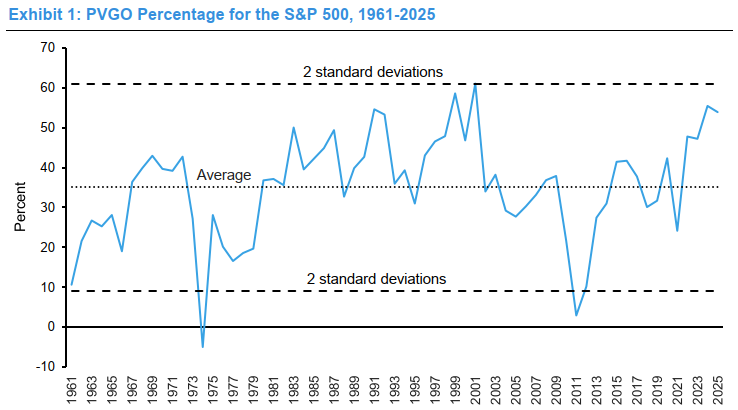 The latest report from Michael Mauboussin and Dan Callahan is “Opportunities and Expectations: The Present Value of Growth Opportunities in Valuation.” Sorting out price and value (and therefore, embedded expectations) is at the core of an analyst’s work:
Price is the transparent part of this calculation because it is quoted continually when the stock market is open. Value is the opaque part because it is based on the present value of future cash flows, and no one knows what the future holds.
“The value of prospective cash flows” starts with the steady-state of current operations. On top of that is the “present value of growth opportunities” (PVGO), “the ability to earn a return on investment higher than the opportunity cost of capital.”
The image above shows PVGO for the S&P 500 over the last 65 years. The report says that market-wide PVGO has “some modest usefulness in timing, but mostly when the PVGO percentage reaches extreme levels.”
Diagrams for four leading companies (including Nvidia) are also provided, in addition to those of the top three stocks in each market sector.
Regret
Anthony Hagan of Freedomization wrote about the second-guessing that’s happening among private market investors given that expectations from a few years ago mostly have not been met:
When many investors look back at their private assets investment portfolio, they see a regret-sized hole. Whether it is investments they made out of FOMO, re-ups they felt obligated to participate in, ZIRP-fueled post-pandemic digital-adoption-stupor commitments, or well-meaning vintage-year diversification allocations, the ugly face of regret inevitably rears its unforgiving head.
For someone trained to make judgments about the investing skills of others, real self-reflection is a necessary but uncomfortable process:
One of the hardest things for me, as an investment research analyst, is to subject myself to the same rigorous, objective assessment of my track record that I apply to the GPs I review. This exercise is not fun at all because it brings to light undeniable issues such as imperceptible biases, past lack of meticulousness, trend-chasing errors, and the absence of clear evidence for a coherent portfolio plan.
Hagan offers a few ideas about how he is “attempting to train my mind and tweak my processes to lessen future mental agony and torture from the effect of current/ongoing decisions.”
Organizational silence
An article by Elise Dyer, “Why You Stayed Silent (And It Was Never About Courage),” examines the roots of organizational silence, specifically the differences between silence because of a lack of courage by an individual and that which stems from a rational assessment of the power dynamics at work in the situation. The latter is particularly pernicious since it impedes new ideas and solutions to problems, yet it is common in organizations and can become the defining aspect of a culture in decline.
Other reads
“AI: Fundamentals, Valuation, and the Next Allocator Dilemma,” Ted Seides, Capital Allocators.
The power law phenomenon in venture capital is more pronounced than ever. The ten largest venture-backed winners are worth around $2.5 trillion and represent over 50% of venture capital value.
“The whirlwind is upon us,” Owen Lamont, Acadian. What are the implications of the huge increases in some stocks and the incredible effects on indexes from some relatively small companies?
“SpaceX, OpenAI and Anthropic: The S&P 500 Inclusion Question and Investment Consequences!” Aswath Damodaran, Musings on Markets.
The bottom line is that S&P needs these companies in its index more than they need to be in the index, with the consequence that the companies will not go out of their way to meet index requirements that they feel are costly to them, and that if there is any bending, it will be S&P that does it.
“US universities boost market risk as financial pressures mount,” Sun Yu, Financial Times. For investors, it’s a question of whether you take what the market will give you within your normal risk tolerance or reach to grab the return you feel you need.
“The Quiet Return of Core-Satellite,” Jan Voss, Cape May Wealth.
For the first time in my career in wealth management, I am seeing a turning point to what previously seemed like an unstoppable trend: affluent investors turning away from private equity and venture capital, and back towards liquid markets in search for Alpha.
“Bridgewater’s Revamp Is Working for Clients But Its Owners Aren’t So Sure,” Hema Parmar, et al., Bloomberg. An interesting look at the battle between investment performance and the scale that delivers higher fee income for owners.
“Did the Manager Change the Model or Just the Settings?” Milos Maricic, Enterprising Investor.
The question allocators should ask is simple:
“Walk me through a time your model was wrong. What did you learn about its structural assumptions, and what did you change architecturally rather than parametrically?”
“The Answers Are Already In The Building,” Investment Masters Class. Foundational principle for the leaders of organizations and the investment analysts who are trying to understand them.
“Decoding Private Markets: Why access to everything is not access to alpha,” Victor Mayer, Pantheon.
Many investors assume that by accessing a GP’s evergreen fund they are securing exposure to the same strategies that built the brand’s reputation. In reality, they are often allocated whatever the firm has capacity to sell.
Timely
“What information consumes is rather obvious: it consumes the attention of its recipients. Hence a wealth of information creates a poverty of attention.” — Herbert Simon.
Flashback: Moe Norman
Norman was not an intriguing investment figure, but a legendary striker of the golf ball. “A golfing savant whose life was as complex as his swing was simple,” according to a posting earlier this year by Ian Cassel.
He never won the U.S. Open or any other major championship, because “the culture of the American PGA was a poor fit for a man who marched to the beat of his own drum.” But top professionals marveled at his ability to hit the ball more purely than anyone.
Cassell’s piece is titled “Find Your Swing.” Its theme is that there isn’t one way to invest:
Successful stock picking isn’t about cloning other investors; it’s about finding where your temperament meets execution.
Moe Norman knew who he was and didn’t need the trappings of success. He just wanted to hit the sweet spot, time after time after time.
Manager selection
Since expectations is the theme of this edition, we’ll end with a posting from 2023, “Identifying Unrealistic Expectations in Manager Selection.” One simple method is to nail down expectations in numbers, as with a question like this one regarding a traditional active fund; the responses are telling, and not at all unusual:
“What is the probability that this manager/strategy/vehicle will outperform by an average of fifty basis points a year over the next ten years (and survive)?”
Some real-world responses:
Due diligence analysts often answer the question with a number in the 65-75% probability range.
When asked what their chief investment officer or investment committee would want to hear as a probability rating before approving an allocation, responses can be more than 10% higher.
After stating that a manager was expected to outperform by two hundred basis points, one analyst was asked what the probability of that occurring was. “Over 80%.”
Good luck with that.
Thanks for reading. Many happy total returns.
Published: June 22, 2026
Subscribe
To comment, please send an email to editor@investmentecosystem.com. Comments are for the editor and are not viewable by readers.