
You hear the phrase “best practices” quite a lot.
What are they? Who sets them? How long-lasting are they? And, are they really best practices?
Exercise
A simple exercise is called for. To get started, consider your role. How would you describe what you do in comparison to the standards that are prevalent across the industry in like positions and situations?
Or, if you prefer, consider your organization’s practices versus those of others like it.
When doing an exercise like this, it’s best to write things down, so make a series of lists with these headings:
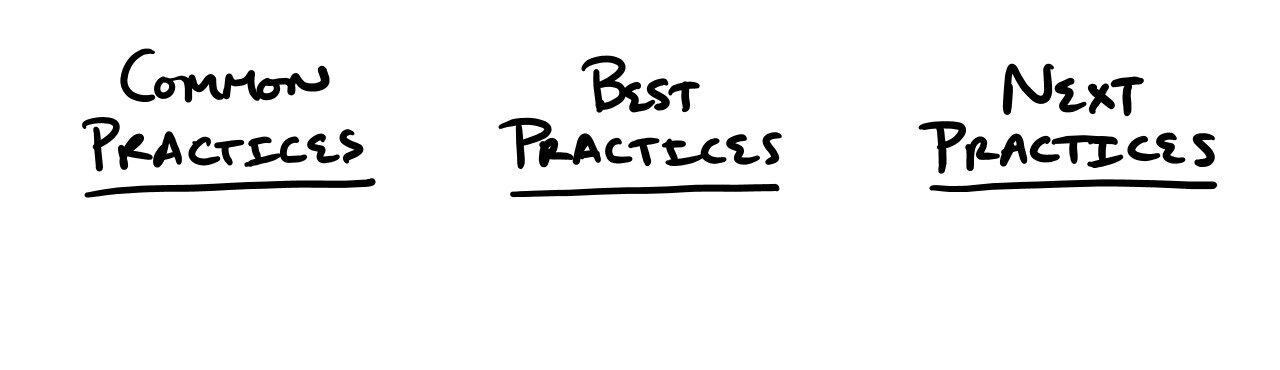
You might even insert a “bad practices” column on the left side if you want to be more complete about it.
Common practices and best practices
Let’s focus initially on the first two columns shown here.
Trying to identify the respective attributes for those categories demonstrates that often what are described as best practices amount to what most everyone else does too.
So the question then is whether best practices are those that have stood the test of time and are widely implemented or those that are superior to others. In other words, what is the meaning of “best”?
People use the phrase in two different ways. We could title them Best Practices (Meeting Generally Accepted Industry Standards), which in this exercise should be placed in the common-practices column, and Best Practices (Different and Better Than Others), which should be put in the best-practices column.
(“Common practices” doesn’t sing as a marketing phrase, so don’t expect to see it in pitch books any time soon. The purpose here is organizational analysis, to identify areas where common practices are exceeded, not to develop a winning narrative.)
As practices evolve and current best practices are adopted by others, they naturally move into the common practices category.
Next practices
Which brings us to the right-most column of “next practices.”
Understanding the ongoing progression of such things and the fleeting nature of edge, innovative organizations are constantly working to improve their methods. Identifying next practices and working toward them (while knowing that some won’t come to fruition) is part of their DNA.
Next practices are the best practices of tomorrow and the common practices beyond.
Profiles
Organizations (and individuals) tend to have one of three patterns in terms of the relative number of practices found in each category:
~ For most, the practices are heavily weighted in or exclusively confined to the common category.
~ Fast followers are eager to have some exposure to best practices as they become apparent (after being developed by others), so they have some more representation there.
~ Innovators have a mix of all three categories.
Of course, the potential risks and rewards vary materially across these profiles. And it must be stressed that successful organizations and individuals (and failing ones) can be found in each grouping. The “right” mix to pursue depends on circumstances; a mismatch between aspirations and the availability of necessary skills and resources will lead to trouble.
Examples and considerations
Categories of organizations differ on these dimensions. For example, systematic quantitative firms are very much on the innovative end of the spectrum, continually looking for new techniques and signals, and expecting that the state of play will change frequently. (One way of seeing that is to look at reports about alternative data in use by them over the years — you’ll see a clear next-to-best-to-common pattern.)
Many fundamental investment strategies have remained much more stable in approach than quantitative ones, although you can see small changes here and there within them. It used to be that everyone had to be on earnings conference calls, then transcripts became prevalent, then natural language processing offered insight into sentiment and tone, now AI provides even quicker summaries and deeper analysis.
Speaking of AI, it is shaking things up already and there is more to come. Right now, large-scale AI developments may be the province of the most innovative entities, but the widespread availability of large language models means that individuals from a variety of organizations are finding new ways to do their work. Experimentation is happening more broadly across the ecosystem than is typically the case.
Importantly, to return to the semantics of it all, who is to say what is best? It is definitely in the eye of the beholder. (Therefore, representing what you do as “best practices” can work against you if governing bodies, stakeholders, clients, or prospects don’t see it that way.)
While introduced as something that you can do yourself, the exercise above is even better when done in concert with your co-workers. Comparing lists can be enlightening, since there are bound to be differences of opinion, which are fodder for further examinations of the current state that can lead to new ideas for continuous improvement.
All in an ongoing quest to be the best.
Published: February 14, 2025
Subscribe
To comment, please send an email to editor@investmentecosystem.com. Comments are for the editor and are not viewable by readers.