
The goal around here is to have this piece live up to its name, that is, to come out fortnightly, early in the evening every other Monday, U.S. time. Generally, that will continue to be the case, but because of other commitments, publication will be a little more erratic that it has been in the past.
As always, your feedback and ideas are appreciated. If you receive this compilation via email (subscribe here), you can simply reply to it, or there’s a link at the bottom of each web page where you can get in touch.
Also, check out our “clippings” of interesting investment visuals on Substack.
Looking for a catalyst
GMO gets a lot of grief for being too conservative during times when animal spirits are in stampede mode. It has also lost assets in response to that caution.
In their latest quarterly letter, “A Catalyst for the AI Break,” Ben Inker and John Pease offer some interesting ideas, but start out with a warning:
For professionals, avoiding bubbles can also be treacherous because getting out too early is generally an even more unforgivable sin than staying in too long.
The authors refer to bubbles that are “killed by increasing supply of the good in question.” But they shift their attention to a different kind of supply and demand — for shares — and note that the balance is changing for the first time in years.
They also consider how the structure of the investment ecosystem has evolved away from profit-maximizing arbitrageurs “pouncing” on deviations from fair value:
The real world has some pure profit maximizers who are looking to take advantage of aberrant prices. But the real world mostly contains constrained profit maximizers.
For all the talk about active share, that measure is at its lowest since 1980 among “active” funds benchmarked to the S&P. It was thought that the metric would lead to less benchmark hugging but it hasn’t. Managers don’t take active risks and allocators, too focused on tracking error, don’t seem to care.
Will increasing equity supply in the most popular corners of the market lead to a change in the status quo? Perhaps not, but the possibilities are worth considering.
OCIO 2.0
FEG published a piece called “OCIO 2.0: What to Ask When Considering a Change in OCIO Partnership.” The outsourced chief investment officer concept has been around for some time now — and some clients are wondering whether they have the right OCIO, while OCIO firms (including FEG) are interested in seeing clients switch to them while protecting their current asset base.
Because most of these arrangements involve the ownership of private funds they are stickier than typical manager or consultant relationships. But sometimes change is necessary.
As with most every investment relationship, past performance takes too big of a role in the decision making process. With OCIOs, clients make the same kinds of errors, but the comparisons are even more challenging, since true OCIO relationships are bespoke in nature (or should be) given the differences across institutions. FEG:
The institution is not comparing two investment managers. It is comparing an existing track record against a marketing document.
FEG covers a variety of considerations, ending with this:
The institutions that do this well are not necessarily the ones with the most sophisticated committees. They are the ones that treat the relationship as an ongoing evaluation rather than a decision made once and revisited only when something goes wrong. Getting there requires a more intentional approach to OCIO due diligence.
A new venture paradigm
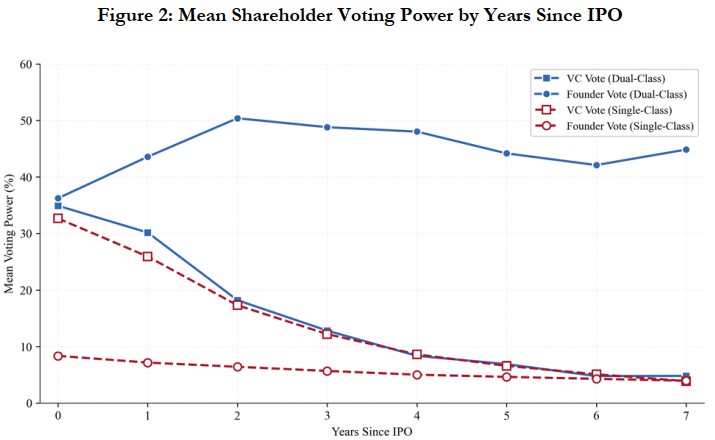
The standard “exit paradigm no longer reflects how many venture-backed startups transition to the public markets,” according to Yifat Aran, et al., in “Exit After Exit”:
We show that the IPO functions less as a clean exit and more as a transitional moment in a longer governance process. Venture capitalists do not simply liquidate and disappear. Instead, they often remain central actors during a firm’s early public life, shaping strategic decisions and moderating founder discretion.
The chart above shows the new reality. The top line illustrates the founder dominance that exists at some firms because of emergence of the dual-class share structure. The middle lines represent the new norm — “venture capital’s role in post-IPO firms as a governance institution that mediates the shift from private to public markets.”
Quantitative investing
For the introductory lecture for the class he is co-teaching at Columbia, Giuseppe Paleologo of Balyasny Asset Management laid out some basic ideas for those interested in quantitative investing. Among the slides is one called “The Sources of Alpha,” which provides this simple definition:
I find it useful to think about alpha as being a combination of three idealized mechanisms: information (“investing”), structure (“trading”) and risk (“risk premia”).
Corporate bonds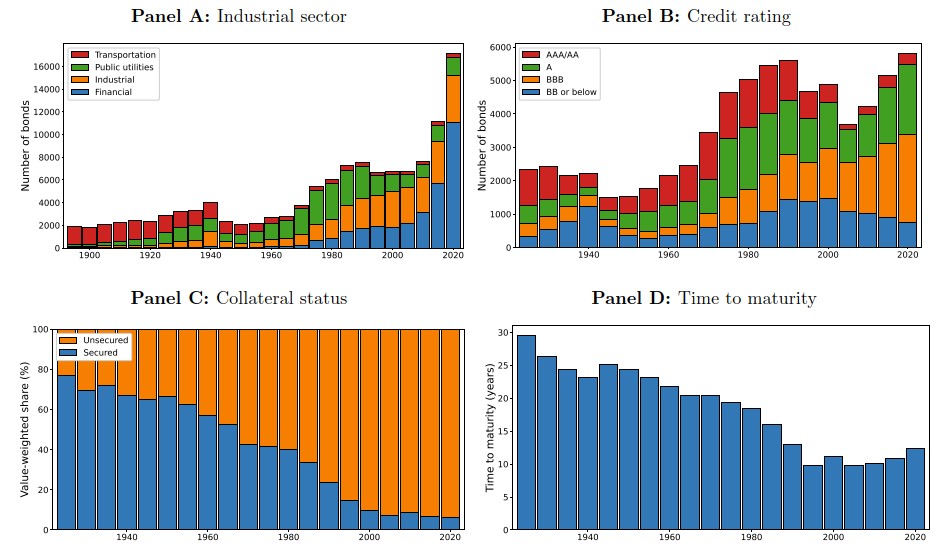
In “Reconstructing a Century of U.S. Corporate Bonds: Credit Risk in Historical Perspective,” Mohammad Ghaderi, et al. write, “While recent samples suggest corporate bond excess returns largely reflect the term premium, our long sample reveals a sizable and statistically significant credit risk premium.”
The charts above show the changes in the corporate bond universe over time: A) The big increase in issuance, with the rise in financials being especially noteworthy. The other charts exclude financials: B) AAAs are hard to find and below investment grade bonds have shrunk relative to the junk heyday. C) While at one time most bonds were issued on a secured basis, almost none are now. D) The length of maturities has also collapsed but is basically level over the last thirty years.
Consultant relations
Coalition Greenwich published three pieces earlier this year on “the unwritten rules of consultant relations.” The first, regarding sales and ratings, began in this way:
In an increasingly crowded and complex investment landscape, asset managers face a daunting challenge: winning the trust of investment consultants who play an outsized role in guiding the flow of institutional capital.
The other postings are on client service and relationship management and private markets.
Other reads
“The Costly Disconnect Between Financial Theory and Practice,” Mark Higgins, Investing in Financial History.
On the surface, this ritual has an aura of sophistication, but beneath the surface it looks more like theater. The imprecision of the assumptions on which the models are based is far more material than the modest benefits implied by their outputs.
“Decoding Defaults in Private Credit,” Fran Beyers, Cliffwater. One provider’s perspective about the range of default rates out there — and a table in the appendix showing the different definitions employed.
“LP incentive pay: incentive for what?” Ludovic Phalippou.
Investment performance is especially poorly suited to individual incentive contracts because the signal is weak, delayed and heavily contaminated by factors outside the employee’s control. We nevertheless have a strong tendency to attribute outperformance to skill and underperformance to bad luck.
“How Baylor University’s CIO is building a talent pipeline with cross-asset training,” Lauren Bailey, Markets Group. Dave Morehead’s strategy for developing and maintaining a well-rounded team away from the major financial centers.
“The End of the Family Office as We Know It,” Frederic Methlow, CAIA Association.
If machines increasingly perform the information-processing functions around which the investment team was organized, why should the existing organizational structure remain unchanged?
“Now AI Can Pass Mock Exams. Can it Replace Investment Analysis?” Michinori Kanokogi, Enterprising Investor.
Our thesis-review agent, PETR, has never returned “not validated” on any of our theses. Sycophancy toward the analyst was our first suspect, but giving AI a role as a critical senior PM barely moved the results. The likelier explanation is the same one: it believes what management says because it does not know what to doubt.
“An open letter to Senator Elizabeth Warren,” Nick Nemeth, Mispriced Assets. Are state insurance commissions up to the task of protecting policyholders (and the financial system)?
“How do you know if persistence will persist?” Christopher Schelling, LinkedIn.
Maybe persistence does decline as markets become more efficient. But I think it certainly migrates from naive persistence to persistence conditional on things that actually drive investment outcomes: the same team, the same strategy, the same market, and the same incentives.
“Navigating semi-liquid private markets in a world of closed-end data,” Bradley Budd, bfinance. A look at the “still young” semi-liquid universe — and ten differences from closed-end funds.
Talent and genius
“Talent hits a target no one else can hit. Genius hits a target no one else can see.” — Arthur Schopenhauer.
Flashback: 1987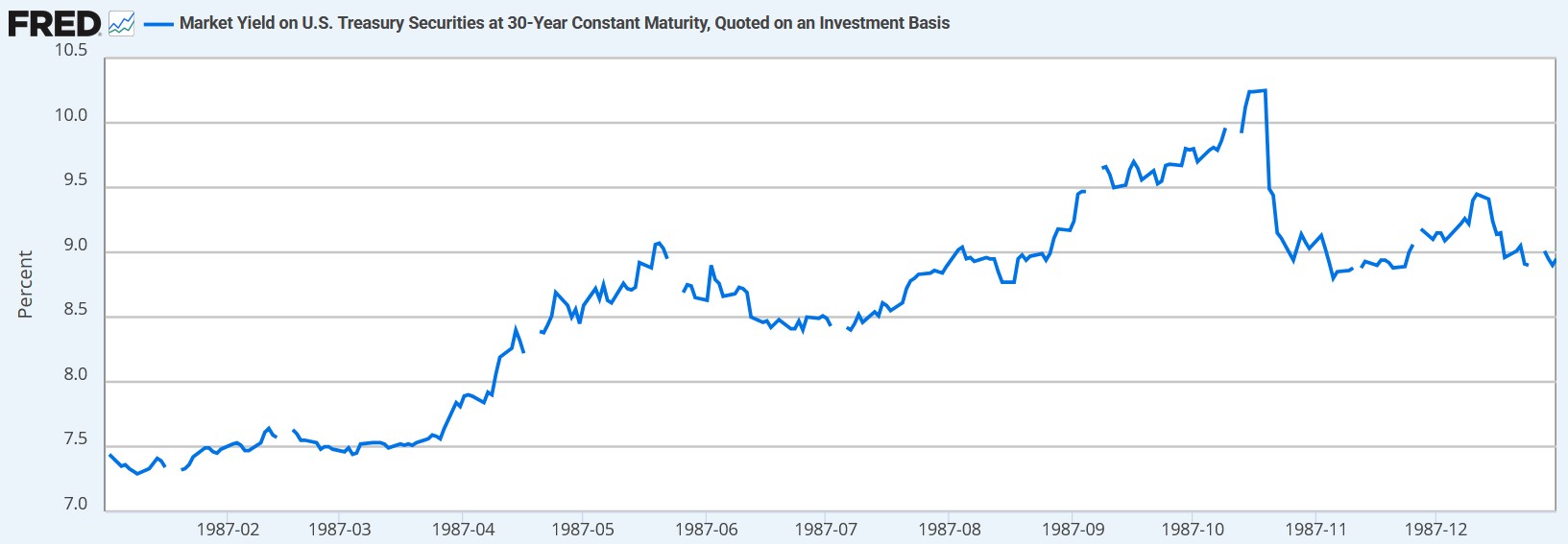
Market observers, searching for analogous times, are quick to reach for a year that reminds them of a similar situation. (For example, a recent Wall Street Journal article looked back at 1994, 1999, 2006, 2016, and 2022 to see what happened to stocks when bond yields rose.)
It’s usually a trap, and we are probably falling into one now, since every era is different. But there’s that whole history rhyming thing that Twain was supposed to have identified (although there’s no evidence he ever said it) so we’ll play along.
In 1987, rates started increasing in the spring and worked higher and higher (the yield on the thirty-year Treasury is shown above), all the while stocks kept ripping too.
The change in rates then was much more dramatic, around three percent, four times what it has been this year. However, bond math being what it is, bond prices are much more volatile now for a given change in rates than they were then. Net of those opposing factors, bond holders haven’t seen anywhere near the price hit in 2026 as they did in 1987.
What does rhyme between then and now are the respective moods of bond and stock investors. Those changed in short order in October 1987. After some wobbles leading up to the 19th, stocks crashed more than twenty percent that day and by the next morning long bonds were up nine percent.
Not a prediction by any means. You never know how long (or how far) things will go.
Pedigree
A 2024 posting took a wide-ranging look at manager pedigree, in the hopes of providing some depth to what often is a simplistic assessment.
It concludes in this way:
Many new firms (or lift-outs migrating to a new firm) struggle and even fail because people have been removed from the environment in which they thrived. Much of what appeared to be their own success was attributable to the organization of which they had been a part. Those who have starred in one show in a supporting role may bomb in another when they assume the lead, because they don’t understand what it takes to mount the whole production and they venture outside their circle of competence rather than building a sustainable organization.
In all of this, there is a big status game going on. Stripping the superfluous elements of that out of the decision making process is essential.
Thanks for reading. Many happy total returns.
Published: October 12, 2026
Subscribe
To comment, please send an email to editor@investmentecosystem.com. Comments are for the editor and are not viewable by readers.